
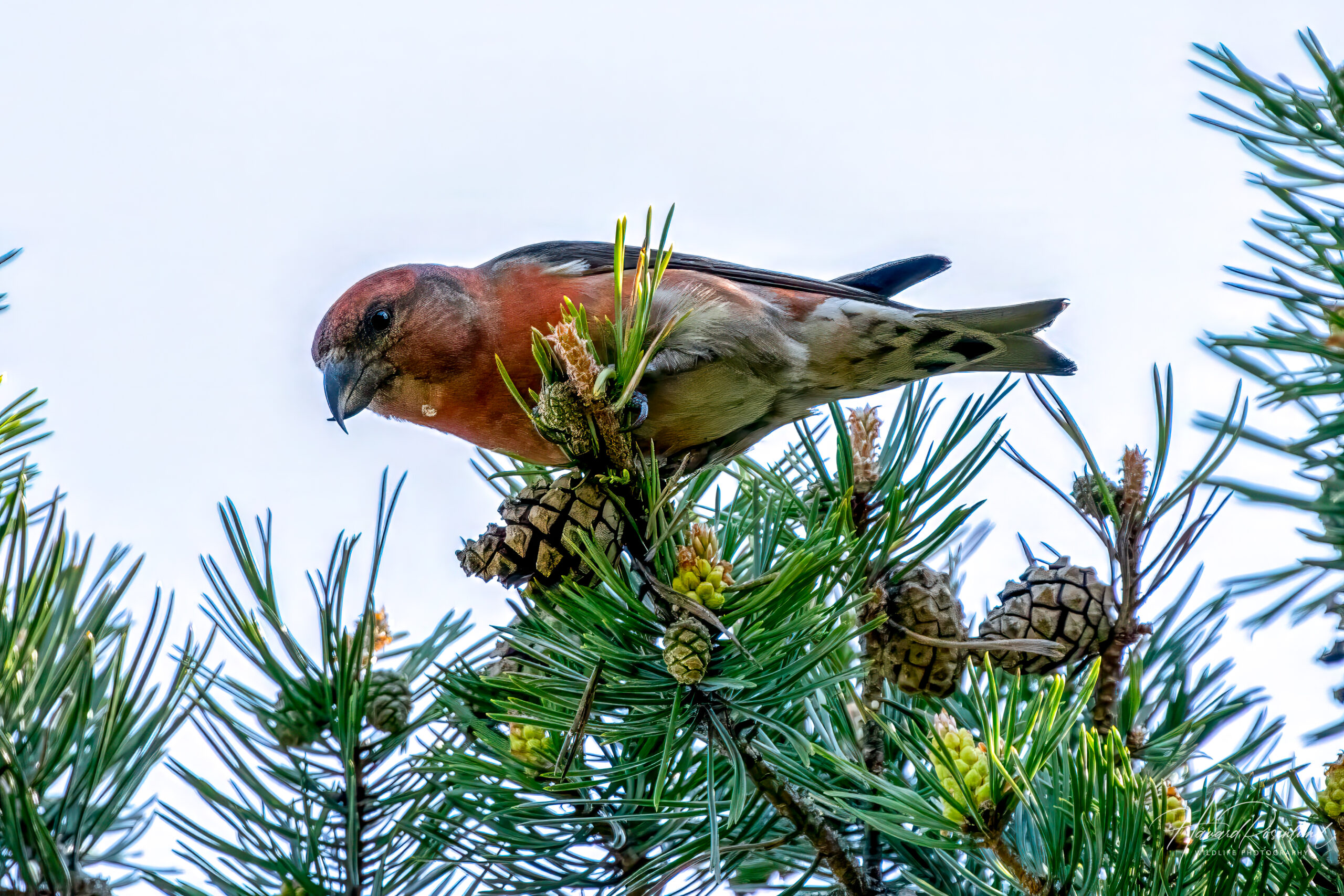
Red Crossbill
Loxia curvirostra
At a glance
Habitat
- Conifer forests and wooded landscapes wherever spruce, pine, fir or larch are producing abundant seed
Diet
- Mainly conifer seeds extracted from cones; small amounts of buds, other seeds and invertebrates
Activity
- Diurnal
Size
- Length: 15–17 cm Weight: 26–39 g
Range
- Coniferous regions across Eurasia and North America, with highly variable local occurrence
Description
The red crossbill (Loxia curvirostra), usually called the common crossbill in Europe, is a strongly specialised finch of coniferous forests across Eurasia and North America. Adults are about 15–17 cm long, have a wingspan of roughly 27–30.5 cm and usually weigh 26–39 g. Males are typically brick-red to orange, while females are more olive-green or yellowish, and juveniles are heavily streaked. The defining feature is the crossed tips of the mandibles, which may cross either to the left or right.
The species varies remarkably in size, bill structure and voice. A study published in 2019 analysed recordings collected over seven years across the western Palearctic and identified at least 17 distinct call types; individual birds normally give calls belonging to one type. These vocal groups do not map neatly onto individual conifer species, and their biological meaning is still not fully understood. In northern Europe the similar parrot crossbill (Loxia pytyopsittacus) is generally bulkier and has a deeper, heavier bill; voice can be particularly useful where the two overlap.
Habitat
Red crossbills are tied to coniferous woodland, but not to one single forest type. They use spruce, pine, fir and larch forests as well as plantations and other wooded landscapes wherever suitable conifers are producing enough seed. The best areas can therefore change markedly from year to year.
Because cone crops shift so much between places and years, a forest with abundant seed may hold large flocks and breeding birds for months, then support very few crossbills once the crop is exhausted. Across much of Europe, Norway spruce (Picea abies) is particularly important in shaping where birds concentrate and when they move.
Diet
Seeds from conifer cones dominate the diet, with spruce, pine, fir and larch all used depending on region and availability. Buds, other seeds and small invertebrates are taken in smaller amounts. Because cone crops fluctuate so strongly, food abundance influences almost every part of the species’ annual cycle, from flock movements to the timing of breeding.
Bill size and shape influence how efficiently birds can exploit cones with different scale thicknesses and structures. These differences are closely tied to which cones a bird can use most efficiently, although European red crossbills can switch among several conifers rather than being restricted to a single tree species.
Cone feeding
The crossed bill is a specialised tool for opening cones. A crossbill inserts the bill between two cone scales and moves the mandibles sideways, forcing the scales apart. The tongue then reaches in to remove the exposed seed, after which the bird strips away the seed wing and coat to reach the nutritious kernel.
The unusual bill therefore works less like a pair of forceps than a small lever. A 1991 experiment showed that crossed mandibles improve access to seeds in partly closed conifer cones. The adaptation is especially valuable where many other seed-eating birds cannot reach the seeds efficiently.
Movements
Red crossbills are nomadic rather than regular long-distance migrants. Flocks track changing cone crops and may remain for months where seed is abundant. In much of Europe the main dispersal period is in summer, when the previous year’s crop is coming to an end and a new crop is forming elsewhere.
A 2006 analysis of European ringing recoveries showed just how far this nomadism can carry individual birds. Some crossbills appeared to have bred in localities as much as 3,170 km apart in different years, while others were found up to 2,950 km from their natal areas. When Norway spruce cone crops fail across a broad region, such movements can develop into large irruptions toward western and south-western Europe.
Breeding
Breeding is unusually flexible and follows food availability rather than a fixed spring timetable. A 1990 study of red and white-winged crossbills found that breeding began when birds could obtain food fast enough to meet the cost of egg production and when food was likely to remain sufficient about three weeks later, as the chicks’ demands increased. Rich cone crops can therefore trigger breeding in winter or very early spring, even while snow covers the forest floor.
The female builds a thick, well-insulated cup nest in a conifer and typically lays three or four eggs. She incubates for about 14–15 days while the male supplies food, and both parents feed the young after hatching. Young normally leave the nest after about 20–25 days. More than one brood can be raised while food remains abundant; in Britain and Ireland two broods are typical in nest records. Chicks hatch with straight mandibles, and the tips cross as the bill develops.
Status
The red crossbill is classified as least concern on the IUCN Red List. It has an enormous range and remains widespread across the coniferous regions of Eurasia and North America.
Local numbers can rise or fall sharply as birds move between changing cone crops, so short-term counts in one forest can give a misleading picture of the wider population. Longer-term changes to conifer forests and seed production can nevertheless affect populations regionally.
Image gallery
Loading map and observations…
Have you seen this species?
Independent species archive
Did you find this species page useful?
Wildlife Vagabond is independently built and maintained. Voluntary support helps cover hosting, maps, data storage and continued improvements to the species archive.
Support Wildlife VagabondSpecies content will remain freely available.
References
Information about the species’ global distribution and status is based primarily on global Red List data. See the references below for details.
- Benkman, C. W., & Lindholm, A. K. (1991). The advantages and evolution of a morphological novelty. Nature, 349(6309), 519-520. https://doi.org/10.1038/349519a0
- Benkman, C. W. (1990). Intake Rates and the Timing of Crossbill Reproduction. The Auk, 107(2), 376-386. https://doi.org/10.2307/4087622
- BirdLife International. (n.d.). Red Crossbill species factsheet. https://datazone.birdlife.org/species/factsheet/red-crossbill-loxia-curvirostra
- British Trust for Ornithology. (n.d.). Common Crossbill BirdFacts. https://www.bto.org/learn/about-birds/birdfacts/common-crossbill
- International Union for Conservation of Nature. (n.d.). Red Crossbill. The IUCN Red List of Threatened Species. https://www.iucnredlist.org/species/22720646/111131604
- Martin, R., Rochefort, J., Mundry, R., & Segelbacher, G. (2019). Delimitation of call types of Red Crossbill (Loxia curvirostra) in the Western Palearctic. Écoscience, 26(2), 177-194. https://doi.org/10.1080/11956860.2018.1564483
- Martin, R., Rochefort, J., Mundry, R., & Segelbacher, G. (2020). On the relative importance of ecology and geographic isolation as drivers for differentiation of call types of red crossbill Loxia curvirostra in the Palearctic. Journal of Avian Biology, 51(10), jav.02358. https://doi.org/10.1111/jav.02358
- Newton, I. (2006). Movement patterns of Common Crossbills Loxia curvirostra in Europe. Ibis, 148(4), 782-788. https://doi.org/10.1111/j.1474-919X.2006.00585.x
- Royal Society for the Protection of Birds. (n.d.). Crossbill. https://www.rspb.org.uk/birds-and-wildlife/crossbill