
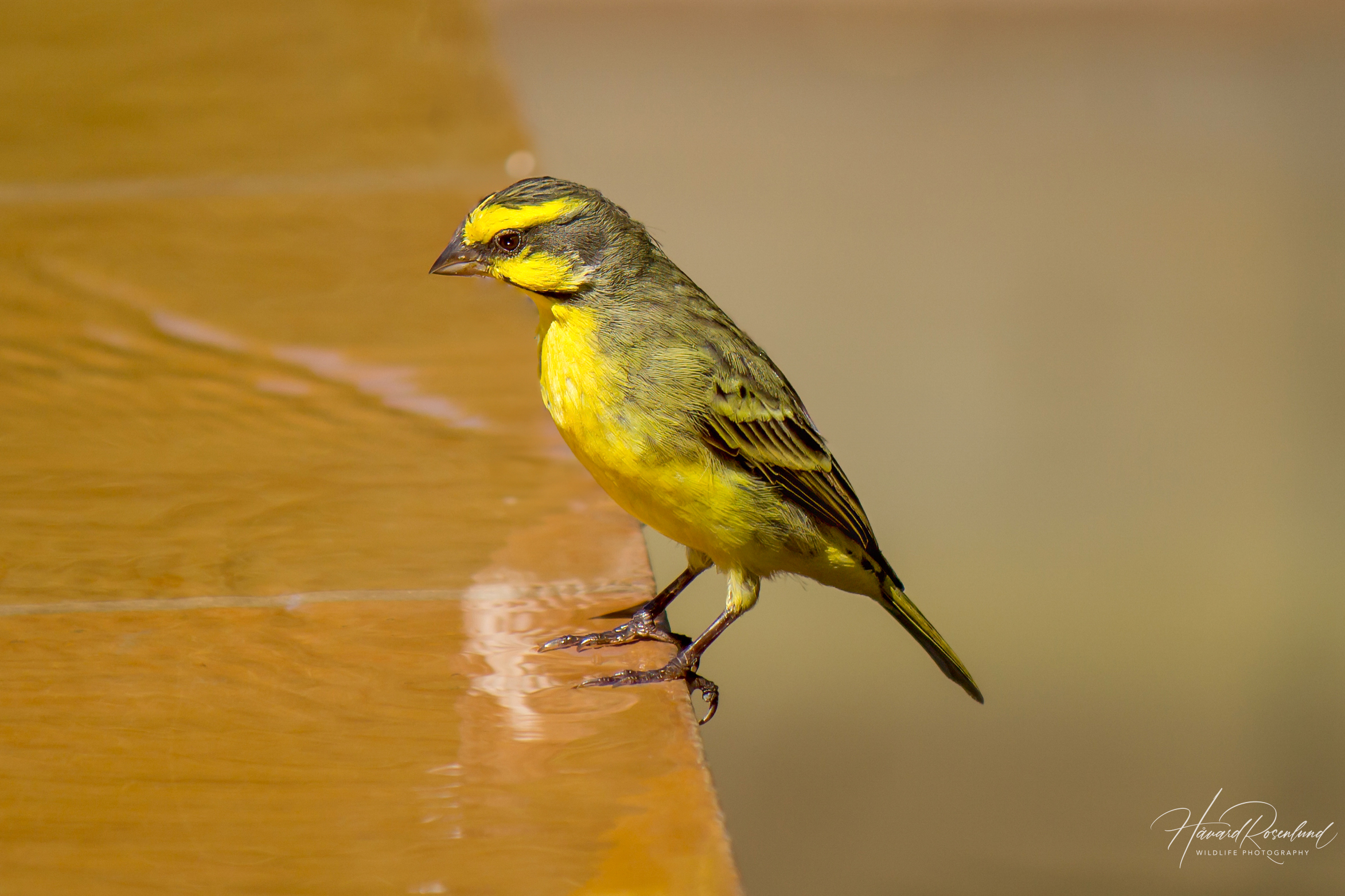
Yellow-fronted Canary
Crithagra mozambica
At a glance
Habitat
- Open woodland, savanna, grassland, farmland and gardens, usually where seeding grasses and scattered trees or shrubs are available.
Diet
- Mainly grass and weed seeds, supplemented by other plant material and small invertebrates.
Activity
- Diurnal
Size
- Length: 11–13 cm Weight: 8.5–16.2 g
Range
- Widespread across much of sub-Saharan Africa; introduced populations occur outside Africa, including in the Hawaiian Islands.
Description
The yellow-fronted canary (Crithagra mozambica) is a small African finch, about 11–13 cm long and weighing roughly 8.5–16.2 g. Adult males have a yellow forehead, supercilium, throat and underparts contrasting with a greyish crown, olive back and dark facial markings. Females resemble males but are generally duller, with less extensive yellow, while juveniles are browner and more heavily streaked.
Plumage varies geographically across the species' large African range, but the combination of yellow underparts, dark moustachial markings and a grey-green crown gives it a distinctive appearance.
Habitat
Yellow-fronted canaries occupy a broad range of relatively open habitats, including savanna, open woodland, grassland, farmland, plantations, villages and gardens.
They are especially associated with places where grasses and herbaceous plants provide abundant seed, while trees, bushes, fences or other elevated structures offer singing, resting and lookout perches.
Diet
Seeds dominate the diet, especially those of grasses and weeds. Fruit, flowers and other plant material are also taken, together with insects and other small invertebrates. The exact balance changes with season and local food availability.
Yellow-fronted canaries feed on the ground and also cling directly to grass stems and seed heads to remove ripe seeds. This lets them exploit both fallen seed and food still held above the ground in seeding vegetation.
Behaviour
The male's persistent musical song is one of the most conspicuous features of the species. Males sing from exposed perches such as tree tops, bushes, fences and utility wires, particularly when advertising a territory and communicating with a mate.
Yellow-fronted canaries are active by day and spend much of their time moving between seed-rich feeding patches and elevated resting sites. Outside breeding they become less territorial and more tolerant of other individuals.
Social behaviour
Outside the breeding season yellow-fronted canaries often gather in pairs, small groups or much larger flocks where seed is concentrated. These groups feed together on the ground or among seeding grasses and can mix with other small seed-eating birds.
Flock size changes with rainfall and food supply, and groups become more dispersed when breeding territories are established.
Breeding
Breeding timing varies widely across the range and is usually linked to local rainfall and food availability. In southern Africa egg-laying is concentrated mainly from spring into autumn. Pairs are monogamous during breeding.
The female builds a small, deep cup from grasses, plant fibres and other fine material, often binding it with spider silk and placing it in a tree or shrub. She incubates a clutch of two to five eggs for about 13–15 days while the male feeds her at the nest.
Both parents feed the chicks after hatching. The young normally leave the nest after roughly 16–24 days and remain with their parents until they become independent at around six weeks of age.
Relationship with humans
The yellow-fronted canary has long been kept as a cage bird, valued especially for its bright plumage and persistent song. A study published in 2021 in northern Benin documented birds being trapped and sold not only for their song but also for local cultural and medicinal uses.
Recent analyses of African bird trade published in 2025 and 2026 also place the species among the more frequently traded African songbirds. Its popularity in captivity has carried it far beyond its natural range: escaped or released birds have established populations in several places, including Hawaiʻi, where the species was introduced during the 1960s.
Status
The yellow-fronted canary is classified as least concern on the IUCN Red List and remains widespread and locally abundant across much of sub-Saharan Africa.
Farmland, villages and other modified habitats can provide abundant seed and suitable nesting vegetation. Capture for the cage-bird trade is intensive in parts of the range, although its effects on local wild populations are still poorly quantified.
Image gallery
Loading map and observations…
Have you seen this species?
Independent species archive
Did you find this species page useful?
Wildlife Vagabond is independently built and maintained. Voluntary support helps cover hosting, maps, data storage and continued improvements to the species archive.
Support Wildlife VagabondSpecies content will remain freely available.
References
Information about the species’ global distribution and status is based primarily on global Red List data. See the references below for details.
- BirdLife International. (n.d.). Yellow-fronted Canary species factsheet. https://datazone.birdlife.org/species/factsheet/yellow-fronted-canary-crithagra-mozambica
- Cornell Lab of Ornithology. (n.d.). Yellow-fronted Canary Life History. https://www.allaboutbirds.org/guide/Yellow-fronted_Canary/lifehistory
- Davies, A., Andersson, A. A., Martin, R. O., Inglis, S., & Dingle, C. (2026). Using customs data to understand overlooked trade in non‐CITES birds between Africa and Asia. Conservation Biology, 40(4), e70265. https://doi.org/10.1111/cobi.70265
- Gildas. Akueson, A. H., Gbaguidi Alia, M., Zakari, S., & Akossou, A. Y. J. (2021). Socioeconomic and Cultural Importance of The Yellow-Fronted Canary (Serinus Mozambicus) in Northern Benin. European Scientific Journal, ESJ, 17(37), 323. https://doi.org/10.19044/esj.2021.v17n37p323
- Hawaiʻi Birding Trails. (n.d.). Yellow-fronted Canary. https://hawaiibirdingtrails.hawaii.gov/bird/yellow-fronted-canary/
- International Union for Conservation of Nature. (n.d.). Yellow-fronted Canary. The IUCN Red List of Threatened Species. https://www.iucnredlist.org/species/22720181/131998999
- Jürgens, J., Staerk, J., Bruslund, S., Nielsen, R. O., & Conde, D. A. (2025). CITES Appendix III matters: Hidden impacts of CITES deletions on global bird trade. Biological Conservation, 310, 111365. https://doi.org/10.1016/j.biocon.2025.111365