
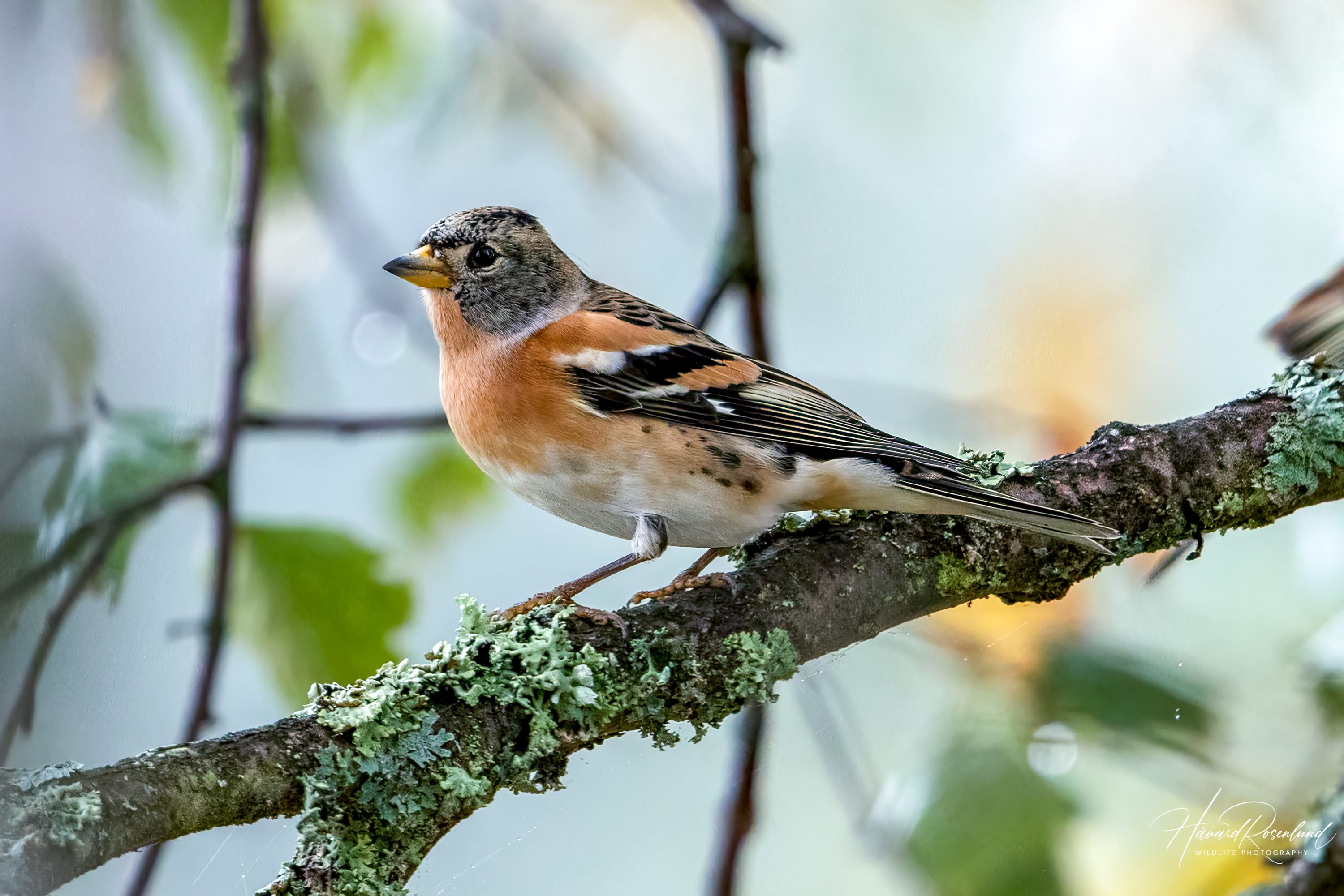
Brambling
Fringilla montifringilla
At a glance
Habitat
- Birch and open conifer forest when breeding; woodland, farmland, parks and gardens in winter
Diet
- Insects and other invertebrates when breeding; mainly seeds, especially beech mast, in winter
Activity
- Diurnal
Size
- Length: 14–16 cm Weight: 24.5 g
Range
- Breeds across northern Eurasia; winters mainly farther south across Europe and Asia
Description
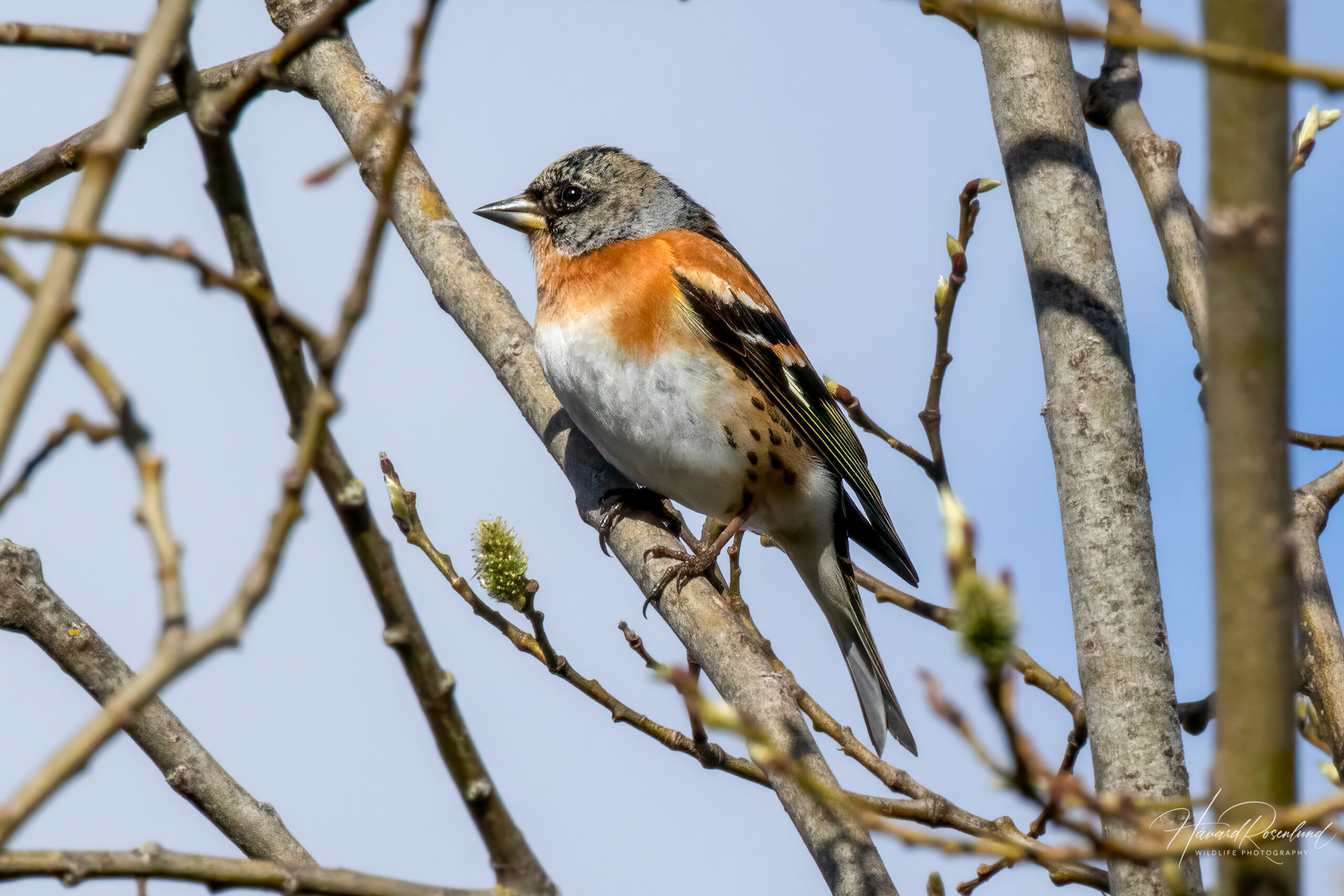
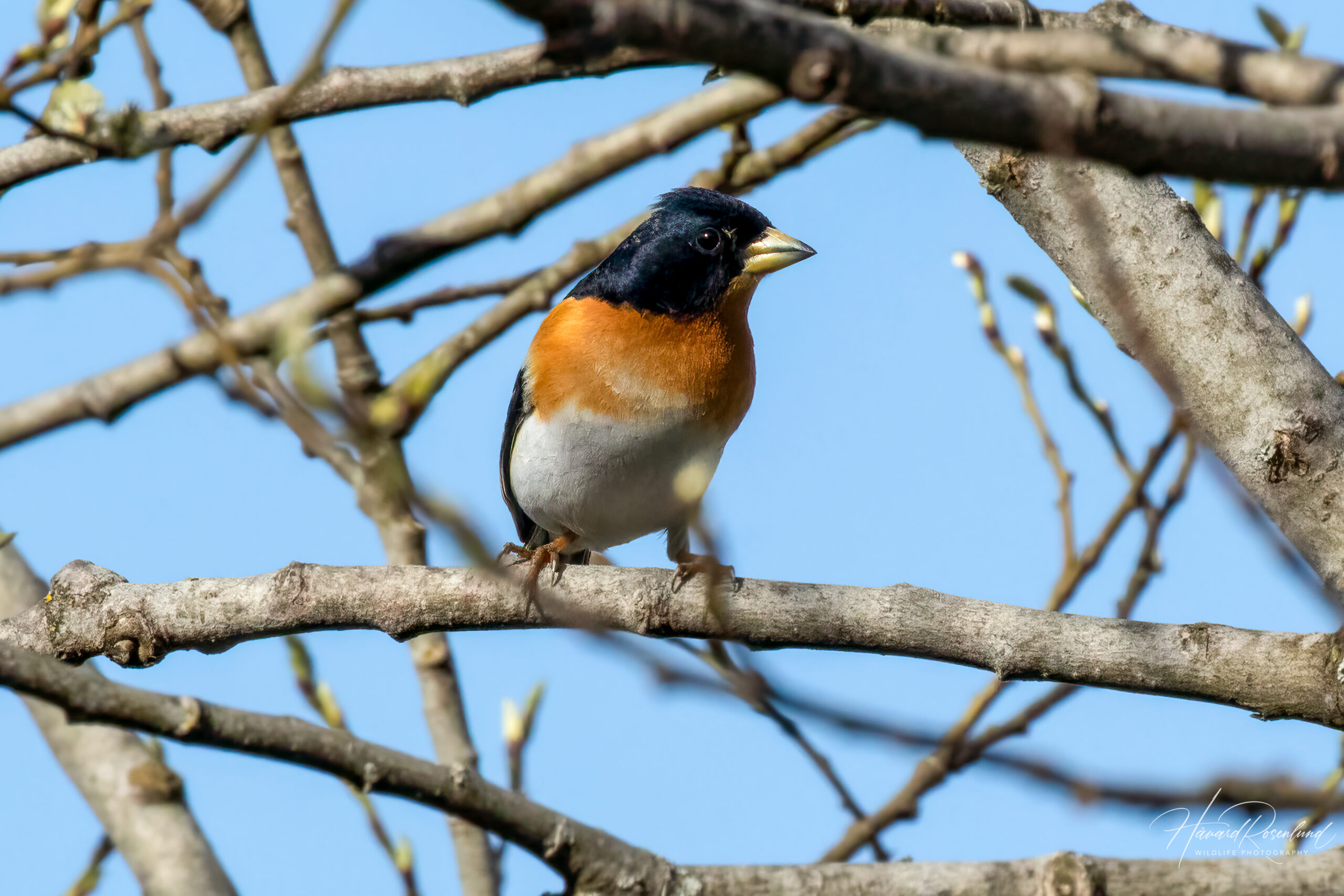
The brambling (Fringilla montifringilla) is a northern finch breeding through birch and conifer forests from Scandinavia across the taiga of northern Eurasia. Adults are about 14–16 cm long and weigh around 24.5 g. Breeding males have a glossy black head and back, orange breast and shoulders and a white belly. Females and non-breeding males are more mottled brown and black but retain warm orange tones and a conspicuous white rump.
The species is similar in size and shape to the closely related common chaffinch (Fringilla coelebs), and the two often occur together outside the breeding season. The brambling’s orange shoulders, white rump and whiter belly are useful identification features, while breeding males become particularly distinctive as the pale tips of the winter head feathers wear away to reveal the black head.
Habitat
During breeding, bramblings favour birch woodland, mountain birch zones and open conifer forest across the northern taiga. Foliage and ground vegetation rich in invertebrates provide important feeding areas for adults and chicks.
Outside the breeding season the species uses a much broader range of habitats, including deciduous woodland, farmland, parks and gardens. Winter distribution is strongly influenced by seed crops, especially beech mast in Europe, so large numbers may concentrate in one region in one winter and be almost absent there the next.
Diet
Insects and other small invertebrates become particularly important during the breeding season and are the main food supplied to growing chicks. Adults take prey from foliage and the ground within northern woodland.
After breeding the diet shifts strongly toward seeds. Beech mast can support exceptionally large winter concentrations, but the birds also take other tree seeds, grain and food found on farmland or at feeders. Their ability to follow temporary seed abundance helps explain why winter distribution can change so dramatically from year to year.
Migration
Bramblings are long-distance and highly flexible migrants. Most birds breeding in Scandinavia and northern Eurasia move south and west in autumn, wintering across much of central and southern Europe and extending into North Africa and parts of southern Asia. Birds return north mainly in April and May.
The precise winter distribution varies dramatically with food. Where beech mast is abundant, birds may gather into very large communal roosts containing hundreds of thousands or several million individuals. A 2022 study of Swiss mass concentrations found that adults, especially adult males, were over-represented, while juveniles—particularly juvenile females—were less common than outside these concentrations. Ring recoveries in the same study linked birds found in Switzerland with breeding areas from Norway to western Siberia, but did not indicate that birds in the mass concentrations came from a different part of the breeding range than birds wintering in Switzerland in normal years.
Historical estimates of much larger roosts are highly uncertain. A 2021 review found supporting evidence for roosts of up to about 15 million birds, while many larger figures repeated in the literature could not be documented reliably.
Breeding
Breeding usually begins in late May across much of the northern range. The female builds a compact cup nest in a tree, using plant fibres, grasses, moss and finer lining material. A typical clutch contains 5–7 eggs.
The female incubates for about 11–12 days, and both parents feed the chicks after hatching. The young normally remain in the nest for another 13–14 days before fledging. One brood is usual, although a second breeding attempt can occur under favourable conditions.
Status
The brambling is classified as least concern on the IUCN Red List. It remains widespread and numerous across the northern Palearctic.
The 2025 update from the Pan-European Common Bird Monitoring Scheme, based on data through 2024, shows a 57% decline in the European breeding index from 1980 to 2024. Over the most recent ten-year period, 2015–2024, the index increased by 9%. The strong long-term decline has therefore not continued at the same rate in the most recent decade.
Because bramblings can shift rapidly between breeding and wintering regions in response to food, numbers can vary greatly from year to year in any one place. Spectacular winter gatherings therefore do not necessarily reflect population trends elsewhere.
Image gallery
Loading map and observations…
Have you seen this species?
Independent species archive
Did you find this species page useful?
Wildlife Vagabond is independently built and maintained. Voluntary support helps cover hosting, maps, data storage and continued improvements to the species archive.
Support Wildlife VagabondSpecies content will remain freely available.
References
Information about the species’ global distribution and status is based primarily on global Red List data. See the references below for details.
- BirdLife International. (n.d.). Brambling species factsheet. https://datazone.birdlife.org/species/factsheet/brambling-fringilla-montifringilla
- British Trust for Ornithology. (n.d.). Brambling. https://www.bto.org/learn/about-birds/birdfacts/brambling
- International Union for Conservation of Nature. (n.d.). Brambling. The IUCN Red List of Threatened Species. https://www.iucnredlist.org/species/22720041/88203665
- Jenni, L. (2022). Which birds participate in mass concentrations of Bramblings Fringilla montifringilla?—Ring recoveries, biometry, age and sex composition. Journal of Ornithology, 163(1), 1-17. https://doi.org/10.1007/s10336-021-01916-7
- Pan-European Common Bird Monitoring Scheme. (n.d.). Species trends, 2025 update. https://pecbms.info/trends-and-indicators/species-trends/
- Svensson, T. (2021). A review of mass concentrations of Bramblings Fringilla montifringilla: implications for assessment of large numbers of birds. Ornis Svecica, 31. https://doi.org/10.34080/os.v31.22031