
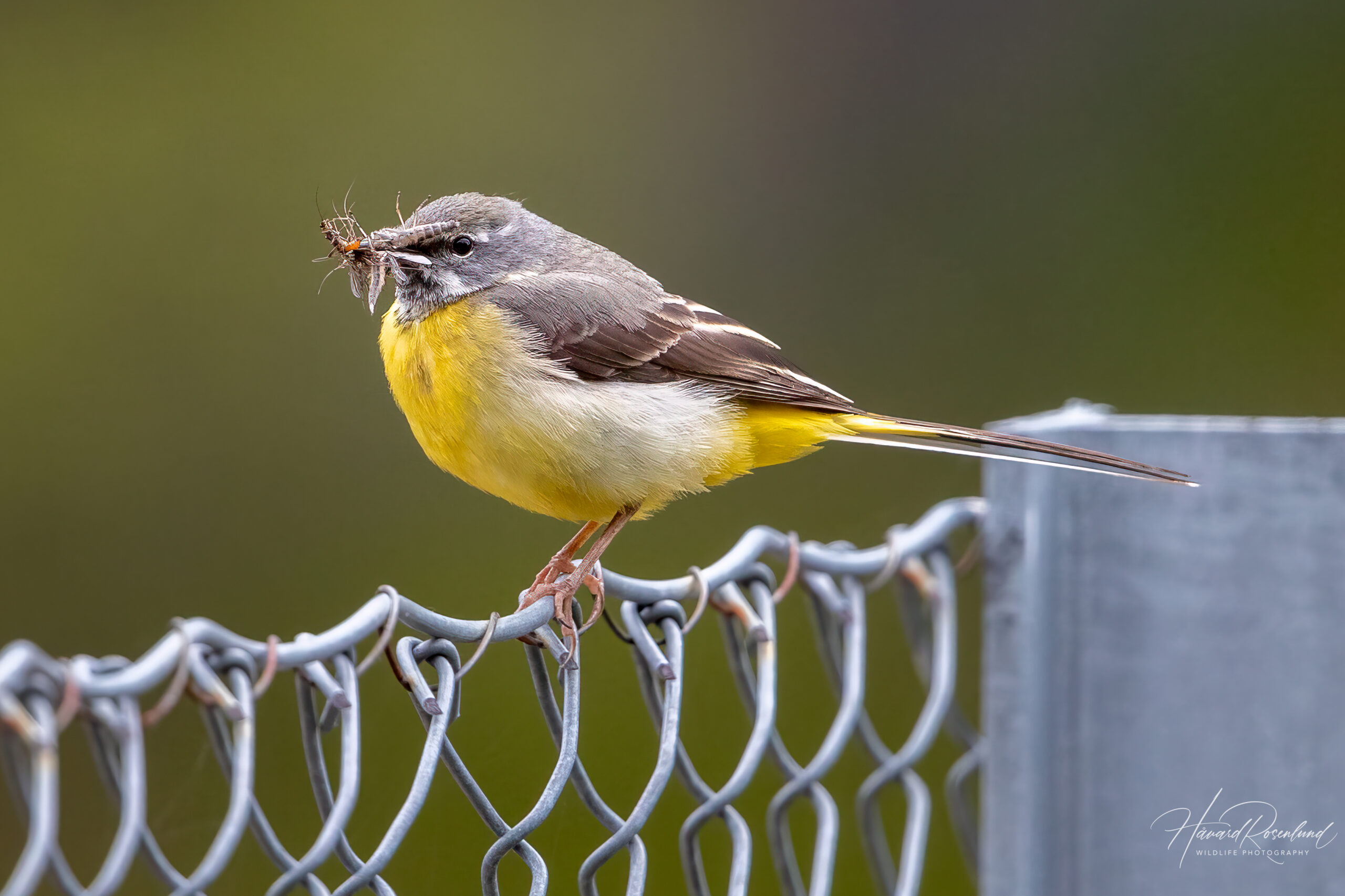
Grey Wagtail
Motacilla cinerea
At a glance
Habitat
- Fast-flowing streams and rivers with exposed rocks, shingle and banks; also slower waters outside breeding
Diet
- Aquatic and terrestrial invertebrates, especially insects and larvae
Activity
- Diurnal
Size
- Length: 17–20 cm Weight: about 18 g
Range
- Europe and Asia; northern and eastern birds migrate south to milder parts of Europe, Africa and southern Asia
Description
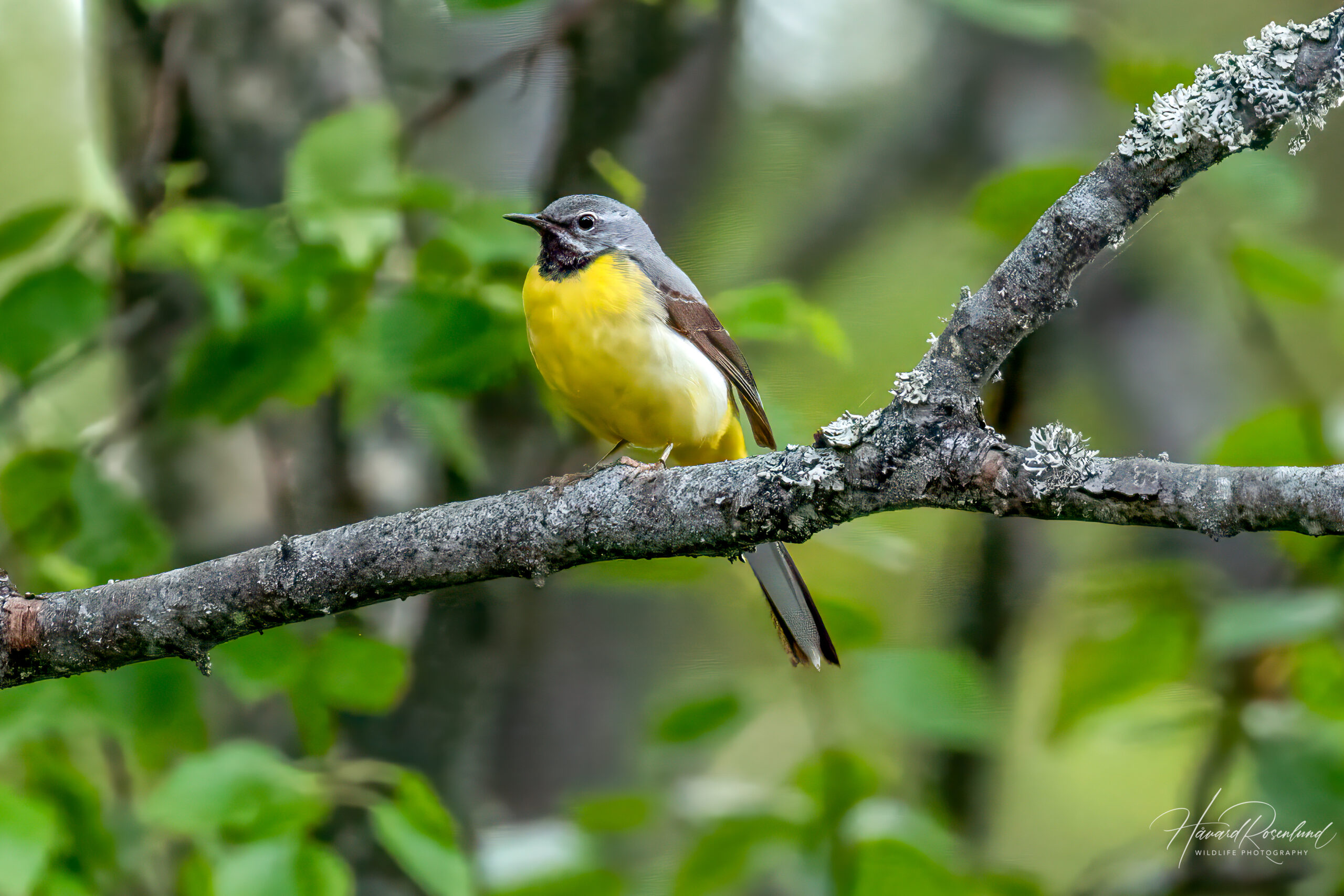
The grey wagtail (Motacilla cinerea) is a long-tailed wagtail breeding across much of Europe and Asia. Adults are about 17–20 cm long and weigh around 18 g. The upperparts are mostly slate-grey, contrasting with a bright yellow vent and yellow underparts that become more extensive in breeding plumage. A pale supercilium is usually obvious. Breeding males develop a black throat, while females generally have a paler or mottled throat. The species characteristically bobs its long tail as it moves and feeds along the water's edge.
The combination of grey upperparts, yellow underparts and an exceptionally long tail separates the species from the western yellow wagtail (Motacilla flava) and other yellow wagtails, which are usually greener or more yellow above and favour open wet grassland rather than fast-flowing streams.
Habitat
Grey wagtails are strongly associated with running water, especially streams and rivers with exposed stones, gravel, riffles, small waterfalls and nearby banks or structures that provide nesting sites. They also use slower rivers, lakes, ponds and urban waterways, particularly outside the breeding season.
A 2024 study of 203 breeding territories in the Beskid Żywiecki Mountains of southern Poland found grey wagtails more often along stream sections with gentler gradients. Such sections can hold larger volumes of water and provide good conditions for aquatic invertebrates. The birds showed no strong preference for one surrounding forest type, suggesting that the structure of the watercourse itself is more important than the type of woodland around it.
Diet
The diet consists mainly of small invertebrates. Aquatic insects and their larvae are especially important, together with flies, beetles and other terrestrial prey. Birds run over stones and margins, pick prey from the water surface and vegetation and make short aerial sallies after flying insects.
Studies at British streams have shown that feeding varies with both prey availability and the structure of the riparian zone. Grey wagtails also take terrestrial insects beside the stream and can rely more on them when aquatic prey becomes less abundant.
Migration
The species is partially migratory. Many birds in western and southern Europe are resident or make only short movements, while populations breeding farther north and east move south in autumn. Wintering birds occur widely across western and southern Europe, North Africa and southern Asia.
Movements are strongly influenced by ice and access to flowing water. Birds may leave inland territories when streams freeze and shift to larger rivers, springs, coasts or urban waterways that remain ice-free. Return to northern breeding areas begins early in spring as waterways open again.
Breeding
Grey wagtails nest in sheltered cavities close to running water. Natural sites include holes in banks, rock faces and among tree roots, while bridges, retaining walls, buildings and other human structures are frequently used. The nest is a compact cup of grass, roots and moss lined with finer material.
A typical clutch contains about five eggs. The female performs most of the incubation for roughly 12–13 days, and both parents feed the chicks. The young usually leave the nest after about 14–15 days. Two broods are common in favourable areas and a third may occasionally be attempted.
Status
The grey wagtail is classified as least concern on the IUCN Red List and remains widespread across a very large Eurasian range.
Regional trends are mixed. Long-term monitoring in the UK indicates a broadly stable population over 1995–2024, although a marked decline occurred after an earlier increase and the pattern varies geographically. Local breeding populations depend closely on the condition of streams, including naturally structured channels, intact banks and riparian habitat.
Image gallery
Loading map and observations…
Have you seen this species?
Independent species archive
Did you find this species page useful?
Wildlife Vagabond is independently built and maintained. Voluntary support helps cover hosting, maps, data storage and continued improvements to the species archive.
Support Wildlife VagabondSpecies content will remain freely available.
References
Information about the species’ global distribution and status is based primarily on global Red List data. See the references below for details.
- BirdLife International. (n.d.). Grey Wagtail species factsheet. https://datazone.birdlife.org/species/factsheet/grey-wagtail-motacilla-cinerea
- British Trust for Ornithology. (n.d.). Grey Wagtail. https://www.bto.org/learn/about-birds/birdfacts/grey-wagtail
- Ciach, M., & Bul, K. (2024). Wybiórczość siedliskowa ptaków związanych z potokami w skali zlewni: pliszka górska Motacilla cinerea i pluszcz Cinclus cinclus w Beskidzie Żywieckim. Ornis Polonica, 65(2), 79-92. https://doi.org/10.12657/ornis.2024.2.1
- International Union for Conservation of Nature. (n.d.). Grey Wagtail. The IUCN Red List of Threatened Species. https://www.iucnredlist.org/species/22718392/111215843
- Ormerod, S. J., & Tyler, S. J. (1987). Aspects of the breeding ecology of Welsh Grey WagtailsMotacilla cinerea. Bird Study, 34(1), 43-51. https://doi.org/10.1080/00063658709476935
- Ormerod, S. J., & Tyler, S. J. (1991). The influence of stream acidification and riparian land use on the feeding ecology of Grey Wagtails Motacilla cinerea in Wales. Ibis, 133(1), 53-61. https://doi.org/10.1111/j.1474-919X.1991.tb04810.x