
Spotted Dove
Spilopelia chinensis
At a glance
Habitat
- Open woodland, scrub, farmland, gardens, parks and urban areas with trees and open feeding ground
Diet
- Mostly seeds and grain, with other plant material, fruit and human-associated foods taken opportunistically
Activity
- Diurnal
Size
- Length: 28–32 cm Weight: about 157–164 g
Range
- South and East Asia; introduced populations occur in Australia, New Zealand, Hawaii, southern California and elsewhere
Description
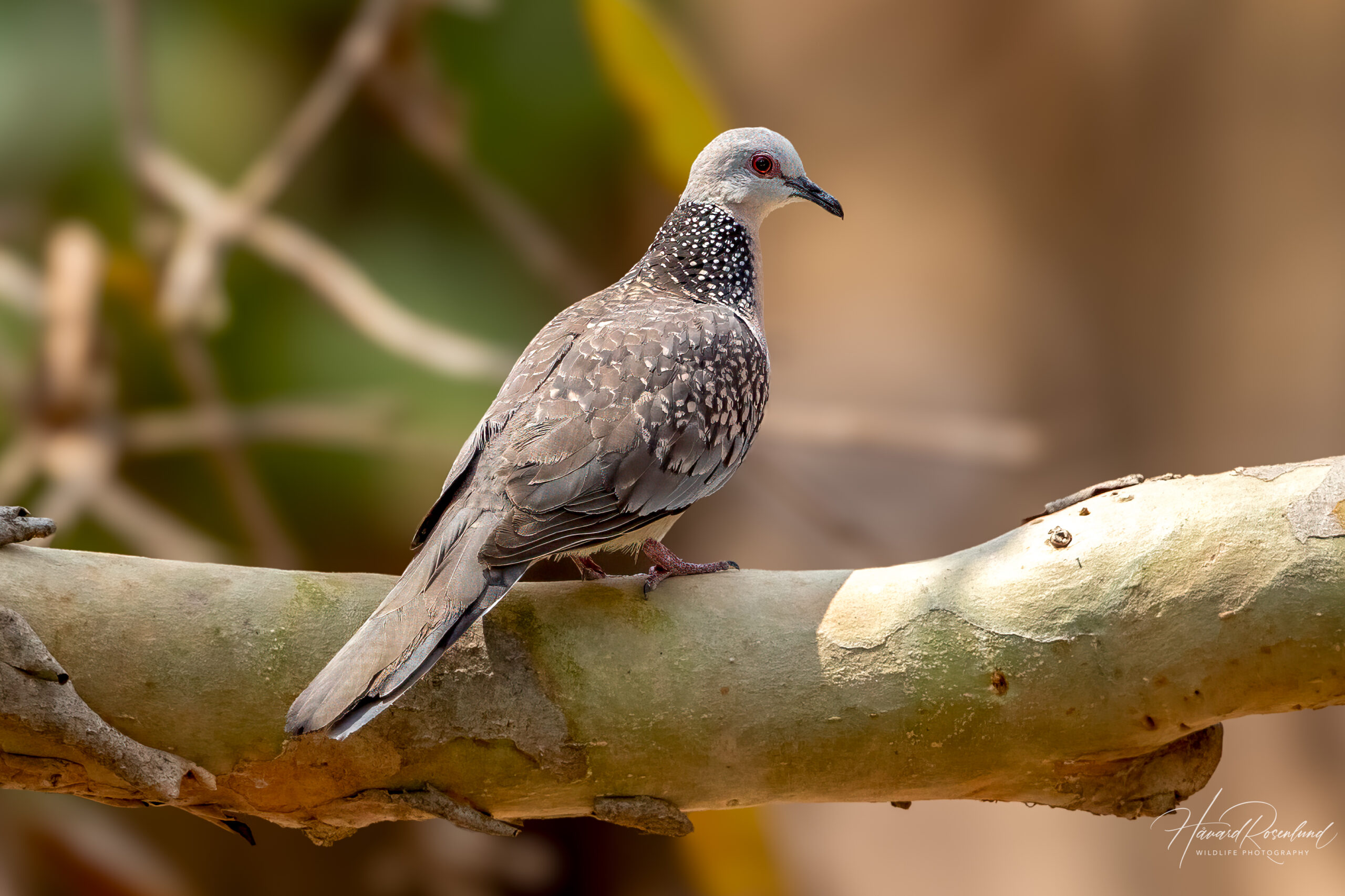
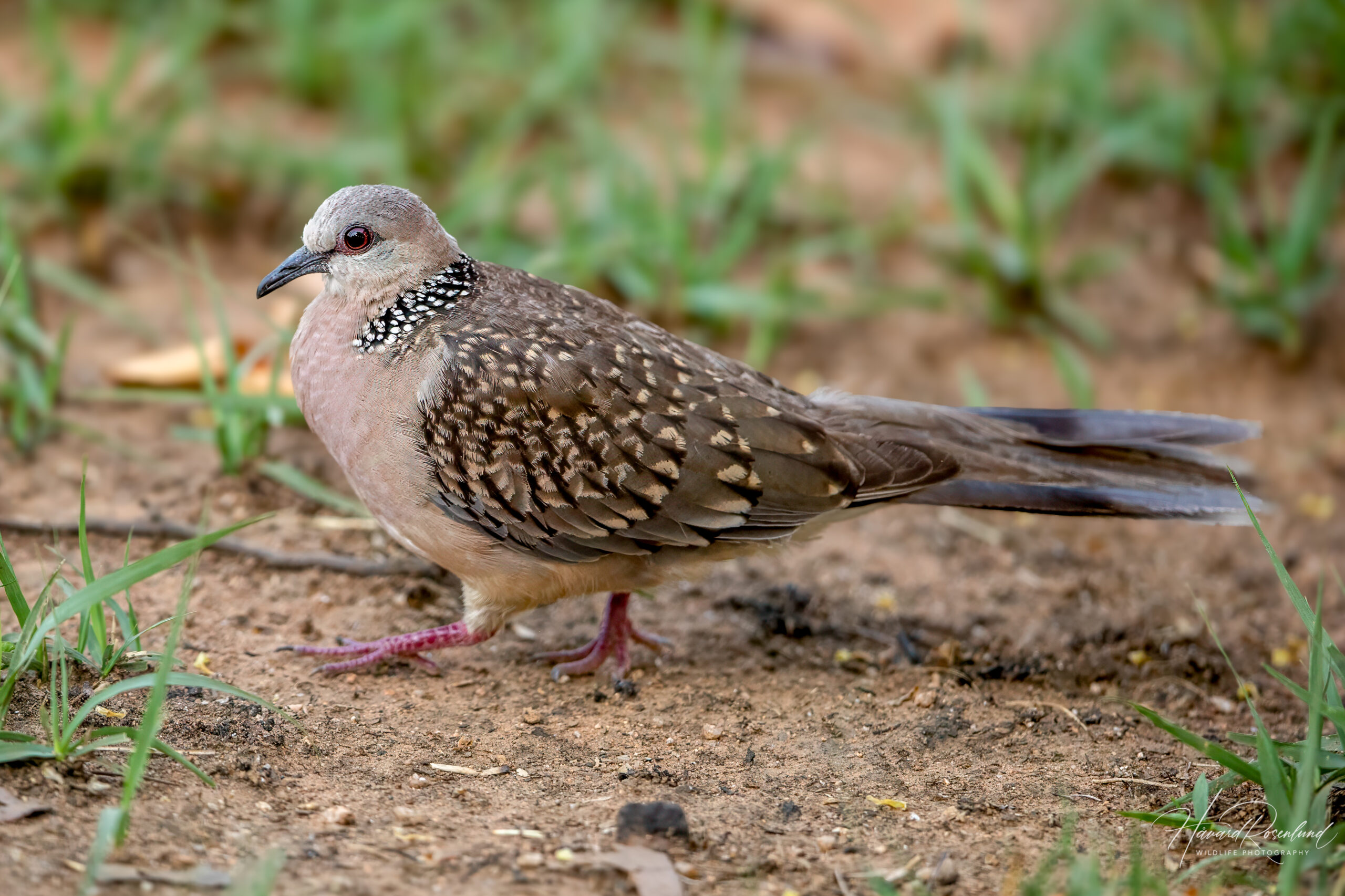
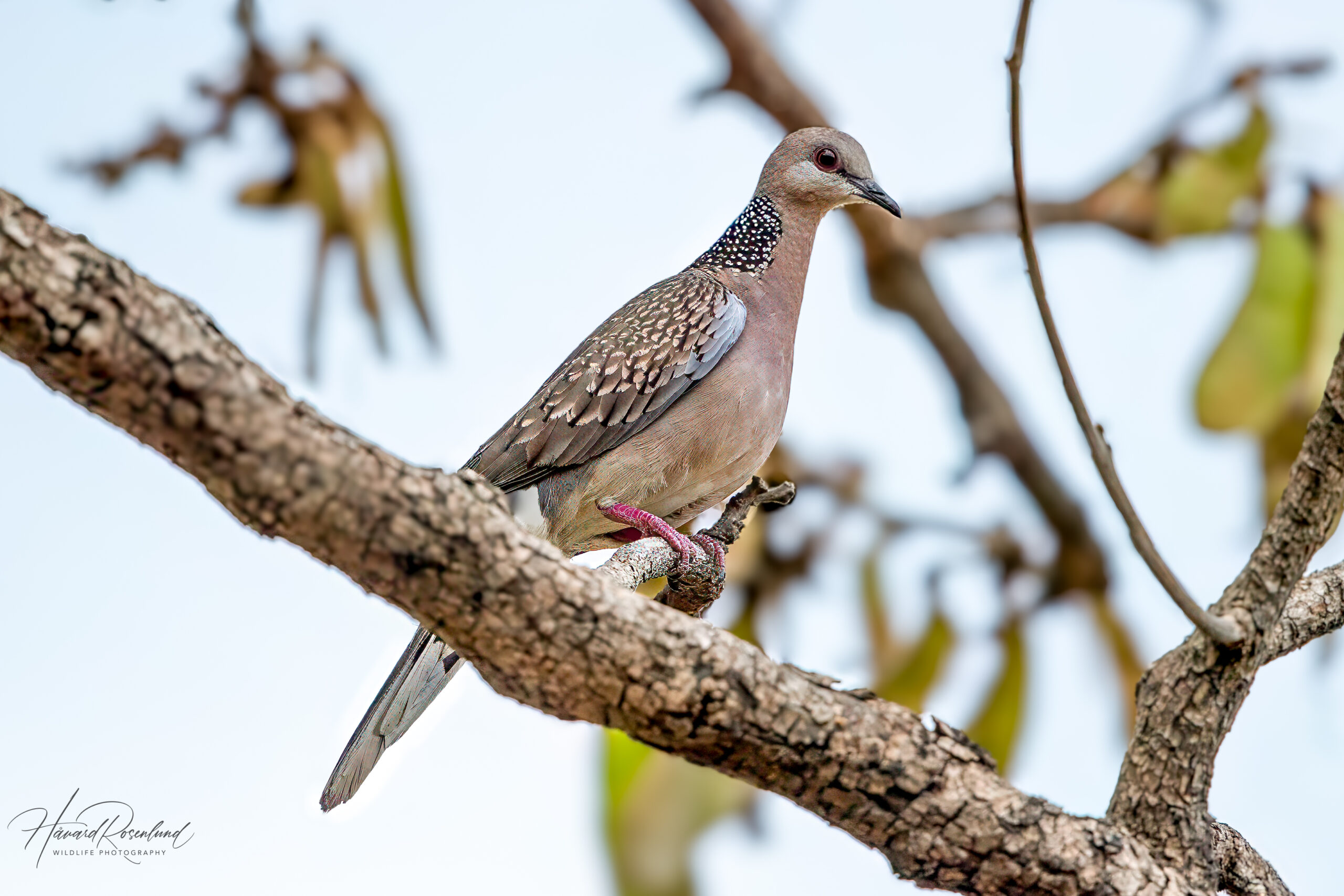
The spotted dove (Spilopelia chinensis) is a medium-sized, long-tailed dove native to South and East Asia. Adults are about 28–32 cm long, have a wingspan of roughly 43–48 cm and weigh roughly 157–164 g. The head is greyish, the underparts pinkish-grey and the upperparts brown with darker patterning. Its defining feature is the broad black patch on the back and sides of the neck, densely marked with small white spots. The sexes are similar, while juveniles are duller and initially lack the fully developed spotted collar.
Where several medium-sized doves occur together, the spotted hindneck patch and long tail are the most useful field marks. The combination is distinctive even when the overall brown-grey plumage appears similar to other common doves.
Taxonomy
AviList v2025b treats the spotted dove as a single species with five subspecies. Birds across most of Pakistan, India and Nepal belong to S. c. suratensis, the form represented by the birds photographed on this page.
The group has not always been treated this way. Some taxonomies have separated western forms such as suratensis from the eastern forms, so older conservation and identification sources may use different species limits.
Habitat
Spotted doves are highly adaptable and occupy open woodland, scrub, farmland, plantations, gardens, parks and cities, provided that trees or shrubs for nesting occur near open feeding ground. They are particularly successful around people and often forage along paths, lawns, roadsides, fields and other disturbed ground.
Urban populations make extensive use of planted vegetation as well as remnant natural habitat. The species therefore benefits from landscapes that combine open ground for feeding with enough trees and shrubs for nesting and shelter.
Diet
Seeds and grain form the core of the diet and are taken mainly from the ground, supplemented by other plant material, small fruits and human-associated foods. The species is flexible enough to shift among food sources as their availability changes.
A 2025 DNA metabarcoding study in Jiangxi Province, China, identified 100 plant species in 251 faecal samples. Seeds of planted camphor trees were the most important year-round resource, while the birds shifted toward seasonally abundant grasses and other fresh plant foods when these became available. This ability to exploit both planted vegetation and changing seasonal resources helps explain the species' success in cities.
Breeding
Spotted doves form pairs and build the characteristically flimsy pigeon nest: a shallow platform of twigs placed in a tree, shrub or suitable structure around buildings. Courtship includes bowing displays and a display flight in which the male rises steeply with audible wing-clapping before gliding back down. A clutch normally contains two white eggs. Incubation lasts about 14–16 days, and both parents share incubation and care of the young.
Like other pigeons and doves, spotted doves feed newly hatched chicks with nutrient-rich crop milk produced in the crop and regurgitated by the parents. A field study published in 2016 from Karnataka, India, documented crop-milk feeding from the first day and young leaving the nest at about 16 days.
Urban birds may also reuse nests rather than beginning from scratch each time. A study published in 2024 from Nanchang in Jiangxi Province, China, followed 302 breeding nests from 2018 to 2021 and found a reuse rate of about 38%. Reused nests were associated with higher reproductive success, while nest height and canopy cover also influenced breeding outcome.
Introduced populations
Humans have transported spotted doves well beyond their native Asian range. Established populations occur in Australia, New Zealand, Hawaii, southern California and several other regions, usually in towns, suburbs and agricultural landscapes.
The same traits that make the species successful in Asian cities—broad habitat tolerance, ground-feeding on common seeds and grain, and frequent breeding around buildings and planted trees—also help introduced populations persist in their new environments.
Status
The spotted dove is classified as least concern on the IUCN Red List. It has a broad distribution and a large global population and remains common in many agricultural and urban landscapes.
State of India's Birds lists the species as a low conservation priority. Its 2025 update shows a long-term national increase of about 73%, while the more recent annual trend corresponds to an increase of roughly 3% per year.
Image gallery
Loading map and observations…
Have you seen this species?
Independent species archive
Did you find this species page useful?
Wildlife Vagabond is independently built and maintained. Voluntary support helps cover hosting, maps, data storage and continued improvements to the species archive.
Support Wildlife VagabondSpecies content will remain freely available.
References
Information about the species’ global distribution and status is based primarily on global Red List data. See the references below for details.
- AviList. (n.d.). v2025b – Spotted Dove taxonomy. https://explore.avilist.org/
- BirdLife Australia. (n.d.). Spotted Dove species profile. https://birdlife.org.au/bird-profiles/spotted-dove/
- BirdLife International. (2026). IUCN Red List for birds. BirdLife DataZone. https://datazone.birdlife.org
- Garrett, K. L., & Walker, R. L. (2023). Spotted Dove (Spilopelia chinensis). In Birds of the World. Cornell Lab of Ornithology. https://doi.org/10.2173/bow.spodov.01.2
- International Union for Conservation of Nature. (n.d.). Spotted Dove. The IUCN Red List of Threatened Species. https://www.iucnredlist.org/species/60483076/95161373
- Lu, M., Zhang, X., Ruan, J., Li, W., Chen, M., Ma, L., Zhang, Z., Guan, B., & Ruan, L. (2025). Selection and Adaptation to Urban Food Resources Promote Spotted Dove (Streptopelia chinensis) as a Common Species in Urban Habitats. Ecology and Evolution, 15(7), e71773. https://doi.org/10.1002/ece3.71773
- Rajashekara & Venkatesha. (2016). On the breeding of Spotted Dove Streptopelia chinensis. Indian BIRDS, 11(4), 91–93. https://indianbirds.in/pdfs/IB_11_4_RajashekaraVenkatesha_SpottedDove.pdf
- Sheng, Y., Lu, M., Bai, J., Xie, X., Ma, L., Li, W., Zhang, Z., Ming, F., Zhang, X., Zhang, Z., Xu, Z., Han, Y., Guan, B., & Ruan, L. (2024). Ecological drivers of nesting behavior in a subtropical city: An observational study on spotted doves. Ecology and evolution, 14(7), e11655. https://doi.org/10.1002/ece3.11655
- State of India's Birds. (2025). 2025 – Spotted Dove. https://stateofindiasbirds.in/species/spodov/
- Tobias, J. A., Sheard, C., Pigot, A. L., Devenish, A. J. M., Yang, J., Sayol, F., Neate‐Clegg, M. H. C., Alioravainen, N., Weeks, T. L., Barber, R. A., Walkden, P. A., MacGregor, H. E. A., Jones, S. E. I., Vincent, C., Phillips, A. G., Marples, N. M., Montaño‐Centellas, F. A., Leandro‐Silva, V., Claramunt, S., … Schleuning, M. (2022). AVONET: morphological, ecological and geographical data for all birds. Ecology Letters, 25(3), 581-597. https://doi.org/10.1111/ele.13898