
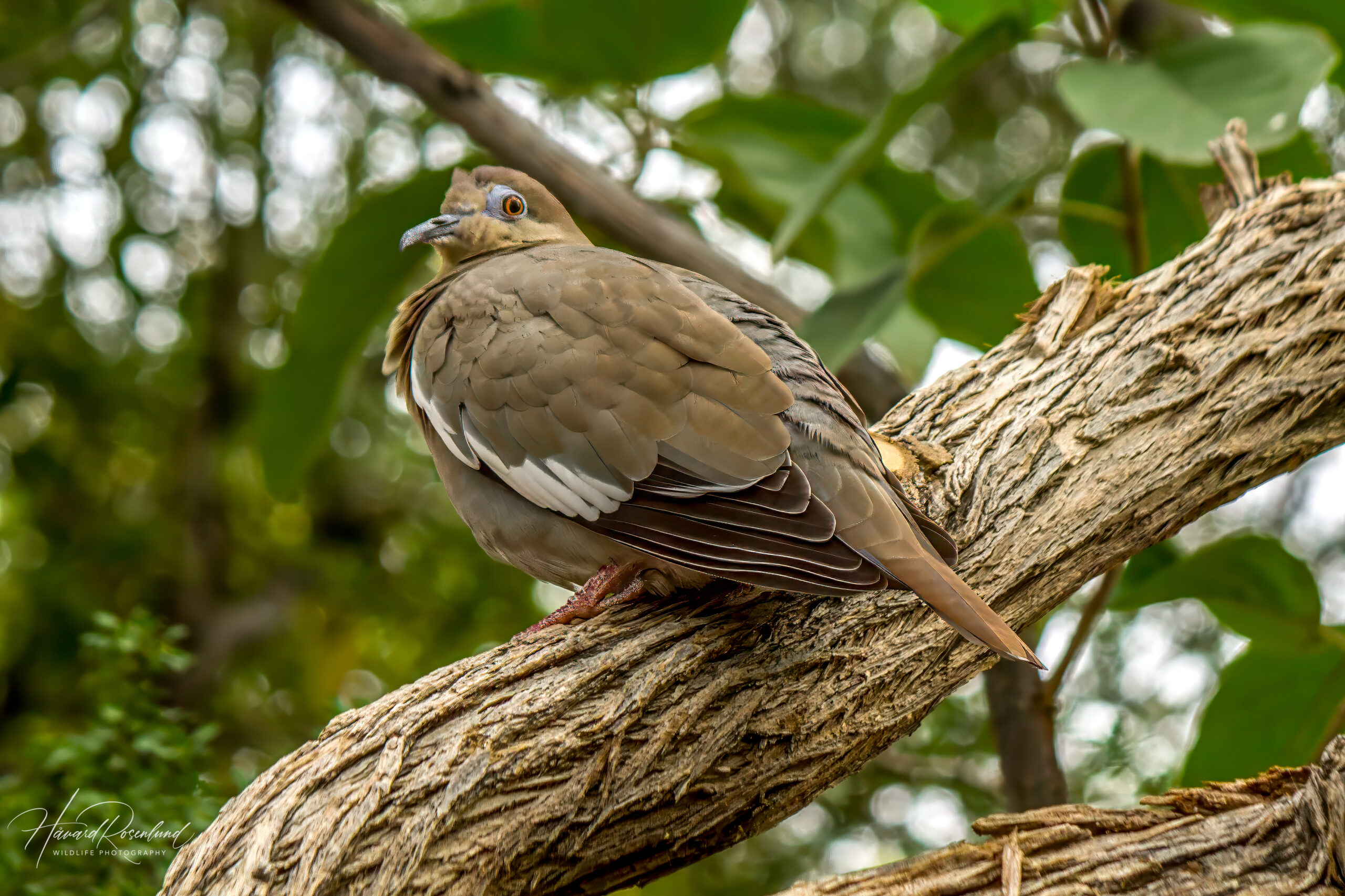
White-winged Dove
Zenaida asiatica
At a glance
Habitat
- Desert scrub, thorn forest, streamside woodland, farmland and increasingly towns and suburbs
Diet
- Mainly seeds, grain and fruit; in the Sonoran Desert, saguaro nectar, pollen and fruit are especially important
Activity
- Diurnal
Size
- Length: About 29–31 cm Weight: 125–187 g
Range
- Southwestern and southern United States through Mexico and Central America to parts of the Caribbean
Description
The white-winged dove (Zenaida asiatica) is a large, sturdy dove of the southern United States, Mexico, Central America and parts of the Caribbean. It is grey-brown overall with a conspicuous white stripe along the folded wing that flashes into a broad white patch in flight. Adults also have red eyes surrounded by blue bare skin, a dark cheek mark and a short, square-tipped tail with white corners.
It is larger and more heavily built than the mourning dove (Zenaida macroura), which also has a much longer pointed tail. Adults are about 29–31 cm long and weigh roughly 125–187 g.
Habitat
White-winged doves use a wide range of relatively dry habitats, including thorn forest, desert scrub, cactus communities, streamside woodland, farmland and plantations.
They have also adapted exceptionally well to towns and suburbs, where large shade trees, gardens and artificial water can replace some of the resources that are patchier in natural desert landscapes.
Diet
The diet is overwhelmingly plant-based and includes seeds, grain, berries and other fruit.
White-winged doves feed both on the ground and above it, often taking seeds directly from seed heads and visiting fruiting trees rather than relying mainly on fallen food.
In the Sonoran Desert the relationship with the saguaro cactus (Carnegiea gigantea) is especially close. Doves visit the flowers for nectar and pollen and later consume large quantities of fruit. As they move between flowering cacti they can transfer pollen and help cross-pollinate the plants. Viable saguaro seeds can also survive passage through the digestive tract and are dispersed in the birds' droppings, so the doves act as seed dispersers as well as pollinators.
Behaviour
White-winged doves are active by day and commonly move between feeding, drinking and resting areas. Like other pigeons and doves they can drink by immersing the bill and sucking water continuously rather than repeatedly tipping the head back.
The male's loud series of deep, rhythmic coos is one of the characteristic sounds of summer in much of the southwestern United States. Calling is used strongly in territorial and pair communication and often makes the species easier to detect than its muted body colours suggest.
Social behaviour
Outside the breeding season white-winged doves can be highly social and gather in large feeding and roosting flocks. Numbers become especially concentrated where grain, fruit, water or safe roost trees are abundant.
After breeding, desert populations may form very large groups before dispersing or migrating. Flock size varies substantially with local food supply and season.
Migration
Movement patterns vary greatly across the range. Many tropical and increasingly urban populations are resident, while birds breeding in western deserts can be strongly migratory. In the Sonoran Desert, large numbers arrive in spring and early summer and time breeding closely to saguaro flowering and fruiting.
This produces an unusually tight link between migration and food supply: nectar and pollen become available first, followed by water-rich fruit as the breeding season progresses. After breeding, many birds move south, while others disperse in several directions or remain farther north where urban areas provide reliable food and warmer winter conditions.
Breeding
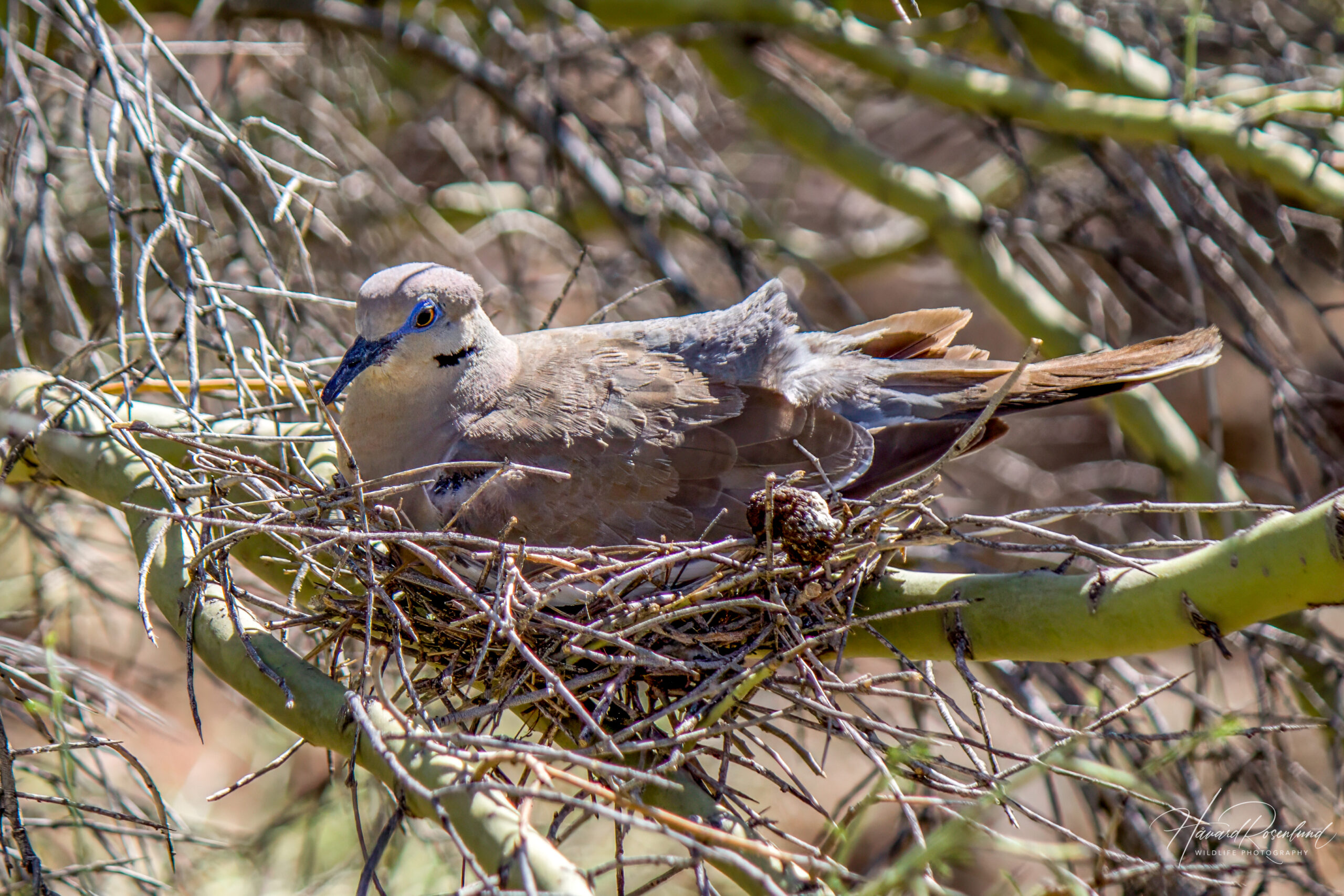
White-winged doves are monogamous for at least a breeding season. Males advertise with repeated calls and display flights, rising before returning in a stiff-winged glide. The male selects a territory and brings nesting material, while the female chooses the exact site and builds the shallow twig platform, usually in a shaded tree or dense shrub.
Clutches contain one or two eggs, and both parents incubate for about 14–20 days. The young remain in the nest for roughly 13–18 days. Both parents feed the young nutrient-rich crop milk early in development before gradually adding softened seeds and other plant food.
Relationship with humans
White-winged doves have expanded strongly into cities and suburbs in the southern United States. Backyard feeders, irrigated vegetation, large shade trees and artificial water provide reliable resources, and the species has spread northward in association with urban landscapes since the late twentieth century.
The species is also an important game bird in the United States and Mexico. Heavy hunting and woodland clearing contributed to major historical declines in parts of Texas, followed by recovery as hunting became more regulated and suitable habitat increased again in many areas.
Status
The white-winged dove is classified as least concern on the IUCN Red List. The species remains widespread and has expanded into many urban and suburban areas.
Regional populations can still be affected by clearing and fragmentation of native nesting woodland, while collisions with vehicles, utility lines and buildings cause local mortality.
Image gallery
Loading map and observations…
Have you seen this species?
Independent species archive
Did you find this species page useful?
Wildlife Vagabond is independently built and maintained. Voluntary support helps cover hosting, maps, data storage and continued improvements to the species archive.
Support Wildlife VagabondSpecies content will remain freely available.
References
Information about the species’ global distribution and status is based primarily on global Red List data. See the references below for details.
- Alcorn, S. M., McGregor, S. E., & Olin, G. (1961). Pollination of Saguaro Cactus by Doves, Nectar-Feeding Bats, and Honey Bees. Science (New York, N.Y.), 133(3464), 1594-5. https://doi.org/10.1126/science.133.3464.1594
- BirdLife International. (n.d.). White-winged Dove species factsheet. https://datazone.birdlife.org/species/factsheet/white-winged-dove-zenaida-asiatica
- Cornell Lab of Ornithology. (n.d.). White-winged Dove Life History. https://www.allaboutbirds.org/guide/White-winged_Dove/lifehistory
- Cornell Lab of Ornithology. (n.d.). White-winged Dove range and migration. https://www.allaboutbirds.org/guide/White-winged_Dove/maps-range
- International Union for Conservation of Nature. (n.d.). White-winged Dove. The IUCN Red List of Threatened Species. https://www.iucnredlist.org/species/22733956/95231875
- U.S. Geological Survey. (n.d.). Feather isotope analysis of White-winged Doves. https://www.usgs.gov/publications/feather-isotope-analysis-reveals-differential-patterns-habitat-and-resource-use
- Wolf, B. O., & Martínez del Rio, C. (2000). Use of saguaro fruit by white-winged doves: isotopic evidence of a tight ecological association. Oecologia, 124(4), 536–543. https://doi.org/10.1007/s004420000406