
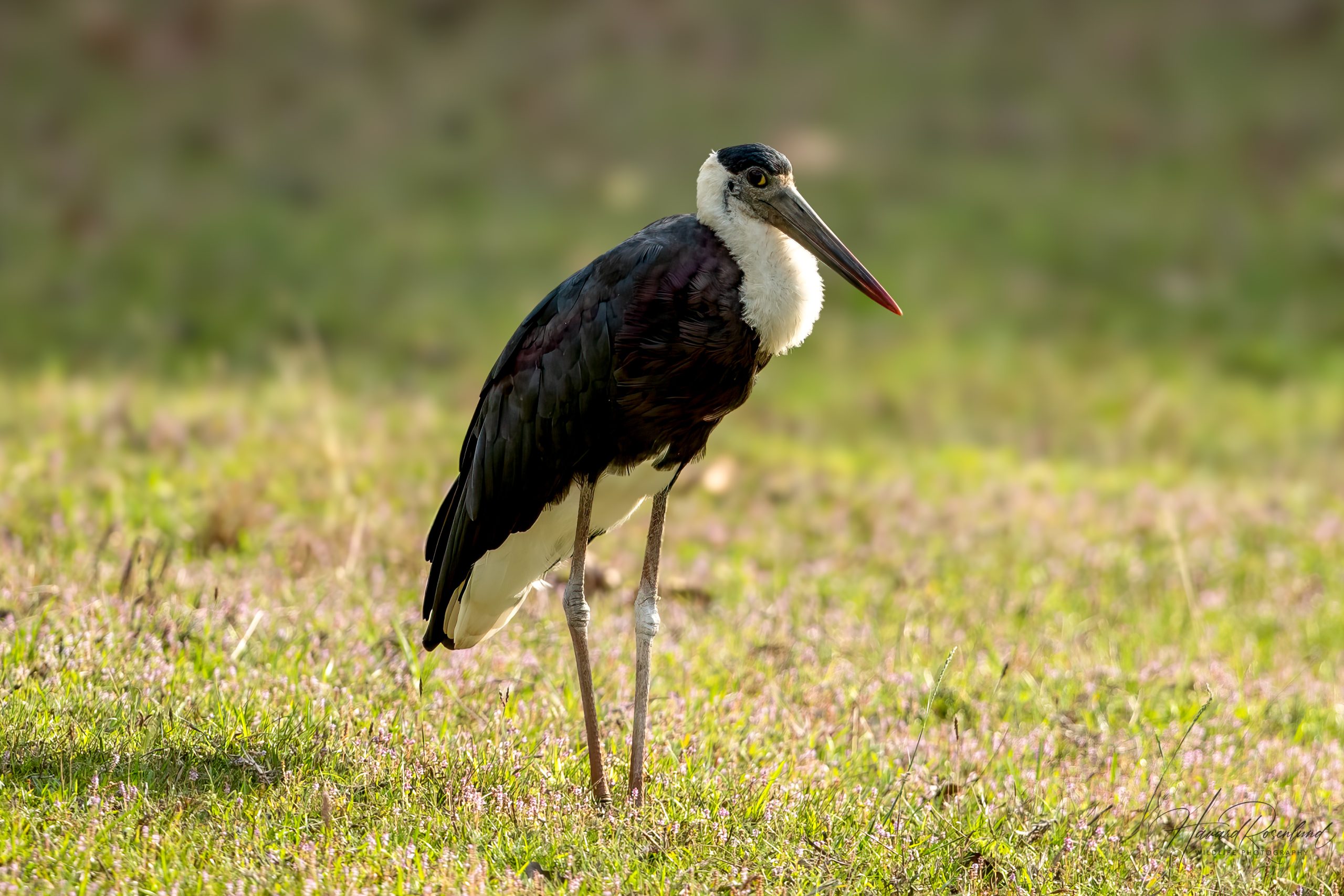
Asian Woolly-necked Stork
Ciconia episcopus
At a glance
Habitat
- Wetlands, river margins, flooded grassland, rice fields and other open agricultural landscapes with scattered trees
Diet
- Fish, frogs, crabs, insects, molluscs, reptiles and other small animals taken from shallow water and open ground
Activity
- Diurnal
Size
- Length: ~86–95 cm Weight: ~2.1 kg average
Range
- Indian subcontinent through mainland Southeast Asia and parts of the Indonesian region
Description
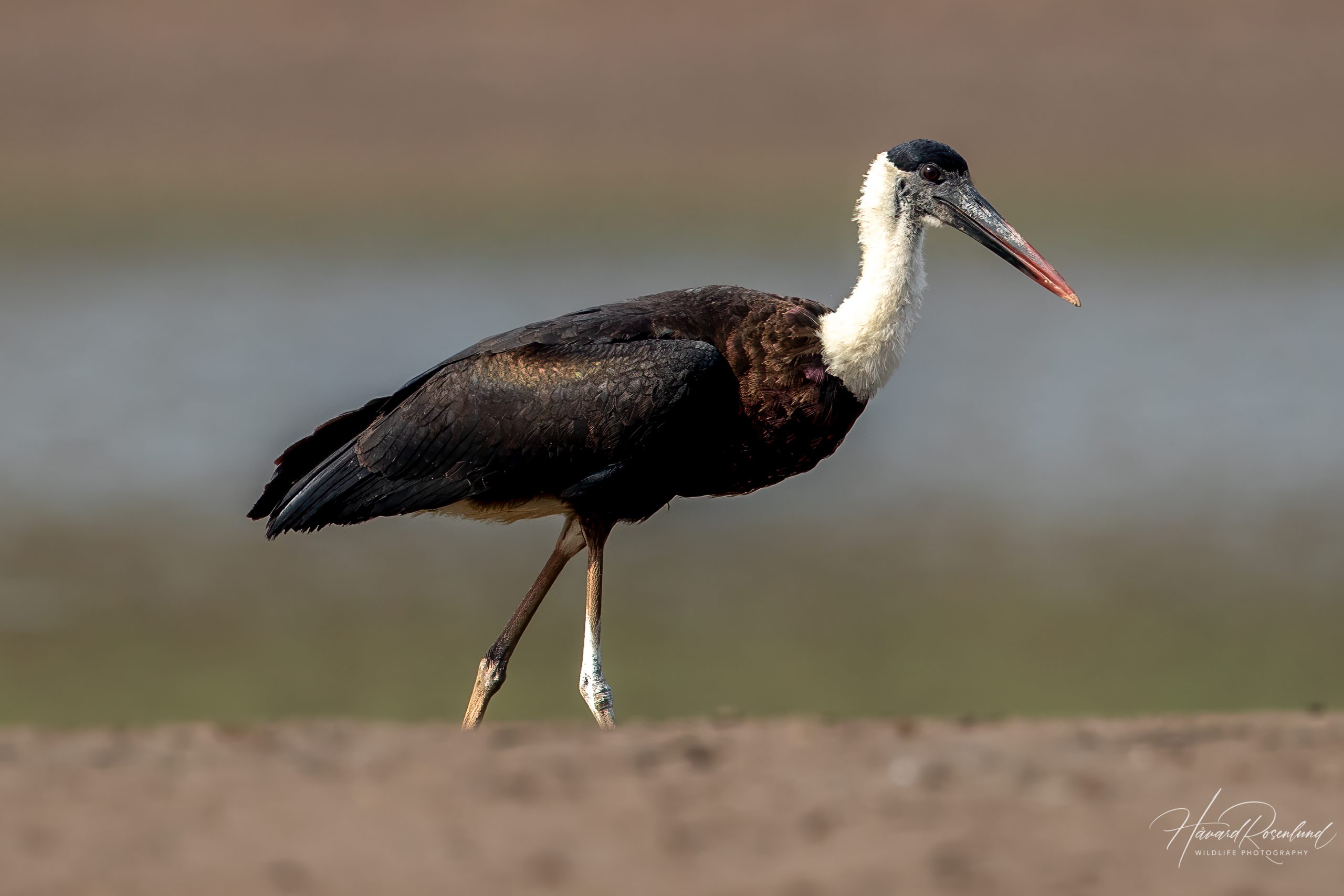
The Asian woolly-necked stork (Ciconia episcopus) is a large, dark-bodied stork with a contrasting white neck and lower belly. Adults are roughly 86–95 cm long and average about 2.1 kg. The wings are glossy black with green and purple iridescence, while the dark cap has a clean border against the woolly-looking white feathers of the neck.
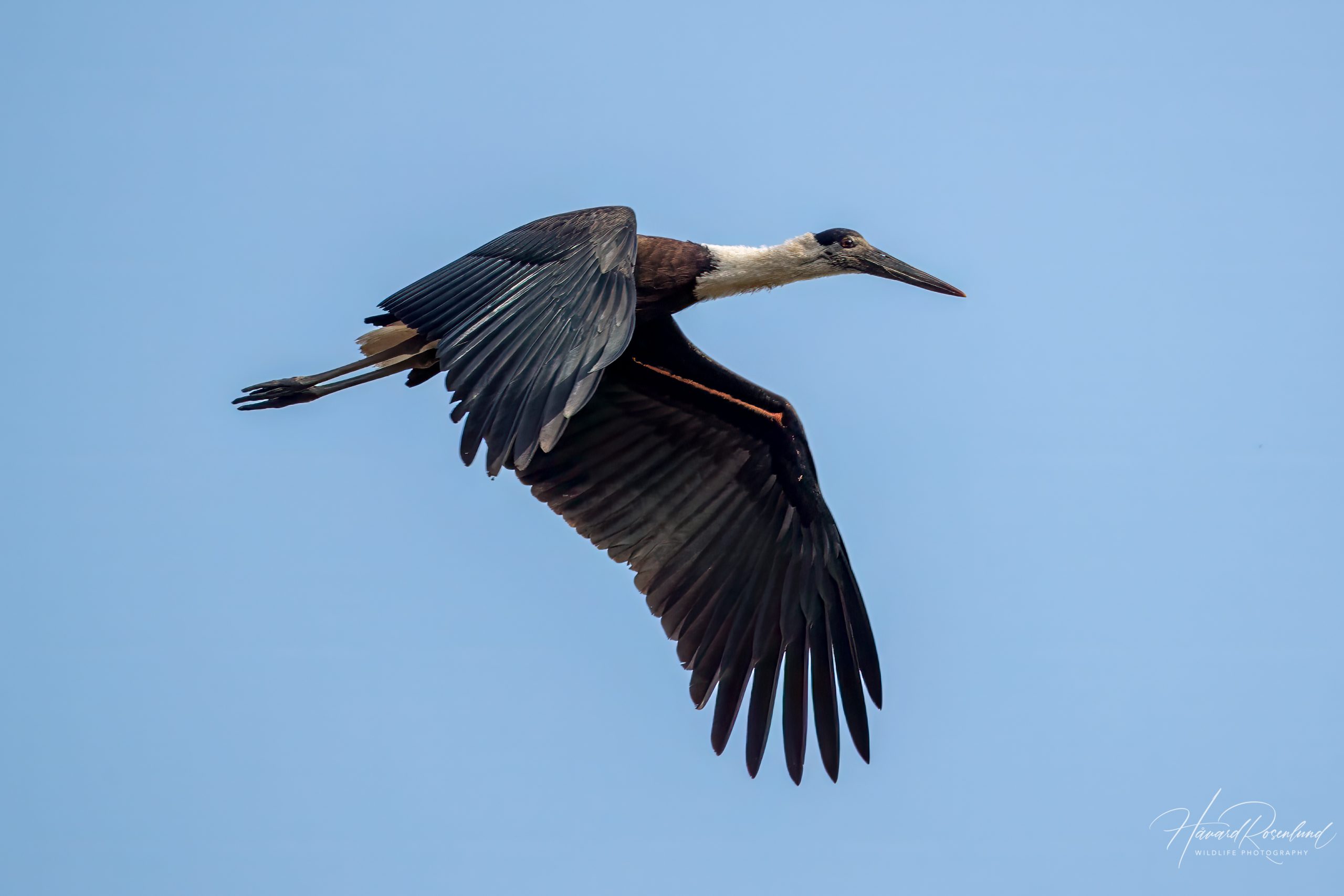
When the wings are spread, a narrow strip of bright orange-red bare skin becomes visible along the underside of the forearm. It is a distinctive feature that is otherwise hidden when the bird is standing with its wings folded.
Taxonomy
Asian and African woolly-necked storks were formerly treated as one species. Current classifications separate the African species Ciconia microscelis from the Asian C. episcopus, based mainly on consistent differences in plumage and other morphology between the widely separated populations. The English name Asian woolly-necked stork now refers specifically to C. episcopus.
A genomic study published in 2024, based on historic museum specimens, found a clear genetic separation between Asian and African woolly-necked storks, supporting the species split. It also found strong genetic differentiation between the two Asian subspecies, C. e. episcopus and C. e. neglecta. The authors suggest that they may represent separate species, but more genomic sampling across Southeast Asia is needed before their status can be resolved.
Habitat
Asian woolly-necked storks use both natural wetlands and human-shaped open landscapes. They feed around marshes, rivers, ponds, reservoirs and flooded grassland, but are also common in rice fields, irrigated farmland and other agricultural areas. Scattered large trees are important because most nests are built high above the ground.
Research in northern India shows how well the species can use traditional farmland. A study published in 2021 covering 298 nests at 166 locations in Haryana between 2016 and 2020 found that nests occurred more often in areas with irrigation canals and less often where human settlement was dense. Agricultural landscapes that retain trees and water networks can therefore provide important breeding habitat beyond untouched wetlands.
Diet
The diet is broad and mainly animal-based. Asian woolly-necked storks take fish, frogs and other amphibians, crabs and other crustaceans, molluscs, large insects, small reptiles and occasionally small mammals. They forage both in shallow water and on open ground.
A feeding bird usually walks slowly while watching the ground or water and then strikes with the bill when prey is detected. This flexible feeding style suits the mosaic of wetlands, flooded fields and drier farmland used across much of the species' range.
Behaviour
Asian woolly-necked storks are most often seen alone, in pairs or in small groups rather than in large permanent flocks. Observations from Kerala published in 2020 found that large groups were uncommon through most of the year, although much larger gatherings could form seasonally where wetlands or fallow fields concentrated food.
The broad wings are also used for efficient soaring. Birds regularly circle in rising warm air to gain height with little flapping and may share thermals with other large birds before gliding on to another feeding or resting area.
Breeding
Asian woolly-necked storks usually nest as solitary pairs rather than in large colonies. The nest is a substantial platform of sticks placed high in a large tree, although pylons and other structures are used occasionally. Breeding timing varies strongly across the range: mainly July–September in northern India, December–March in southern India and January–May in the hills of Nepal. In Southeast Asia the species may breed throughout the year, with peaks in February–May and August–November.
Clutches usually contain three to four eggs, with two to five recorded. Both parents collect nest material, incubate and feed the young. Incubation lasts around 35–40 days, and the young leave the nest after about nine weeks.
The Haryana study, published in 2021, found that many nest sites were reused: 44.5% were used in more than one year. Among 42 successful nests, the average brood contained 3.1 young. A study published in 2026 from Kerala recorded 30 active nests across four districts during 2022 and 2023, showing that the species can also breed in heavily human-influenced landscapes when suitable nest sites and feeding areas remain.
Status
The Asian woolly-necked stork is classified as near threatened on the IUCN Red List. The species remains widespread and India holds a major part of its population, but trends vary greatly between regions and severe declines have been reported from parts of Southeast Asia.
In India, the long-term decline is estimated at about 27%. In recent years the population has declined by around 1.8% per year.
Threats
Loss and degradation of wetlands can remove important feeding areas, while changes to traditional agricultural landscapes may reduce the trees, irrigation canals and vegetated margins that the species uses for nesting and foraging. Increasing urbanisation can further reduce the open wetland–farmland mosaics that support breeding pairs.
Threats vary across the range. The strongest documented regional declines are in parts of Southeast Asia, where basic information on population size, movements and the local causes of decline is still limited.
Conservation
Conserving the Asian woolly-necked stork depends on retaining the combination of wetlands, agricultural feeding areas and secure nest sites that it uses. Large nest trees, irrigation canals, field-edge vegetation and other feeding habitat can allow breeding pairs to persist in working agricultural landscapes.
The species also nests on pylons and telecom structures in some areas. Active nests on such structures may therefore need local protection. Better population monitoring is especially important in Southeast Asia, where the scale and causes of declines remain poorly understood.
Image gallery
Loading map and observations…
Have you seen this species?
Independent species archive
Did you find this species page useful?
Wildlife Vagabond is independently built and maintained. Voluntary support helps cover hosting, maps, data storage and continued improvements to the species archive.
Support Wildlife VagabondSpecies content will remain freely available.
References
Information about the species’ global distribution and status is based primarily on global Red List data. See the references below for details.
- BirdLife International. (n.d.). Asian Woolly-necked Stork species factsheet. https://datazone.birdlife.org/species/factsheet/asian-woolly-necked-stork-ciconia-episcopus
- Dunning. (2008). CRC Handbook of Avian Body Masses, 2nd edition. https://www.routledge.com/CRC-Handbook-of-Avian-Body-Masses/DunningJr/p/book/9781420064445
- Ghimire, P., Ghimire, R., Low, M., Bist, B. S., & Pandey, N. (2021). The Asian Woollyneck Ciconia episcopus: A Review of its Status, Distribution and Ecology. Ornithological Science, 20(2). https://doi.org/10.2326/osj.20.223
- Ghimire, P., Palacios, C., Trimble, J., & Lamichhaney, S. (2024). Museum genomics approach to study the taxonomy and evolution of Woolly-necked storks using historic specimens. G3: Genes, Genomes, Genetics, 14(7), jkae081. https://doi.org/10.1093/g3journal/jkae081
- Hancock, Kushlan & Kahl. (1992). Storks, Ibises and Spoonbills of the World. https://books.google.com/books/about/Storks_Ibises_and_Spoonbills_of_the_Worl.html?id=7CJaxF8G1bEC
- International Union for Conservation of Nature. (n.d.). Asian Woolly-necked Stork. The IUCN Red List of Threatened Species. https://www.iucnredlist.org/species/22727255/175530482
- IOC World Bird List – species updates. (n.d.). split of African and Asian Woolly-necked Storks. https://www.worldbirdnames.org/new/updates/species-updates/
- Kittur, S., & Sundar, K. G. (2021). Of irrigation canals and multifunctional agroforestry: Traditional agriculture facilitates Woolly-necked Stork breeding in a north Indian agricultural landscape. Global Ecology and Conservation, 30, e01793. https://doi.org/10.1016/j.gecco.2021.e01793
- Roshnath & Paleeri. (2020). Status of Woolly-necked Storks in Kerala, south-western India. SIS Conservation 2. https://storkibisspoonbill.org/publications/sis-conservation-issue-2/
- Roshnath, R., Amal, U. K., & Mathew, N. P. (2026). Nest-site Selection and Adaptability of the Asian Woolly-necked Stork (Ciconia episcopus) in Human-dominated Landscapes of Kerala, India. Journal of Wildlife Science. https://doi.org/10.63033/JWLS.DBPL7531
- State of India's Birds. (2025). 2025 – Woolly-necked Stork. https://stateofindiasbirds.in/species/wonsto1/
- Store norske leksikon. (n.d.). ullhalsstork. https://snl.no/ullhalsstork