
African Jacana
Actophilornis africanus
At a glance
Habitat
- Shallow freshwater wetlands with abundant floating vegetation
Diet
- Mainly aquatic and terrestrial invertebrates; also seeds and other plant material
Activity
- Diurnal
Size
- Length: 23–31 cm Weight: Males about 140 g; females about 260 g
Range
- Sub-Saharan Africa
Description
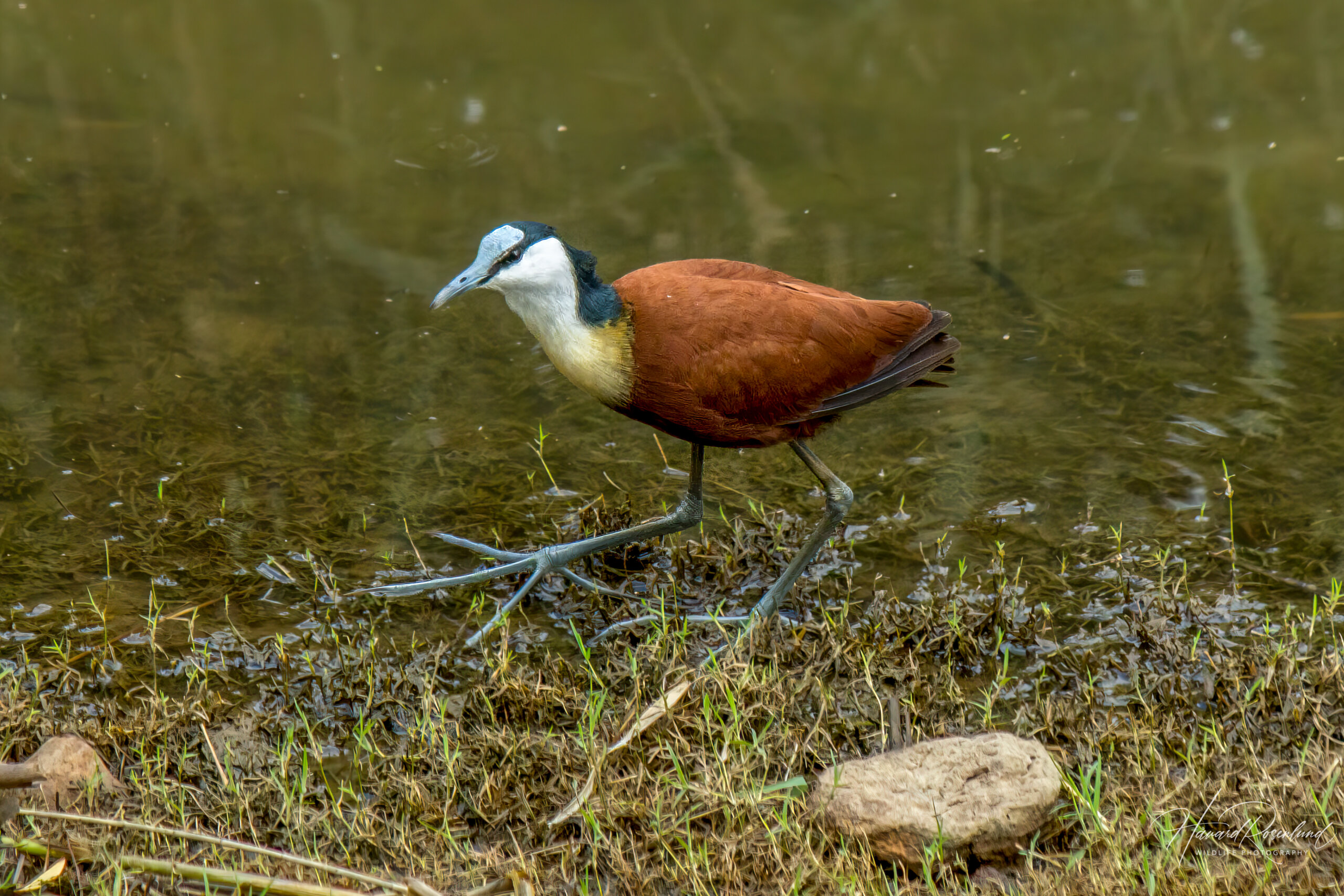
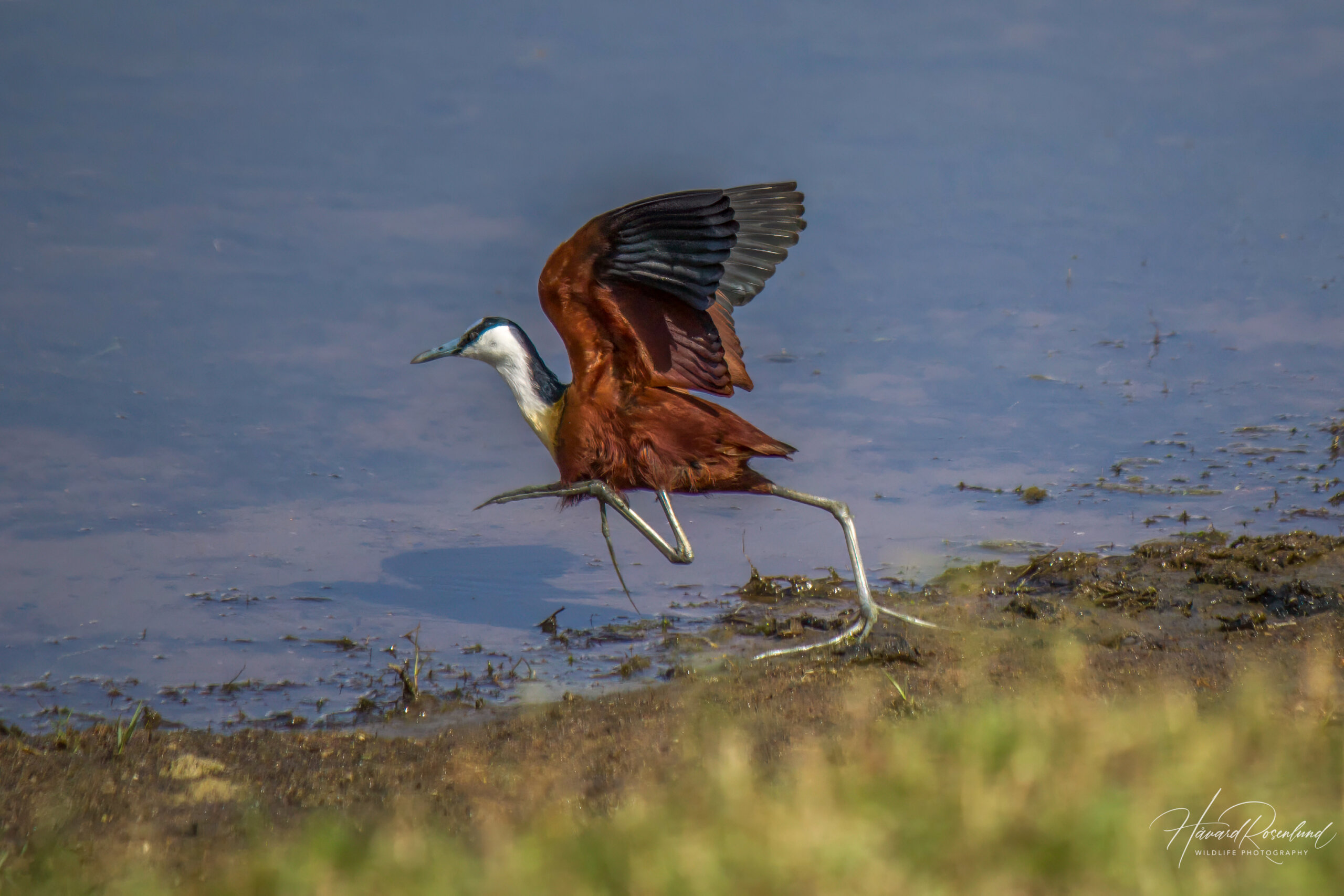
The African jacana (Actophilornis africanus) is a distinctive wetland bird of sub-Saharan Africa. Adults are 23–31 cm long, with chestnut plumage, a black hindneck and eye-stripe, white face and throat, and a blue-grey bill and frontal shield. The species shows reversed sexual size dimorphism, meaning females are larger than males. Females average about 260 g, almost twice the mass of males at about 140 g. Its exceptionally long toes and claws are among its most distinctive features.
Habitat
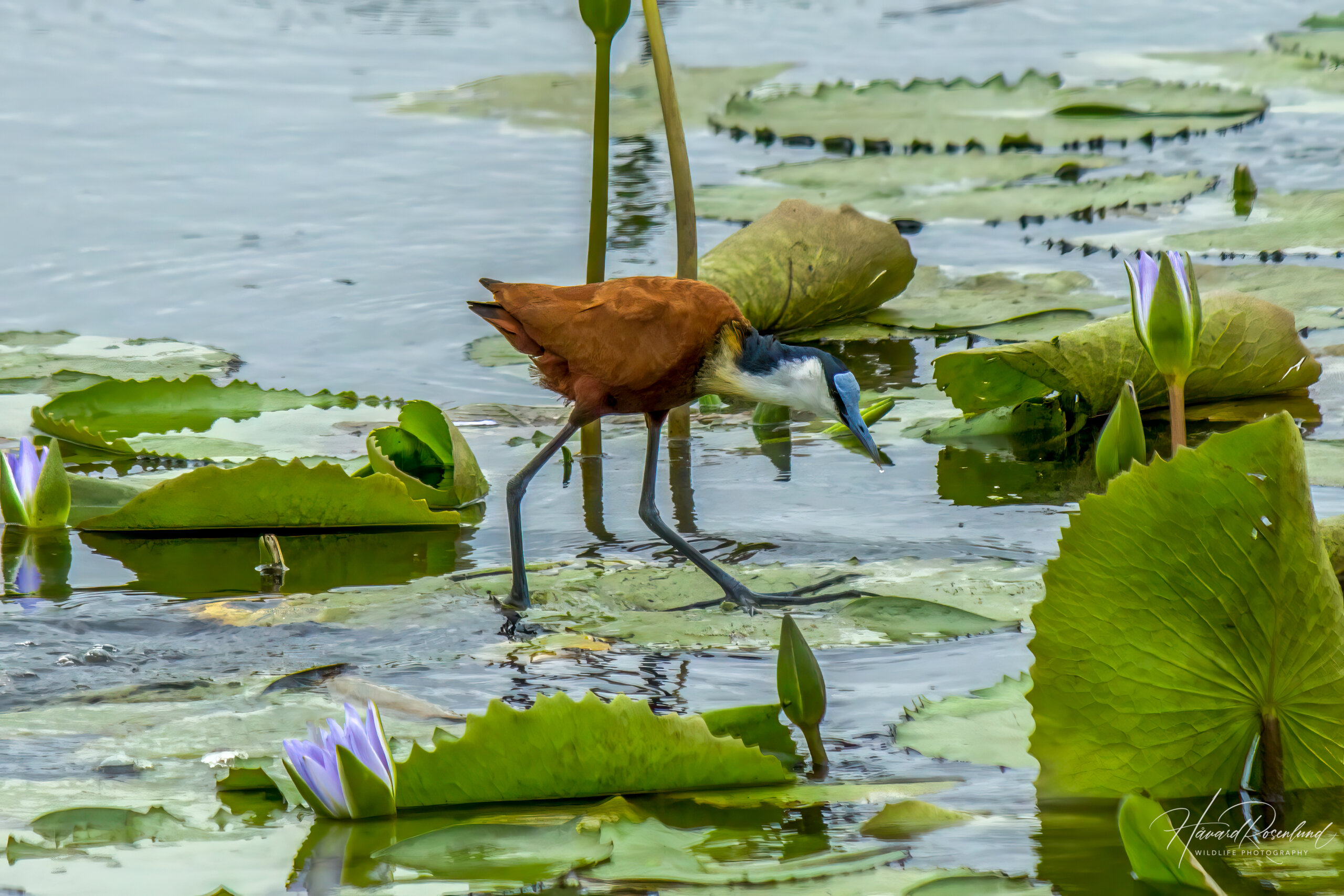
African jacanas live in shallow freshwater wetlands such as lakes, marshes, swamps, pans and slow rivers. Floating and emergent vegetation is essential because it provides feeding surfaces, nest sites and cover.
Local numbers can change quickly with water levels. The species also uses some artificial wetlands, including man-made dams, when suitable floating vegetation develops.
Diet
Insects and other small invertebrates dominate the diet, including spiders, worms, crustaceans and molluscs. Seeds and other plant material are also taken.
Most food is collected while the bird walks across floating vegetation and picks or probes prey from leaves, stems and the water surface.
Behaviour
African jacanas spend much of their time moving over floating vegetation. Their exceptionally long toes and claws spread the bird's weight across leaves and stems, allowing it to walk over surfaces that would sink beneath a more compact foot. This unusual way of moving through the wetland is central to how the species uses its habitat.
Calls and visual displays are also important in social and territorial interactions, especially where several birds occupy the same patch of suitable wetland.
Breeding
The African jacana has reversed sex roles and is polyandrous, meaning one female may mate and breed with several males. A large female may hold a territory that overlaps those of several breeding males and lay a separate clutch for each male. Males also compete with one another over access to breeding opportunities, and the number of males associated with a female varies with factors such as bird density, rainfall, habitat and clutch loss.
The male maintains the floating nest platform and alone incubates the usual clutch of four patterned eggs. Incubation lasts about three weeks. A study published in 1993 found that males adjust incubation to weather conditions, spending longer covering the eggs in cool periods and shading them when it is hot.
The chicks are precocial, meaning they are well developed and mobile when they hatch, and can feed for themselves soon afterwards. They still depend on the male for warmth, guidance and protection. He can gather small chicks beneath his wings and carry them to a safer place when needed.
Status
The African jacana remains classified as Least Concern on the IUCN Red List. The 2024 global assessment estimated about 667,000 mature individuals and considered the overall trend stable.
BirdLife South Africa's 2025 regional assessment also classified the species as Least Concern. Wetland loss, prolonged drying and loss of floating vegetation can reduce local populations, although the species can also make use of some artificial wetlands.
Image gallery
Loading map and observations…
Have you seen this species?
Independent species archive
Did you find this species page useful?
Wildlife Vagabond is independently built and maintained. Voluntary support helps cover hosting, maps, data storage and continued improvements to the species archive.
Support Wildlife VagabondSpecies content will remain freely available.
References
Information about the species’ global distribution and status is based primarily on global Red List data. See the references below for details.
- AviList. (2026). 2026. AviList: The Global Avian Checklist, v2025b. https://www.avilist.org/checklist/v2025b/
- BirdLife International. (2026). IUCN Red List for birds. BirdLife DataZone. https://datazone.birdlife.org
- BirdLife South Africa. (n.d.). 2025. African Jacana. In: Lee ATK, Rose S, Banda S, Bezeng SB, Maphalala MI, Maphisa DH, Smit-Robinson H (eds), The 2025 Red Data Book of Birds of South Africa, Lesotho and Eswatini. BirdLife South Africa. https://www.birdlife.org.za/red-list/african-jacana/
- Bonkewitzz AN. (n.d.). 1997. Behaviour and social organization of the African Jacana Actophilornis africanus. PhD thesis, University of Natal, Pietermaritzburg. https://researchspace.ukzn.ac.za/items/4d10e5ff-6fda-44b2-a4b1-b1112b4925c0
- International Union for Conservation of Nature. (n.d.). 2024. Actophilornis africanus. The IUCN Red List of Threatened Species. https://www.iucnredlist.org/species/22693528/265020215
- Tarboton, W. (1993). Incubation behaviour of the African jacana. South African Journal of Zoology, 28(1), 32-39. https://doi.org/10.1080/02541858.1993.11448285
- Tareloton, W. R. (1995). Polyandry in the African jacana: The roles of male dominance and rate of clutch loss. Ostrich, 66(2-3), 49-60. https://doi.org/10.1080/00306525.1995.9633759