
Little Stint
Calidris minuta
At a glance
Habitat
- Arctic tundra when breeding; mudflats, lagoons, saltpans, shallow wetlands and reservoir edges on migration and in winter
Diet
- Small insects and other invertebrates, including larvae, crustaceans, worms and molluscs
Activity
- Diurnal, with feeding also extending into twilight
Size
- Length: 12–14 cm; wingspan 28–31 cm Weight: 17–44 g
Range
- Breeds in Arctic Eurasia; migrates to Africa, the Middle East and South Asia, with smaller numbers reaching Southeast Asia
Description
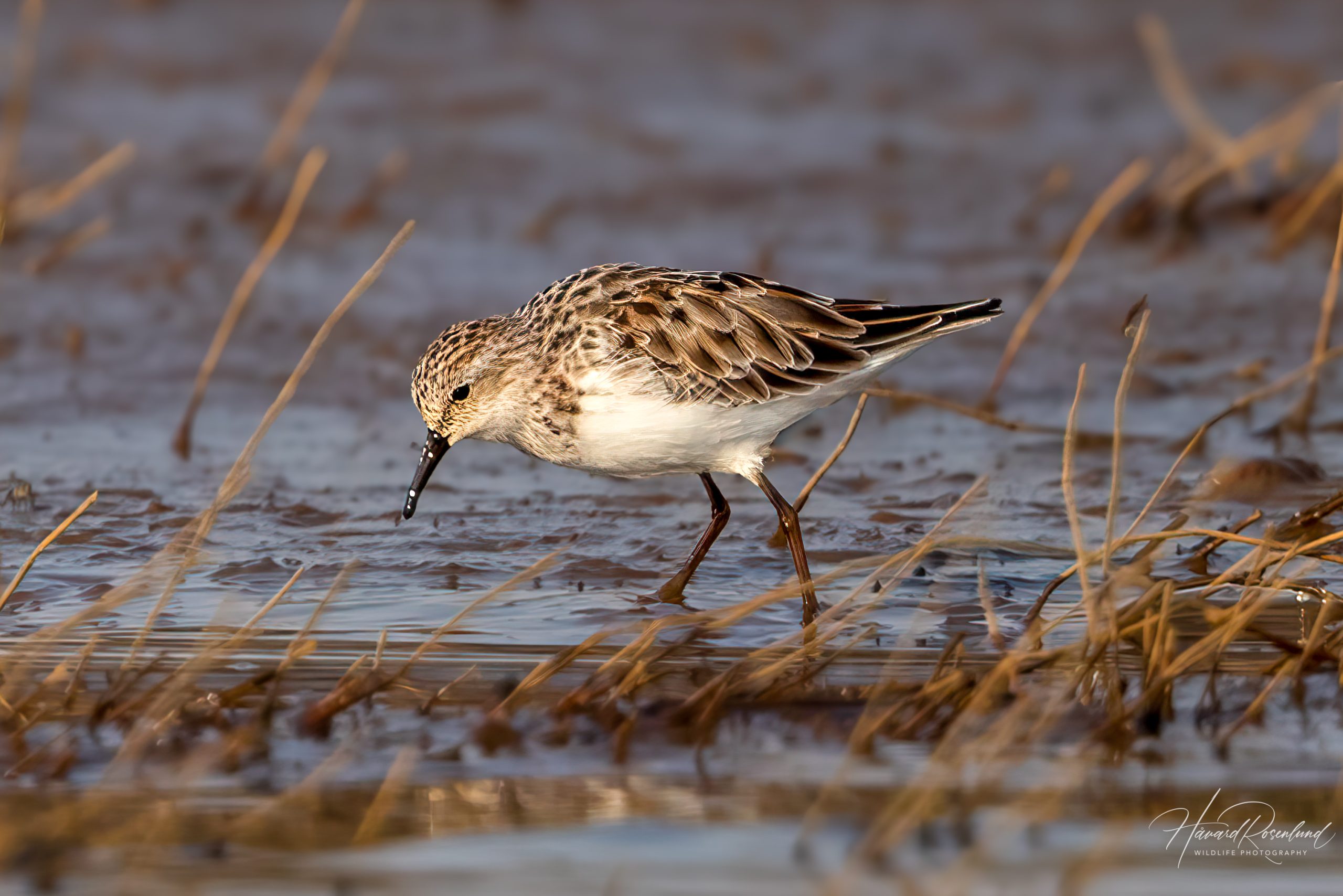
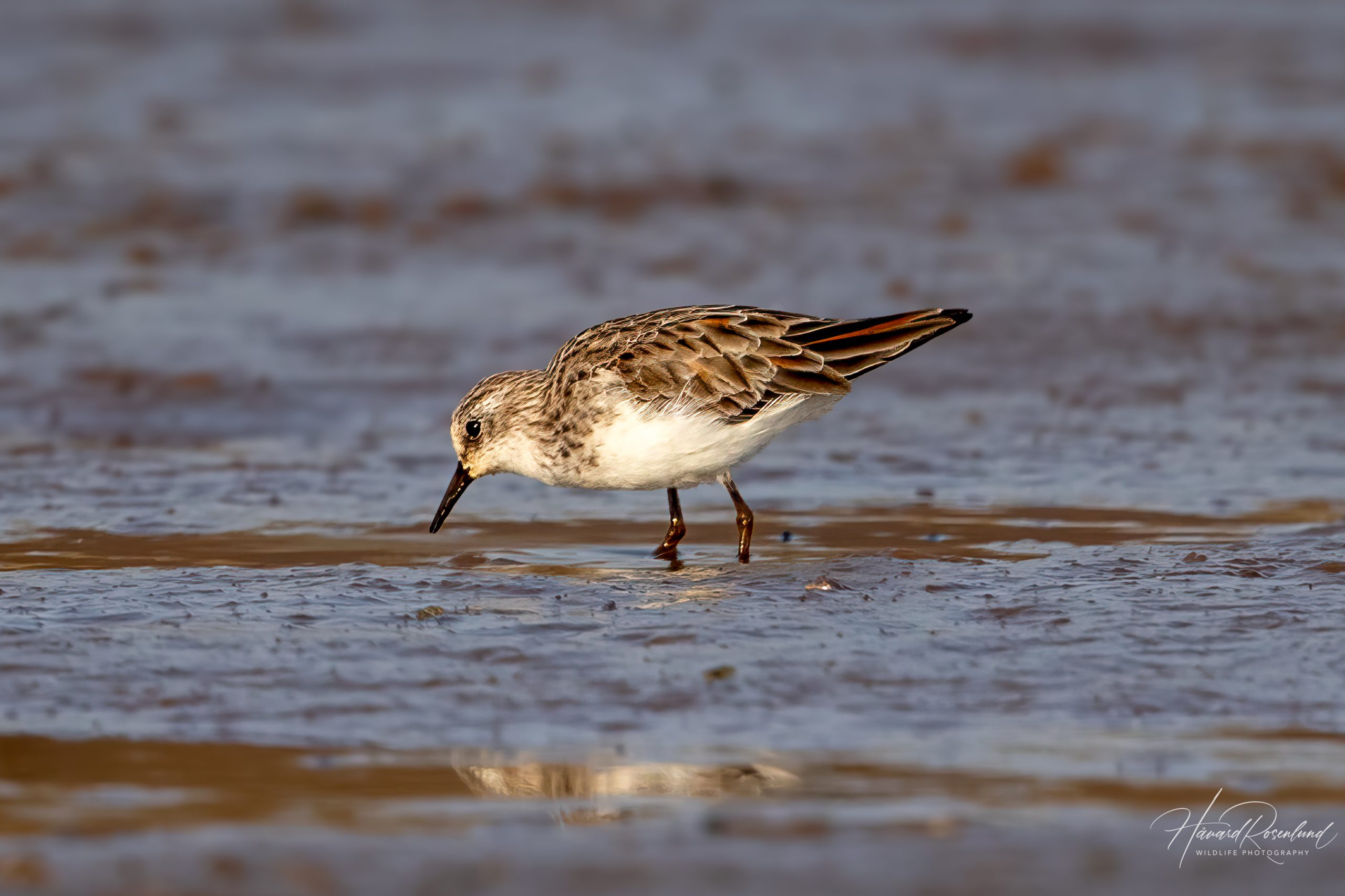
The little stint (Calidris minuta) is one of the smallest sandpipers, measuring about 12–14 cm, with a wingspan of roughly 28–31 cm and a mass that can vary from about 17 to 44 g through the annual cycle. It has a short straight black bill and black legs. Non-breeding birds are pale grey-brown above and white below, while breeding adults develop rich rufous, black and pale patterning across the head and upperparts.
Temminck’s stint (Calidris temminckii) is similar in size, but usually looks plainer and longer-bodied and has yellowish to greenish legs rather than black ones. In flight, Temminck’s stint also shows conspicuous white outer tail feathers, unlike little stint.
Habitat
Little stints breed on Arctic tundra in northern Eurasia, using relatively dry open ground with sparse vegetation close to pools, marshes and other wet feeding areas. The short Arctic summer provides a brief burst of abundant insects needed for breeding.
For most of the year the species uses shallow wetlands farther south: tidal mudflats, estuaries, saltpans, lagoons, flooded fields, lake margins, sewage ponds and reservoir edges. Soft exposed mud and very shallow water are especially important during migration and winter.
Diet
Small invertebrates dominate the diet. On the breeding grounds these are mainly insects and their larvae, while migrating and wintering birds also take small crustaceans, worms, molluscs and other prey from mud and shallow water.
Little stints feed rapidly, picking prey from the surface and probing only shallowly with the short bill. Flocks spread across wet mud or ankle-deep water and may feed alongside other small sandpipers when food is concentrated.
Behaviour
Outside the breeding season, little stints are strongly social and are often seen in compact flocks or mixed groups with other small waders. They are restless, quick-moving birds that repeatedly change direction across mud and shallow water and may continue feeding into twilight when conditions remain favourable.
Flocks also gather at safe resting sites when feeding areas are covered by water or disturbed. The birds are alert and take flight readily when approached, often wheeling together before settling again nearby. On the Arctic breeding grounds the social pattern changes, with adults becoming much more dispersed and territorial around nesting areas.
Migration
Little stint is a long-distance migrant. Birds leave the Eurasian Arctic from mid-summer onward and travel through Europe, the Middle East and Central Asia to major wintering areas in Africa and South Asia. India receives large numbers during the non-breeding season, while smaller numbers continue into Southeast Asia.
Young birds often migrate later than adults. Stopover wetlands are essential because these tiny shorebirds must repeatedly rebuild fat reserves during journeys spanning thousands of kilometres. The same individuals may therefore depend on many separate wetlands between breeding and wintering grounds.
Breeding
Breeding begins during the short Arctic summer, usually in June. A typical clutch contains four camouflaged eggs in a shallow ground scrape. Each clutch is normally incubated by one adult alone for about 20–21 days. The chicks hatch downy and mobile, leave the nest soon afterwards and feed for themselves; they usually become capable of flight after about 15–21 days while the attending adult continues to guard and guide them.
The breeding system is unusual. Females can produce two successive clutches during the same season: the first is usually attended by the male and the second by the female, so each parent may care for a separate clutch and brood alone. A study published in 2009 from the High Arctic found incubation to be the most energetically demanding stage for little stints because a lone parent had far less time available for feeding while keeping the eggs warm than when guarding self-feeding chicks.
Status
The little stint is classified as least concern on the IUCN Red List. It remains widespread across the Palearctic and its African and Asian wintering range, while populations along particular flyways can still decline severely.
State of India’s Birds 2025 classifies the little stint as High Priority nationally. The updated estimates show a long-term decline of about 67.9% and a current annual decline of about 3.6%; both are classified as Rapid Decline. Loss and degradation of mudflats and shallow wetlands, altered water regimes and disturbance at feeding sites can affect the same birds repeatedly along their migration route.
Image gallery
Loading map and observations…
Have you seen this species?
Independent species archive
Did you find this species page useful?
Wildlife Vagabond is independently built and maintained. Voluntary support helps cover hosting, maps, data storage and continued improvements to the species archive.
Support Wildlife VagabondSpecies content will remain freely available.
References
Information about the species’ global distribution and status is based primarily on global Red List data. See the references below for details.
- AviList. (n.d.). v2025 – Global avian checklist. https://www.avilist.org/
- BirdLife International. (2024). Red List update reveals migratory shorebirds are declining globally. https://datazone.birdlife.org/articles/2024-red-list-update-reveals-migratory-shorebirds-are-declining-globally
- BirdLife International. (n.d.). Little Stint (Calidris minuta) species factsheet. https://datazone.birdlife.org/species/factsheet/little-stint-calidris-minuta
- eBird. (n.d.). Little Stint. Cornell Lab of Ornithology. https://ebird.org/species/litsti
- International Union for Conservation of Nature. (n.d.). Little Stint (Calidris minuta). The IUCN Red List of Threatened Species. https://www.iucnredlist.org/species/22693379/138406063
- State of India's Birds. (2025). State of India’s Birds (2025 update) – Little Stint. https://stateofindiasbirds.in/species/litsti/
- Tulp, I., Schekkerman, H., Bruinzeel, L. W., Jukema, J., Visser, G. H., & Piersma, T. (2009). Energetic demands during incubation and chick rearing in a uniparental and a biparental shorebird breeding in the high Arctic. The Auk, 126(1), 155–164. https://doi.org/10.1525/auk.2009.07181
- Tulp, I., Schekkerman, H., Chylarecki, P., Tomkovich, P., Soloviev, M., Bruinzeel, L., Van Dijk, K., Hildén, O., Hötker, H., Kania, W., Van Roomen, M., Sikora, A., & Summers, R. (2002). Body mass patterns of Little Stints at different latitudes during incubation and chick‐rearing. Ibis, 144(1), 122-134. https://doi.org/10.1046/j.0019-1019.2001.00014.x