
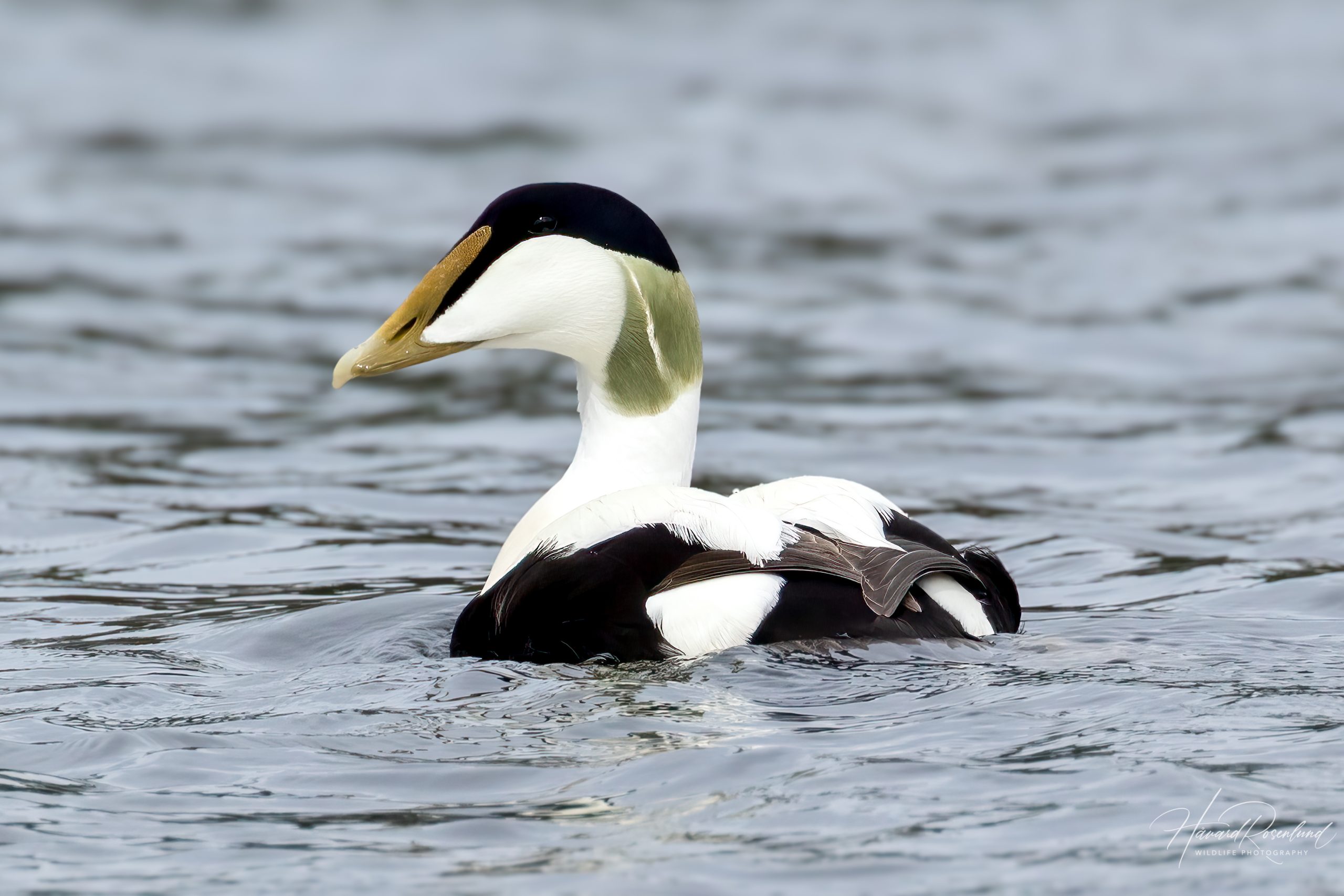
Common Eider
Somateria mollissima
At a glance
Habitat
- Cold coastal waters, rocky shores, islands, shallow bays and reefs; nests close to the sea
Diet
- Mostly bottom-dwelling molluscs, especially mussels, with crustaceans and echinoderms
Activity
- Diurnal; much feeding is by diving in shallow coastal water
Size
- Length: 50–71 cm Weight: about 2.1 kg on average
Range
- Circumpolar northern coasts of Europe, North America and eastern Siberia
Description
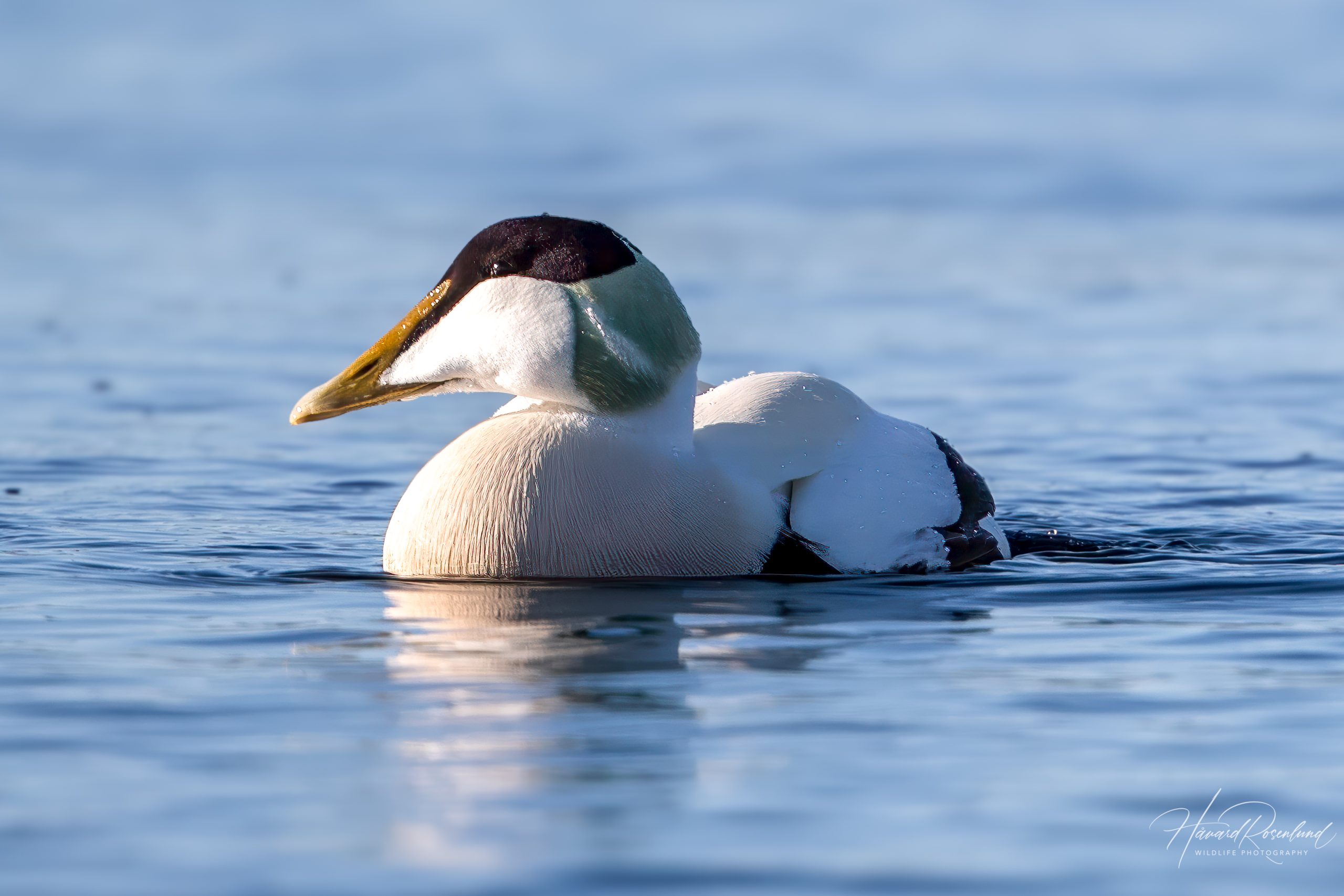
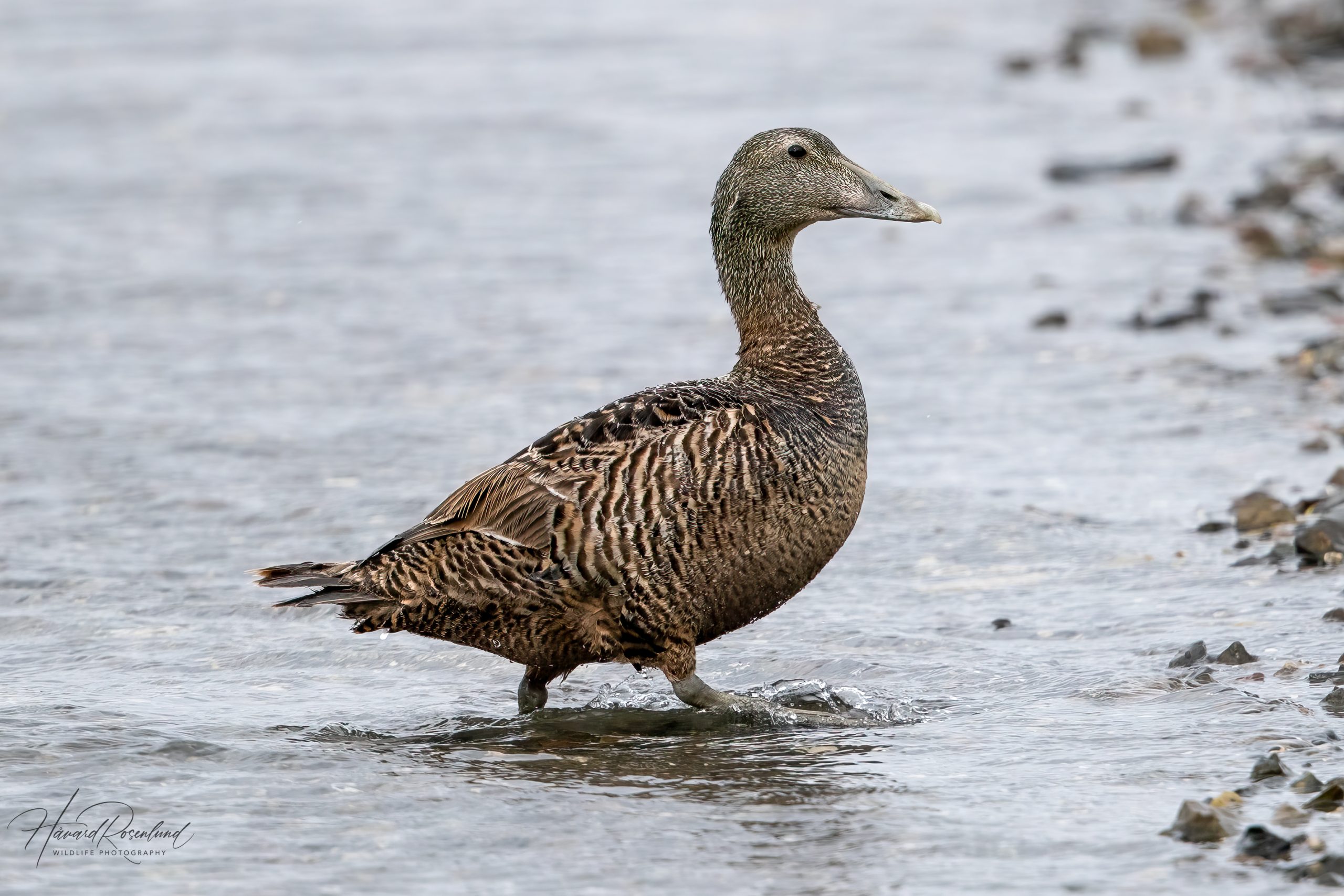
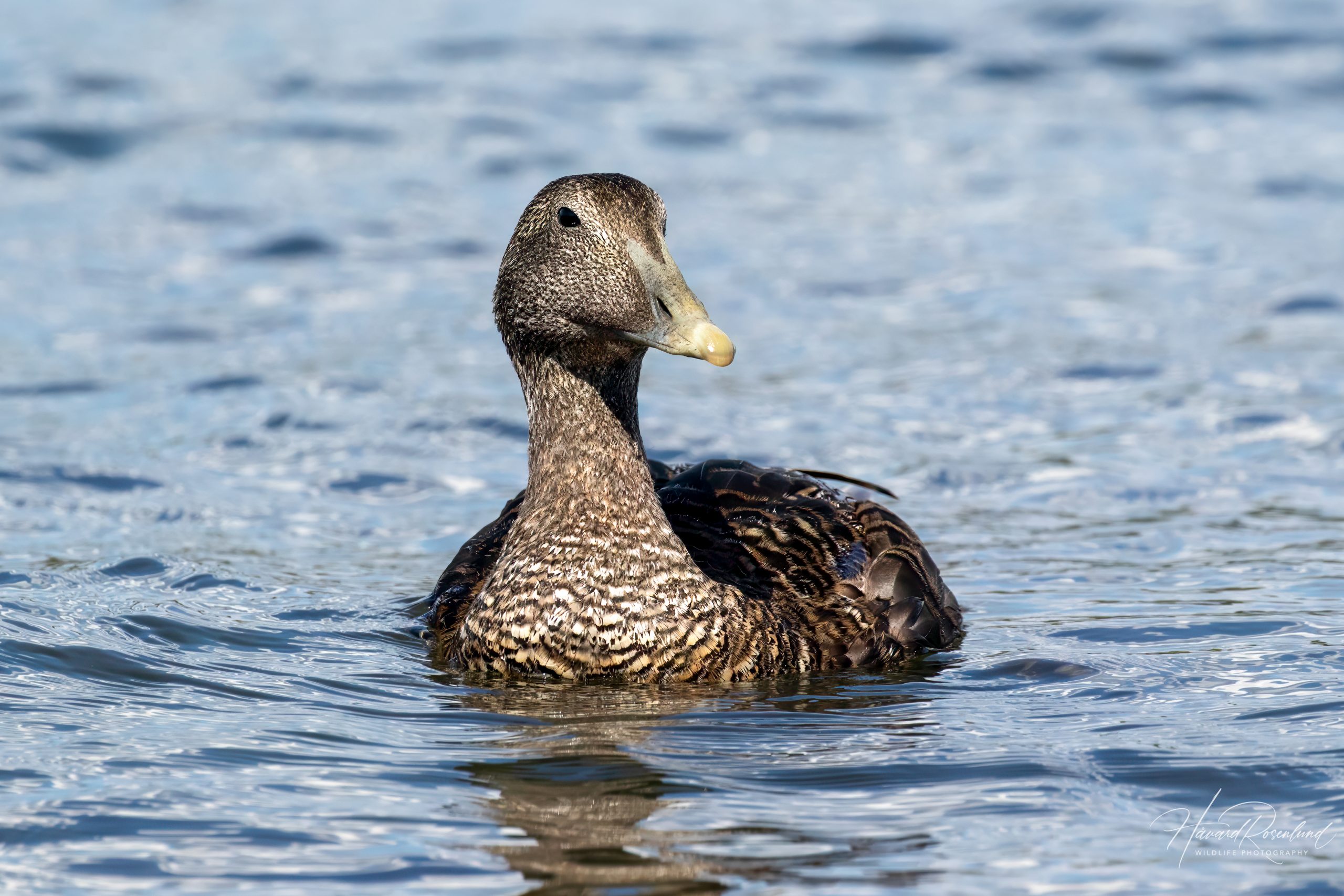
The common eider (Somateria mollissima) is one of the largest sea ducks of the Northern Hemisphere, distributed around cold northern coasts from Europe and eastern Siberia to North America. Adults are roughly 50–71 cm long, have a wingspan of about 80–108 cm and average around 2.1 kg, with males generally larger than females. Breeding males are unmistakable, with a largely white back and breast, black underparts and flanks, a black crown and soft green patches on the nape. Females are heavily barred brown, providing excellent camouflage while nesting.
Both sexes have a distinctive long, wedge-shaped bill that merges smoothly into the sloping forehead. This profile is especially useful when identifying females and immature birds. Female common eiders can be confused with female king eiders (Somateria spectabilis), but king eiders have a rounder head, shorter bill and a more upturned line at the bill base, while common eiders show a longer, more even slope from forehead to bill.
Habitat
Common eiders are strongly marine and favour rocky coasts, islands, shallow bays, reefs and other coastal waters rich in bottom-dwelling invertebrates. Breeding colonies are usually close to productive shallow feeding grounds, often on islands and skerries that also provide some protection from terrestrial predators.
Outside the breeding season, large numbers may gather in sheltered coastal waters with abundant seabed prey and reliable access to ice-free feeding areas. Habitat use varies across the broad circumpolar range, but shallow marine waters remain central throughout most of the year.
Diet
Molluscs dominate the diet, with blue mussels particularly important in many regions. Crustaceans, sea urchins, marine worms and other benthic prey are also taken. Mussels are generally swallowed whole rather than broken open; their shells are crushed later in the powerful muscular gizzard.
Processing large quantities of hard shell requires substantial muscular work. A winter study published in 1998 from the Gulf of St. Lawrence, Canada, showed that eiders had to process much larger quantities of shell in midwinter than in spring, and the data supported a larger gizzard when digestive demand was highest. Eiders can therefore adjust digestive capacity as diet and feeding conditions change.
Foraging
Common eiders obtain most food by diving to the seabed and detaching or collecting prey with the bill. They do not simply take the first item encountered: field studies show prey selection during dives and shifts in which substrates and prey are exploited as profitability changes.
Dive behaviour is equally flexible. Depth, current and the time needed to recover at the surface all affect how long a bird can spend feeding on the bottom. The Gulf of St. Lawrence study found wintering eiders spending about 56% of the day feeding in midwinter, compared with 33% in spring. The proportion of each dive cycle spent underwater versus recovering at the surface, however, remained approximately constant. Short winter days are therefore met mainly by devoting more of the day to feeding and by increasing digestive capacity, rather than by making each dive cycle more efficient.
Migration
Migration varies greatly among populations. Eiders breeding in milder coastal regions often make only short seasonal movements, whereas high-Arctic birds may travel much farther to reach ice-free wintering waters. Large flocks can form during migration, winter and the post-breeding moult.
The species is therefore better described as a partial migrant than as following one uniform route. Access to open, productive water is a major constraint: where shallow feeding grounds remain ice-free, birds may stay far north, while populations exposed to extensive sea ice must move much farther.
Predation
Predation can strongly shape breeding success and even adult survival. Eggs are taken by hooded crows (Corvus corone), large gulls and Arctic foxes (Vulpes lagopus) in different parts of the range, while ducklings are vulnerable to gulls and other coastal predators. A study published in 2013, based on 41 years of Arctic data, showed that fox abundance and the availability of alternative prey could strongly influence nest success. Introduced American mink (Neogale vison) can be an especially severe predator on islands. A long-term study published in 2023 from western Iceland linked mink establishment to a reduction of about 60% in common-eider nest numbers in the Brokey archipelago.
White-tailed eagles (Haliaeetus albicilla) are an especially important predator of incubating females in parts of the Baltic. A study published in 2021, using long-term data from 1978–2016, concluded that eagle predation directly helped regulate the local eider population. Predation risk therefore affects not only eggs and young but also the adult females on which this slow-reproducing species depends.
Breeding
Common eiders often breed colonially on islands, skerries and sheltered coastal ground. The female makes a shallow nest and gradually lines it with the exceptionally soft down plucked from her own breast. A typical clutch contains 4–6 eggs. The female incubates alone for about 25–28 days and feeds very little during this period. A study published in 2003 found females losing roughly 23–36% of their body mass during incubation, which is supported largely by stored body reserves.
The ducklings are precocial, meaning they hatch well developed, leave the nest soon afterwards and begin feeding for themselves under female protection. Brood care is unusually flexible. A study published in 2002 found females in shared brood-rearing groups able to spend more time feeding while collective vigilance was at least 20% higher than among females tending broods alone. A 23-year study published in 2012 found no clear tendency for such shared brood care to be organised among close relatives. The cooperation can therefore provide direct benefits to females rather than being explained only by kinship.
Cultural significance
Eider down has been part of northern coastal culture for centuries because of its exceptional insulating properties. The strongest surviving example is Norway's Vega Archipelago, where fishing and farming communities developed a way of life closely tied to the annual arrival of wild eiders. UNESCO describes a tradition extending back around 1,500 years; by the ninth century, down had become an important source of income in the islands.
The practice also has a distinctive social history. Women played a central role in tending eiders, collecting and cleaning the down and maintaining the knowledge associated with the tradition. This long relationship between people, birds and coastal landscape is one of the main reasons Vegaøyan is recognised as a UNESCO World Heritage cultural landscape.
Relationship with humans
Eider down is unusual as a traditional animal resource because it is collected from wild birds without keeping them in captivity. The female lines the nest with down from her own breast, and people gather this material only after she has left with the ducklings. The same nesting areas can therefore be used repeatedly while the birds remain fully wild.
This relationship continues on several Norwegian islands, although on a smaller scale than in the past. It represents a rare form of long-term coexistence in which people have received a valuable resource from wild birds while becoming closely familiar with their breeding cycle and behaviour.
Status
The common eider is classified as near threatened on the IUCN Red List. At European level, the species is assessed as endangered in the European Red List of Birds 2021 following extensive population declines.
Population trends differ sharply among regions and populations. Some colonies remain locally numerous, while others have declined substantially.
Threats
Threats vary among populations and act at several stages of the annual cycle. Important pressures include disease outbreaks, oil pollution, drowning in fishing gear, hunting, disturbance of breeding colonies and changes in the abundance or quality of shellfish prey.
Because eiders often gather in dense breeding colonies, moulting groups and winter flocks, episodic events such as avian-influenza outbreaks or oil spills can affect many birds at once. Longer-term changes in coastal food webs and climate may alter the shallow marine habitats on which the species depends.
Conservation
Conservation therefore requires action both at breeding colonies and across the wider marine landscape. Important measures include protecting key nesting islands and shallow feeding areas, limiting disturbance during incubation and brood rearing, reducing accidental mortality in fishing gear and oil pollution, and maintaining monitoring that can detect changes in survival, breeding success and food availability.
Traditional eider tending can also function as a local conservation measure where people prepare sheltered nesting places and protect breeding birds from disturbance and predators. AEWA published an international action plan in 2022 for the period 2023–2032 covering, among others, the Norway–Russia and Svalbard–Franz Josef Land populations. Broader recovery still depends on safe and productive marine feeding and wintering areas.
Image gallery
Loading map and observations…
Have you seen this species?
Independent species archive
Did you find this species page useful?
Wildlife Vagabond is independently built and maintained. Voluntary support helps cover hosting, maps, data storage and continued improvements to the species archive.
Support Wildlife VagabondSpecies content will remain freely available.
References
Information about the species’ global distribution and status is based primarily on global Red List data. See the references below for details.
- Agreement on the Conservation of African-Eurasian Migratory Waterbirds. (n.d.). AEWA – International Single Species Action Plan for the Conservation of the Common Eider. https://www.unep-aewa.org/publication/international-single-species-action-plan-conservation-common-eider
- Beauchamp, G., Guillemette, M., & Ydenberg, R. (1992). Prey selection while diving by common eiders, Somateria mollissima. Animal Behaviour, 44, 417-426. https://doi.org/10.1016/0003-3472(92)90052-B
- BirdLife International. (n.d.). Common Eider species factsheet. https://datazone.birdlife.org/species/factsheet/common-eider-somateria-mollissima
- British Trust for Ornithology. (n.d.). Eider BirdFacts. https://www.bto.org/learn/about-birds/birdfacts/eider
- Cornell Lab of Ornithology. (n.d.). Common Eider life history. https://www.allaboutbirds.org/guide/Common_Eider/lifehistory
- Erikstad, K. E., & Tveraa, T. (1995). Does the cost of incubation set limits to clutch size in common eiders Somateria mollissima? Oecologia, 103(3), 270-274. https://doi.org/10.1007/BF00328614
- European Environment Agency. (n.d.). Common Eider conservation status. EUNIS. https://eunis.eea.europa.eu/species/1273
- Guillemette, M. (1998). The effect of time and digestion constraints in Common Eiders while feeding and diving over Blue Mussel beds. Functional Ecology, 12(1), 123-131. https://doi.org/10.1046/j.1365-2435.1998.00164.x
- Heath, J. P., Gilchrist, H. G., & Ydenberg, R. C. (2007). Can dive cycle models predict patterns of foraging behaviour? Diving by common eiders in an Arctic polynya. Animal Behaviour, 73(5), 877-884. https://doi.org/10.1016/j.anbehav.2006.10.015
- International Union for Conservation of Nature. (n.d.). Common Eider. The IUCN Red List of Threatened Species. https://www.iucnredlist.org/species/22680405/132525971
- UNESCO World Heritage Centre. (n.d.). Vegaøyan – The Vega Archipelago. https://whc.unesco.org/en/list/1143/
- Öst, M., Mantila, L., & Kilpi, M. (2002). Shared care provides time-budgeting advantages for female eiders. Animal Behaviour, 64(2), 223-231. https://doi.org/10.1006/anbe.2002.3064
- Öst, M., Vitikainen, E., Waldeck, P., Sundström, L., Lindström, K., Hollmén, T., Franson, J. C., & Kilpi, M. (2005). Eider females form non‐kin brood‐rearing coalitions. Molecular Ecology, 14(12), 3903-3908. https://doi.org/10.1111/j.1365-294X.2005.02694.x