
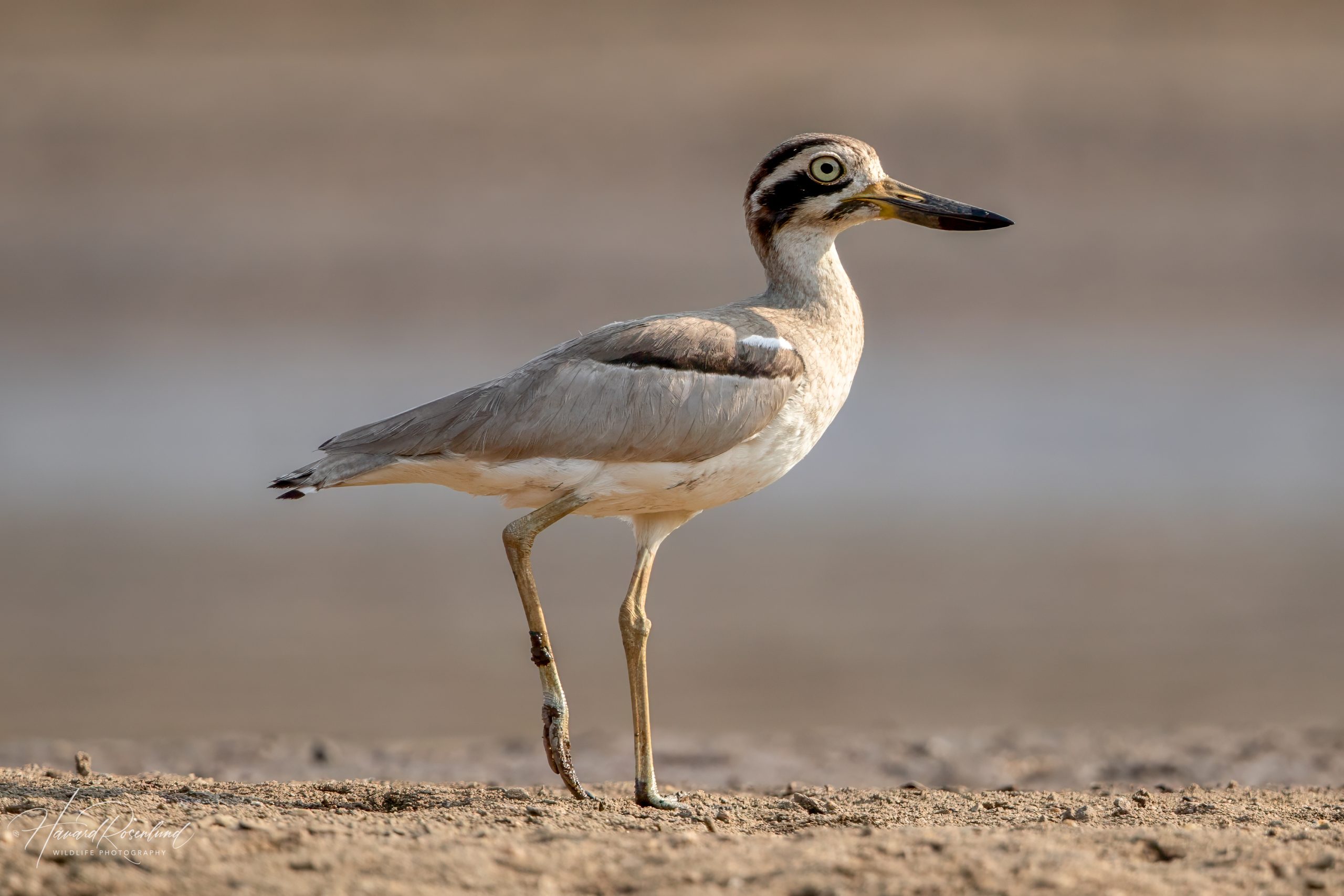
Great Thick-knee
Esacus recurvirostris
At a glance
Habitat
- Large rivers and lakes with open sand, gravel, shingle banks and islands
Diet
- Crustaceans, molluscs, insects, worms, small fish and other aquatic prey
Activity
- Mostly crepuscular and nocturnal; also active by day
Size
- Length: 49–54 cm Weight: about 700–800 g
Range
- South Asia east through mainland Southeast Asia
Description
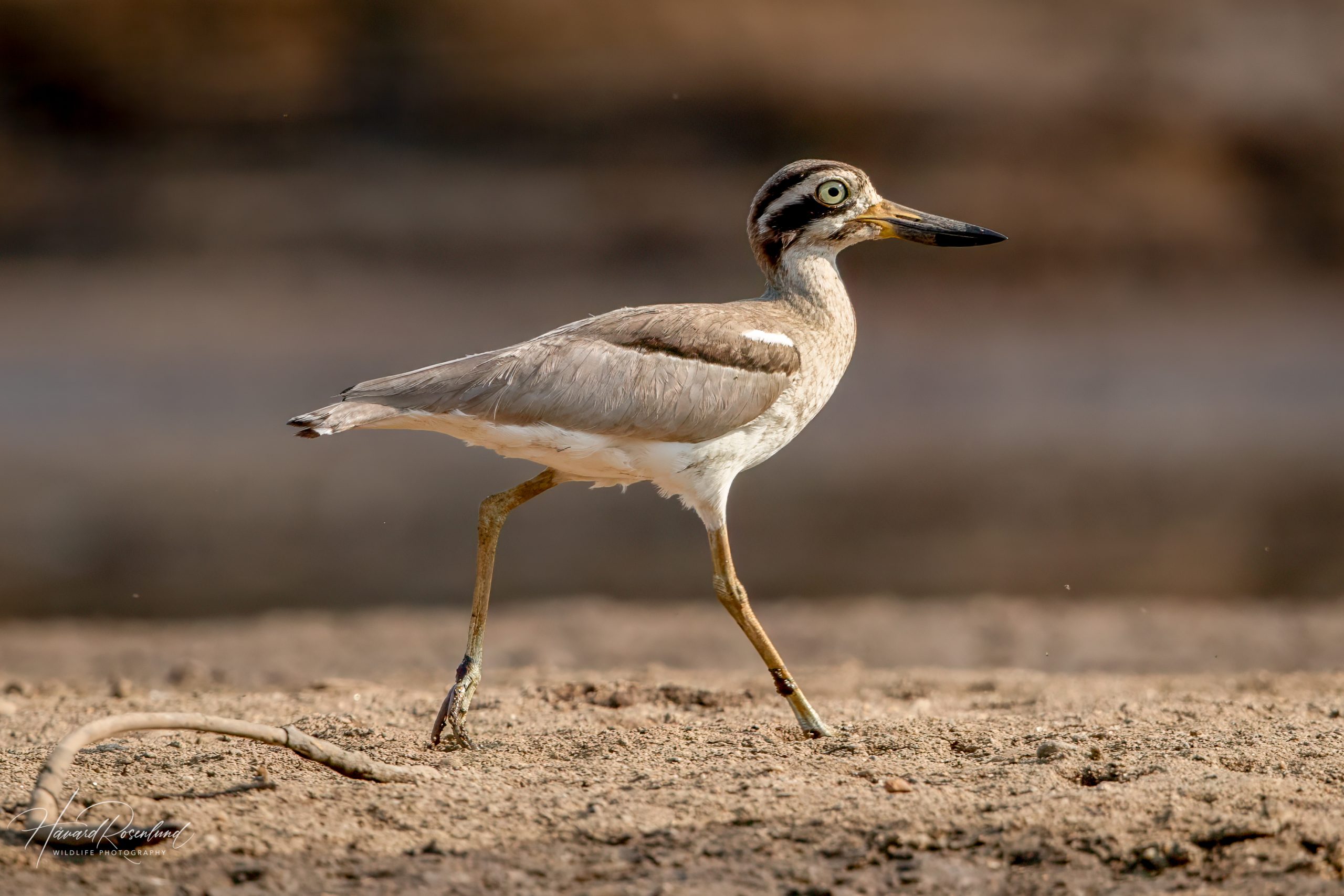
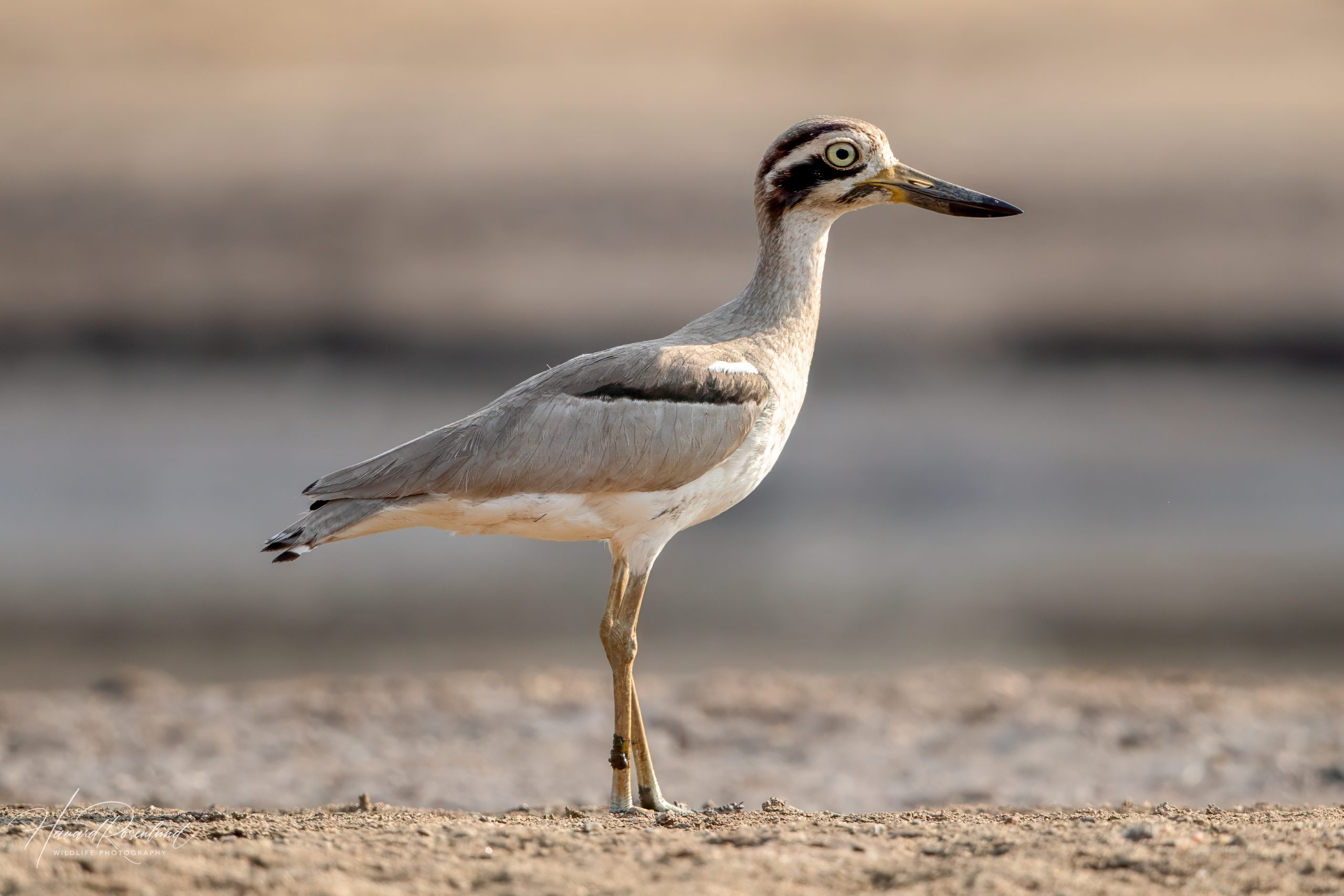
The great thick-knee (Esacus recurvirostris) is one of the largest members of the thick-knee family, measuring about 49–54 cm, with a wingspan of roughly 90–100 cm and a weight of about 700–800 g. It has a large head, striking yellow eyes and an exceptionally heavy yellow-and-black bill whose tip curves slightly upward. The upperparts are sandy grey-brown, the underparts are white, and bold black-and-white markings cross the face and wings.
The closely related beach thick-knee (Esacus magnirostris) is larger and more heavily billed and is primarily a coastal bird. Great thick-knees are much more strongly associated with large inland rivers and lakes, although they also occur locally in estuaries and other coastal wetlands.
Habitat
Great thick-knees depend strongly on broad rivers, reservoirs and large lakes with open sand, gravel, shingle or rocky margins. Exposed bars and islands provide resting and breeding sites, while shallow water and wet edges supply food.
These habitats are naturally dynamic. Seasonal falls in water level expose feeding and nesting ground, whereas sudden releases of water or flooding can submerge nests. The species can also use estuaries, mudflats and occasionally agricultural wetlands, but open undisturbed riverbanks remain especially important across much of the range.
Diet
The large bill is used to take comparatively substantial prey. Crabs and other crustaceans, molluscs, large insects, worms, small fish and other aquatic animals are eaten along shorelines and in shallow water.
Birds usually walk slowly while scanning the ground and water, then seize exposed prey or probe among stones, sand and soft sediment. Much feeding takes place from dusk into the night, when many invertebrates become more active.
Behaviour
Great thick-knees are usually encountered alone or in pairs, although small groups can form at good feeding or resting sites. They often spend the brighter part of the day resting quietly on exposed banks, where the sandy plumage blends well with stones and dry sediment.
Activity increases around dusk and at night, but birds may also feed or move by day. Their loud, carrying calls are particularly conspicuous after dark, and birds may remain remarkably still when resting before moving off rapidly if disturbance becomes too close.
Breeding
Breeding is closely linked to low water levels that expose dry riverbanks, gravel bars and reservoir margins. In India it is recorded mainly from February to July, with regional timing depending on rainfall and river conditions. Breeding pairs become territorial around suitable nesting stretches. The nest is little more than a shallow scrape on bare sand, gravel or stones, and the clutch usually contains one or two well-camouflaged eggs.
Both parents incubate and guard the nesting area and may confront or distract intruders approaching the eggs or chicks. A study published in 2025 at a freshwater reservoir near Wankaner in Gujarat recorded an incubation period of about 28 days and fledging at around 40 days. The chicks hatch well developed and mobile, leave the scrape soon after hatching and remain protected by both adults.
Status
The great thick-knee is classified as near threatened on the IUCN Red List, with a decreasing global population trend. A reliable range-wide population estimate is not available.
State of India's Birds classifies the species as High Priority nationally. Both its long-term and recent Indian trend categories are Rapid Decline. Its dependence on exposed river margins makes the species especially sensitive to changes in large river systems.
Threats
River regulation is a major threat. Dams and water releases can alter the seasonal pattern that creates exposed nesting bars or flood nests during incubation. Sand and gravel extraction, conversion of shorelines, pollution and increasing human activity further reduce suitable habitat.
Ground nests are also vulnerable to trampling by livestock and people, disturbance from boats and recreation, free-ranging dogs and other predators. Because suitable bars are often narrow and temporary, repeated disturbance at a relatively small number of breeding sites can affect many pairs.
Conservation
The species depends on river systems that continue to create and expose sand and gravel bars through natural changes in water level. A National Mission for Clean Ganga programme includes the great thick-knee among the sandbar-nesting birds associated with the endangered Indian skimmer (Rynchops albicollis) and covers important stretches of the Ganga basin, including the Chambal, Upper Ganga, the Ganga–Yamuna confluence and the lower Ganga.
The programme monitors breeding sites and uses trained local Nest Guardians and River Watchers to protect nests. It also addresses sand mining, livestock movement, human disturbance and sudden water-level changes and works with water-resource authorities where river management affects breeding habitat.
Image gallery
Loading map and observations…
Have you seen this species?
Independent species archive
Did you find this species page useful?
Wildlife Vagabond is independently built and maintained. Voluntary support helps cover hosting, maps, data storage and continued improvements to the species archive.
Support Wildlife VagabondSpecies content will remain freely available.
References
Information about the species’ global distribution and status is based primarily on global Red List data. See the references below for details.
- AviList. (n.d.). v2025 – Global avian checklist. https://www.avilist.org/
- Bhatiya, R. & Raval, V. (2025). Breeding Biology of Great Thick-knee (Esacus recurvirostris) in Fresh Water Reservoir near Wankaner of Morbi District, Gujarat. https://journals.stmjournals.com/rrjobt/article%3D2025/view%3D196666/
- BirdLife International. (n.d.). Great Thick-knee (Esacus recurvirostris) species factsheet. https://datazone.birdlife.org/species/factsheet/great-thick-knee-esacus-recurvirostris
- eBird. (n.d.). Great Thick-knee. Cornell Lab of Ornithology. https://ebird.org/species/grtthi1
- International Union for Conservation of Nature. (n.d.). Great Thick-knee (Esacus recurvirostris). The IUCN Red List of Threatened Species. https://www.iucnredlist.org/species/22693604/118013237
- National Mission for Clean Ganga. (n.d.). Safeguarding Breeding Habitats of Indian Skimmer and Sympatric Sandbar-Nesting Birds in the Ganga Basin. https://www.nmcg.nic.in/conservation_aquatic_birds.aspx
- State of India's Birds. (n.d.). State of India’s Birds (2023/2025) – national trends and conservation assessment. https://stateofindiasbirds.in/