
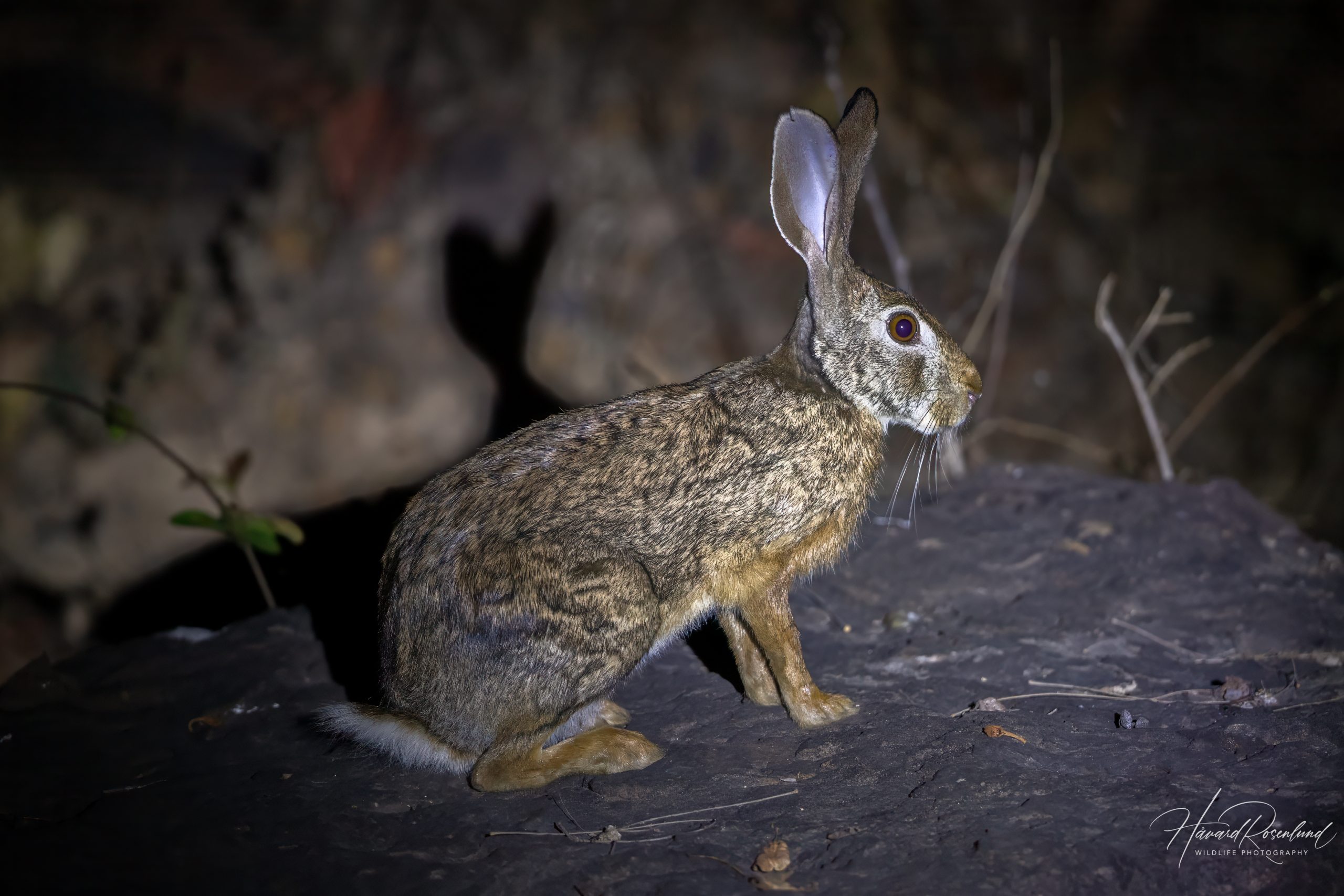
Indian Hare
Lepus nigricollis
At a glance
Habitat
- Open grassland, scrub, dry woodland edges and agricultural mosaics with enough cover for daytime resting
Diet
- Grasses, herbs and other plant material, with browsing and cultivated plants used when available
Activity
- Mainly crepuscular and nocturnal
Size
- Length: 33–53 cm head-body length Weight: about 1.8–3.6 kg
Range
- Indian subcontinent and Sri Lanka; also Java, with introduced populations on several Indian Ocean islands
Description
The Indian hare (Lepus nigricollis), also known as the black-naped hare, is a medium-sized hare of the Indian subcontinent and Sri Lanka. Adults typically have a head-body length of about 33–53 cm and weigh roughly 1.8–3.6 kg. The coat is brown to grey-brown with paler underparts, long ears and powerful hind legs. A dark band across the nape is often conspicuous and gives rise to the alternative English name.
The species is widespread across Pakistan, India, Nepal, Bhutan, Bangladesh and Sri Lanka. The origin of the Java population remains uncertain: current mammal databases flag a possible introduction while also noting that the population has been considered native. Several island populations elsewhere in the Indian Ocean are known introductions.
Habitat
Indian hares use a wide range of open and semi-open habitats, including grassland, scrub, dry deciduous forest edges, fallow ground and agricultural landscapes. They favour areas that combine feeding sites with patches of grass, shrubs or other cover where they can remain concealed during inactive periods.
This flexibility allows the species to persist in many agricultural landscapes, but open ground alone is not enough. Heavy removal of scrub, field-edge vegetation and tall grass can reduce the cover needed for daytime resting and predator avoidance even when grazing habitat remains.
Diet
Indian hares are herbivores. They feed mainly on grasses, herbs and other low vegetation, but may also browse leaves, shoots, bark and cultivated plants depending on local availability. Their diet therefore changes with season, rainfall and habitat.
Feeding is concentrated mainly from dusk through the night and around dawn. During hotter parts of the day the animals usually remain concealed in a shallow depression, known as a form, beneath grass, shrubs or other cover.
Behaviour
Indian hares are mainly crepuscular and nocturnal and are usually encountered alone. Adults do not dig permanent burrow systems like many rabbits, instead resting above ground in shallow forms hidden by vegetation. Stable social groups are not characteristic of the species.
Predation
Indian hares form part of the prey base for several carnivores, including dholes (Cuon alpinus) and leopards (Panthera pardus). A DNA metabarcoding study published in 2026 analysed 169 genetically confirmed dhole scats from Tadoba Andhari Tiger Reserve in Central India. Black-naped hare occurred in 30.8% of samples, making it the fourth most frequently detected vertebrate prey after chital, sambar and barking deer. The result shows that a relatively small hare can be a regular component of the diet of a pack-hunting carnivore dominated by larger ungulate prey.
The hare’s main defences are early detection and rapid escape. It often remains motionless while danger is distant, relying on camouflage, then accelerates sharply and changes direction repeatedly if forced to run. Long ears provide acute hearing and the laterally placed eyes give a broad field of view.
Reproduction
Breeding biology varies geographically. A classic study of the desert form L. n. dayanus in north-western India found reproductive activity through much of the year, with strong seasonal variation. Gestation lasted about 41–47 days, and litters in that desert population ranged from one to several young, illustrating how strongly reproduction can vary with local conditions.
As in other hares, the young are born well furred, with their eyes open, and are mobile soon after birth. The female hides the leverets separately in vegetation and returns to nurse them rather than remaining continuously at a nest. This strategy differs markedly from rabbits, whose young are generally born much less developed.
Introduced populations
Indian hares have been introduced to several islands in the Indian Ocean, including Mauritius, Réunion and islands in the Seychelles, often in connection with hunting or deliberate releases.
Introductions can have ecological consequences in island ecosystems. A study published in 1992 on Cousin Island in the Seychelles found that introduced black-naped hares consumed at least 24 of the 130 plant species recorded on the island. Browsing could also inhibit regeneration of Casuarina equisetifolia, an important foraging tree for several rare endemic landbirds and a nesting tree for some seabirds.
Status
The Indian hare is classified as least concern on the IUCN Red List and is likewise treated as Least Concern by the Mammal Diversity Database. It has a broad range, occurs in many habitat types and can persist in modified agricultural landscapes.
Local populations may nevertheless be reduced by intensive hunting and trapping, conversion of grassland and scrub, and increasing fragmentation. Such declines can occur where both food and protective cover are heavily reduced even though the species remains widespread overall.
Image gallery
Loading map and observations…
Have you seen this species?
Independent species archive
Did you find this species page useful?
Wildlife Vagabond is independently built and maintained. Voluntary support helps cover hosting, maps, data storage and continued improvements to the species archive.
Support Wildlife VagabondSpecies content will remain freely available.
References
Information about the species’ global distribution and status is based primarily on global Red List data. See the references below for details.
- Animal Diversity Web. (n.d.). Lepus nigricollis. https://animaldiversity.org/accounts/Lepus_nigricollis/
- India Biodiversity Portal. (n.d.). Lepus nigricollis. https://www.indiabiodiversity.org/species/show/238503
- International Union for Conservation of Nature. (n.d.). Indian Hare. The IUCN Red List of Threatened Species. https://www.iucnredlist.org/species/41282/45188041
- Kirk & Racey. (1992). Effects of introduced black-naped hare on Cousin Island vegetation. https://www.sciencedirect.com/science/article/abs/pii/0006320792911137
- Mammal Diversity Database. (n.d.). Lepus nigricollis. American Society of Mammalogists. https://www.mammaldiversity.org/taxon/1001098/
- Prakash, I., & Taneja, G. C. (1969). Reproduction biology of the Indian desert hare, Lepus nigricollis dayanus Blanford. Mammalia, 33(1). https://doi.org/10.1515/mamm.1969.33.1.102
- Tyagi, A., M., A., Hushangabadkar, P., Kale, N., Ramgaokar, J., & Ramakrishnan, U. (2026). Minimal Sample, Maximum Insight: DNA Metabarcoding Uncovers the Diet of Endangered Dholes in Central India. Environmental DNA, 8(3), e70306. https://doi.org/10.1002/edn3.70306