
Indian Thick-knee
Burhinus indicus
At a glance
Habitat
- Dry grassland, open scrub, sparse dry woodland, river margins, fallow ground and some cultivated or urban mosaics
Diet
- Mostly insects and other small invertebrates, with small vertebrates and occasional plant food
Activity
- Mostly crepuscular and nocturnal; commonly rests motionless in shade by day
Size
- Length: ~40–45 cm Weight: —
Range
- Indian subcontinent east through Myanmar and parts of mainland Southeast Asia
Description
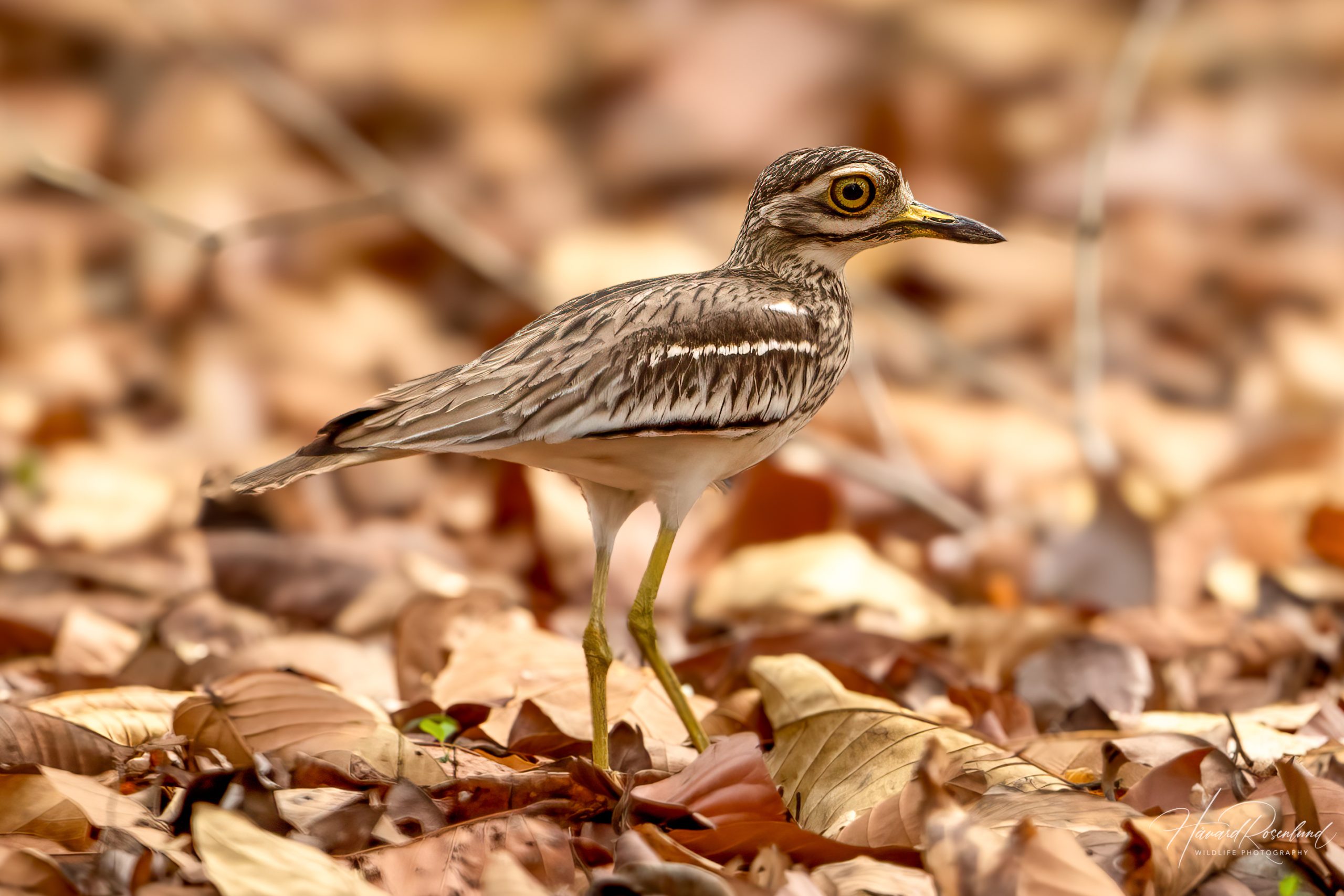
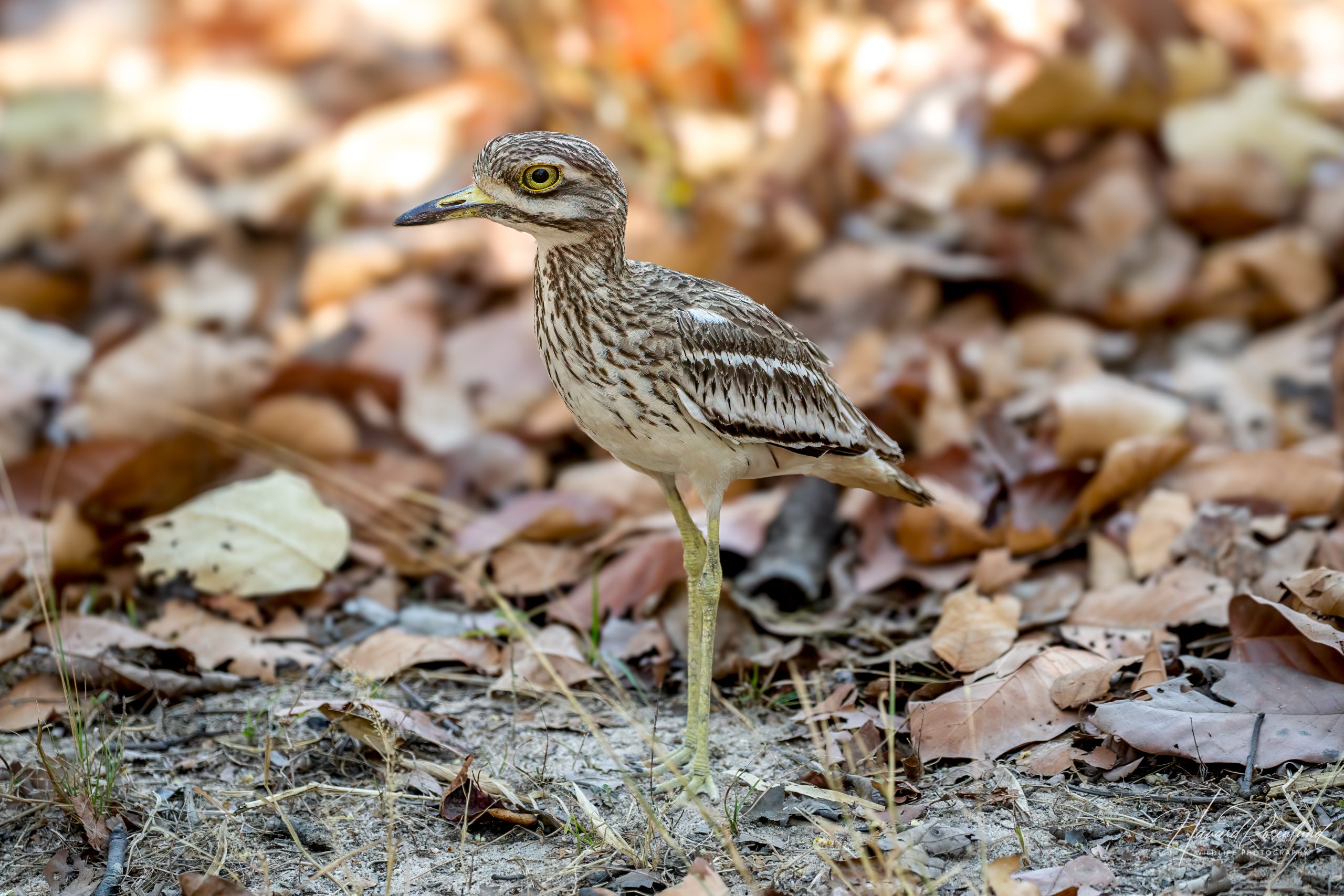
The Indian thick-knee (Burhinus indicus), also called the Indian stone-curlew, is a cryptically coloured ground bird distributed across the Indian subcontinent and into mainland Southeast Asia. Its sandy-brown plumage is heavily streaked and blends closely with dry soil, leaf litter and stones. The very large pale-yellow eyes are well adapted to low light. The legs are stout and yellowish, and the strong bill has a yellow base and black tip.
Adults are about 40–45 cm long. In flight they reveal bold black-and-white wing markings that are much less obvious when the wings are folded. The similar Eurasian stone-curlew (Burhinus oedicnemus) occurs farther west and differs in details of plumage, wing pattern and structure; the Indian thick-knee was historically sometimes treated within that wider species complex but is now recognised as a distinct species.
Habitat
Indian thick-knees favour open, dry and sparsely vegetated ground where their plumage provides effective camouflage. Typical habitats include dry grassland, thorn and scrub, open dry woodland, stony ground, dry river margins, fallow fields and other areas with patches of bare soil. They can also persist in modified landscapes where enough quiet open ground and daytime cover remain.
A study published in 2015 from Haryana found nests on well-drained clay, gravel and sandy ground, while a 2024 report of nesting in Raimona National Park in Assam described a breeding site beside a river and grassland. These records illustrate that the species is not tied to one vegetation type; exposed ground for nesting and nearby cover for resting and feeding appear more important than a particular plant community.
Diet
The diet is predominantly animal-based. Beetles, grasshoppers, termites, worms and other invertebrates form important prey, together with small reptiles, amphibians and other small animals when available. Seeds and other plant material are taken occasionally rather than forming the core of the diet.
Behaviour
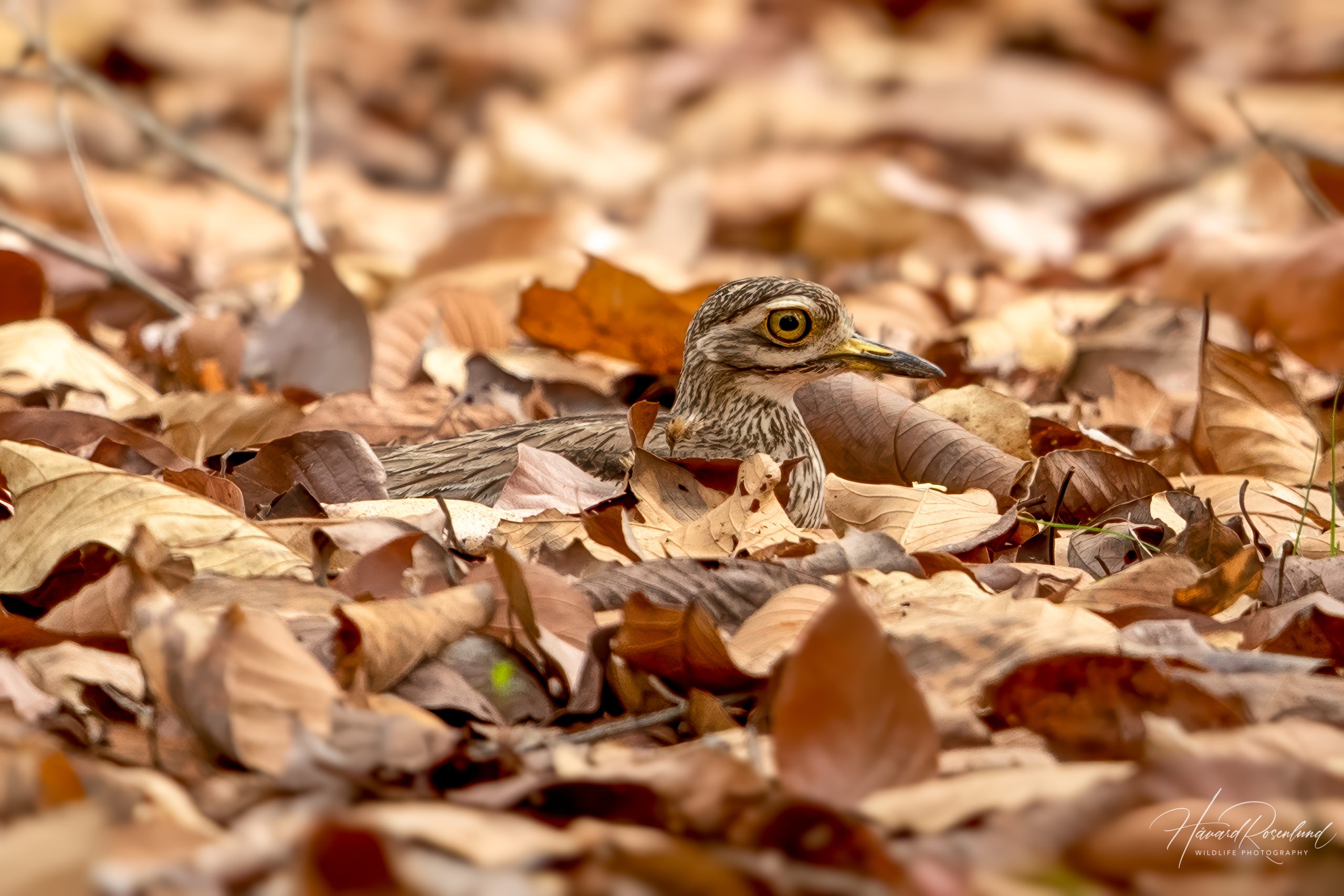
The Indian thick-knee is crepuscular, with much of its activity concentrated around dusk, and it remains active into the night. During daylight it often crouches motionless beneath bushes or among stones and dry vegetation, relying on camouflage rather than flight when first disturbed. After sunset it becomes much more conspicuous through movement and loud whistling calls.
Most feeding occurs on the ground. Birds walk deliberately through open habitat, pause to detect movement and seize prey with short rapid lunges. Large eyes help them hunt in low light, allowing the species to forage after dusk when many insects and other small prey become active.
Pairs may remain close together, while small groups can occur outside the nesting period. When alarmed, birds may flatten the body against the ground and stretch the neck, making the streaked plumage merge with the surroundings. This combination of stillness, camouflage and nocturnal activity explains why the species can be surprisingly difficult to notice even where it is present.
Breeding
Breeding timing varies geographically, with nesting commonly recorded in spring in northern India and at other times elsewhere according to local climate and rainfall. The nest is a minimal scrape on bare or sparsely vegetated ground, often on dry, well-drained soil, gravel or sand. Two eggs are common, although clutches of up to three have been reported.
The eggs and chicks are strongly camouflaged, and both adults remain closely associated with the breeding site and defend the nest area and young. A study published in 2015 from Haryana found two eggs in each monitored nest and an incubation period of 27 days, shared by both adults. The chicks left the nest on the day they hatched and began feeding for themselves by the following day while both parents continued to care for them.
Status
The Indian thick-knee is classified as least concern on the IUCN Red List and remains widespread across South and mainland Southeast Asia, including protected areas, agricultural mosaics and some urbanised landscapes.
Ground-nesting makes local populations vulnerable to rapid habitat change, disturbance, vehicles and conversion of open scrub or grassland. The species can tolerate some human modification, but successful breeding still depends on suitable open ground, low disturbance and enough surrounding cover and feeding habitat.
Image gallery
Loading map and observations…
Have you seen this species?
Independent species archive
Did you find this species page useful?
Wildlife Vagabond is independently built and maintained. Voluntary support helps cover hosting, maps, data storage and continued improvements to the species archive.
Support Wildlife VagabondSpecies content will remain freely available.
References
Information about the species’ global distribution and status is based primarily on global Red List data. See the references below for details.
- Abedin, I., Saikia, M. K., & Saikia, P. K. (2024). Nesting record of Indian Thick-knee (Indian Stone-Curlew) Burhinus indicus (Salvadori, 1866) in Raimona National Park, Kokrajhar, Assam. Asian Journal of Conservation Biology, 13(2), 232–235. https://doi.org/10.53562/ajcb.85008
- BirdLife International. (n.d.). Indian Thick-knee species factsheet. https://datazone.birdlife.org/species/factsheet/indian-thick-knee-burhinus-indicus
- Indian BIRDS. (2025). On the breeding of the Indian Thick-knee Burhinus indicus in Aravalli Biodiversity Park, Delhi. https://indianbirds.in/vol-21-no-5/
- International Union for Conservation of Nature. (n.d.). Indian Thick-knee. The IUCN Red List of Threatened Species. https://www.iucnredlist.org/species/45111544/95142370
- Sharma & Sharma. (2015). Ecology and breeding biology of Indian Stone Curlew Burhinus indicus. Nature Environment and Pollution Technology, 14, 423–426. https://www.neptjournal.com/upload-images/NL-51-28-(26)B-3040.pdf