
Tufted Duck
Aythya fuligula
At a glance
Habitat
- Shallow lakes, ponds, reservoirs and slow rivers; also coastal waters in winter
Diet
- Mostly molluscs, aquatic insects and crustaceans; some plants and small fish
Activity
- Diurnal
Size
- Length: 40–47 cm Weight: 850 g
Range
- Breeds across much of Eurasia; winters farther south and west
Description
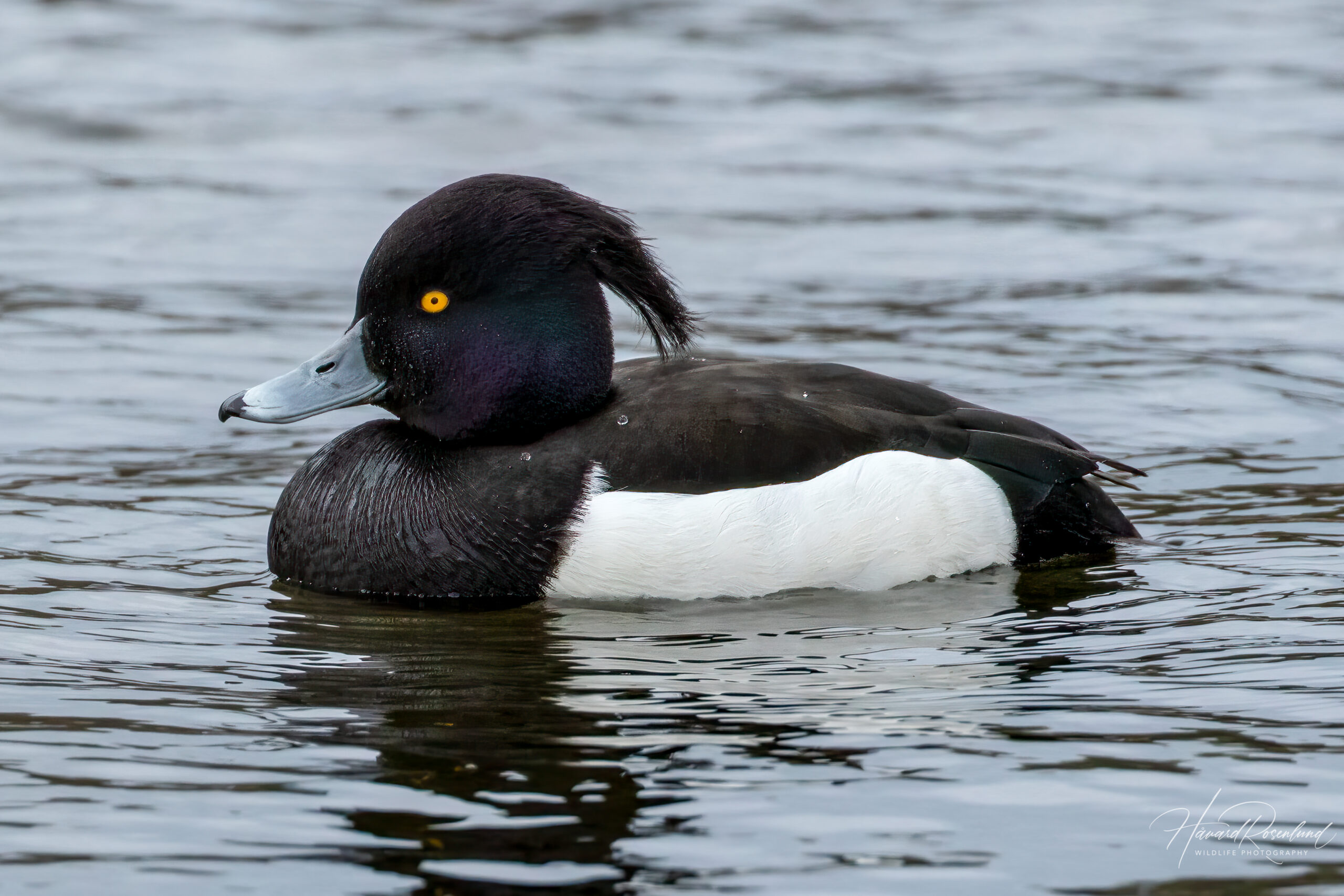
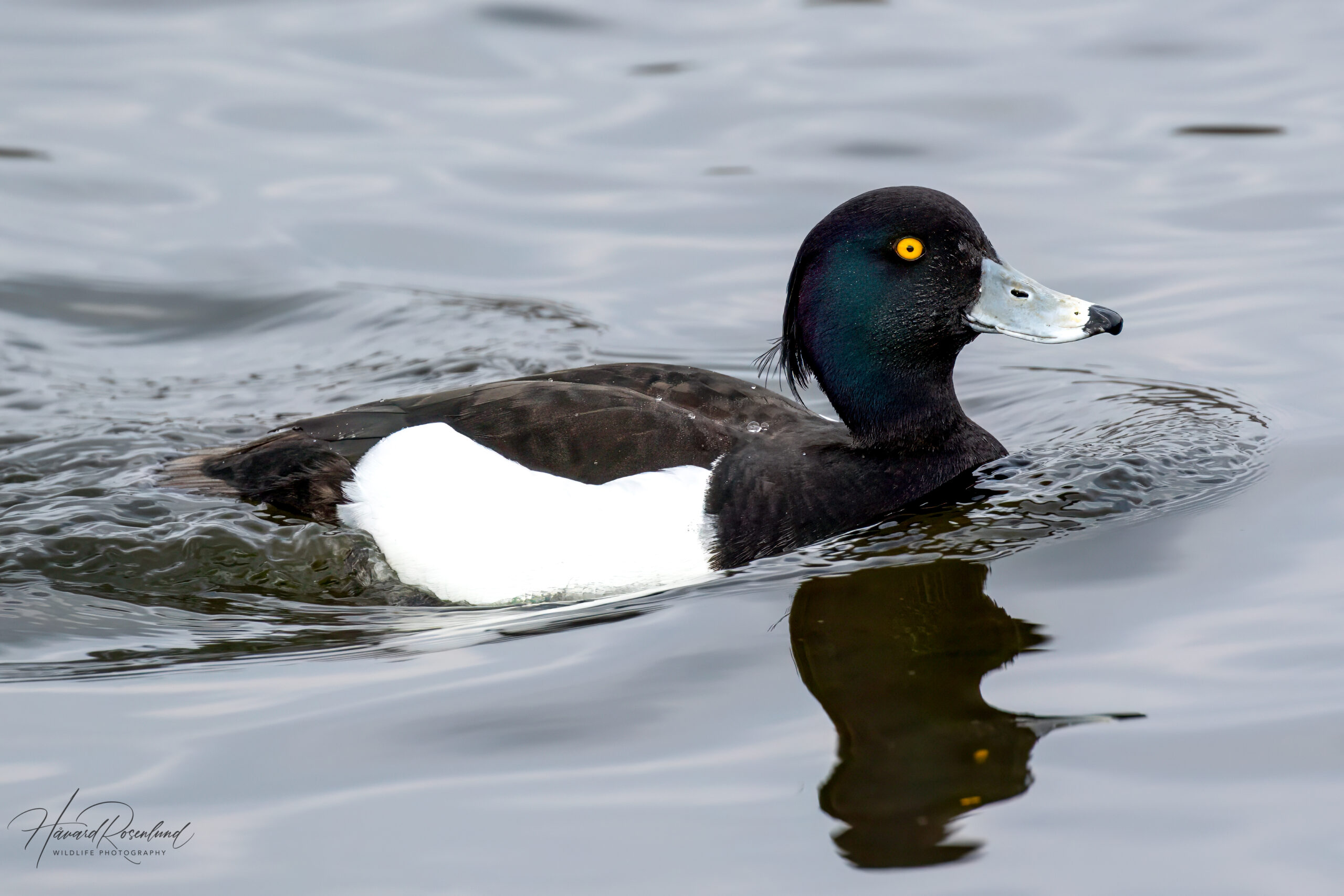
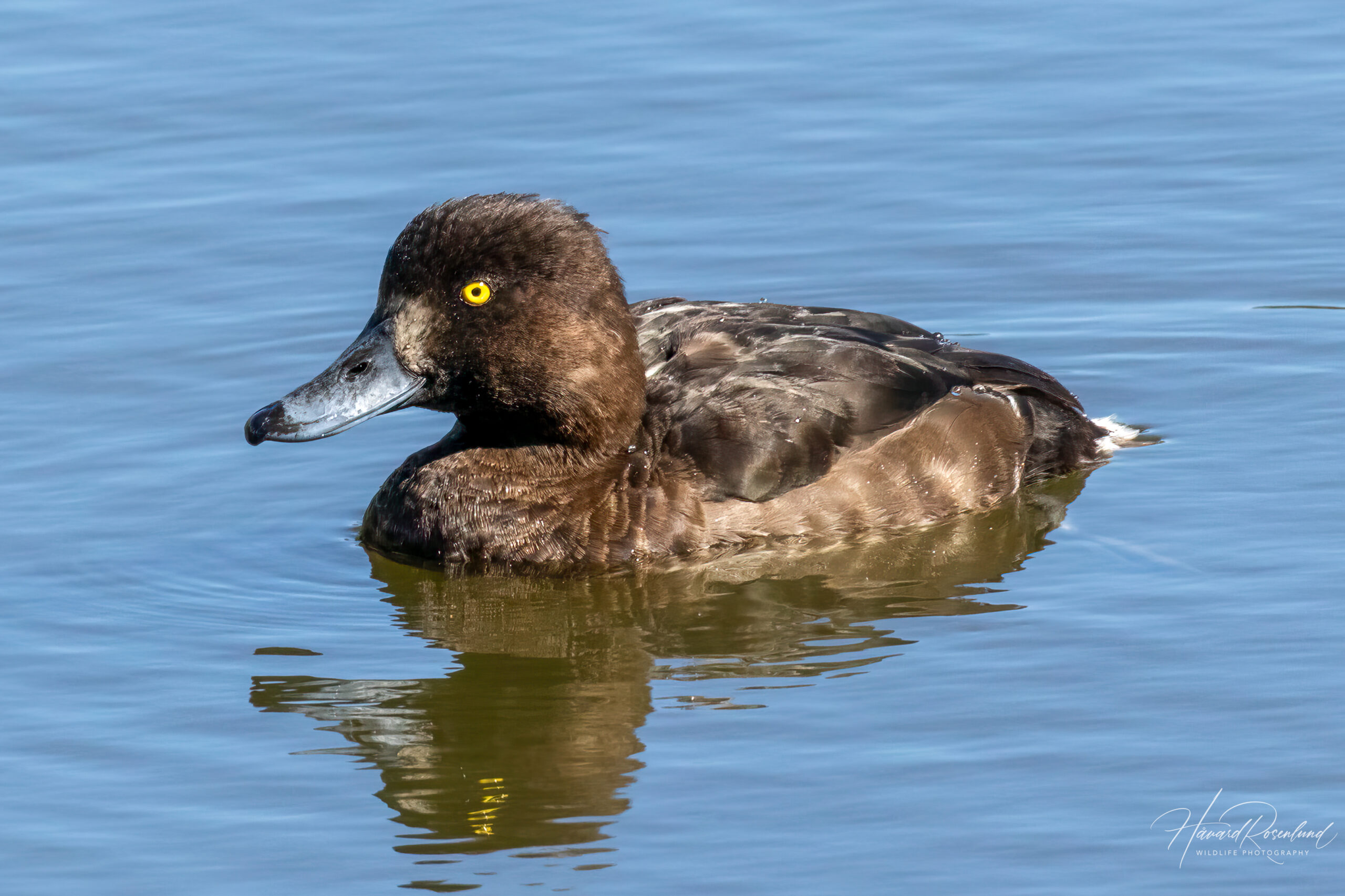
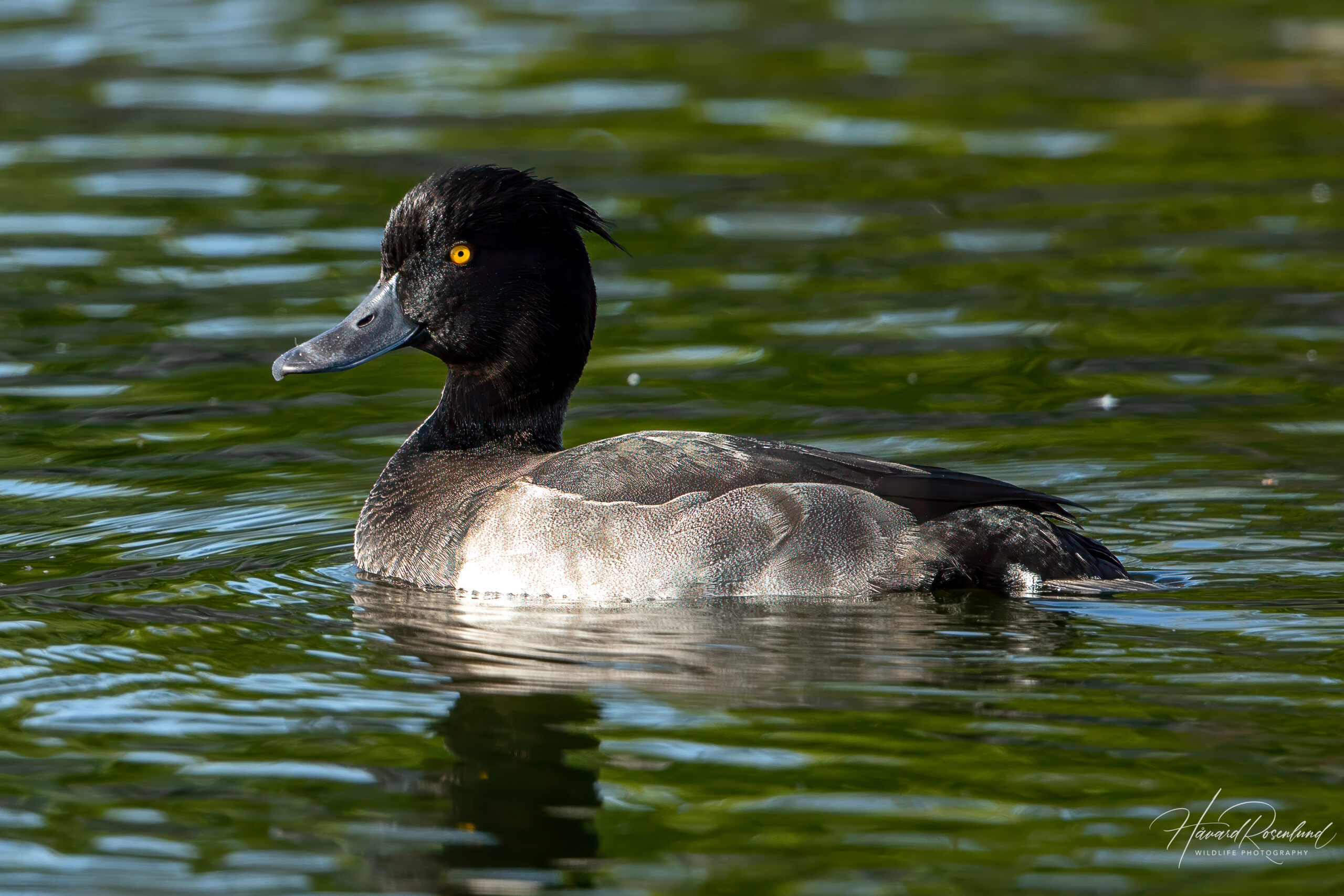
The tufted duck (Aythya fuligula) is a compact Eurasian diving duck named for the narrow tuft of feathers hanging from the back of the head. Adult males are strikingly black and white, with yellow eyes, a blue-grey bill and a long glossy-black tuft. Females are dark brown with a shorter tuft and may show a variable pale patch around the base of the bill. Adults are about 40–47 cm long and weigh around 850 g on average.
The species can resemble greater scaup (Aythya marila), but tufted ducks are darker-backed, more peaked at the rear of the head and normally show at least some trace of the characteristic tuft. Females can be more difficult, especially when a pale area around the bill is well developed.
Habitat
Tufted ducks breed on shallow freshwater lakes, ponds, reservoirs and slow rivers, including many artificial water bodies in parks and urban areas. Dense vegetation or islands close to open water provide useful nesting cover.
Outside breeding they often move to larger lakes, reservoirs, estuaries and sheltered coastal waters. The species is strongly associated with places where bottom-dwelling prey is abundant and water remains open through winter.
Diet
Molluscs, aquatic insects, crustaceans and other invertebrates form most of the diet, supplemented by aquatic plants and occasional small fish. Zebra mussels and other small bivalves can become especially important at productive wintering sites.
Foraging
Tufted ducks usually feed by repeated dives to the bottom or submerged vegetation. Many dives last around 20 seconds, but underwater time and the following surface interval change with depth and the energetic cost of feeding. Experiments with tufted ducks have shown that when foraging below water becomes more energetically costly, the birds can spend longer searching during the dive and increase oxygen uptake at the surface rather than simply extending the time between dives.
Feeding technique also changes with the prey. Experiments published in 1992 showed that mussels smaller than about 16 mm could be strained from a water flow generated through the bill, allowing several to be collected efficiently, whereas larger mussels were picked up and handled individually. As diving depth increased from 1 to 5 m, the ducks became increasingly selective for the smaller mussels that could be gathered rapidly during the limited time available on the bottom. The birds swallow the shells and later crush them in the muscular gizzard, so both diving costs and the cost of processing hard prey influence what is profitable to take.
Migration
The species is partially migratory. Birds breeding in northern and eastern areas move toward ice-free lakes, reservoirs, estuaries and coasts in autumn, while populations in milder regions may remain closer to their breeding areas. Western Europe receives large numbers of wintering birds from farther north and east.
A Europe-wide analysis of winter counts from 1980–2010 found that the winter distribution of tufted ducks shifted northeastward as winter temperatures increased. Winter flocks can contain hundreds or thousands of individuals, and the shift shows how strongly seasonal movements depend on where suitable open water remains available.
Breeding
The female places the nest on the ground close to water, often hidden in vegetation or situated on an island. Courtship takes place on the water, where males display the long head tuft along with a series of postures and calls. A typical clutch contains 8–11 eggs, incubated by the female for about 25 days.
The ducklings are precocial, hatching covered in down with open eyes and the ability to walk and swim soon afterwards. They leave the nest shortly after hatching but remain under the female’s care while learning feeding areas and avoiding danger. Young become capable of sustained flight after roughly 45–50 days.
Tufted ducks also practise brood parasitism within the species: females sometimes lay eggs in neighbouring tufted duck nests. A long-term study at Engure Marsh in Latvia, combining egg-addition experiments with observations of natural nests, found little detectable cost to hosts from moderate levels of parasitism. Females made no obvious attempts to remove the extra eggs, although nests containing more than six parasitic eggs had somewhat lower nest success.
Status
The tufted duck is classified as least concern on the IUCN Red List. It has an extremely large range and remains numerous across Eurasia.
Water quality, abundant aquatic invertebrates and suitable wetland habitat remain important locally. Regional trends differ, but the species as a whole is not currently considered globally threatened.
Image gallery
Loading map and observations…
Have you seen this species?
Independent species archive
Did you find this species page useful?
Wildlife Vagabond is independently built and maintained. Voluntary support helps cover hosting, maps, data storage and continued improvements to the species archive.
Support Wildlife VagabondSpecies content will remain freely available.
References
Information about the species’ global distribution and status is based primarily on global Red List data. See the references below for details.
- BirdLife International. (n.d.). Tufted Duck species factsheet. https://datazone.birdlife.org/species/factsheet/tufted-duck-aythya-fuligula
- Blums, P., & Clark, R. G. (2004). Correlates of lifetime reproductive success in three species of European ducks. Oecologia, 140(1), 61-67. https://doi.org/10.1007/s00442-004-1573-8
- British Trust for Ornithology. (n.d.). Tufted Duck. https://www.bto.org/learn/about-birds/birdfacts/tufted-duck
- de Leeuw & van Eerden. (1992). Size selection in diving Tufted Ducks Aythya fuligula explained by differential handling of small and large mussels Dreissena polymorpha. Ardea, 80, 353–362. https://research.wur.nl/en/publications/size-selection-in-diving-tufted-ducks-aythya-fuligula-explained-b/
- Dugger, B. D., & Blums, P. (2001). Effect of Conspecific Brood Parasitism on Host Fitness for Tufted Duck and Common Pochard. The Auk, 118(3), 717-726. https://doi.org/10.1093/auk/118.3.717
- Halsey, L., Reed, J. Z., Woakes, A., & Butler, P. (2003). The Influence of Oxygen and Carbon Dioxide on Diving Behaviour of Tufted Ducks,Aythya fuligula. Physiological and Biochemical Zoology, 76(4), 436-446. https://doi.org/10.1086/375658
- Halsey, L., Woakes, A., & Butler, P. (2003). Testing optimal foraging models for air-breathing divers. Animal Behaviour, 65(4), 641-653. https://doi.org/10.1006/anbe.2003.2090
- International Union for Conservation of Nature. (n.d.). Tufted Duck. The IUCN Red List of Threatened Species. https://www.iucnredlist.org/species/22680391/86013549
- Lehikoinen, A., Jaatinen, K., Vähätalo, A. V., Clausen, P., Crowe, O., Deceuninck, B., Hearn, R., Holt, C. A., Hornman, M., Keller, V., Nilsson, L., Langendoen, T., Tománková, I., Wahl, J., & Fox, A. D. (2013). Rapid climate driven shifts in wintering distributions of three common waterbird species. Global Change Biology, 19(7), 2071-2081. https://doi.org/10.1111/gcb.12200