Description
The greater white-fronted goose (Anser albifrons) is a medium-sized goose with a broad circumpolar distribution. It breeds across Arctic and subarctic tundra regions of northern Eurasia and North America, and winters much farther south in temperate regions of Europe, Asia, and North America. During migration and winter, it is a familiar sight in wetlands, grasslands, and agricultural landscapes.
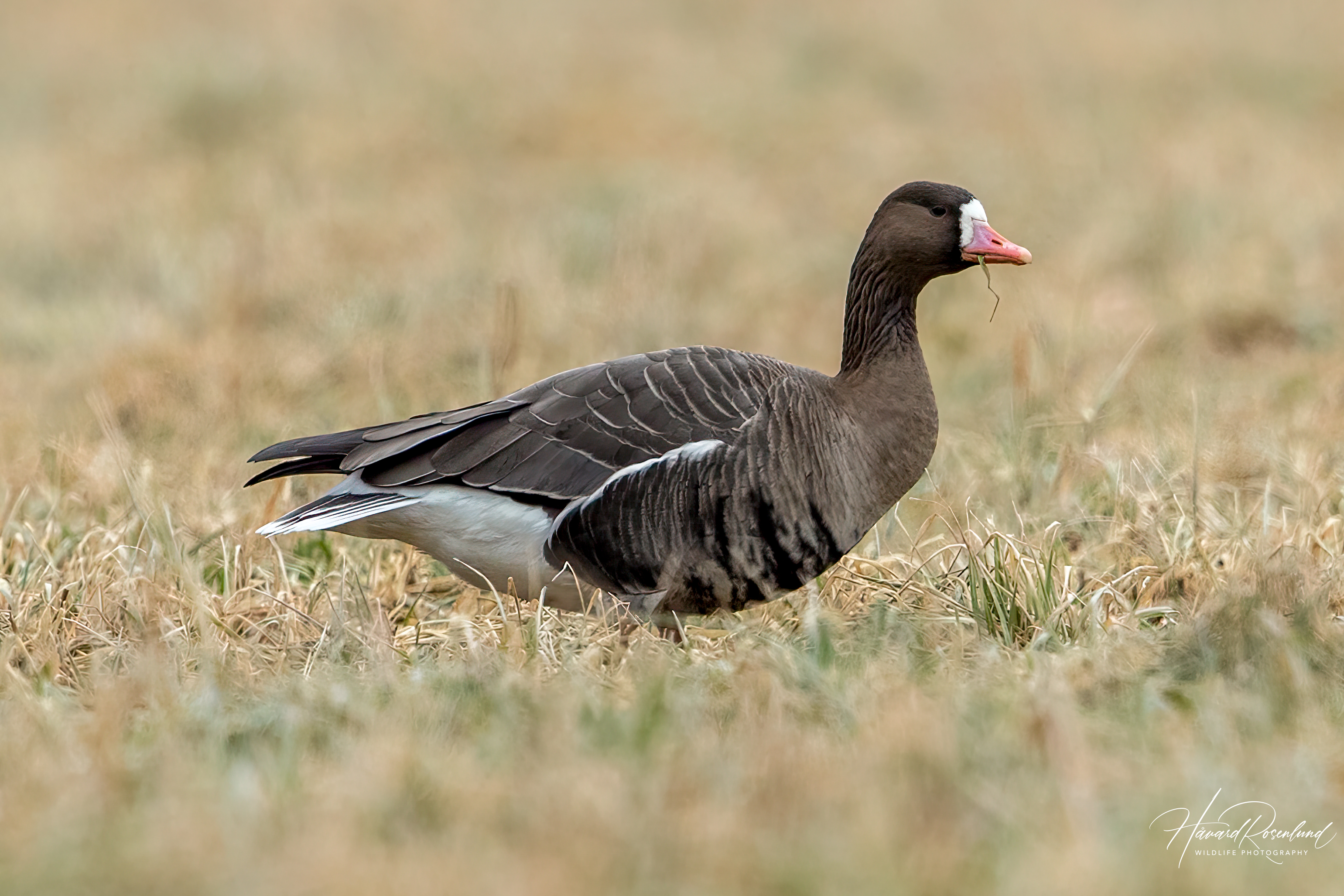
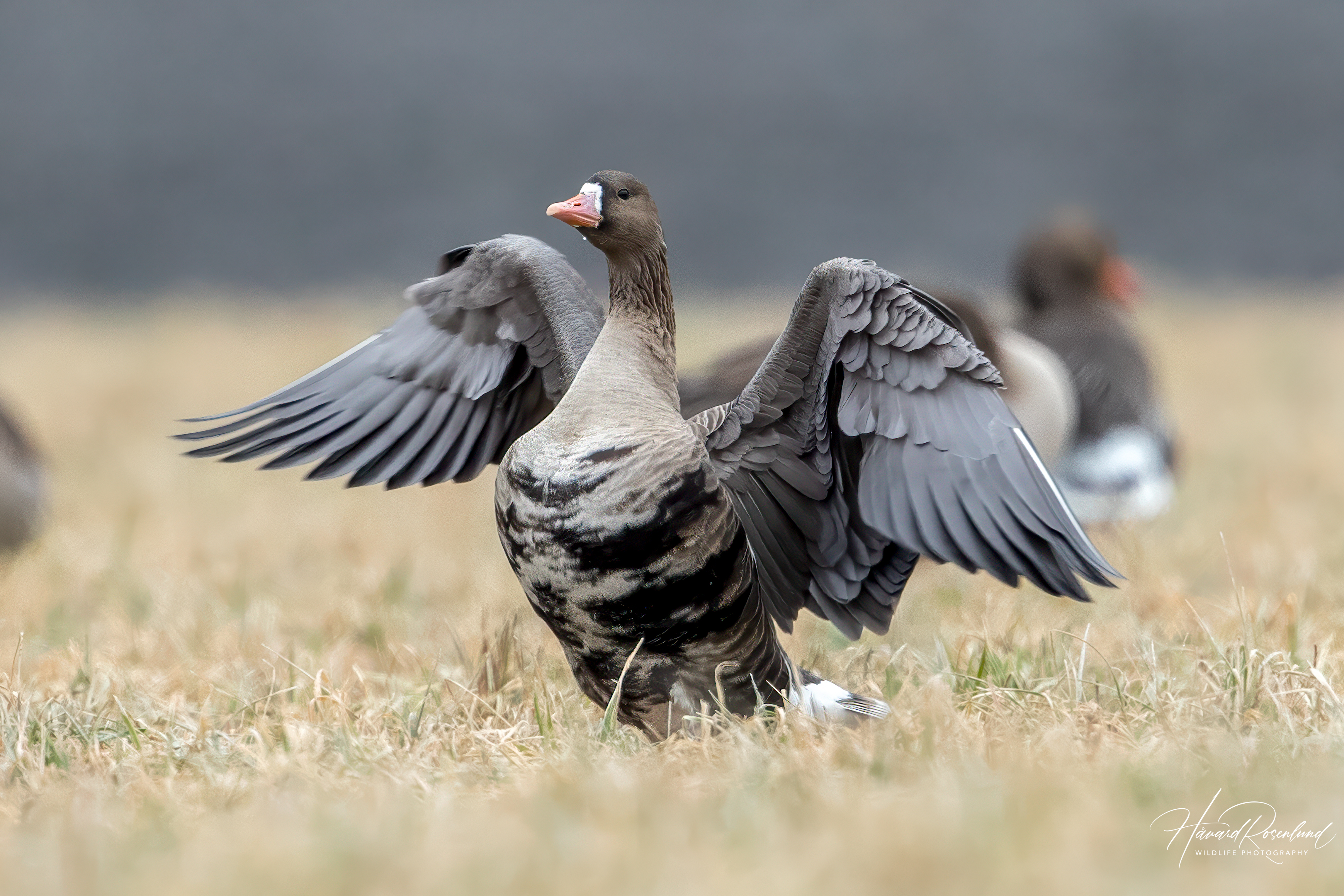
Adults measure approximately 64–81 cm (25-32 in) in length, with a wingspan of 130–165 cm (51-65 in), and typically weigh between 2.0 and 3.3 kg (4.9–6.6 lb). Plumage is mostly grey-brown, with paler feather edges giving a subtly scaled appearance. The species is named for the distinctive white patch at the base of the bill, which is most pronounced in adults. Another key feature is the presence of dark blotches or bars on the belly, which vary individually and become more extensive with age. Legs are orange, and the bill is pinkish with a white base.
The greater white-fronted goose can be confused with other grey geese. Compared to the greylag goose (Anser anser), it is smaller and slimmer, with a shorter bill and lacks the greylag’s uniform belly and bulky appearance. Separation from the lesser white-fronted goose (Anser erythropus) is more challenging. The lesser species is noticeably smaller, with a shorter neck, a more rounded head, a stronger yellow eye-ring, and a more extensive white blaze that often reaches higher onto the forehead. The greater white-fronted goose appears longer-necked and heavier-bodied, and usually lacks the pronounced yellow eye-ring.
Diet & habitat
The greater white-fronted goose occupies a wide range of open habitats throughout the year. On the breeding grounds, it favors tundra wetlands, river valleys, marshes, and lakesides, often in relatively open terrain with good visibility. Outside the breeding season, it shifts to lowland wetlands, coastal marshes, grasslands, and farmland, where food availability is high.
It feeds primarily on plant material, including grasses, sedges, leaves, shoots, roots, and rhizomes. During migration and winter, agricultural fields provide an important food source, with birds grazing on pasture, stubble fields, and newly sprouted crops. Feeding is usually done by grazing on land or by dabbling and grubbing in soft ground, often in large, loosely coordinated flocks.
Behavior
This species is highly gregarious outside the breeding season. During migration and winter, greater white-fronted geese form large flocks that may number in the thousands. These flocks often roost communally on lakes, rivers, or coastal waters and travel daily to feeding areas inland.
They are known for their high-pitched, yelping calls, which are frequently heard both in flight and while feeding. Social structure is strongly based around family groups, with parents and their offspring remaining together through the first winter and often into the following migration. Within large flocks, these family units tend to stay close, contributing to the organized appearance of feeding and flying groups.
Nesting
Breeding takes place in the Arctic, where the short summer provides a narrow window for nesting and chick development. Pairs form strong, often long-term bonds and nest on the ground, typically in dry, elevated areas near water with good visibility.
The female lays a clutch of 4–7 eggs, which are incubated for approximately 22–28 days. Shortly after hatching, the goslings leave the nest and follow their parents to feeding areas. Both adults take part in guarding the young. Goslings fledge after about 40–45 days.
During the breeding season, adults undergo a simultaneous wing molt and become temporarily flightless, making access to food and safe habitat especially critical. The young usually remain with their parents through migration and winter. In the wild, greater white-fronted geese can live well over 10 years, with some individuals reaching considerably older ages.
Status
The greater white-fronted goose is currently classified as least concern on the IUCN Red List. Its global population is large, and several populations are stable or increasing. However, population trends vary between flyways.
Primary threats include habitat loss and degradation, particularly at key stopover and wintering sites, as well as disturbance and hunting pressure in parts of its range. Because the species relies on a network of suitable breeding, staging, and wintering areas across vast distances, changes at important sites can have significant regional effects even when the overall global status remains secure.
Pictures