
Greater White-fronted Goose
Anser albifrons
At a glance
Habitat
- Arctic tundra and wetlands when breeding; grassland, farmland, marshes and shallow wetlands during migration and winter
Diet
- Grasses, sedges, leaves, shoots, roots, rhizomes and agricultural crops
Activity
- Diurnal, with feeding also extending into twilight where disturbance or conditions favour it
Size
- Length: 64–81 cm; wingspan 130–165 cm Weight: about 2.0–3.3 kg
Range
- Arctic Eurasia and North America when breeding; winters across temperate Europe, Asia and North America
Description
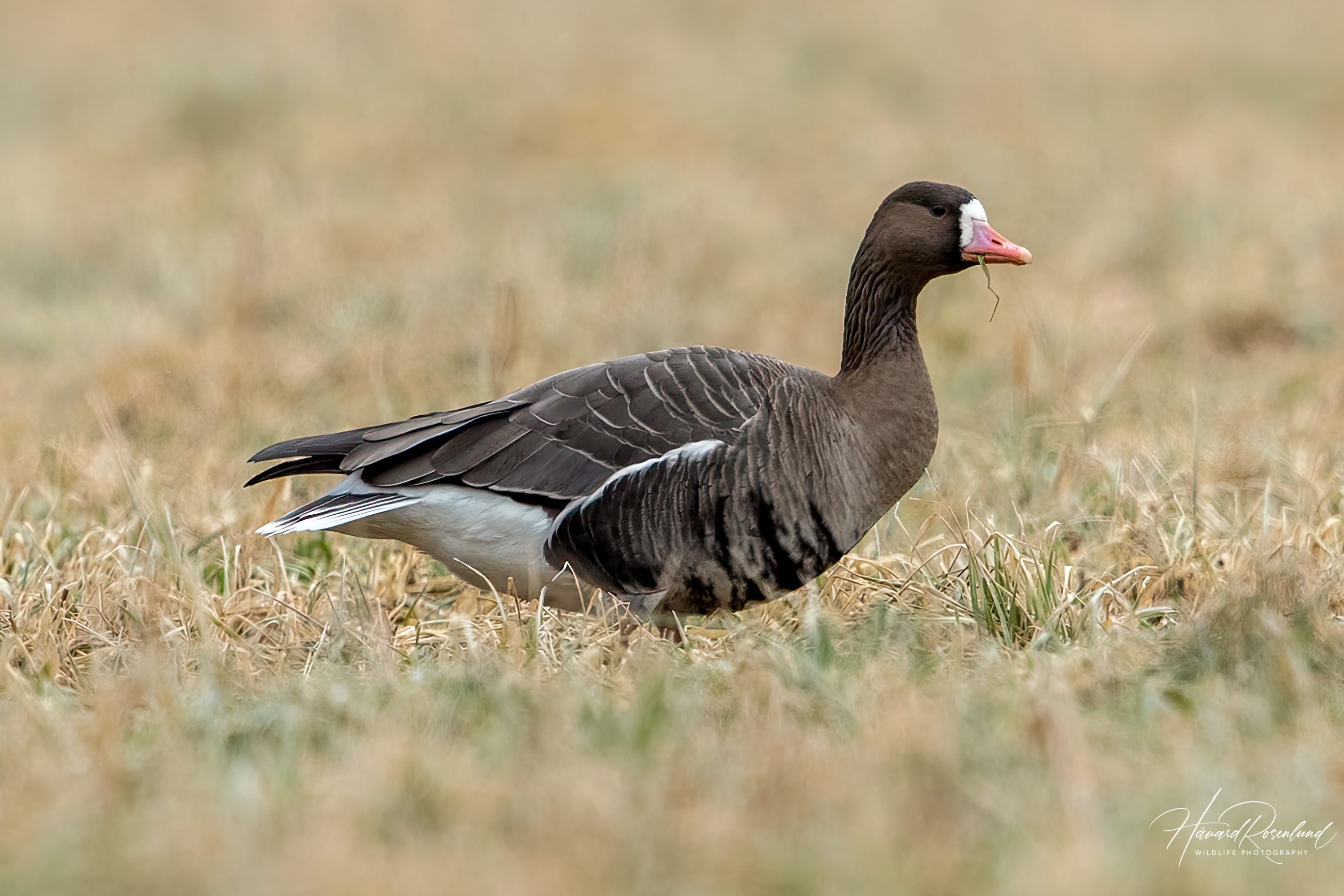
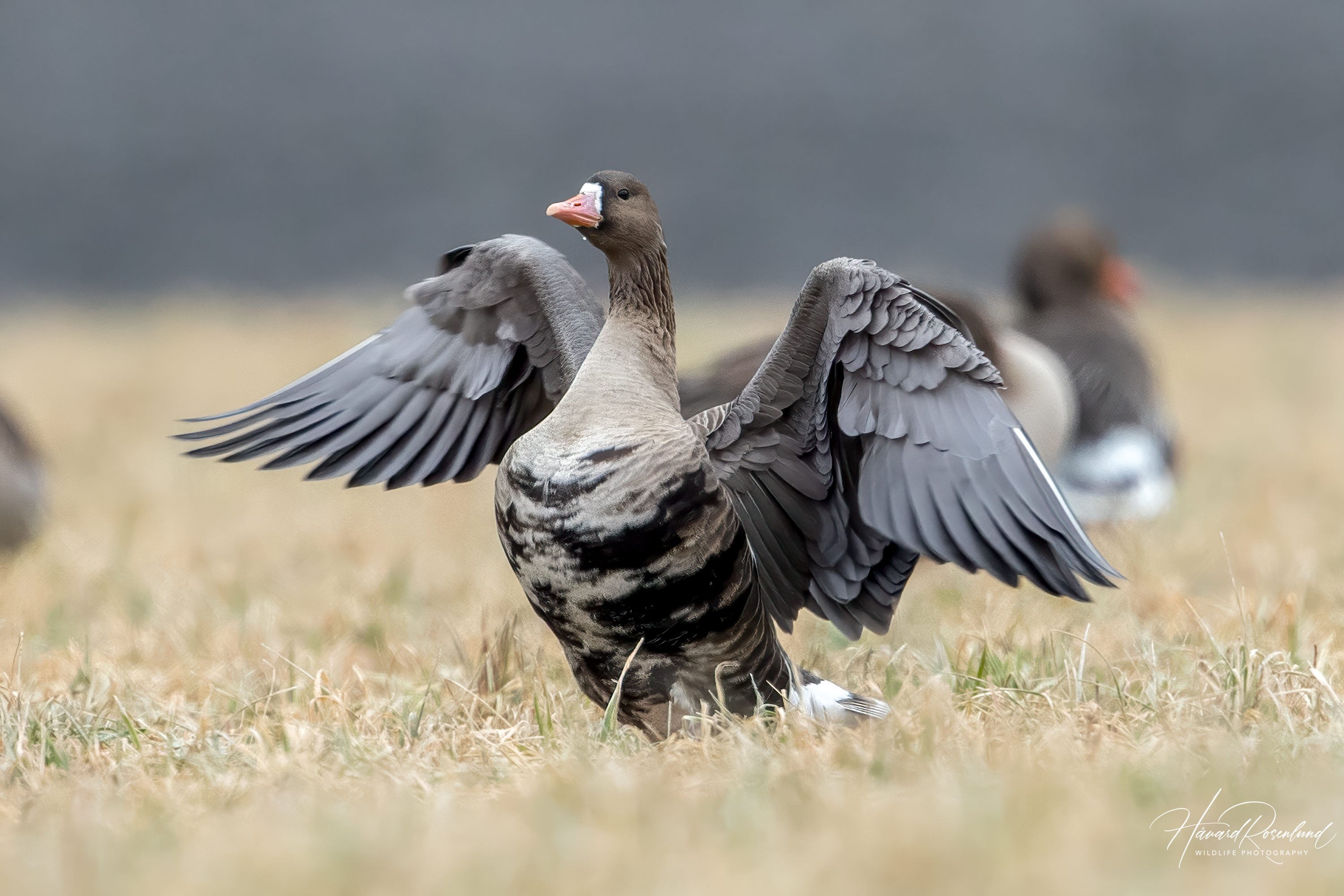
The greater white-fronted goose (Anser albifrons) is a medium-sized grey goose, about 64–81 cm long with a wingspan of roughly 130–165 cm and a body mass commonly around 2.0–3.3 kg. Adults have a conspicuous white patch around the base of the bill, orange legs and irregular black bars and blotches across the belly. Juveniles lack the white forehead and belly markings during their first autumn.
It is smaller and more compact than greylag goose (Anser anser). Lesser white-fronted goose (Anser erythropus) is a more difficult confusion species but is smaller, shorter-necked and rounder-headed, with a prominent yellow eye-ring and a white forehead patch that usually extends farther onto the crown.
Habitat
Breeding birds occupy open Arctic and subarctic landscapes with tundra pools, marshes, river valleys, wet sedge meadows and lake margins. Nest sites are usually on relatively dry ground with good visibility and quick access to feeding wetlands.
During migration and winter the species shifts into much more productive lowland habitats, including wet grassland, coastal marshes, shallow lakes, reservoirs and farmland. Safe communal roosts on water are often separated from daytime feeding areas, so flocks may make regular daily flights between the two.
Diet
Greater white-fronted geese are predominantly herbivorous. They graze grasses and sedges and also eat leaves, shoots, roots and rhizomes. On the breeding grounds, rapidly growing tundra vegetation provides highly nutritious summer food.
Farmland becomes important on many migration and wintering grounds. Flocks feed on pasture, stubble, waste grain and newly sprouting crops, which can allow large numbers of geese to exploit landscapes far more intensively than natural wetlands alone would support.
Behaviour
During the family period after hatching, breeding adults replace all flight feathers at once and are temporarily unable to fly. Non-breeders and birds that have failed to breed may moult earlier and can travel to separate moulting areas. Secure wetlands with abundant food are therefore especially important while the birds are flightless.
A study published in 2019 compared 91 GPS tracks from North Sea and Pannonian greater white-fronted geese. The two populations overlapped most strongly during the moult, when birds from both used the Pyasina Delta on the Taimyr Peninsula. Two tracked geese switched between flyways around the moult and early autumn, showing that these movements can also create longer-term exchange between populations.
Social behaviour
Family bonds are unusually important in the social organisation of greater white-fronted geese. Pairs generally remain together for years, and parents and young commonly stay together through the first winter. Some offspring continue to associate with parents or siblings well beyond their first year.
Outside breeding, these family groups become embedded within flocks that may number hundreds or thousands of birds. Geese roost communally, travel between feeding areas in organised formations and maintain contact with frequent high-pitched, laughing or yelping calls.
Migration
Greater white-fronted geese are long-distance migrants, but there is no single species-wide route. Different breeding populations use distinct flyways between Arctic nesting areas and wintering grounds in Europe, Asia and North America, and tracking work shows substantial variation even between geographically close populations.
Migration is strongly social and can be learned within the family. A study published in 2020 tracked one complete family of six geese over about 2,300 km during spring migration. One of the parents was always at the front of the V-formation, with the father leading most often, so the young travelled within an experienced family unit rather than navigating the route alone.
Winter distribution can also change over time. A 31-year study published in 2026 from Hortobágy National Park in eastern Hungary found that autumn numbers increased from fewer than 2,000 to more than 30,000 birds, while regular overwintering emerged from the mid-2000s. Milder winters were strongly associated with this increase and with the development of the new wintering area.
Breeding
Breeding begins rapidly after arrival on the Arctic tundra because the productive summer is short. The female makes a shallow ground nest lined with vegetation and down, often on slightly raised ground near water. Clutches commonly contain four to seven eggs.
The female performs most incubation for roughly 22–28 days while the male remains nearby and guards the territory. The goslings leave the nest soon after hatching and can walk, swim and feed for themselves, but both parents lead and protect them. Young birds generally make their first sustained flights at around 40–45 days, and families usually remain together through migration and the first winter.
Banding records show that the species can be exceptionally long-lived. The North American longevity record is more than 34 years for a wild bird.
Relationship with humans
Large wintering flocks frequently use pasture, stubble and growing crops, and this close association with agriculture can create conflict where grazing geese damage fields. At the same time, farmland provides highly productive feeding habitat that now supports large numbers of birds in many regions.
The species is also hunted in parts of its range. In North America, hunting seasons and bag limits vary among populations, while banding and population counts are used to follow survival and changes in abundance.
Status
The greater white-fronted goose is classified as least concern on the IUCN Red List. The global population is large, but populations associated with different flyways can show very different trends.
Regional populations depend on networks of breeding, staging, moulting and wintering sites spread across continents. Loss or disturbance of important sites can therefore affect a population even while the species remains secure globally.
Image gallery
Loading map and observations…
Have you seen this species?
Independent species archive
Did you find this species page useful?
Wildlife Vagabond is independently built and maintained. Voluntary support helps cover hosting, maps, data storage and continued improvements to the species archive.
Support Wildlife VagabondSpecies content will remain freely available.
References
Information about the species’ global distribution and status is based primarily on global Red List data. See the references below for details.
- AviList. (n.d.). v2025 – Global avian checklist. https://www.avilist.org/
- BirdLife International. (n.d.). Greater White-fronted Goose (Anser albifrons) species factsheet. https://datazone.birdlife.org/species/factsheet/greater-white-fronted-goose-anser-albifrons
- Ely, C. R., & Takekawa, J. Y. (1996). Geographic Variation in Migratory Behavior of Greater White-Fronted Geese (Anser albifrons). The Auk, 113(4), 889-901. https://doi.org/10.2307/4088866
- Ely, C. R. (1993). Family Stability in Greater White-Fronted Geese. The Auk, 110(3), 425-435. https://doi.org/10.2307/4088407
- Gupte, P. R., Koffijberg, K., Müskens, G. J. D. M., Wikelski, M., & Kölzsch, A. (2019). Family size dynamics in wintering geese. Journal of Ornithology, 160(2), 363–375. https://doi.org/10.1007/s10336-018-1613-5
- Gyüre, P. & Lengyel, S. (2026). Flyway population increase and emergence of new wintering grounds with climate change in an Arctic-breeding goose. Scientific Reports. https://www.nature.com/articles/s41598-026-40447-0
- International Union for Conservation of Nature. (n.d.). Anser albifrons. The IUCN Red List of Threatened Species. https://www.iucnredlist.org/species/22679881/213839615
- Kölzsch, A., Flack, A., Müskens, G. J. D. M., Kruckenberg, H., Glazov, P., & Wikelski, M. (2020). Goose parents lead migration V. Journal of Avian Biology, 51(3), jav.02392. https://doi.org/10.1111/jav.02392
- Kölzsch, A., Müskens, G. J. D. M., Szinai, P., Moonen, S., Glazov, P., Kruckenberg, H., Wikelski, M., & Nolet, B. A. (2019). Flyway connectivity and exchange primarily driven by moult migration in geese. Movement Ecology, 7(1), 3. https://doi.org/10.1186/s40462-019-0148-6
- U.S. Fish & Wildlife Service. (n.d.). Midcontinent Greater White-fronted Goose Banding in Alaska. https://www.fws.gov/rivers/carp/project/midcontinent-greater-white-fronted-goose-banding-alaska
- U.S. Geological Survey. (n.d.). USGS Bird Banding Laboratory – Longevity Records of North American Birds. https://www.pwrc.usgs.gov/BBL/Bander_Portal/login/Longevity.php