
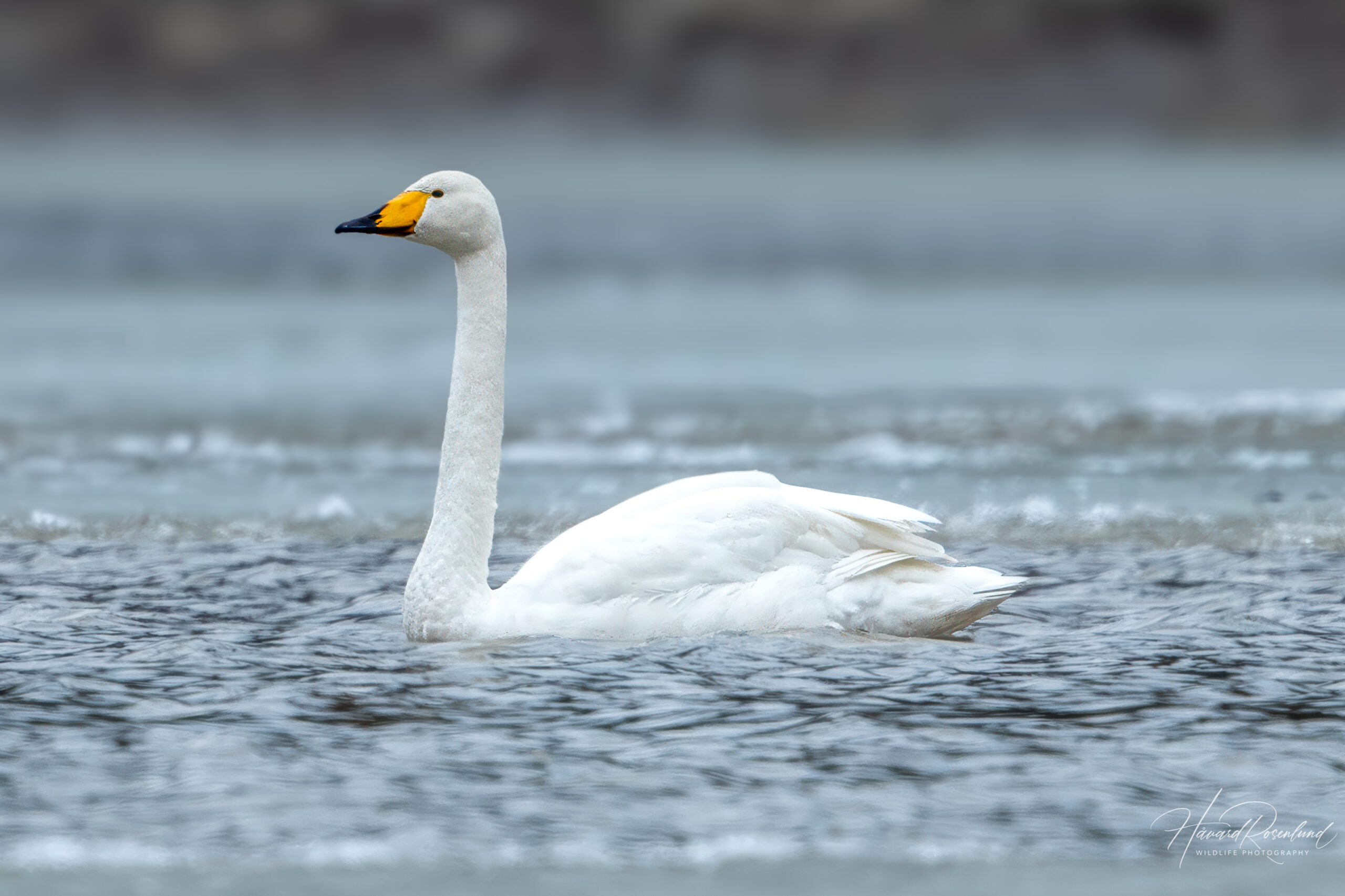
Whooper Swan
Cygnus cygnus
At a glance
Habitat
- Lakes, wetlands, slow rivers and marshes for breeding; ice-free waters, coasts and farmland in winter
Diet
- Aquatic plants, grasses, roots and crops; some aquatic invertebrates
Activity
- Diurnal
Size
- Length: 140–165 cm Weight: ca. 9 kg
Range
- Breeds from Iceland and northern Europe across northern Eurasia; migratory populations winter farther south in Europe and Asia
Description
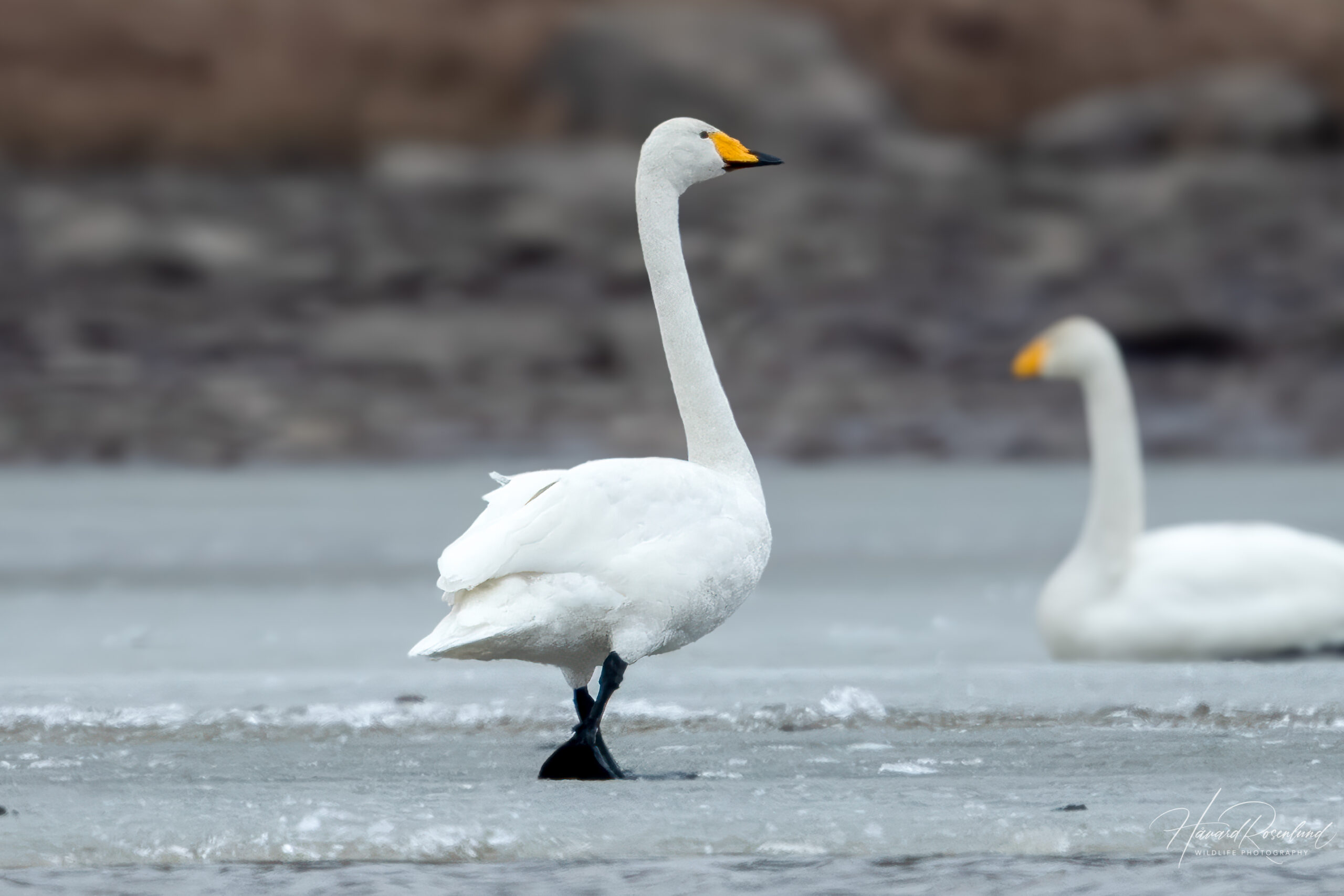
The whooper swan (Cygnus cygnus) is a large white swan of northern Eurasia. Adults are about 140–165 cm long and average around 9 kg. The bill is black with a large wedge-shaped yellow patch that usually extends beyond the nostril, and the neck is typically held straighter than in the mute swan (Cygnus olor). The sexes look alike, although males average larger.
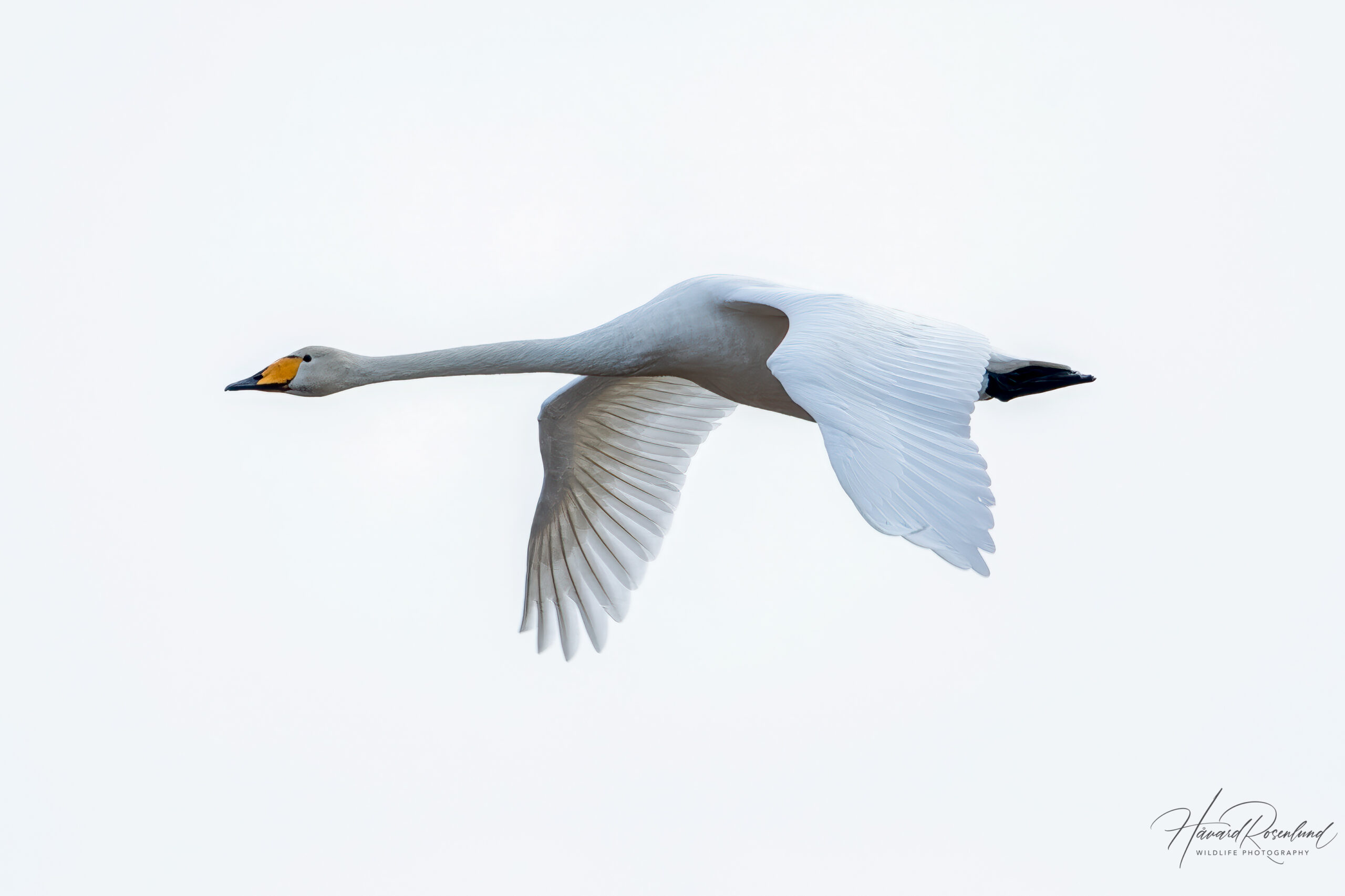
Its loud, resonant calls are among the easiest ways to recognise a flock in flight. The smaller tundra swan (Cygnus columbianus), including the European Bewick's swan form, has less yellow on the bill and a more compact head and body.
Habitat
Whooper swans breed on shallow lakes, marshes, slow rivers and other wetlands with abundant aquatic vegetation, often in boreal or open northern landscapes. Nesting sites normally combine quiet water, emergent vegetation and enough open space for these very large birds to take off and land.
Outside breeding they use a much broader range of habitats, including larger lakes, estuaries, sheltered coasts and agricultural fields. Access to ice-free water is especially important in winter, while farmland can provide abundant feeding opportunities near traditional roosting waters.
Diet
The diet is predominantly plant-based. Whooper swans pull up aquatic vegetation with the long neck and also graze on grasses, roots and agricultural crops. Small aquatic invertebrates are taken as well, particularly by young birds.
The increasing use of farmland in winter has become an important feature of several north-west European populations. Crops and post-harvest fields can provide concentrated food that helps support large winter flocks away from natural aquatic feeding areas.
Migration
The species includes both long-distance migrants and birds that make much shorter seasonal movements. Northern populations move south or toward ice-free coasts as waters freeze, while milder conditions can allow some birds to remain much closer to their breeding areas. Traditional stopover and wintering sites are often used repeatedly.
Tracking and ringing studies show that migration is flexible and strongly influenced by weather and wind. Family groups commonly travel together, with young remaining alongside their parents through their first winter. Increasing populations in Fennoscandia and Iceland have also contributed to changes in winter distribution across north-western Europe.
Breeding
Whooper swans form long-lasting pair bonds and normally raise one brood per year. Pair displays include repeated head movements, coordinated movements of the neck and wings, and short pre-copulation displays; some pairs also preen one another after mating. The nest is a large mound of vegetation built close to water, often on an island, marsh edge or low bank. A typical clutch contains four to five eggs, with two to seven recorded.
The female incubates for about 31–42 days while the male remains nearby and defends the territory. The cygnets are precocial, meaning they hatch well developed and can swim and feed soon afterwards, but they remain closely guarded by both parents. They take roughly 78–96 days to become capable of sustained flight and usually remain as a family group through the following winter.
Status
The whooper swan is classified as least concern on the IUCN Red List. Several European populations have expanded strongly in both numbers and range during recent decades. Protection from hunting and increased access to agricultural food during winter are among the factors thought to have contributed to this recovery.
The expansion is especially striking in Fennoscandia, where birds that once bred mainly in remote northern wetlands now nest much farther south. Local problems still occur, including wetland loss or disturbance and mortality from collisions with power lines and other infrastructure, but these pressures have not prevented the broad regional increase.
Image gallery
Loading map and observations…
Have you seen this species?
Independent species archive
Did you find this species page useful?
Wildlife Vagabond is independently built and maintained. Voluntary support helps cover hosting, maps, data storage and continued improvements to the species archive.
Support Wildlife VagabondSpecies content will remain freely available.
References
Information about the species’ global distribution and status is based primarily on global Red List data. See the references below for details.
- Artsdatabanken. (2021). Sangsvane, Norsk rødliste 2021. https://lister.artsdatabanken.no/rodlisteforarter/2021/28409
- BirdLife International. (n.d.). Whooper Swan species factsheet. https://datazone.birdlife.org/species/factsheet/whooper-swan-cygnus-cygnus
- British Trust for Ornithology. (n.d.). Whooper Swan BirdFacts. https://www.bto.org/learn/about-birds/birdfacts/whooper-swan
- Dale, S. (2016). Breeding population increase and range expansion of the Whooper Swan <em>Cygnus cygnus</em> in Oslo and Akershus. Ornis Norvegica, 39, 29. https://doi.org/10.15845/on.v39i0.1032
- International Union for Conservation of Nature. (n.d.). Whooper Swan. The IUCN Red List of Threatened Species. https://www.iucnredlist.org/species/22679856/85965262
- Laubek, B., Clausen, P., Nilsson, L., Wahl, J., Wieloch, M., Meissner, W., Shimmings, P., Larsen, B. H., Hornman, M., Langendoen, T., Lehikoinen, A., Luigujõe, L., Stīpniece, A., Švažas, S., Sniauksta, L., Keller, V., Gaudard, C., Devos, K., Musilová, Z., … Fox, A. D. (2019). Whooper Swan Cygnus cygnus January population censuses for Northwest Mainland Europe, 1995–2015. Wildfowl(Special Issue 5), 103–122. https://tidsskrift.dk/Wildfowl/article/view/154490
- Pennycuick, C., Bradbury, T., Einarsson, Ó., & Owen, M. (1999). Response to weather and light conditions of migrating Whooper Swans Cygnus cygnus and flying height profiles, observed with the Argos satellite system. Ibis, 141(3), 434-443. https://doi.org/10.1111/j.1474-919X.1999.tb04412.x