
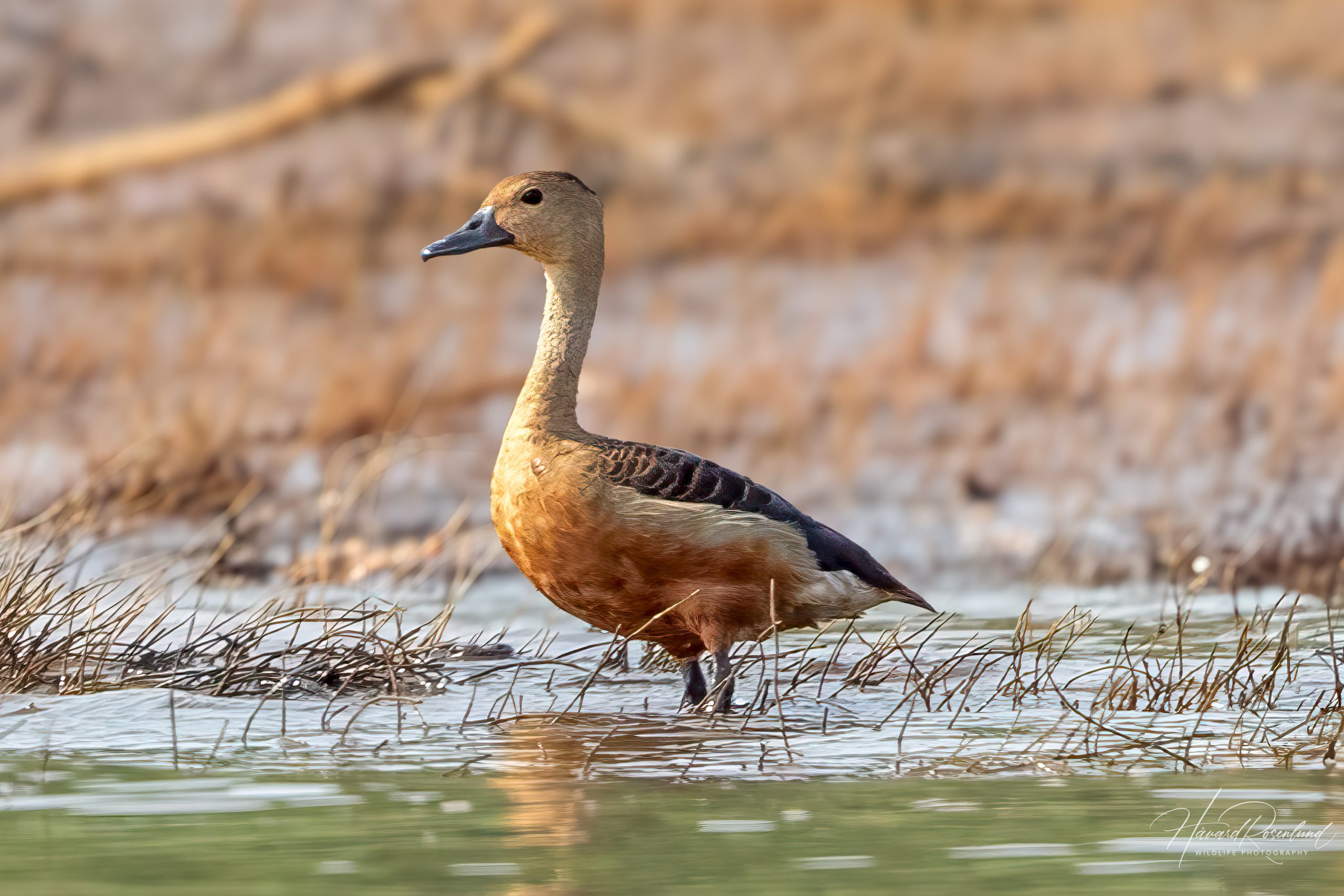
Lesser Whistling-Duck
Dendrocygna javanica
At a glance
Habitat
- Freshwater lakes, marshes, ponds, reservoirs, flooded grassland and rice fields, often with floating or emergent vegetation
Diet
- Mostly plant material, seeds and grain, with aquatic invertebrates and insects also taken
Activity
- Feeds mainly from dusk through the night and often rests in flocks by day
Size
- Length: about 38–42 cm Weight: about 520–600 g
Range
- South and Southeast Asia, from the Indian subcontinent through mainland Southeast Asia to Indonesia
Description
The lesser whistling-duck (Dendrocygna javanica) is a small, long-legged whistling duck of South and Southeast Asia. Adults are about 38–42 cm long, have a wingspan of roughly 70–74 cm and weigh around 520–600 g. The plumage is warm brown, with a darker crown and back, chestnut underparts and a rich chestnut patch around the rump and upper tail.
The sexes look alike. The dark bill, long neck and upright posture give the bird a rather goose-like outline compared with many other small ducks. It is smaller and generally darker than the fulvous whistling-duck (Dendrocygna bicolor), which also has a paler rump and a different pattern on the flanks.
Habitat
Lesser whistling-ducks are wetland specialists but use a wide range of shallow freshwater habitats. Lakes, marshes, village ponds, reservoirs, flooded grassland, rice fields and slow-moving water can all be suitable, especially where floating or emergent vegetation provides food and shelter.
In India, the species is resident and has a very large national range. Urban ponds and agricultural wetlands can support large numbers when water quality, vegetation and safe resting areas remain suitable.
Diet
The diet is mainly plant-based. Seeds, grain, aquatic plants, grasses and other vegetation are important, while aquatic insects, small molluscs and other invertebrates are also taken. Birds feed by dabbling at the surface, reaching down into shallow water and occasionally making short dives.
Rice fields and other flooded farmland can provide both seeds and small aquatic animals. Because much feeding takes place after dusk, a flock seen resting quietly on a pond during the day may move to different wetlands or fields to feed once evening arrives.
Behaviour
Lesser whistling-ducks feed mainly from dusk through the night and often spend much of the day resting. Unlike many familiar ducks, they also perch readily in trees. Strong feet and relatively long legs make movement on branches less awkward than it would be for most surface-feeding ducks.
Social behaviour
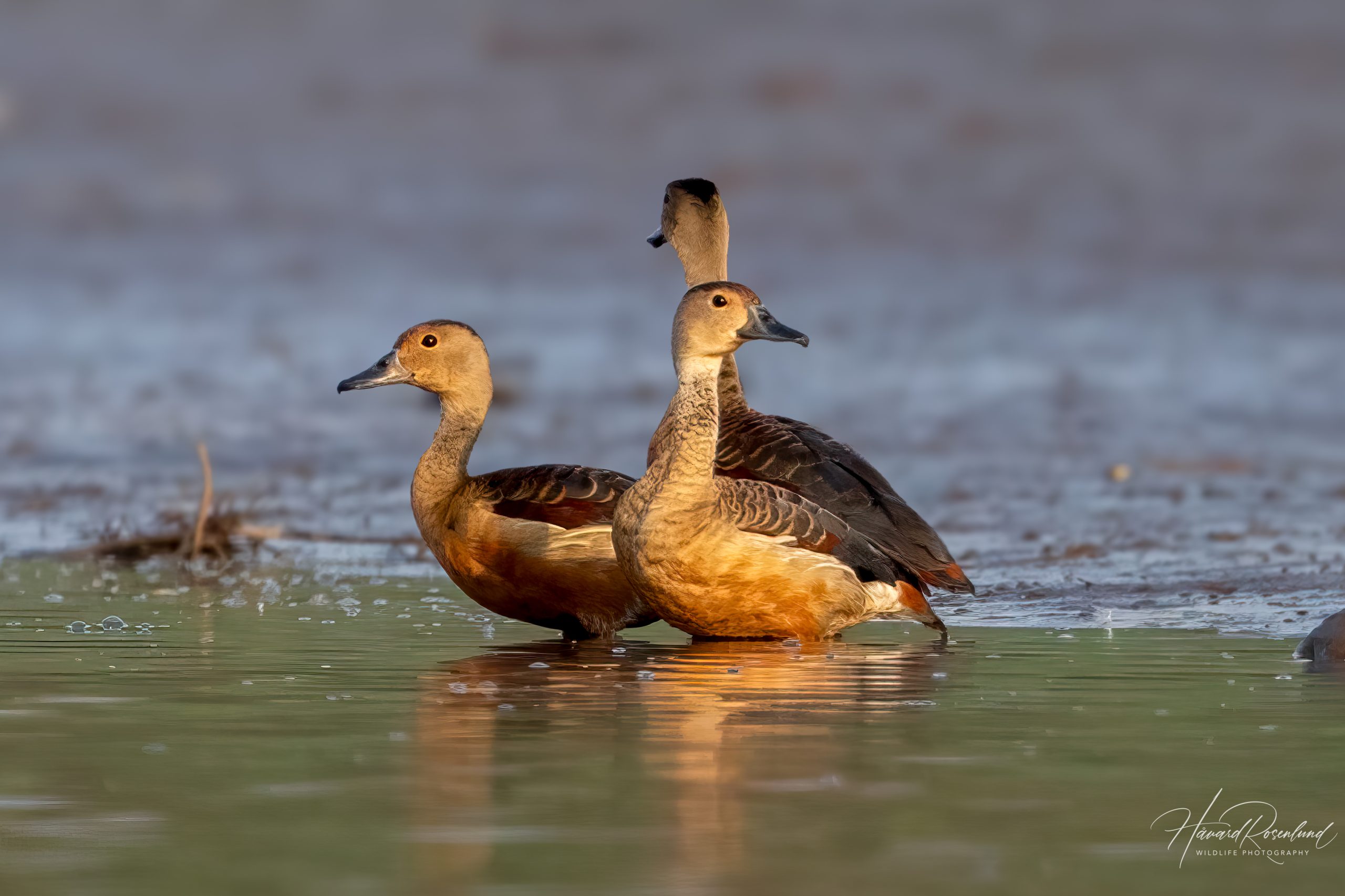
Outside breeding, lesser whistling-ducks are highly social and often gather in large flocks on open water or around wet fields. Several hundred birds can share the same daytime resting site, and their repeated high whistling calls are especially noticeable when a flock takes flight.
Breeding
Breeding timing varies with rainfall and often follows the monsoon. Pairs may nest in tree cavities, old nests made by other birds, nest boxes or dense vegetation close to water. Clutches are usually large, commonly around eight to twelve eggs, and incubation lasts about three to four weeks.
Both parents take part in caring for the brood. The ducklings are precocial: they hatch covered in down, can walk and swim almost immediately and leave the nest soon after hatching. Adults lead them to feeding areas and remain with them while they grow.
A study in Assam followed 13 nesting attempts between 2011 and 2014. It recorded nest losses to grey mongooses and also documented adults performing a broken-wing distraction display near nests, apparently drawing attention away from eggs or young. Breeding success in the observed attempts was 38.5%, illustrating how vulnerable ground-level and accessible nests can be even in otherwise suitable wetlands.
Status
The lesser whistling-duck is classified as least concern on the IUCN Red List and remains widespread and common across much of South and Southeast Asia.
Data from State of India’s Birds 2025 indicate a stable national long-term trend in India, with an estimated change of about +26.4%, while the current annual trend is essentially flat at about +0.01%. Local populations can still be reduced by wetland drainage, pollution, heavy disturbance and changes in water management. Its ability to use rice fields, reservoirs and urban ponds gives the species considerable flexibility, but it remains fundamentally dependent on functioning wetlands.
Image gallery
Loading map and observations…
Have you seen this species?
Independent species archive
Did you find this species page useful?
Wildlife Vagabond is independently built and maintained. Voluntary support helps cover hosting, maps, data storage and continued improvements to the species archive.
Support Wildlife VagabondSpecies content will remain freely available.
References
Information about the species’ global distribution and status is based primarily on global Red List data. See the references below for details.
- BirdLife International. (n.d.). Lesser Whistling-Duck species factsheet. https://datazone.birdlife.org/species/factsheet/lesser-whistling-duck-dendrocygna-javanica
- International Union for Conservation of Nature. (n.d.). Lesser Whistling-Duck. The IUCN Red List of Threatened Species. https://www.iucnredlist.org/species/22679758/92828691
- Oiseaux.net. (n.d.). Lesser Whistling Duck biometrics. https://www.oiseaux.net/en/oiseaux/lesser.whistling.duck.html
- Ranade, S. P., & Prakash, V. (2016). Nesting of Lesser Whistling-Duck Dendrocygna javanica (Horsfield, 1821) and broken-wing distraction display at Kamrup District, Assam, India. Journal of Threatened Taxa, 8(5), 8824–8826. https://doi.org/10.11609/jott.2817.8.5.8824-8826
- State of India's Birds. (n.d.). State of India’s Birds – Lesser Whistling Duck. https://stateofindiasbirds.in/species/lewduc1/