
Acorn Woodpecker
Melanerpes formicivorus
At a glance
Habitat
- Oak woodland, pine-oak forest and other wooded habitats with reliable acorn crops
Diet
- Acorns; also insects, fruit, sap and other plant foods
Activity
- Diurnal
Size
- Length: 19–23 cm Weight: 65–90 g
Range
- Western North America through Mexico and Central America to northern South America
Description
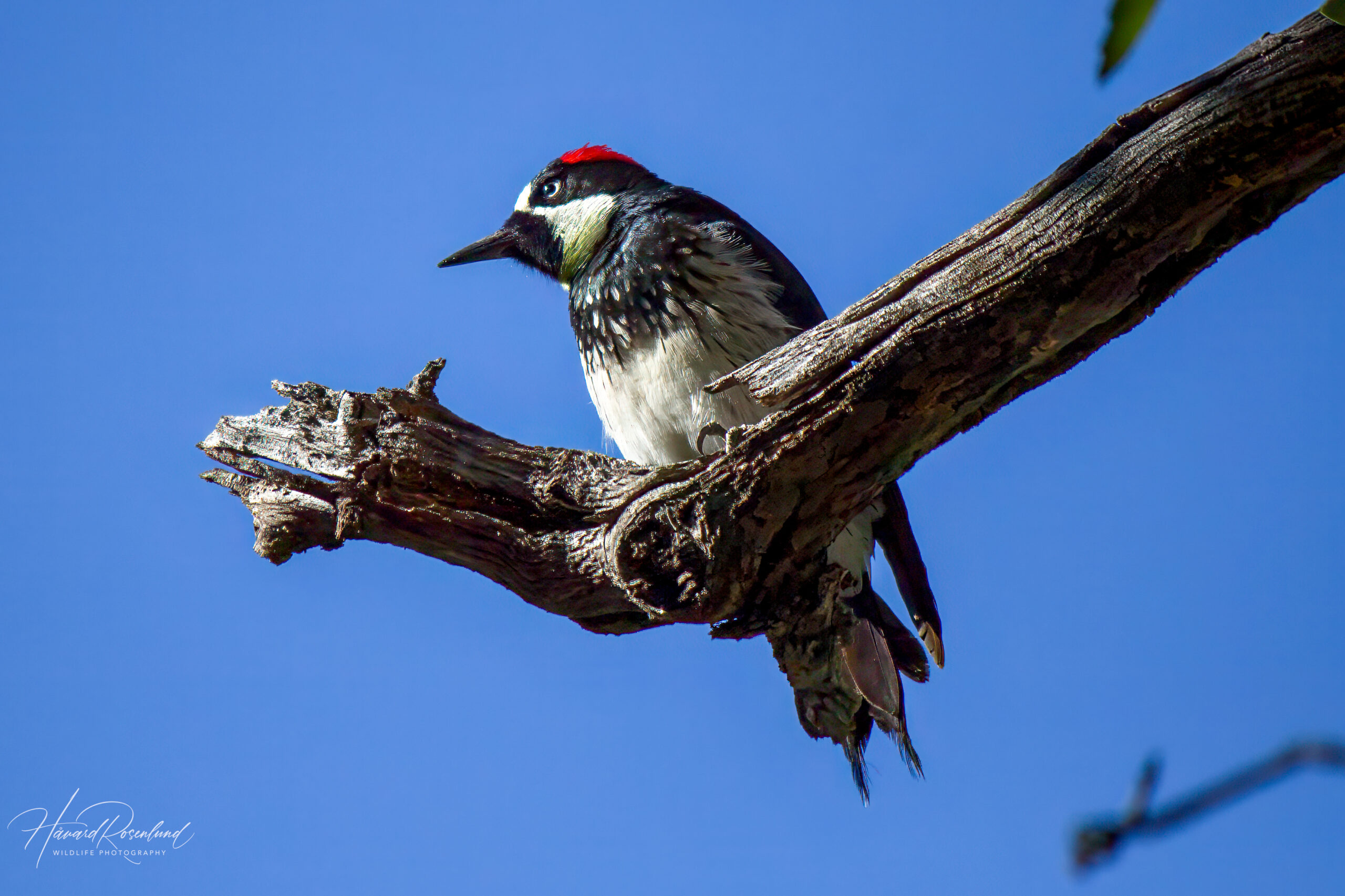
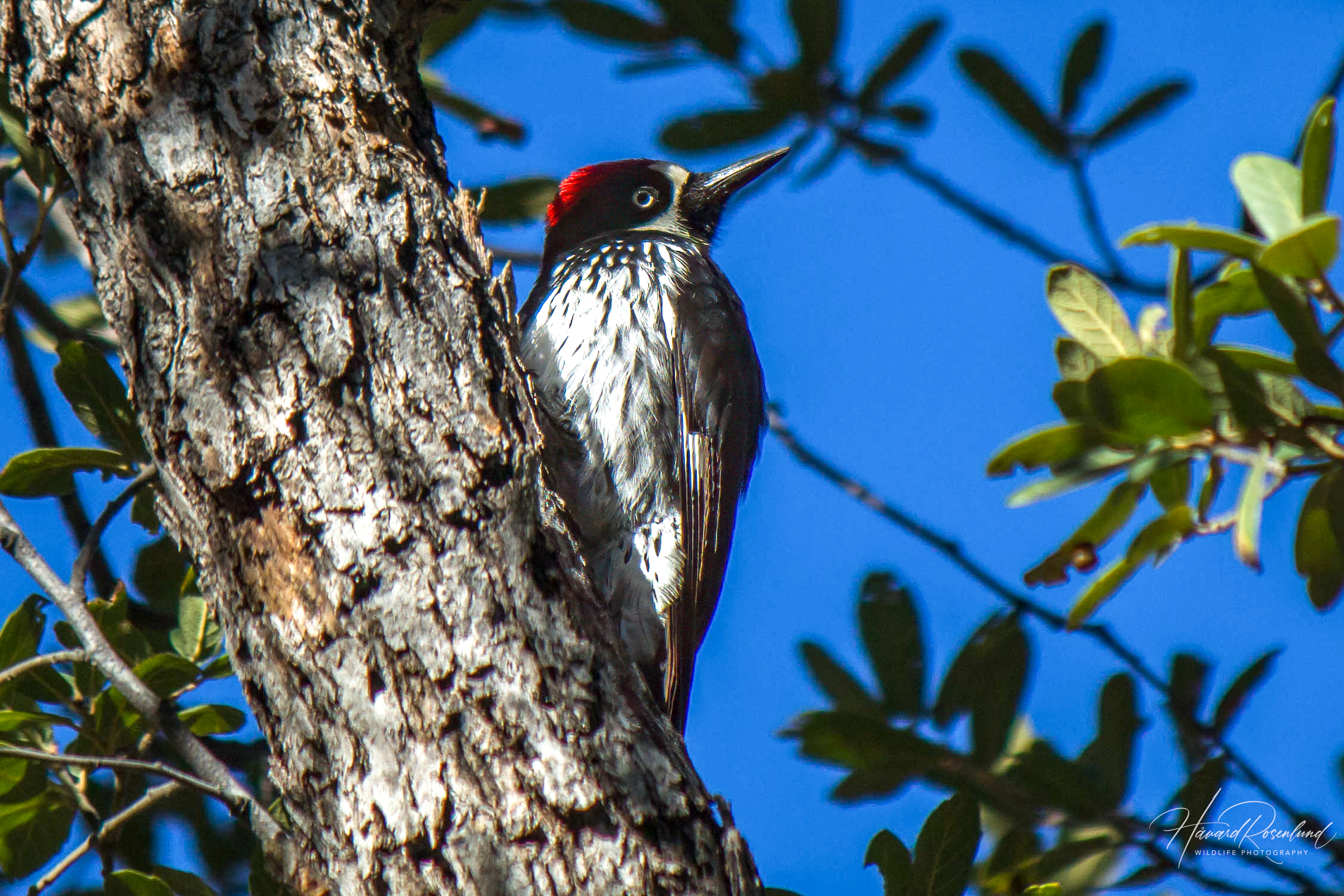
The acorn woodpecker (Melanerpes formicivorus) is a medium-sized woodpecker with one of the most distinctive colour patterns in its family. Adults are about 19–23 cm long, have a wingspan of roughly 35–43 cm and weigh around 65–90 g. The back and wings are glossy black, the rump and parts of the wings are white, the face is pale and the eyes are strikingly light. Males have red extending across the crown, while females have a black band separating the pale forehead from the red on the rear crown and nape.
Plumage varies geographically. In the Colombian form, males have a reduced red crown, females lack red on the crown altogether, and the throat is yellower than in northern birds.
The species occurs from the western United States through Mexico and Central America into northern South America. It is especially famous for an unusual combination of communal food storage and complex group living, both of which shape much of its daily life.
Habitat
Acorn woodpeckers are strongly associated with oak woodland and mixed pine-oak forest, although they also use parks, ranchland and other wooded landscapes. They occur from sea level into mountain country, generally following the elevational range of oaks. The most valuable territories combine mature trees for nesting and roosting with dependable acorn crops and one or more suitable sites for communal food storage.
Long-term research has shown that productive territories with established granaries can be inherited across generations, helping to explain why some young birds delay dispersal and remain with their family group.
Diet
Acorns are a major food resource, but the diet is considerably broader than the name suggests. Acorn woodpeckers also take flying and bark-dwelling insects, fruit, sap and other plant foods. Insects become particularly important while chicks are being raised.
The birds forage both on trees and in the air, searching bark and branches for food and often catching flying insects in short sallies from exposed perches. Fresh food varies seasonally, whereas stored acorns provide a much more dependable reserve when other food becomes scarce.
Food caching
The best-known behaviour of the species is communal acorn storage. Social groups drill thousands of small holes into one or more large trees, utility poles or other wooden structures and wedge individual acorns into them. These storage sites, known as granaries, can hold more than 50,000 stored nuts and may be maintained by the same social group over many years.
Stored acorns are continually checked and moved as they dry and shrink so that they remain tightly wedged. Group members invest substantial time in collecting, inserting, maintaining and defending this shared food supply. The granary is therefore more than a pantry: it is a central resource around which much of the territory and social system is organised.
Social behaviour
Acorn woodpeckers live in social units ranging from simple pairs to extended family groups containing breeding adults and non-breeding helpers. Helpers are usually offspring from earlier breeding attempts that remain on the territory where they grew up. Family members cooperate in granary defence and territorial defence, and several generations can remain associated with the same high-quality territory.
Long-term field studies have documented intense competition when a breeding position becomes vacant. If all breeders of one sex disappear from a territory, coalitions of outsiders may converge on the vacancy in prolonged contests known as “power struggles”. These events can involve birds from many neighbouring groups and may continue for days before a new breeding coalition gains control.
A study published in 2020 found that both helpers and breeders regularly made forays into territories beyond their own, sometimes several times in a day, with helpers visiting high-quality territories especially often. These visits give birds information about where breeding vacancies may arise and which individuals occupy neighbouring groups, knowledge that can become valuable when they eventually disperse.
Breeding
The breeding system is unusually variable. Some groups contain a single breeding pair, while others are cooperatively polygynandrous, with several related males sharing reproduction and two or more related females laying in the same nest. Non-breeding helpers may also assist with incubation, nest defence and chick feeding.
Joint nesting combines cooperation with reproductive conflict. Before all breeding females have begun laying, females may remove eggs already present in the communal nest. Genetic studies have shown that when several females breed together, they usually produce roughly similar numbers of young, whereas paternity among co-breeding males can be much more unequal.
Groups excavate nest cavities in living or dead trees and may reuse suitable cavities for years. The cavity floor is covered with wood chips rather than a constructed nest. A single breeding female commonly lays about 3–6 eggs, while communal nests can contain more because several females contribute. Incubation lasts about 11–14 days. Breeders and, in many groups, helpers share incubation and chick care, and the young remain in the cavity for roughly a month before fledging.
Status
The acorn woodpecker is classified as least concern on the IUCN Red List. It has a broad range from western North America into northern South America and remains locally common in suitable habitat.
Local populations can nevertheless depend strongly on mature oak and pine-oak woodland, established granary sites and long-lived trees suitable for nesting. Removal of large trees or loss of productive oak habitat can therefore remove resources that a social group may have used and defended for many years.
Image gallery
Loading map and observations…
Have you seen this species?
Independent species archive
Did you find this species page useful?
Wildlife Vagabond is independently built and maintained. Voluntary support helps cover hosting, maps, data storage and continued improvements to the species archive.
Support Wildlife VagabondSpecies content will remain freely available.
References
Information about the species’ global distribution and status is based primarily on global Red List data. See the references below for details.
- Barve, S., Hagemeyer, N. D. G., Winter, R. E., Chamberlain, S. D., Koenig, W. D., Winkler, D. W., & Walters, E. L. (2020). Wandering woodpeckers: foray behavior in a social bird. Ecology, 101(2), e02943. https://doi.org/10.1002/ecy.2943
- Barve, S., Koenig, W. D., Haydock, J., & Walters, E. L. (2019). Habitat saturation results in joint-nesting female coalitions in a social bird. The American Naturalist, 193(6), 830–840. https://doi.org/10.1086/703188
- BirdLife International. (n.d.). Acorn Woodpecker species factsheet. https://datazone.birdlife.org/species/factsheet/acorn-woodpecker-melanerpes-formicivorus
- Cornell Lab of Ornithology. (n.d.). Acorn Woodpecker. https://www.allaboutbirds.org/guide/Acorn_Woodpecker/overview
- Hagemeyer, N. D. G., Koenig, W. D., & Walters, E. L. (2024). Active facilitation of helper dispersal by parents and siblings in the cooperatively breeding acorn woodpecker. Behavioral Ecology and Sociobiology, 78(8), 89. https://doi.org/10.1007/s00265-024-03505-z
- Haydock & Koenig. (2002). Reproductive skew in the polygynandrous acorn woodpecker. Proceedings of the Royal Society B, 269, 1295–1301. https://pubmed.ncbi.nlm.nih.gov/11997473/
- Haydock, Koenig & Stanback. (2001). Shared parentage and incest avoidance in the cooperatively breeding acorn woodpecker. Molecular Ecology, 10, 1515–1525. https://pubmed.ncbi.nlm.nih.gov/11412372/
- International Union for Conservation of Nature. (n.d.). Acorn Woodpecker. The IUCN Red List of Threatened Species. https://www.iucnredlist.org/species/22680813/92880196
- Koenig, W. D., Haydock, J., Dugdale, H. L., & Walters, E. L. (2023). Territory inheritance and the evolution of cooperative breeding in the acorn woodpecker. Animal Behaviour, 205, 241-249. https://doi.org/10.1016/j.anbehav.2023.08.021