
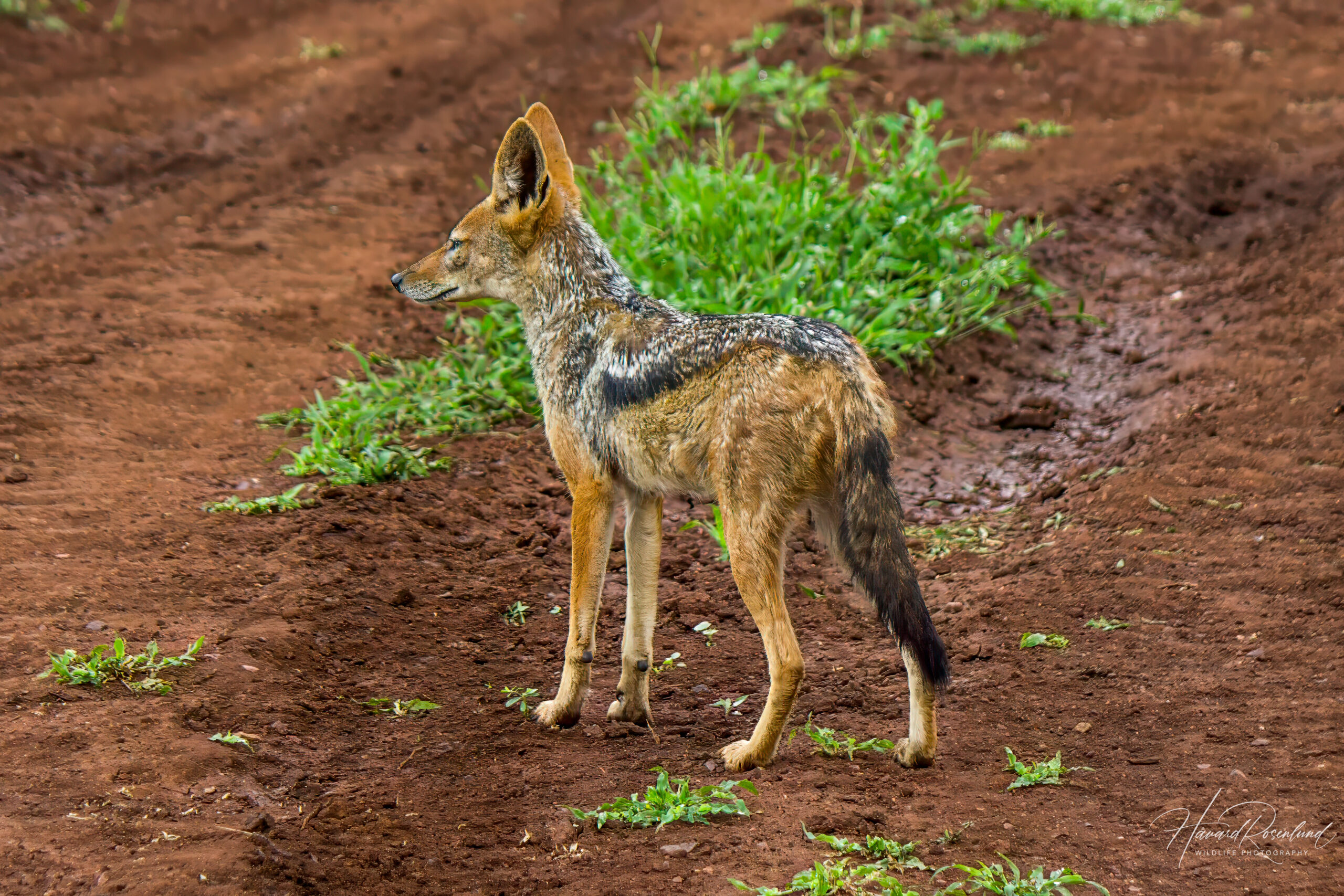
Black-backed Jackal
Lupulella mesomelas
At a glance
Habitat
- Open grassland, savanna, shrubland, semi-desert, coast and farmland
Diet
- Omnivorous; small vertebrates, invertebrates, carrion, fruit and coastal food
Activity
- Active by day and night; often more nocturnal near people
Size
- Length: 67–81 cm (head–body) Weight: 6–13 kg
Range
- Separate populations in eastern and southern Africa
Description
The black-backed jackal (Lupulella mesomelas) is one of Africa’s two jackals in the genus Lupulella and occurs only on the continent. Adults measure about 67–81 cm from head to body, stand roughly 38–48 cm at the shoulder and usually weigh 6–13 kg.
The flanks vary from reddish brown to tan, while a distinctive saddle of black and silver hairs covers the back. A sharp dark line separates the saddle from the redder flanks, and the tail has a black tip. The larger side-striped jackal (Lupulella adusta) is generally greyer, with a pale-edged dark stripe on the flank and a white-tipped tail.
Taxonomy
The black-backed and side-striped jackals were long placed in Canis alongside wolves, coyotes and domestic dogs. Genetic studies instead place them in a distinct, older African lineage, and the IUCN SSC Canid Specialist Group and Mammal Diversity Database now use the genus Lupulella.
Two geographically separated subspecies are traditionally recognised: L. m. mesomelas in southern Africa and L. m. schmidti in East Africa. Mitochondrial studies have found deep divergence between the two regional lineages, but broader genomic evidence is still needed before there is strong support for treating them as separate species.
Habitat
Black-backed jackals favour open country and occur in grassland, savanna, shrubland, semi-desert, open woodland, farmland and coastal desert. They are especially successful in landscapes with a mosaic of open hunting ground, cover and reliable food.
The species tolerates considerable human modification and can persist on livestock farms and around settlements as long as persecution is not too intense. In areas where it overlaps with the side-striped jackal, the black-backed jackal generally makes greater use of open and drier habitats while the side-striped species is more closely associated with denser vegetation.
Diet
The black-backed jackal is a highly adaptable omnivore. It eats insects and other arthropods, rodents, hares, birds, reptiles, fruit, carrion and small antelopes. Young or weakened animals substantially larger than a jackal may also be taken when an opportunity arises.
The diet can change quickly with season and local food availability. This flexibility allows it to live in prey-rich savannas, livestock country and some of Africa’s driest coastal environments.
Foraging
Black-backed jackals hunt alone, in pairs or occasionally in small family groups. Small prey is usually caught individually, while pairs can cooperate to bring down larger animals. Exceptionally they can go much further: in the Okavango Delta a single black-backed jackal was documented pursuing and killing an apparently healthy adult female impala (Aepyceros melampus). Such attacks on healthy adult antelopes are rare, but show how opportunistic the species can be.
They also scavenge readily and exploit carcasses and the remains of kills whenever opportunities arise. Some of the most unusual populations live on the Namibian coast, where jackals exploit marine food including stranded fish, seabirds and eggs, seal carcasses and Cape fur seal (Arctocephalus pusillus) pups.
Behaviour
Black-backed jackals can be active both by day and by night. They are often most active around dawn, dusk and during the cooler hours, while animals near people may become more nocturnal. Activity and movement can shift rapidly when seasonal prey, carrion or human-related food becomes available.
Territories are marked with urine, faeces and other scent marks, while a varied repertoire of yelps, barks and long-distance howls helps pairs and family members maintain contact and advertise their presence to neighbours. Dens may be excavated by the jackals themselves or adapted from burrows made by other animals.
Social behaviour
Black-backed jackals are usually seen alone, as a long-term pair or in a small family group. Pair bonds can persist for several years, and the pair cooperates in territorial defence, foraging and reproduction.
Older offspring sometimes remain in their natal territory and help guard or feed the next litter rather than dispersing immediately. This cooperative care can improve pup survival. Other young jackals leave and may travel widely before finding a mate and establishing a territory of their own.
Home ranges
Resident pairs and family groups maintain well-defined home ranges whose size changes with food availability and landscape structure. At Benfontein Game Farm in South Africa, radio-tracked dominant and subordinate adults used remarkably similar ranges averaging about 9.4 and 9.8 km² respectively. This shows that the whole family can share much the same area.
That pattern changes where food is exceptionally concentrated. At large Cape fur seal colonies on the Namibian coast, abundant and predictable carrion and seal pups can weaken normal territorial spacing and allow unusually many jackals to use the same feeding area. The species can therefore shift between strongly defended family ranges and much looser territorial behaviour when food is readily available to many individuals at the same time.
Interspecific competition
Black-backed jackals share their range with much larger carnivores that can both provide food and kill them. Lions (Panthera leo), African wild dogs (Lycaon pictus), spotted hyenas (Crocuta crocuta), leopards (Panthera pardus) and cheetahs (Acinonyx jubatus) have all been recorded killing jackals. At kills made by larger carnivores, jackals exploit brief openings to steal scraps but cannot directly challenge the dominant predator.
Tracking studies in Venetia, South Africa, showed that jackals did not avoid lion or wild-dog home ranges as a whole. When researchers looked more closely at the parts of those ranges used most heavily, however, the overlap was small. The jackals can therefore live in the same general landscape while largely avoiding the places most heavily used by the larger carnivores.
Reproduction
Breeding is seasonal, but timing varies across the range. In many populations, the period when pups need the most food coincides with seasonal peaks in food availability. After a gestation of about 60–65 days, the female usually gives birth to three to six pups, although both smaller and larger litters occur.
The pups remain close to the den during their first weeks. Both parents provide food and defence, and older siblings may assist when they remain with the family. The young gradually range farther from the den and become independent during their first year.
Relationship with humans
Few African carnivores have a longer history of conflict with livestock farmers. Black-backed jackals can kill sheep and goats, especially young animals, and have been controlled with shooting, traps and poison across large parts of southern Africa. Their flexible diet, rapid dispersal and ability to occupy altered landscapes make large-scale population control difficult.
Reviews of livestock conflict in South Africa have found little evidence that large-scale killing produces lasting reductions in livestock losses. Removing territorial animals can create vacant space that is later occupied by dispersing jackals while the conditions making livestock vulnerable remain. This has encouraged greater use of locally adapted measures such as better husbandry, fencing and livestock-guarding animals.
Black-backed jackals are also important hosts in rabies transmission in parts of southern Africa, another reason the relationship between the species, livestock and people is closely monitored.
Status
The black-backed jackal is listed as Least Concern on the IUCN Red List. It is widespread and locally common across separate eastern and southern African ranges, and the overall population trend is considered stable.
Persecution in livestock areas, road mortality and disease can reduce local numbers, but the species’ high adaptability allows it to persist in protected areas, farmland and many modified landscapes. Even intensive control campaigns have generally produced only temporary local reductions rather than a lasting range-wide decline.
Image gallery
Loading map and observations…
Have you seen this species?
Independent species archive
Did you find this species page useful?
Wildlife Vagabond is independently built and maintained. Voluntary support helps cover hosting, maps, data storage and continued improvements to the species archive.
Support Wildlife VagabondSpecies content will remain freely available.
References
Information about the species’ global distribution and status is based primarily on global Red List data. See the references below for details.
- Atickem, A., Stenseth, N. C., Drouilly, M., Bock, S., Roos, C., & Zinner, D. (2018). Deep divergence among mitochondrial lineages in African jackals. Zoologica Scripta, 47(1), 1-8. https://doi.org/10.1111/zsc.12257
- Avery, G., Avery, D. M., Braine, S., & Loutit, R. (1987). Prey of coastal black‐backed jackal Canis mesomelas (Mammalia: Canidae) in the Skeleton Coast Park, Namibia. Journal of Zoology, 213(1), 81-94. https://doi.org/10.1111/j.1469-7998.1987.tb03679.x
- Ferguson, J. W. H., Nel, J. A. J., & Wet, M. J. D. (1983). Social organization and movement patterns of Black‐backed jackals Canis mesomelas in South Africa*. Journal of Zoology, 199(4), 487-502. https://doi.org/10.1111/j.1469-7998.1983.tb05101.x
- International Union for Conservation of Nature. (n.d.). Lupulella mesomelas. The IUCN Red List of Threatened Species. https://www.iucnredlist.org/species/3755/46122476
- IUCN SSC Canid Specialist Group. (n.d.). Black-backed jackal (Lupulella mesomelas). https://www.canids.org/species/view/PREKN8360151
- Kamler, J. F., Foght, J. L., & Collins, K. (2010). Single black‐backed jackal (Canis mesomelas) kills adult impala (Aepyceros melampus). African Journal of Ecology, 48(3), 847-848. https://doi.org/10.1111/j.1365-2028.2009.01173.x
- Kamler, J. F., Nicholson, S., Stenkewitz, U., Gharajehdaghipour, T., & Davies‐Mostert, H. (2020). Do black‐backed jackals exhibit spatial partitioning with African wild dogs and lions? African Journal of Ecology, 58(3), 552-556. https://doi.org/10.1111/aje.12740
- Kamler, J. F., Stenkewitz, U., Gharajehdaghipour, T., & Macdonald, D. W. (2019). Social organization, home ranges, and extraterritorial forays of black‐backed jackals. The Journal of Wildlife Management, 83(8), 1800-1808. https://doi.org/10.1002/jwmg.21748
- Nattrass, N., Drouilly, M., & O'Riain, M. J. (2020). Learning from science and history about black‐backed jackalsCanis mesomelasand their conflict with sheep farmers in South Africa. Mammal Review, 50(1), 101-111. https://doi.org/10.1111/mam.12179
- Roberts, M., Degrugillier, F., Dzingwena, L., Fritz, H., Rougeron, V., & Prugnolle, F. R. (2025). Dietary Response of Black‐Backed Jackals (Lupulella mesomelas) to Contrasted Land Use. Ecology and Evolution, 15(10), e72186. https://doi.org/10.1002/ece3.72186
- Walton & Joly. (2003). Canis mesomelas, Mammalian Species 715. https://academic.oup.com/mspecies/article/doi/10.1644/0.715.1/2600807