
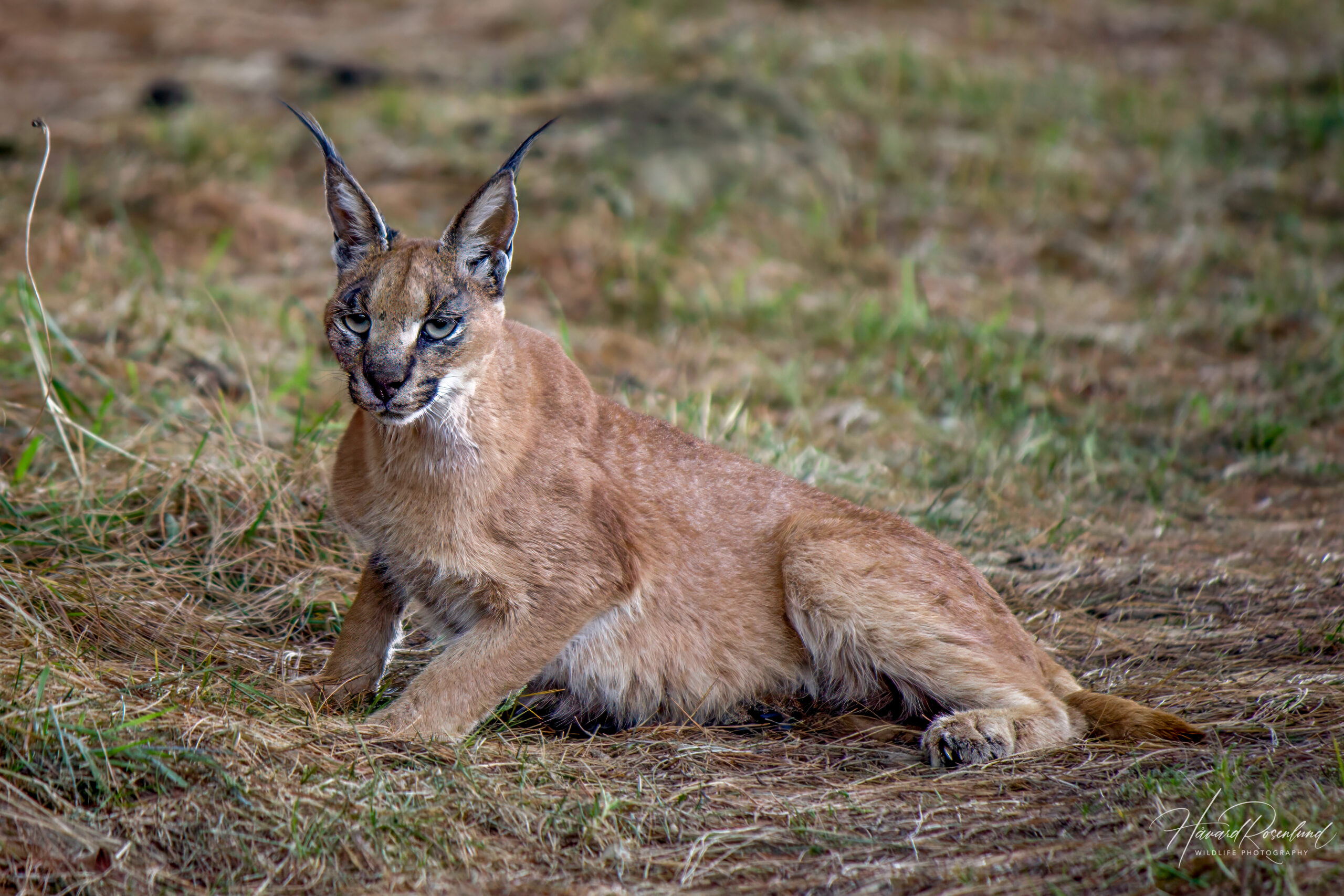
Caracal
Caracal caracal
At a glance
Habitat
- Semi-desert, steppe, savanna, scrub, dry woodland and rocky mountain country
Diet
- Carnivore; mainly small to medium-sized mammals and birds, with reptiles and other prey taken opportunistically
Activity
- Mostly nocturnal and crepuscular, but also active by day in cool or undisturbed areas
Size
- Length: 80–100 cm body; 20–34 cm tail Weight: 6–18 kg
Range
- Africa through the Middle East and Central Asia to northwestern India
Description
The caracal (Caracal caracal) is a medium-sized wild cat distributed across much of Africa and through the Middle East and Central Asia to northwestern India. It is sometimes called the desert lynx, but it is not a true lynx. Genetic evidence places it in the caracal lineage together with the African golden cat (Caracal aurata) and serval (Leptailurus serval). The name comes from the Turkish karakulak, meaning “black ear”.
Its long legs, short tail and tall, black-backed ears with prominent tufts give it a distinctive outline. The coat is usually plain tawny, sandy or brick-red with pale underparts and subtle facial markings; melanistic animals occur rarely. Adults measure roughly 80–100 cm from head to body, with a 20–34 cm tail, and generally weigh 6–18 kg. Males are larger than females.
Habitat
Caracals occupy semi-desert, steppe, savanna, scrub, dry forest, open woodland and rocky mountain country. They favour relatively open landscapes with enough vegetation, rocks or broken ground to provide cover for stalking and resting.
The species is well adapted to dry conditions and can obtain much of its water from prey, although it drinks when water is available. Caracals can also persist in some farmland, livestock country and landscapes around large cities if sufficient cover and prey remain. They generally avoid true sand desert and dense tropical rainforest.
Diet
The caracal is a flexible carnivore whose diet changes strongly with local prey availability. Hares, rodents, hyraxes, birds and small antelopes are important prey, while reptiles, invertebrates, fish, carrion and occasionally other small carnivores are also taken.
Most prey weighs less than about 5 kg, but caracals are powerful enough to kill animals two or three times their own mass. Diet differs markedly between regions and ecosystems, reflecting the prey available in each landscape and the opportunities encountered by individual cats.
Hunting
Hunting takes place mainly on the ground. The cat stalks close before accelerating in a short rush, using cover and broken terrain to reduce the distance to prey before the final attack.
Powerful hind legs allow a caracal to leap more than two metres into the air and seize birds as they take flight. Larger unfinished kills may be hidden under vegetation or, less often, cached in a tree for later use.
Behaviour
Caracals are solitary outside mating and the period when a female raises her young. Activity is usually concentrated at night and around dawn and dusk, but the pattern is flexible. In cooler conditions and protected areas caracals may be active in daylight, while animals exposed to greater human disturbance often shift activity toward darker hours.
Urine, faeces and other scent marks are important for communicating between animals that seldom meet directly.
Home ranges
Caracal space use varies enormously with prey density, habitat productivity and sex. Males generally use much larger areas than females, and a male range may overlap those of several females. Tracking studies illustrate the scale of this variation: in the Western Cape, male ranges have been roughly 26–65 km² and female ranges around 7 km², with females sometimes contracting to about 3 km² while raising young.
At the other extreme, studies in arid environments have recorded vastly larger ranges. A male in Saudi Arabia used more than 1,100 km² during winter, while annual ranges in Israel averaged about 220 km² for males and 57 km² for females. Caracals therefore adjust their movements dramatically to differences in prey distribution and the amount of productive habitat.
Reproduction
Breeding can occur throughout the year. Females may mate with several males during a short oestrus period, and after a gestation of about 78–80 days the mother gives birth in dense cover, a rock crevice, tree cavity or abandoned burrow. Litters contain one to six kittens, although two or three are more typical.
Kittens are born blind and usually open their eyes after about 6–10 days. The female raises the litter alone. Kittens begin eating meat at around one month, gradually accompany their mother as hunting skills develop and become independent at roughly nine to ten months. Young females may remain close to their mother's range longer than young males.
A Cape Peninsula study published in 2024 followed four females and found that mothers used their main denning areas for about six weeks. Six of seven documented dens were in dense fynbos and one was among boulders, all with heavy overhead cover. While the kittens were small, females used only about a third of the area they normally occupied.
Relationship with humans
People have interacted with caracals in very different ways. In India and Iran they were historically tamed and used to hunt birds and other small game, taking advantage of the species' remarkable jumping ability. Today, conflict with livestock owners is more important across much of the range because caracals can kill sheep, goats and poultry when these are accessible. Retaliatory shooting, trapping and poisoning remain important sources of mortality in several regions.
Tracking studies on the Cape Peninsula have shown that caracals living beside a major city alter both habitat use and daily activity in response to urbanisation while still obtaining most of their food from wild prey. A study published in 2025 used isotope analyses along individual whiskers to reveal striking dietary differences between animals, showing that some urbanising caracals specialise on different food sources from others.
Status
The caracal is classified as least concern on the IUCN Red List, but the global category hides major regional differences. The species remains common and relatively stable in parts of southern and eastern Africa, while populations are sparse, fragmented or declining through much of North Africa, the Middle East and Asia.
Habitat loss and fragmentation, depletion of wild prey, road traffic, persecution following livestock losses, poisoning and wildlife trade are important pressures in different parts of the range. African populations are listed in CITES Appendix II, while Asian populations are in Appendix I.
Image gallery
Loading map and observations…
Have you seen this species?
Independent species archive
Did you find this species page useful?
Wildlife Vagabond is independently built and maintained. Voluntary support helps cover hosting, maps, data storage and continued improvements to the species archive.
Support Wildlife VagabondSpecies content will remain freely available.
References
Information about the species’ global distribution and status is based primarily on global Red List data. See the references below for details.
- International Union for Conservation of Nature. (n.d.). Caracal caracal. The IUCN Red List of Threatened Species. https://www.iucnredlist.org/species/3847/102424310
- IUCN SSC Cat Specialist Group. (n.d.). Caracal. https://www.catsg.org/living-species-caracal
- Leighton, G. R. M., Bishop, J. M., Merondun, J., Winterton, D. J., O’Riain, M. J., & Serieys, L. E. K. (2022). Hiding in plain sight: risk mitigation by a cryptic carnivore foraging at the urban edge. Animal Conservation, 25(2), 244-258. https://doi.org/10.1111/acv.12732
- Leighton, G. R. M., Brooke, A. R., Froneman, P. W., Serieys, L. E. K., & Bishop, J. M. (2025). The Cat's Whiskers: Stable Isotopes Reveal Individual Specialisation of Adaptable Caracals (Caracal caracal) Foraging in an Urbanising Landscape. Ecology and Evolution, 15(3), e71154. https://doi.org/10.1002/ece3.71154
- Mammal Diversity Database. (n.d.). Caracal caracal. American Society of Mammalogists. https://www.mammaldiversity.org/taxon/1005981/
- Parchizadeh, J., Schooler, S. L., Adibi, M. A., Arias, M. G., Rezaei, S., & Belant, J. L. (2023). A review of caracal and jungle cat diets across their geographical ranges during 1842–2021. Ecology and Evolution, 13(5), e10130. https://doi.org/10.1002/ece3.10130
- Serieys, L. E., Bishop, J. M., Rogan, M. S., Smith, J. A., Suraci, J. P., O’Riain, M. J., & Wilmers, C. C. (2023). Anthropogenic activities and age class mediate carnivore habitat selection in a human-dominated landscape. iScience, 26(7), 107050. https://doi.org/10.1016/j.isci.2023.107050
- Serieys, L. E. K., Leighton, G. R. M., Merondun, J., & Bishop, J. M. (2024). Denning and maternal behavior of caracals (Caracal caracal). Mammalian Biology, 104(5), 615-621. https://doi.org/10.1007/s42991-024-00429-z