
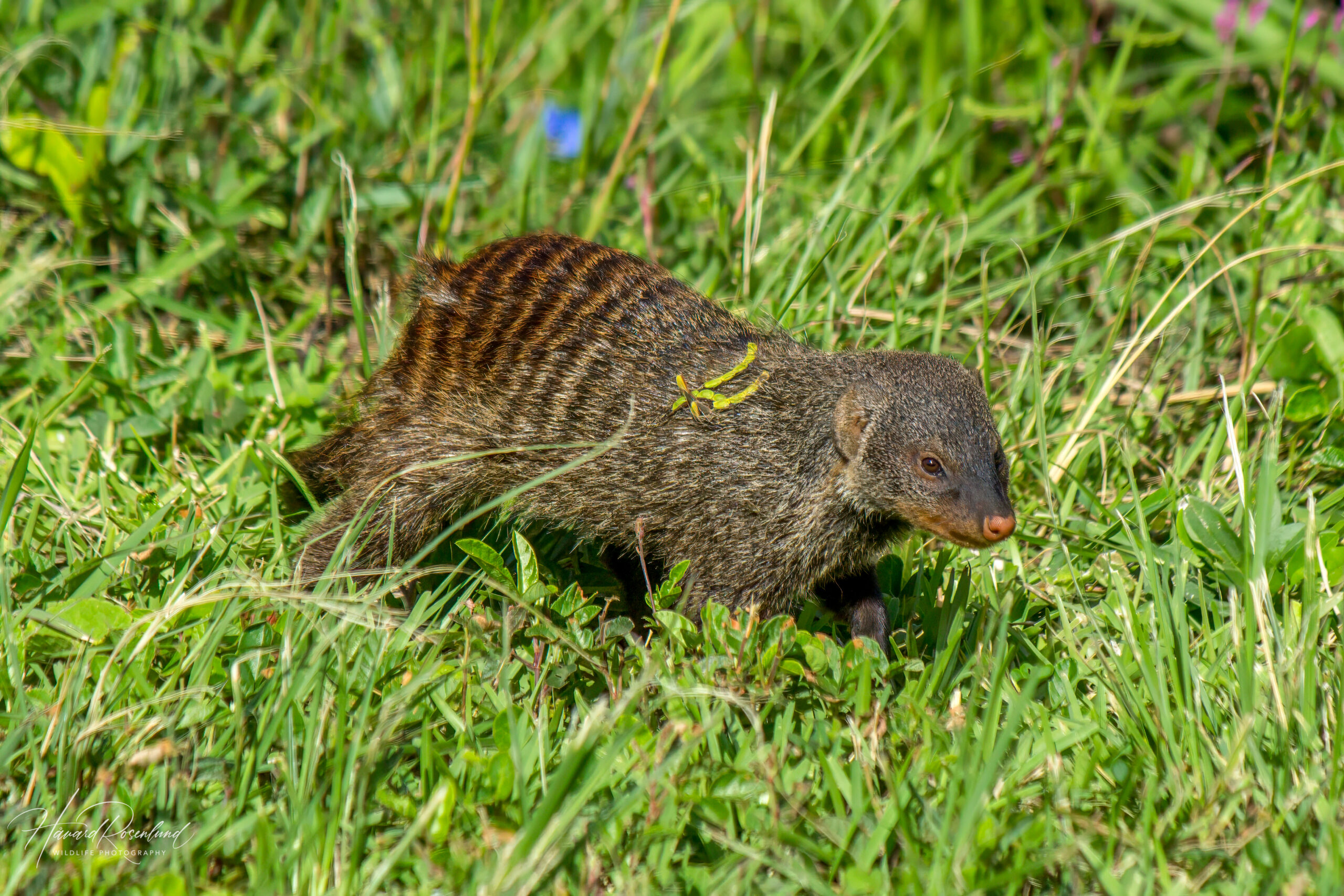
Banded Mongoose
Mungos mungo
At a glance
Habitat
- Savanna, grassland, shrubland, open woodland and some human-modified areas
Diet
- Mainly insects and other invertebrates; also small vertebrates, eggs and occasional plant food
Activity
- Diurnal, especially morning and late afternoon
Size
- Length: 30–45 cm + 15–30 cm tail Weight: 1.5–2.25 kg
Range
- Broadly distributed across sub-Saharan Africa
Description
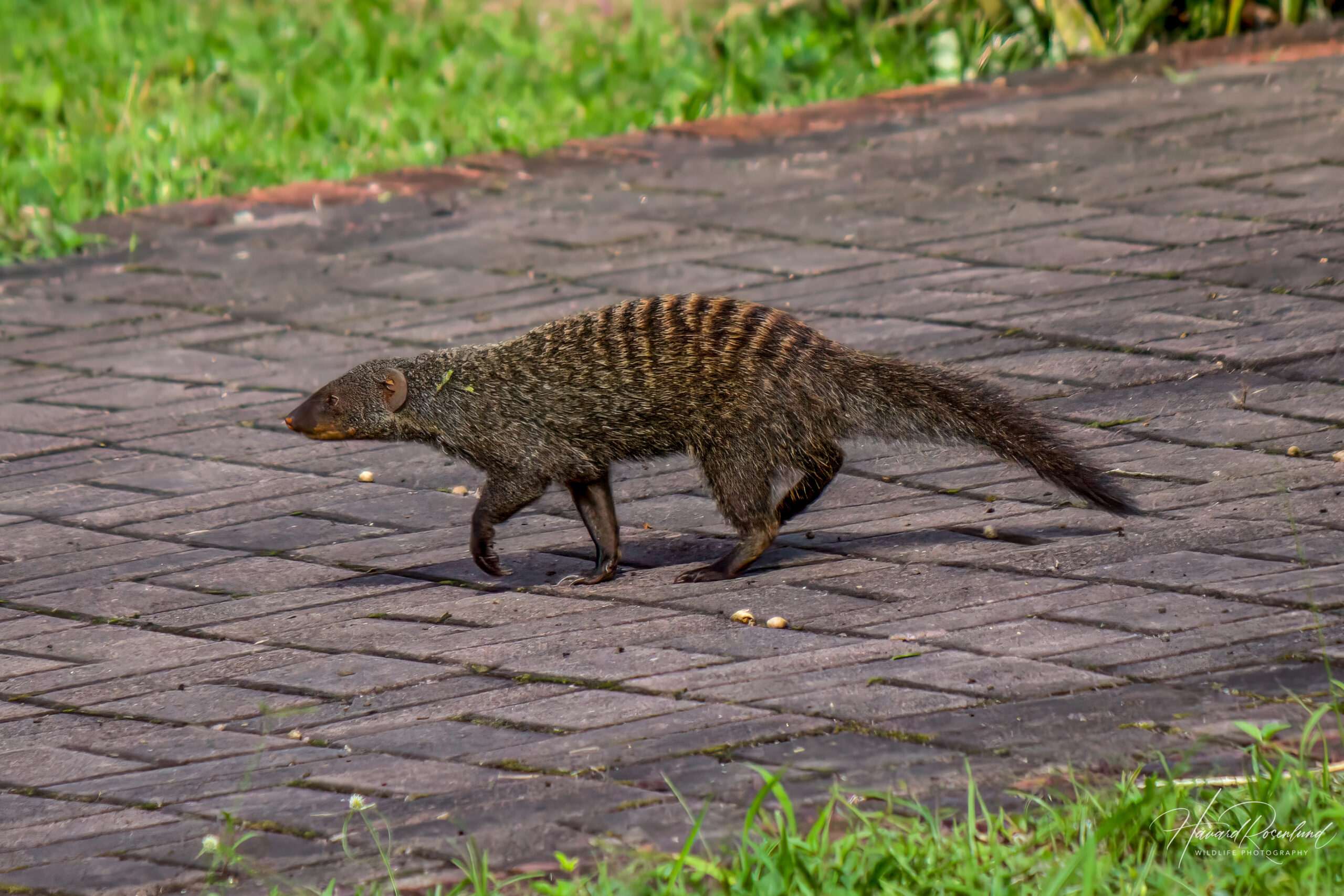
The banded mongoose (Mungos mungo) is a highly social African mongoose with short legs, an elongated body and tail, strong digging claws and a series of dark bands across the back. Coat colour varies from dark brown in wetter regions to paler grey-brown in dry country.
Head-and-body length is about 30–45 cm, the tail 15–30 cm, and adults usually weigh 1.5–2.25 kg. Males and females look broadly alike.
Habitat
Banded mongooses live in savanna, grassland, shrubland and open woodland and are often associated with water. They also use farmland, lodge grounds and settlements where shelter and food are available.
Groups depend on networks of dens and normally move between sites every few days. Abandoned termite mounds are especially important, but rock crevices, thickets, gullies, hollow logs and spaces beneath buildings may also be used.
Diet
Insects and other invertebrates dominate the diet, including beetles, termites, larvae, millipedes and many other small prey. Banded mongooses also take small reptiles, amphibians, birds, eggs and occasional plant material.
Larger or more dangerous prey may trigger cooperation. Several group members may confront venomous snakes together, even though most everyday prey is caught and eaten individually.
Foraging
A group spreads out while searching for food, but individuals usually capture their own prey. Smell is important, and the long front claws are used to dig prey from soil, leaf litter, holes and cavities. Banded mongooses also often search dung from large herbivores for beetles and other invertebrates.
A 2025 field study in equatorial Uganda found that high temperatures reduced the time the mongooses could spend foraging effectively.
This video, which I filmed in St Lucia, South Africa, shows a group foraging together.
Behaviour
Banded mongooses are diurnal and usually leave the den after sunrise. They remain active through much of the morning, rest during the hottest part of the day and become active again later in the afternoon. Daily movement depends on food, temperature and where the next den lies.
They communicate with contact calls, alarm calls, scent marks and latrines. Group members keep in close acoustic contact while spread out, allowing the troop to move as a coordinated unit even when individuals are hidden by vegetation.
Social behaviour
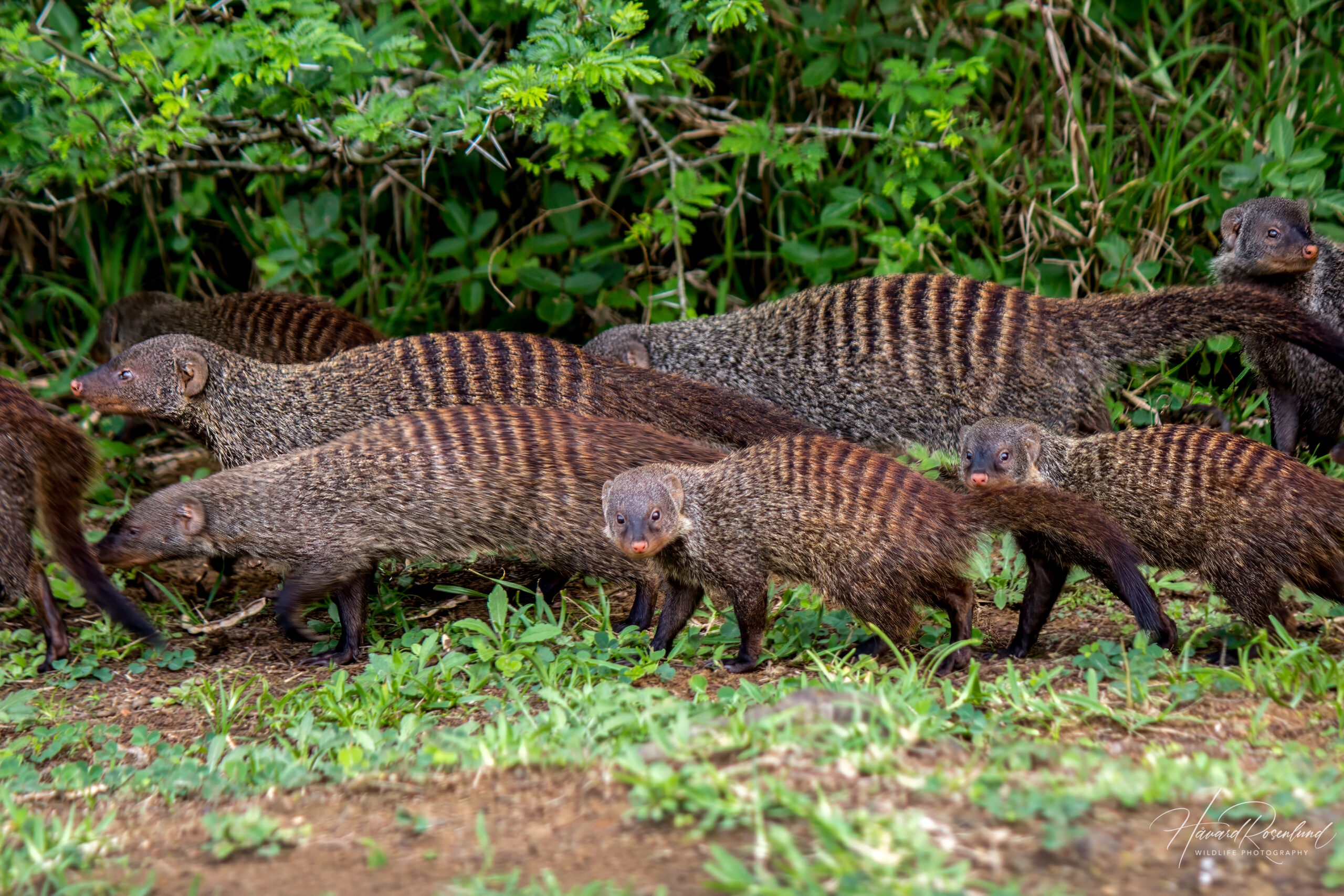
Banded mongooses live in cohesive mixed-sex groups, often numbering around 10–20 animals but sometimes considerably more. Group members travel, defend territory and rear young together. Groups do not have a simple, rigid hierarchy, but age, reproductive condition and alliances influence access to mates and resources.
Cooperation coexists with intense competition within the group. Older females generally reproduce earlier and more successfully, and groups may forcibly evict subordinate females, sometimes together with males. Animals evicted together may form new groups, reshaping the social structure of the population.
Encounters between neighbouring groups can be extremely violent and may cause serious injury or death. Groups compete over territory, food and mating opportunities, and a distinctive “war cry” can bring members together before a confrontation. Males do most of the direct fighting, and long-term work in Uganda has shown that both the number and experience of adult males can strongly influence which group wins.
Intergroup conflicts also affect mating. Females in oestrus are especially likely to lead their group towards rivals and can use the confusion of a fight to mate with males from the opposing group. Genetic studies have found that many pups are fathered by males outside the group, helping females avoid inbreeding in long-established groups. The result is a social system in which close cooperation within the group is tightly linked to dangerous competition between groups.
Pups receive extensive cooperative care. Once they leave the den, many form a stable one-to-one relationship with an adult “escort” that protects them and helps them find food. Pups that receive more escort care grow better, and long-term studies show benefits that can persist into adulthood.
Reproduction
Reproduction is highly synchronised within each group. Adult females enter oestrus within only a few days of one another, and many return to oestrus within about ten days of giving birth. Males closely guard individual females during these periods, often for two to three days, following them throughout the day and driving rival males away. Older, more competitive males obtain a disproportionate share of matings, but they cannot monopolise every female because so many are receptive at once.
Subordinate males therefore have other opportunities. Some use sneaking tactics rather than directly challenging a guarding male, and long-term work has shown that males may shift between guarding females, sneaking matings and periods without mating over their lives. As noted earlier, females also mate outside their own group during intergroup encounters, giving additional males opportunities to sire pups.
Gestation lasts roughly 60–70 days. Several females often give birth within a few days of one another, and births may be so tightly synchronised that most pups in the communal litter arrive on the same night. Individual litters commonly contain two to six pups.
Newborn pups remain in the den for several weeks and are guarded by babysitters while much of the group forages. Later they receive the one-to-one escort care described above. Breeding can occur several times a year where conditions allow, although a long-term study in equatorial Uganda found clear reproductive peaks associated with the wet seasons, showing that rainfall and food availability still shape reproduction even close to the equator.
Relationship with humans
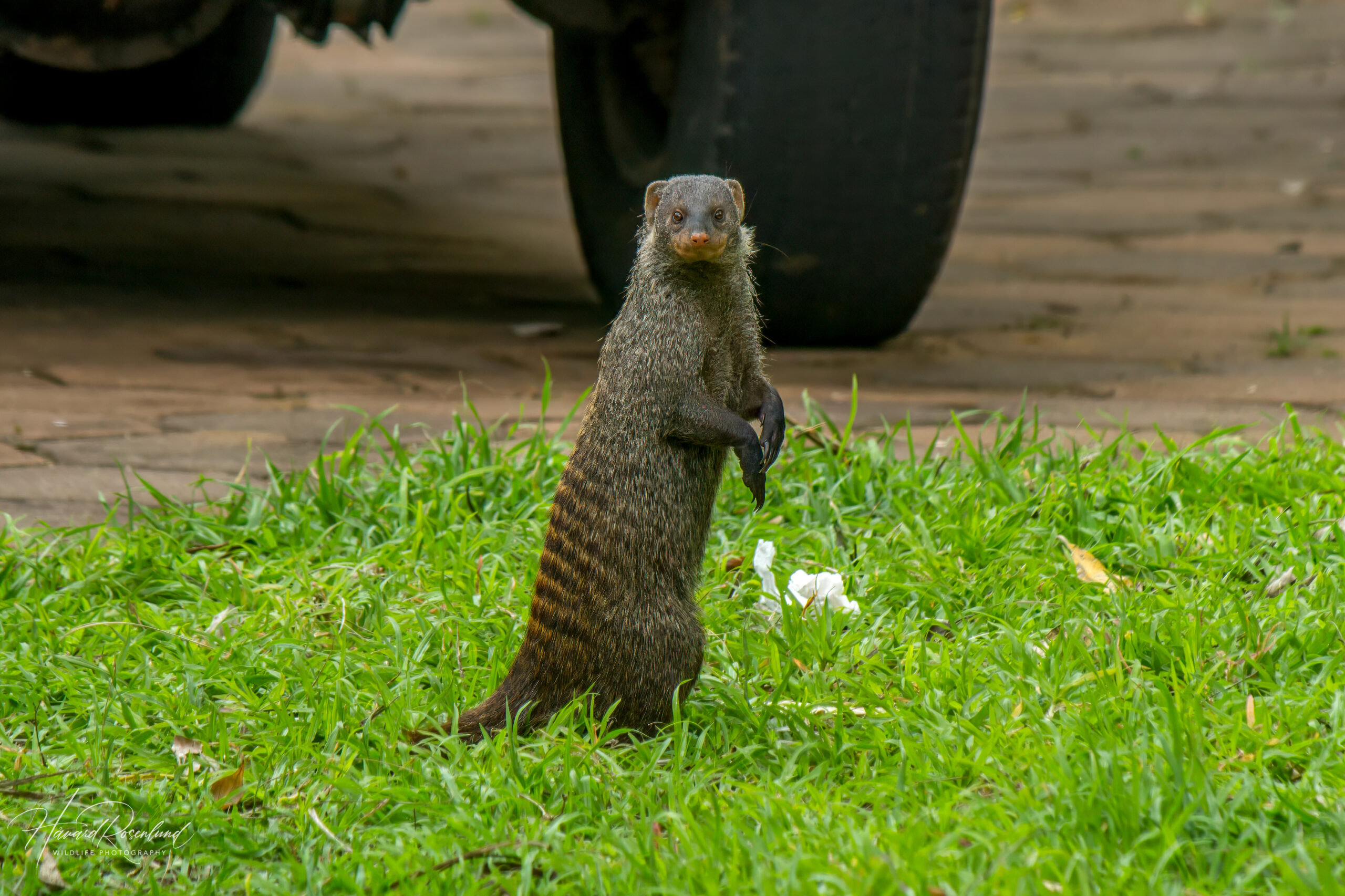
Banded mongooses adapt readily to human-modified landscapes and may den under buildings, forage around lodges and use refuse sites. This flexibility can make them conspicuous around settlements and tourist areas.
Human food sources are not always beneficial. Studies in northern Botswana found that using garbage was linked to changes in both aggression and disease transmission within mongoose groups. Banded mongooses there also carry several infectious agents of concern where wildlife, people and livestock live in close proximity, including a distinctive tuberculosis-causing bacterium, Mycobacterium mungi. Human settlements can therefore provide food and shelter while also altering the risks of disease transmission and conflict.
Status
The banded mongoose is listed as Least Concern on the IUCN Red List. The global assessment published in 2016 describes it as widespread, common and present in many protected areas.
No major range-wide threat is recognised. Bushmeat hunting, disease, road mortality and conflict around settlements can affect local groups, but the species remains broadly distributed across sub-Saharan Africa.
Image gallery
Loading map and observations…
Have you seen this species?
Independent species archive
Did you find this species page useful?
Wildlife Vagabond is independently built and maintained. Voluntary support helps cover hosting, maps, data storage and continued improvements to the species archive.
Support Wildlife VagabondSpecies content will remain freely available.
References
Information about the species’ global distribution and status is based primarily on global Red List data. See the references below for details.
- Birch, G., Nichols, H. J., Mwanguhya, F., Blount, J. D., & Cant, M. A. (2025). Strategic use of male alternative reproductive tactics in cooperatively breeding banded mongoose groups. Royal Society Open Science, 12(2), 242215. https://doi.org/10.1098/rsos.242215
- Cant, M. A., Otali, E., & Mwanguhya, F. (2002). Fighting and Mating Between Groups in a Cooperatively Breeding Mammal, the Banded Mongoose. Ethology, 108(6), 541-555. https://doi.org/10.1046/j.1439-0310.2002.00795.x
- Flint, B. F., Hawley, D. M., & Alexander, K. A. (2016). Do not feed the wildlife: associations between garbage use, aggression, and disease in banded mongooses (Mungos mungo). Ecology and evolution, 6(16), 5932-9. https://doi.org/10.1002/ece3.2343
- Gilchrist, J. S. (2004). Pup escorting in the communal breeding banded mongoose: behavior, benefits, and maintenance. Behavioral Ecology, 15(6), 952-960. https://doi.org/10.1093/beheco/arh071
- Hodge, S. J., Bell, M. B. V., & Cant, M. A. (2011). Reproductive competition and the evolution of extreme birth synchrony in a cooperative mammal. Biology Letters, 7(1), 54–56. https://doi.org/10.1098/rsbl.2010.0555
- International Union for Conservation of Nature. (2016). Mungos mungo. The IUCN Red List of Threatened Species. https://www.iucnredlist.org/species/41621/45208886
- Johnstone, R. A., Cant, M. A., Cram, D., & Thompson, F. J. (2020). Exploitative leaders incite intergroup warfare in a social mammal. Proceedings of the National Academy of Sciences of the United States of America, 117(47), 29759-29766. https://doi.org/10.1073/pnas.2003745117
- Khera, M., Arbuckle, K., Bwambale, O., Mwanguhya, F., Nicholl, M. H., Cant, M. A., & Nichols, H. J. (2025). High Ambient Temperatures Are Associated With Reduced Foraging Capacity in an Equatorial Mammal, the Banded Mongoose (Mungos mungo). Ecology and Evolution, 15(8), e71872. https://doi.org/10.1002/ece3.71872
- Khera, M., Arbuckle, K., Mwanguhya, F., Cant, M. A., & Nichols, H. J. (2025). Reproduction is driven by seasonal environmental variation in an equatorial mammal, the banded mongoose (Mungos mungo). Behavioral Ecology, 36(2), araf007. https://doi.org/10.1093/beheco/araf007
- Laver, P. N., & Alexander, K. A. (2018). Association with humans and seasonality interact to reverse predictions for animal space use. Movement Ecology, 6(1), 5. https://doi.org/10.1186/s40462-018-0123-7
- Mammal Diversity Database. (n.d.). Mungos mungo. American Society of Mammalogists. https://www.mammaldiversity.org/taxon/1006069/
- Nichols, C. A., & Alexander, K. A. (2019). Characteristics of banded mongoose (Mungos mungo) den sites across the human-wildlife interface in Northern Botswana. Mammalian Biology, 97, 80-87. https://doi.org/10.1016/j.mambio.2019.03.005
- Thompson, F. J., Marshall, H. H., Sanderson, J. L., Vitikainen, E. I. K., Nichols, H. J., Gilchrist, J. S., Young, A. J., Hodge, S. J., & Cant, M. A. (2016). Reproductive competition triggers mass eviction in cooperative banded mongooses. Proceedings. Biological sciences, 283(1826), 20152607. https://doi.org/10.1098/rspb.2015.2607