
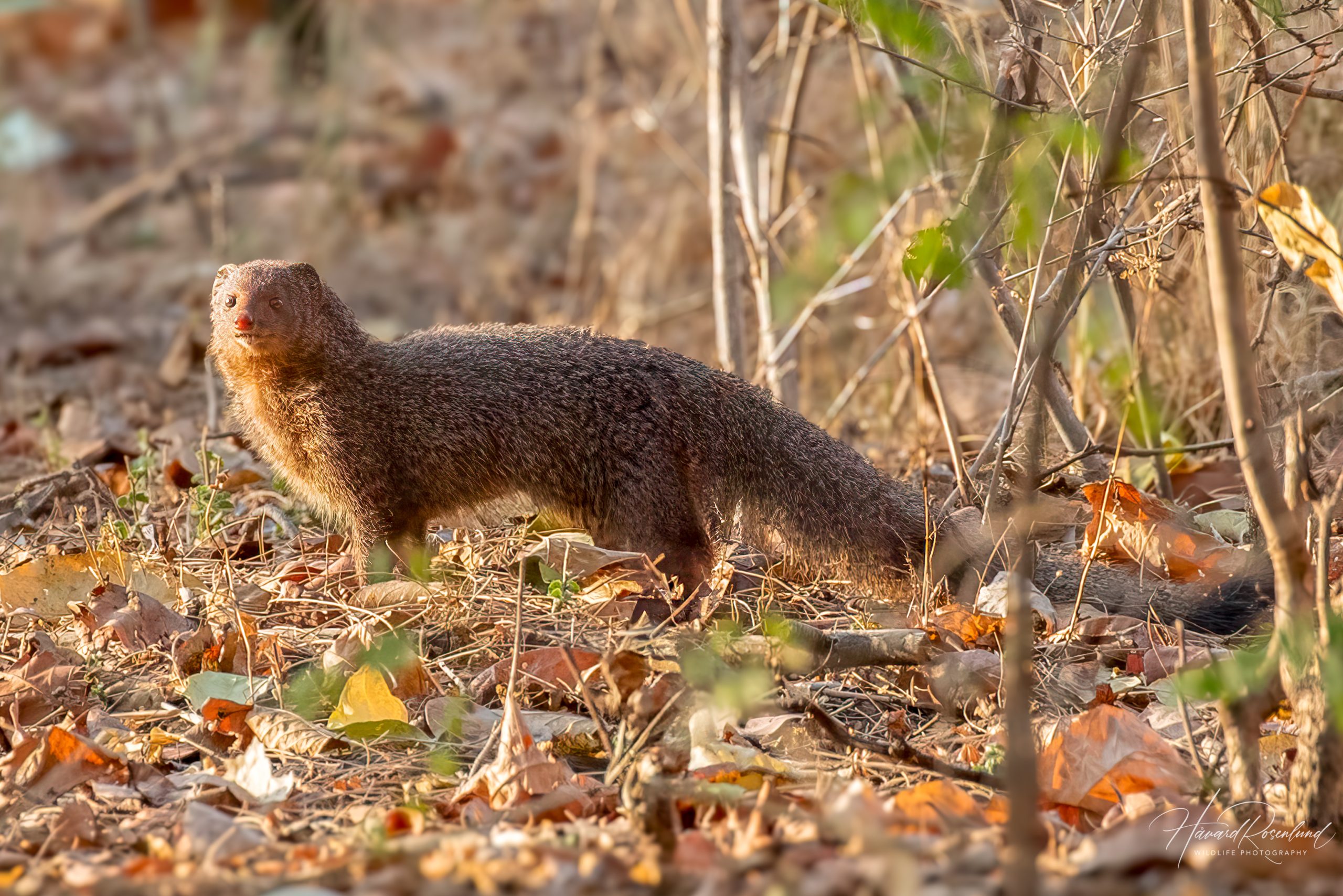
Ruddy Mongoose
Urva smithii
At a glance
Habitat
- Dry and moist deciduous forest, thorn forest, semi-evergreen forest, rocky woodland and scrub
Diet
- Opportunistic predator; small mammals, reptiles, birds, eggs and invertebrates are reported, but diet is poorly quantified
Activity
- Primarily diurnal
Size
- Length: Body 39–47 cm; tail 30–36 cm Weight: about 1.8–2.7 kg
Range
- India and Sri Lanka; documented locally in western Nepal
Description
The ruddy mongoose (Urva smithii) is a medium-sized Asian mongoose found primarily in India and Sri Lanka. A camera-trap record from Banke National Park in January 2014 also documented the species in Nepal for the first time. Adults have a head-and-body length of roughly 39–47 cm, a long bushy tail of about 30–36 cm and weigh about 1.8–2.7 kg. The coat varies from grey-brown to rich reddish-brown, and the tail ends in a conspicuous black tip. This combination is useful for separating it from the Indian grey mongoose (Urva edwardsii), although colour alone can vary with light, season and individual.
Older literature usually places the species in Herpestes. Genetic research on mongoose relationships showed that the Asian species traditionally grouped there form a separate branch of the family, and the current Mammal Diversity Database places the ruddy mongoose in Urva as Urva smithii.
Habitat
Ruddy mongooses occur in a broad range of wooded and semi-open habitats, including dry and moist deciduous forest, tropical thorn forest, semi-evergreen forest, rocky woodland and scrub.
A camera-trap study published in 2014 from Mudumalai Tiger Reserve found the ruddy mongoose to be the most abundant small carnivore during the dry season, with abundance increasing in dry thorn forest. A broader study published in 2022 from the Western Ghats found rainfall, elevation and proximity to water important in shaping the distributions of several mongoose species. In Kumana National Park, Sri Lanka, a 2025 study found the ruddy mongoose most likely to occur in tropical thorn forest and more likely farther from visitor roads. Habitat use therefore varies among landscapes and responds to vegetation, climate, water and disturbance.
Diet
The ruddy mongoose is an opportunistic predator, but its diet remains poorly documented. Small mammals, reptiles, birds, eggs and invertebrates have all been reported, but there are few good studies showing how important the different prey types actually are.
In Nagarahole Tiger Reserve, Karnataka, a ruddy mongoose was observed taking a pipistrelle bat from a tree crevice in December 2022; the record was published in 2024 as the first documented case of bat predation by this species. In Similipal Tiger Reserve, Odisha, a ruddy mongoose was observed in January 2020 attempting to take an adult Indian giant squirrel and pursuing it several metres up a tree; the observation was published later that year. These records show that the species can exploit very different mammalian prey and hunt above ground, but how often such prey are taken remains unknown.
Behaviour
Ruddy mongooses are primarily active during daylight. A study published in 2022 from the Western Ghats found ruddy and stripe-necked mongooses to be diurnal, while the brown mongoose was more nocturnal. The three species also showed different activity peaks through the day, which may reduce competition where they share the same landscapes.
Ruddy mongooses are most often encountered alone, although their social organisation has received little dedicated study. They search mainly on the ground through leaf litter, rocks and low vegetation. Precise territory sizes and vocal repertoire remain poorly documented for the species.
Reproduction
Reproduction is one of the least studied parts of ruddy mongoose biology. PanTHERIA-derived data give a mean litter size of about 2.5 young. Beyond this, reliable species-specific data on mating season, gestation, den use, weaning, age at independence and the rest of juvenile development remain very sparse for Urva smithii.
Status
The ruddy mongoose is classified as least concern on the IUCN Red List. The species occurs in many protected areas and can be locally common, but species-specific population trends remain poorly known across much of the range.
Habitat loss and hunting affect small carnivores in parts of India, while illegal trade in mongoose hair for paintbrushes is a wider problem for the country's mongoose species. A forensic study published in 2025 developed diagnostic hair characters for all six Indian Urva species because confiscated mongoose hair can otherwise be difficult to identify to species.
Image gallery
Loading map and observations…
Have you seen this species?
Independent species archive
Did you find this species page useful?
Wildlife Vagabond is independently built and maintained. Voluntary support helps cover hosting, maps, data storage and continued improvements to the species archive.
Support Wildlife VagabondSpecies content will remain freely available.
References
Information about the species’ global distribution and status is based primarily on global Red List data. See the references below for details.
- Anawarathna, M. A. D. C. K., Weerasinghe, H. M., Rodrigo, B. K. P. D., Mendis, V. N., Gunathilaka, W. D. C. N., Dasanayake, D. M. T., Jayasekara, E. D. G. P., & Mahaulpatha, W. A. D. (2025). Habitat factors influencing the distribution of Herpestidae species in Kumana National Park, Sri Lanka. In Proceedings of the 29th International Forestry and Environment Symposium (pp. 67). University of Sri Jayewardenepura. https://doi.org/10.31357/fesympo.v29.8066
- Chikkanaragund Harshakumar, Puttaswamaiah, R., & Nag, K. C. (2024). First sighting record of a Ruddy Mongoose Urva smithii Gray, 1837 feeding on a pipistrelle bat in Nagarahole Tiger Reserve, India. Journal of Threatened Taxa, 16(10), 26027-26029. https://doi.org/10.11609/jott.9347.16.10.26027-26029
- International Union for Conservation of Nature. (n.d.). Ruddy Mongoose. The IUCN Red List of Threatened Species. https://www.iucnredlist.org/species/41617/45208195
- Jones, K. E., Bielby, J., Cardillo, M., Fritz, S. A., O'Dell, J., Orme, C. D. L., Safi, K., Sechrest, W., Boakes, E. H., Carbone, C., Connolly, C., Cutts, M. J., Foster, J. K., Grenyer, R., Habib, M., Plaster, C. A., Price, S. A., Rigby, E. A., Rist, J., … Purvis, A. (2009). PanTHERIA: a species‐level database of life history, ecology, and geography of extant and recently extinct mammals. Ecology, 90(9), 2648-2648. https://doi.org/10.1890/08-1494.1
- Kalle, R., Ramesh, T., Qureshi, Q., & Sankar, K. (2014). Estimating seasonal abundance and habitat use of small carnivores in the Western Ghats using an occupancy approach. Journal of Tropical Ecology, 30(5), 469-480. https://doi.org/10.1017/S0266467414000340
- Kumara & Singh. (2007). Small carnivores of Karnataka: distribution and sight records. Journal of the Bombay Natural History Society, 104, 155–162. https://repository.ias.ac.in/89658/
- Mammal Diversity Database. (n.d.). Urva smithii. American Society of Mammalogists. https://www.mammaldiversity.org/taxon/1006056/
- Patou, M.-L., Mclenachan, P. A., Morley, C. G., Couloux, A., Jennings, A. P., & Veron, G. (2009). Molecular phylogeny of the Herpestidae (Mammalia, Carnivora) with a special emphasis on the Asian Herpestes. Molecular Phylogenetics and Evolution, 53(1), 69-80. https://doi.org/10.1016/j.ympev.2009.05.038
- Rathore, Pati & Pandav. (2020). A Ruddy Mongoose Urva smithii observed to attempt to prey on an Indian Giant Squirrel Ratufa indica, Similipal Tiger Reserve, India. Small Carnivore Conservation, 58, e58016. https://www.researchgate.net/publication/382076742_A_Ruddy_Mongoose_Urva_smithii_observed_to_attempt_to_prey_on_an_Indian_Giant_Squirrel_Ratufa_indica_Similipal_Tiger_Reserve_India
- Roy, M., Kundu, S., & Kamalakannan, M. (2025). Tricho-taxonomic profiling of Indian mongoose guard hairs reveal potential applications in wildlife forensics and species conservation. Discover Conservation, 2(1), 42. https://doi.org/10.1007/s44353-025-00060-0
- Shameer, T. T., Backer, S. J., Nandhini, S., Raman, S., Mujawar, A. N., Yogesh, J., Kaushal, K. K., Reddy, S. R., Nazia, A., & Sanil, R. (2022). How do the sympatric forest mongooses coexist in the Western Ghats landscape? Insights from spatio-temporal approach. Community Ecology, 23(2), 231-245. https://doi.org/10.1007/s42974-022-00101-x
- Subba, S. A., Malla, S., Dhakal, M., Thapa, B. B., Bhandari, L. B., Ojha, K., Bajracharya, P., & Gurung, G. S. (2014). Ruddy mongoose Herpestes smithii: a new species for Nepal. Small Carnivore Conservation, 51, 88–89. https://www.researchgate.net/publication/273783888_Ruddy_mongoose_Herpestes_smithii_a_new_species_for_Nepal