
Blackbuck
Antilope cervicapra
At a glance
Habitat
- Semi-arid grassland, savanna, open scrub, dry plains and agricultural mosaics
Diet
- Primarily grasses, with herbs, pods, crops and some browse taken seasonally
Activity
- Diurnal, with strongest feeding activity often in the cooler parts of the day
Size
- Length: about 100–150 cm Weight: about 19–57 kg
Range
- Native to the Indian subcontinent, now concentrated mainly in India with smaller populations in Nepal and locally elsewhere
Description
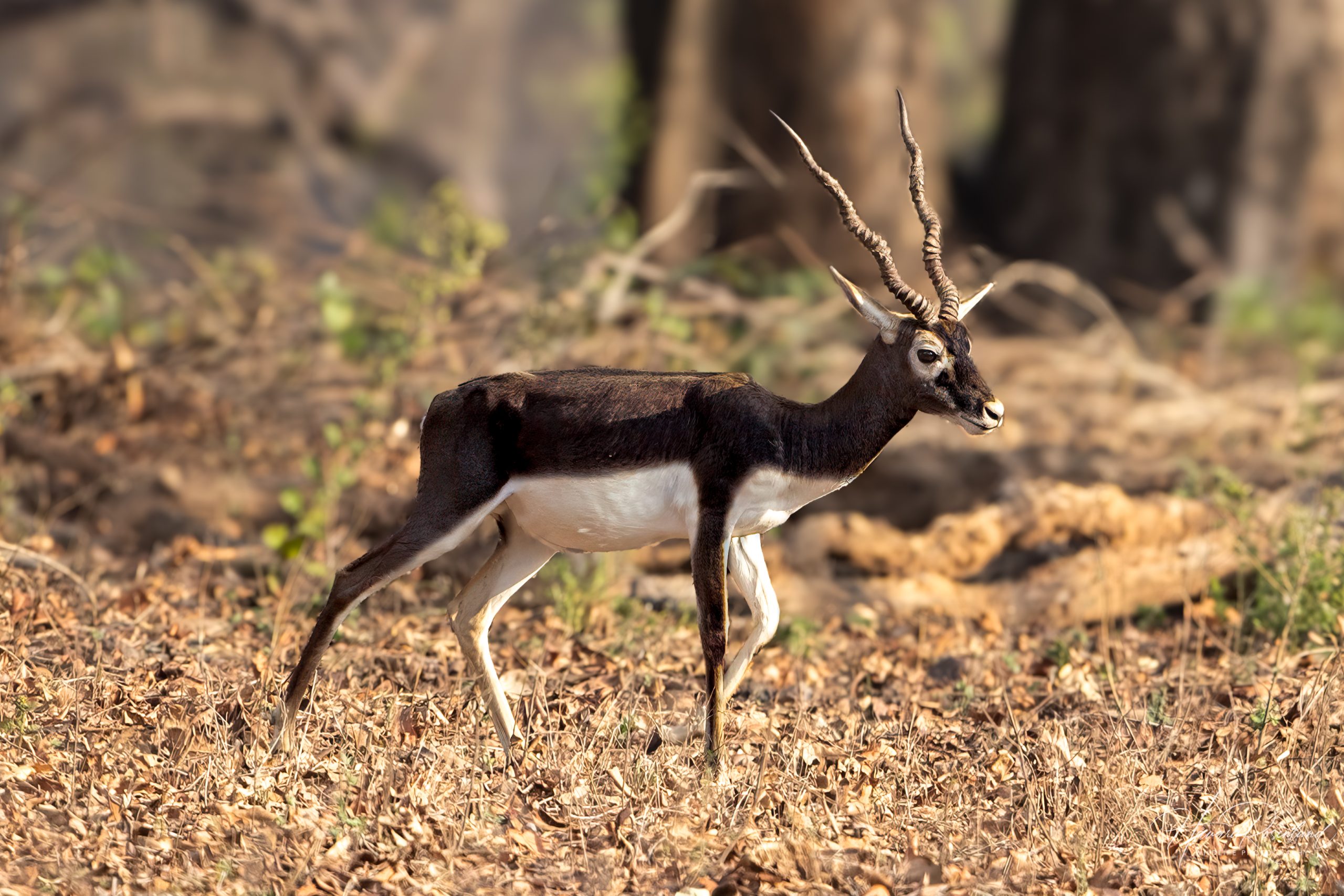
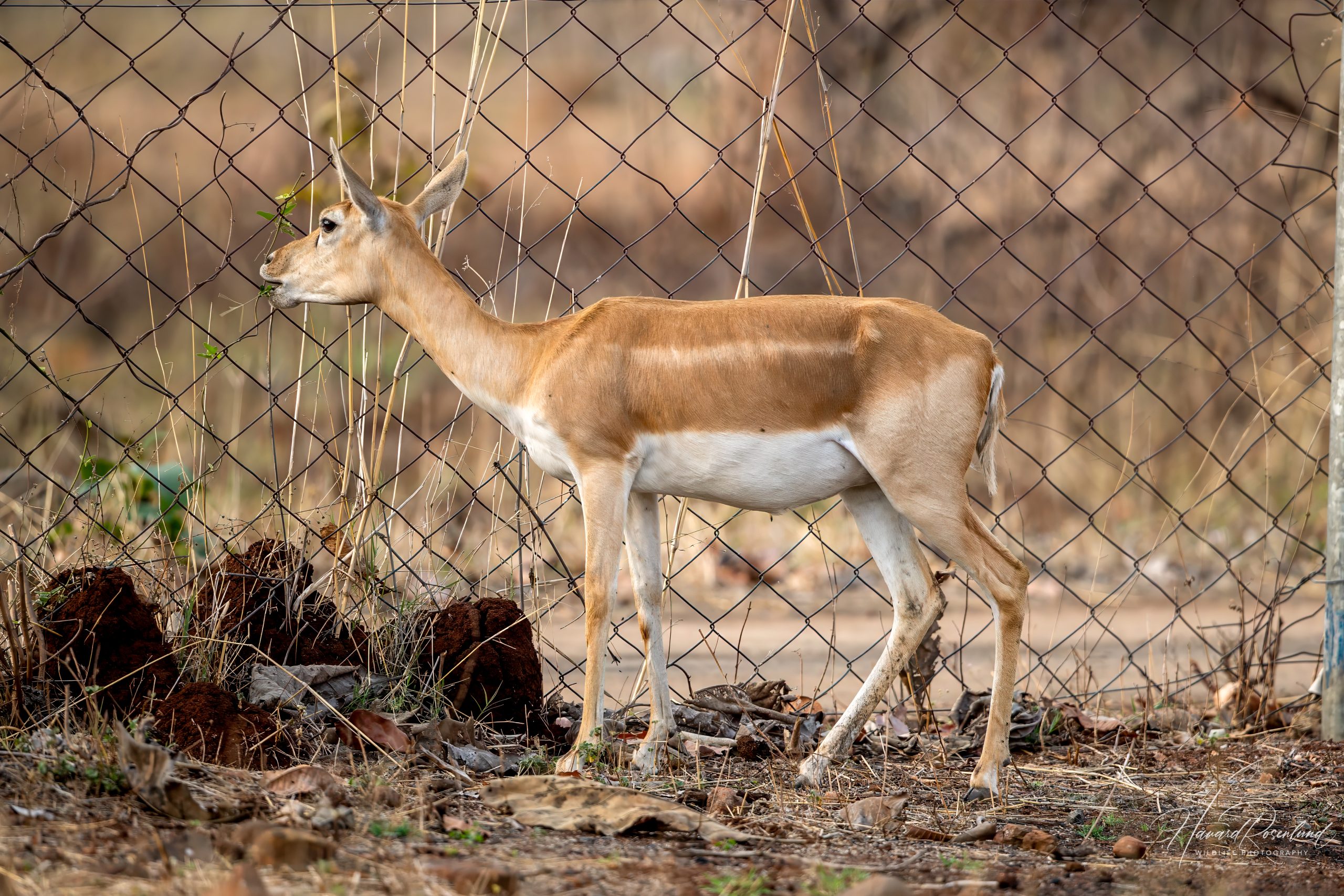
The blackbuck (Antilope cervicapra) is a medium-sized antelope and the only living species in the genus Antilope. Adults are roughly 100–150 cm long and stand about 74–84 cm at the shoulder. Males generally weigh about 20–57 kg and females about 19–33 kg. The species shows striking sexual dimorphism: mature males become dark brown to almost black above with sharply contrasting white underparts, while females and young males remain fawn to yellow-brown.
Long, ringed, corkscrew-like horns are normally restricted to males and can reach about 79 cm in exceptional individuals. The slender build, long legs and strong colour contrast make adult males unmistakable in open country. Females are smaller and hornless in most populations.
Habitat
Blackbuck are specialists of open landscapes, especially semi-arid grassland, savanna, short-grass plains, open scrub and agricultural mosaics. They perform best where vegetation remains low enough to provide wide visibility and abundant grazing. Dense shrub growth and conversion of natural grassland to plantations can reduce habitat quality even when an area still appears superficially green.
A 2025 study around Jayamangali Blackbuck Conservation Reserve in Karnataka found blackbuck no more frequently inside the small reserve than in the surrounding landscape, illustrating how strongly the species depends on areas beyond protected boundaries. Blackbuck were recorded less often as shrub density increased, and the study showed that fragmentation, woody encroachment and poorly planned tree planting can all reduce the quality of this open habitat.
Diet
Blackbuck are primarily grazers. Grasses dominate the diet where suitable short grassland remains available, although herbs, pods, flowers, leaves and agricultural crops are also eaten seasonally. Their digestive anatomy and feeding behaviour are both strongly adapted to a grass-based diet.
Food quality changes sharply between wet and dry seasons. Heavy livestock grazing can remove preferred grasses before the dry season and shift grass communities toward less palatable species. Maintaining productive native grassland is therefore more important than simply preserving open space.
Behaviour
Blackbuck graze in several distinct bouts through the day rather than feeding continuously for one long period. Classic behavioural studies found grazing concentrated during daylight, while lying and resting were more common at night, with shorter periods of standing or movement between feeding bouts.
Social behaviour
Blackbuck have a flexible social system built around three recurring social units: female herds, bachelor groups and solitary territorial males. Mixed groups and groups centred on a single adult male also occur, and herd size changes according to habitat, season and local density. The same species can therefore show quite different group structures across open landscapes and through the year.
Predation
Indian wolves (Canis lupus pallipes) are important predators of blackbuck in parts of western India. A study published in 2004 analysed 1,246 wolf scats from five packs in the Bhal region of Gujarat and found blackbuck remains in 55.5% of them. Adult male blackbuck accounted for about 70% of the prey biomass consumed by the wolves. Work in Velavadar and Nannaj has likewise documented wolves relying heavily on blackbuck where the two species occur together.
Living in open country gives blackbuck an early-warning advantage. Alert animals adopt a conspicuous upright posture, sometimes accompanied by short sneeze- or click-like calls, and herds combine vigilance with rapid flight when danger is detected. Predation pressure is therefore closely tied to the same open visibility that characterises the species' preferred grassland habitat.
Reproduction
The mating system is unusually flexible. Adult males may defend relatively large solitary mating territories, loosely clustered territories or extremely small territories packed into leks, where many male territories lie close together. A study published in 2021 from Velavadar National Park found that female visits and matings were concentrated toward the centre of these leks, where competition among males was especially intense. Territorial males also use scent marking, including urine and secretions from facial glands, to advertise ownership and status.
Blackbuck can breed through much of the year rather than being tied to one short rut. A study published in 2022, based on observations at Velavadar between 2000 and 2002, documented two main calving periods: roughly mid-February to mid-April before the monsoon and mid-July to mid-October after the rains. Lactation was shorter after pre-monsoon births and longer after post-monsoon births, showing how females can adjust maternal investment to seasonal changes in forage quality.
Gestation lasts about six months and a single calf is usual. Shortly before giving birth, the female withdraws from the group. Newborn calves use a hiding strategy during their first days, lying concealed and remaining apart from the mother for much of the time between nursing visits.
Cultural significance
Blackbuck have a particularly strong cultural relationship with the Bishnoi communities of north-western India. Bishnoi religious and cultural traditions emphasise protection of wildlife, and blackbuck can live at high densities in landscapes where local people tolerate and actively protect them.
A study published in 2025 in the Abohar Wildlife Sanctuary landscape of Punjab found that local willingness to protect blackbuck remained strongly rooted in cultural and religious beliefs even as agricultural expansion, fencing and other changes made coexistence more difficult. The relationship is therefore more than symbolic: Bishnoi traditions have helped create real refuges for blackbuck in agricultural landscapes where wildlife and people live closely together.
Introduced populations
Blackbuck have been introduced well beyond their native Asian range, most notably to Texas in the United States and to Argentina, originally largely through private game ranches and hunting estates. The first documented Texas introduction involved animals released in Kerr County in 1932. In Argentina the species arrived even earlier, with introductions recorded in 1906 and 1912. Both regions now support established free-ranging populations.
In Argentina the species is treated as an introduced invasive mammal and occurs free-ranging in several provinces. These populations are biologically interesting but are not a substitute for conserving native blackbuck and their grasslands in South Asia; introduced ungulates can compete with native herbivores and create additional challenges in the ecosystems where they have been introduced.
Status
The blackbuck is classified as least concern on the IUCN Red List, but this category conceals a much more fragmented distribution than in the past. Hunting and conversion of open grasslands caused severe historical declines, and a 2025 review found continuing range contraction and declining or stable populations across many parts of Rajasthan even while some regional strongholds remain large.
A genetic study published in 2026 analysed 163 mitochondrial DNA samples from four northern and southern Indian populations. It found high genetic diversity, shallow north–south differentiation and evidence of historical gene flow, indicating that substantial genetic connectivity persisted despite the present fragmentation of the range. Maintaining connections among remaining grasslands is therefore important for preserving both this diversity and the evolutionary potential it provides.
Image gallery
Loading map and observations…
Have you seen this species?
Independent species archive
Did you find this species page useful?
Wildlife Vagabond is independently built and maintained. Voluntary support helps cover hosting, maps, data storage and continued improvements to the species archive.
Support Wildlife VagabondSpecies content will remain freely available.
References
Information about the species’ global distribution and status is based primarily on global Red List data. See the references below for details.
- Adhikari, T., Gehlot, H., Gaurav, & Suthar, P. (2025). A review of population trend, distribution, and threats to blackbuck (Antilope cervicapra Linn. 1758) in India with special reference to Rajasthan. Journal for Nature Conservation, 86, 126880. https://doi.org/10.1016/j.jnc.2025.126880
- Ballari, S. A. (2023). Antilope cervicapra: blackbuck, antílope negro. In Introduced Invasive Mammals of Argentina (pp. 209–213). Sociedad Argentina para el Estudio de los Mamíferos. https://ri.conicet.gov.ar/handle/11336/228277
- Cary. (1976). Territorial and reproductive behavior of the blackbuck antelope. https://hdl.handle.net/1969.1/DISSERTATIONS-613417
- Delu, V., Gondhali, U., Gupta, S. K., & Kumar, A. (2026). Genetic analysis reveals resilient historical connectivity among blackbuck (Antilope cervicapra) populations in India based on mtDNA control region. Gene Reports, 43, 102490. https://doi.org/10.1016/j.genrep.2026.102490
- International Union for Conservation of Nature. (n.d.). Blackbuck. The IUCN Red List of Threatened Species. https://www.iucnredlist.org/species/1681/50181949
- Isvaran, K. (2021). Lek Territory Size and the Evolution of Leks: A Model and a Test Using an Ungulate With a Flexible Mating System. Frontiers in Ecology and Evolution, 8, 539061. https://doi.org/10.3389/fevo.2020.539061
- Jethva, B. D., & Jhala, Y. V. (2004). Foraging ecology, economics and conservation of Indian wolves in the Bhal region of Gujarat, Western India. Biological Conservation, 116(3), 351-357. https://doi.org/10.1016/S0006-3207(03)00218-0
- Jhala, Y. V. (1993). Predation on Blackbuck by Wolves in Velavadar National Park, Gujarat, India. Conservation Biology, 7(4), 874-881. https://doi.org/10.1046/j.1523-1739.1993.740874.x
- Mammal Diversity Database. (n.d.). Antilope cervicapra. American Society of Mammalogists. https://www.mammaldiversity.org/taxon/1006139/
- Manoj Kumar, B., Ganesh, T., & Seshadri, K. (2025). Blackbuck conservation in fragmented Landscapes: Evaluating habitat use in and around a conservation reserve. Journal for Nature Conservation, 88, 127040. https://doi.org/10.1016/j.jnc.2025.127040
- Mariaselvam, G., Toivonen, R., Damato, D., Sumelius, J., Bhardwaj, A., & Cruz, A. M. (2025). Promoting Conservation and Coexistence: The Case of Blackbucks (Antilope cervicapra L.) and the Bishnoi Community in Abohar, Punjab, India. Integrative Conservation, 4(3), 393-404. https://doi.org/10.1002/inc3.70034
- Priyadarshini, K. V. R., Gort, G., Rice, C. G., & Yoganand, K. (2022). The reproductive phenology of blackbuck: influence of seasonal nutritional resources and flexible lactation as an adaptive strategy. Journal of Zoology, 316(1), 11-23. https://doi.org/10.1111/jzo.12928
- Rai, D., & Jyoti. (2019). Crowding, group size and population structure of the Blackbuck <i>Antilope cervicapra</i> (Linnaeus, 1758) (Mammalia: Cetartiodactyla: Bovidae) in the semi-arid habitat of Haryana, India. Journal of Threatened Taxa, 11(9), 14194–14203. https://doi.org/10.11609/jott.4788.11.9.14194-14203
- Rajagopal, T., Archunan, G., Geraldine, P., & Balasundaram, C. (2010). Assessment of dominance hierarchy through urine scent marking and its chemical constituents in male blackbuck Antelope cervicapra, a critically endangered species. Behavioural Processes, 85(1), 58-67. https://doi.org/10.1016/j.beproc.2010.06.007
- Sistema de Información de Biodiversidad. (n.d.). SIB, Administración de Parques Nacionales Argentina – Antilope cervicapra. https://sib.gob.ar/especies/antilope-cervicapra
- Texas Tech University Natural Science Research Laboratory. (n.d.). Texas Tech University NSRL – Blackbuck. https://www.depts.ttu.edu/nsrl/mammals-of-texas-online-edition/Accounts_Introduced_Artiodactyla/ANTILOPE%20CERVICAPRA.php