
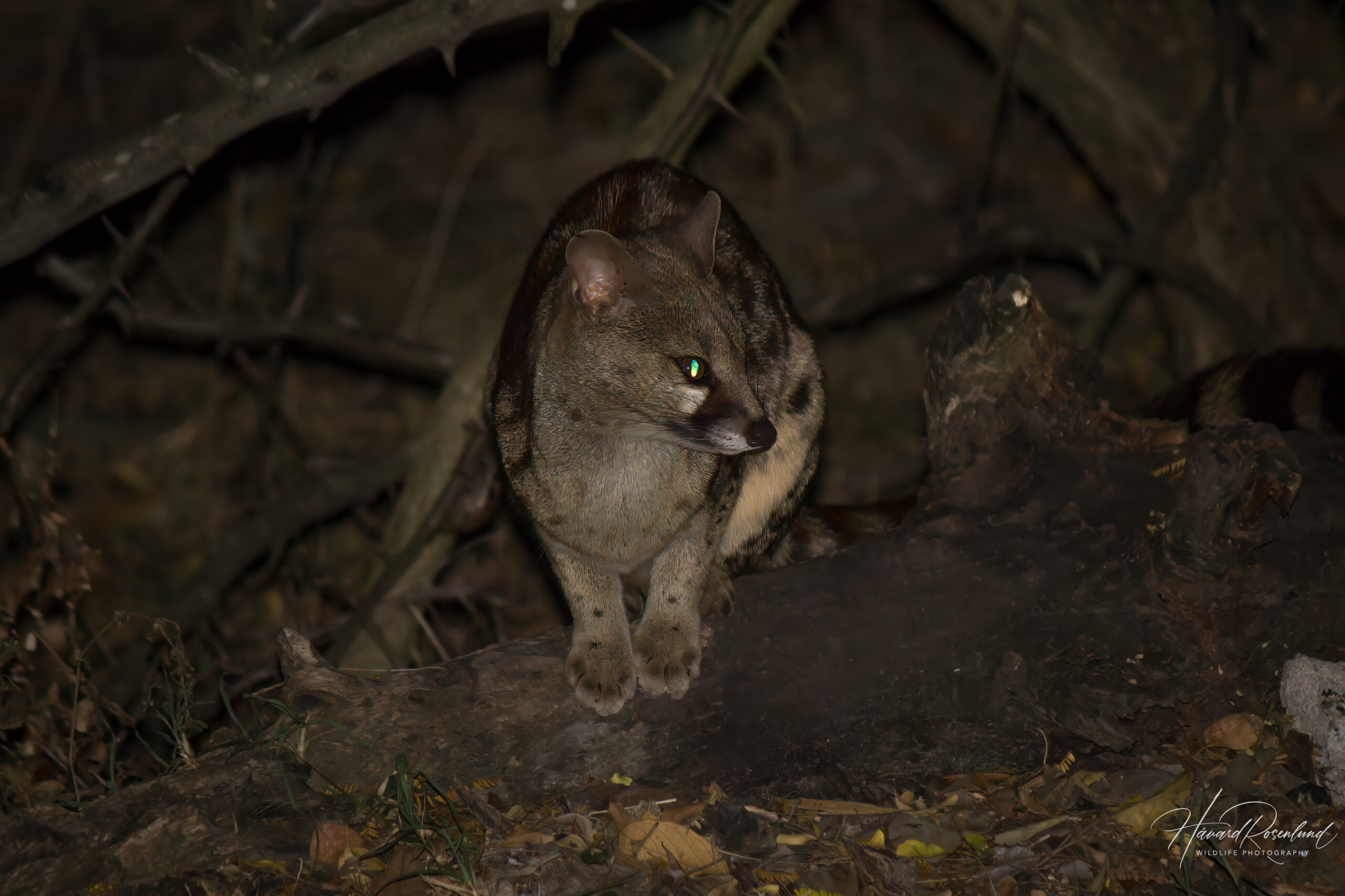
Rusty-spotted Genet
Genetta fieldiana
At a glance
Habitat
- Forest, riverine vegetation, woodland, thicket, savanna mosaics and modified landscapes
Diet
- Rodents, insects and other small animals; also fruit, seeds and berries
Activity
- Nocturnal
Size
- Length: 49–60 cm + 42–50 cm tail Weight: about 1.8 kg
Range
- Widespread in sub-Saharan Africa from West and Central Africa to eastern South Africa
Description
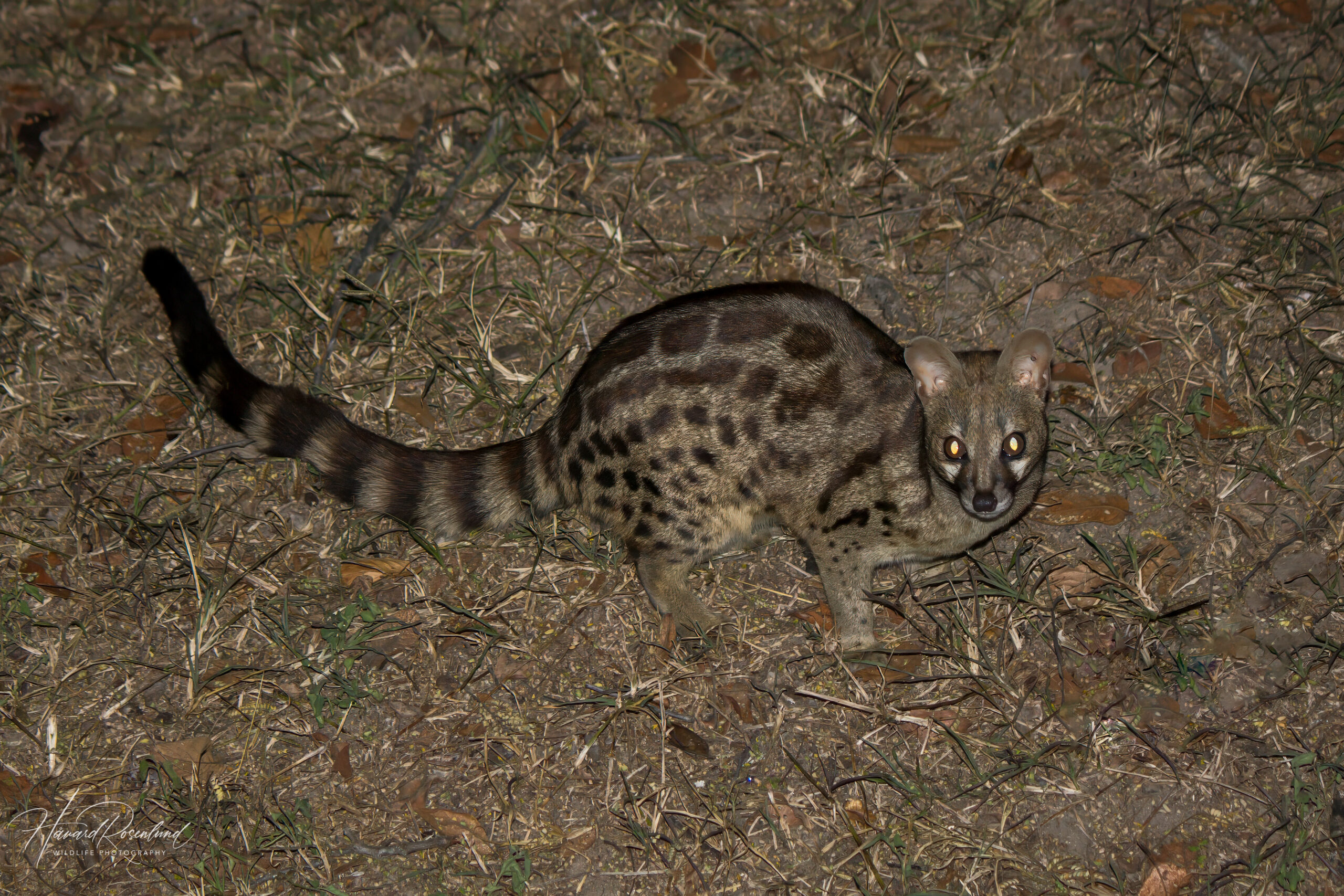
The rusty-spotted genet (Genetta fieldiana), also called the panther genet or large-spotted genet, is a slender, long-tailed carnivore in the viverrid family. Its coat varies from pale yellow-grey to warmer brown, with large rusty-brown to black spots and a ringed tail. Markings tend to be weaker in dry country and more distinct in wetter habitats.
It resembles both the common genet (Genetta genetta) and Cape genet (Genetta tigrina). Compared with the common genet it generally has larger spots and lacks a pronounced dorsal crest, while the Cape genet is usually darker and differs in the patterning of the limbs and body. Head-and-body length is about 49–60 cm, with a further 42–50 cm of tail, and adults average around 1.8 kg.
Taxonomy
This species was long known as Genetta maculata, the name still used by the IUCN assessment and much of the older literature. The current Mammal Diversity Database uses Genetta fieldiana because maculata was already occupied by an older zoological name and the International Commission on Zoological Nomenclature declined to conserve it for this species.
This is a change of scientific name, not the recognition of a newly split species. Older records under G. maculata therefore remain relevant to the same animal.
Habitat
Rusty-spotted genets occupy rainforest, riverine vegetation, woodland, thicket, savanna mosaics, farmland and even suburban areas. Dense vegetation is important for concealment, and in the drier parts of the range the species is strongly associated with water and well-vegetated drainage lines.
They rest during the day in concealed sites such as trees, dense shrubs, rock crevices, abandoned burrows and sometimes buildings. Their ability to climb and use several layers of vegetation allows them to exploit shelter both on the ground and above it.
Diet
Rusty-spotted genets are opportunistic feeders. Rodents and insects are important, but the diet can also include other invertebrates, reptiles, amphibians, small birds and eggs, fish, fruit, seeds and berries. The diet varies with local food availability rather than being specialised on a narrow range of foods.
Recent camera-trap work in the Republic of Congo documented genets repeatedly entering a bat cave and consuming bats, adding a striking example of how flexibly the species can exploit local food sources.
Behaviour
The species is mainly nocturnal, solitary and territorial, although home ranges can overlap and animals are occasionally seen in pairs. Activity normally begins around sunset, while daylight hours are spent in a concealed resting place.
Rusty-spotted genets hunt both on the ground and in vegetation, using stealth, quick acceleration and agility to catch small prey. They are accomplished climbers and can move through trees when feeding, travelling or seeking refuge, but they also spend substantial time on the ground.
Urine, faeces and secretions from scent glands are used for communication and territorial marking. Shared latrines may function as information points between neighbouring animals without requiring direct contact.
Reproduction
Breeding varies across the species’ wide range. In southern Africa, births have been reported most often from October to December, with a smaller peak from March to May. Litters generally contain two to five young, born in a protected nest or den.
The young are born blind and dependent on the female. Detailed field information on gestation, development and parental care remains limited, so figures from captivity or closely related genet species should not automatically be applied to wild rusty-spotted genets.
Status
The species is assessed as Least Concern on the IUCN Red List, under its former name Genetta maculata. It has a broad distribution, occurs in many protected areas and tolerates a range of modified landscapes.
No major range-wide threat is recognised. Road mortality, hunting and trapping, persecution around poultry and predation by domestic or feral dogs and cats can affect local populations, but the global population has not been quantified precisely and the species remains widespread.
Image gallery
Loading map and observations…
Have you seen this species?
Independent species archive
Did you find this species page useful?
Wildlife Vagabond is independently built and maintained. Voluntary support helps cover hosting, maps, data storage and continued improvements to the species archive.
Support Wildlife VagabondSpecies content will remain freely available.
References
Information about the species’ global distribution and status is based primarily on global Red List data. See the references below for details.
- International Commission on Zoological Nomenclature. (2007). Opinion 2183: Viverra maculata; specific name not conserved. https://www.biodiversitylibrary.org/page/34334762
- International Union for Conservation of Nature. (n.d.). Genetta maculata (Rusty-spotted Genet), assessment published under the former scientific name. The IUCN Red List of Threatened Species. https://www.iucnredlist.org/species/41699/45218948
- Labadie, M., Do Linh San, E., Morand, S., Caron, A., Niama, F. R., Nguilili, G. F., Tobi, N., De Nys, H. M., & Bourgarel, M. (2024). Video of rusty‐spotted genets consuming bats and other prey: Behaviors observed and eco‐epidemiological considerations. Ecosphere, 15(11), e70011. https://doi.org/10.1002/ecs2.70011
- Mammal Diversity Database. (n.d.). Genetta fieldiana (Rusty-spotted Genet), current taxonomy and distribution. American Society of Mammalogists. https://www.mammaldiversity.org/taxon/1006082/
- Roux, R., Zemouche, J., Blomsterberg, S. E., Strauss, W. M., Madikiza, Z. J. K., Somers, M. J., Gaubert, P., & Do Linh San, E. (2016). A conservation assessment of <i>Genetta maculata</i>. South African National Biodiversity Institute and Endangered Wildlife Trust. https://ewt.org/wp-content/uploads/2022/11/16.-Rusty-spotted-Genet-Genetta-maculata_LC.pdf