
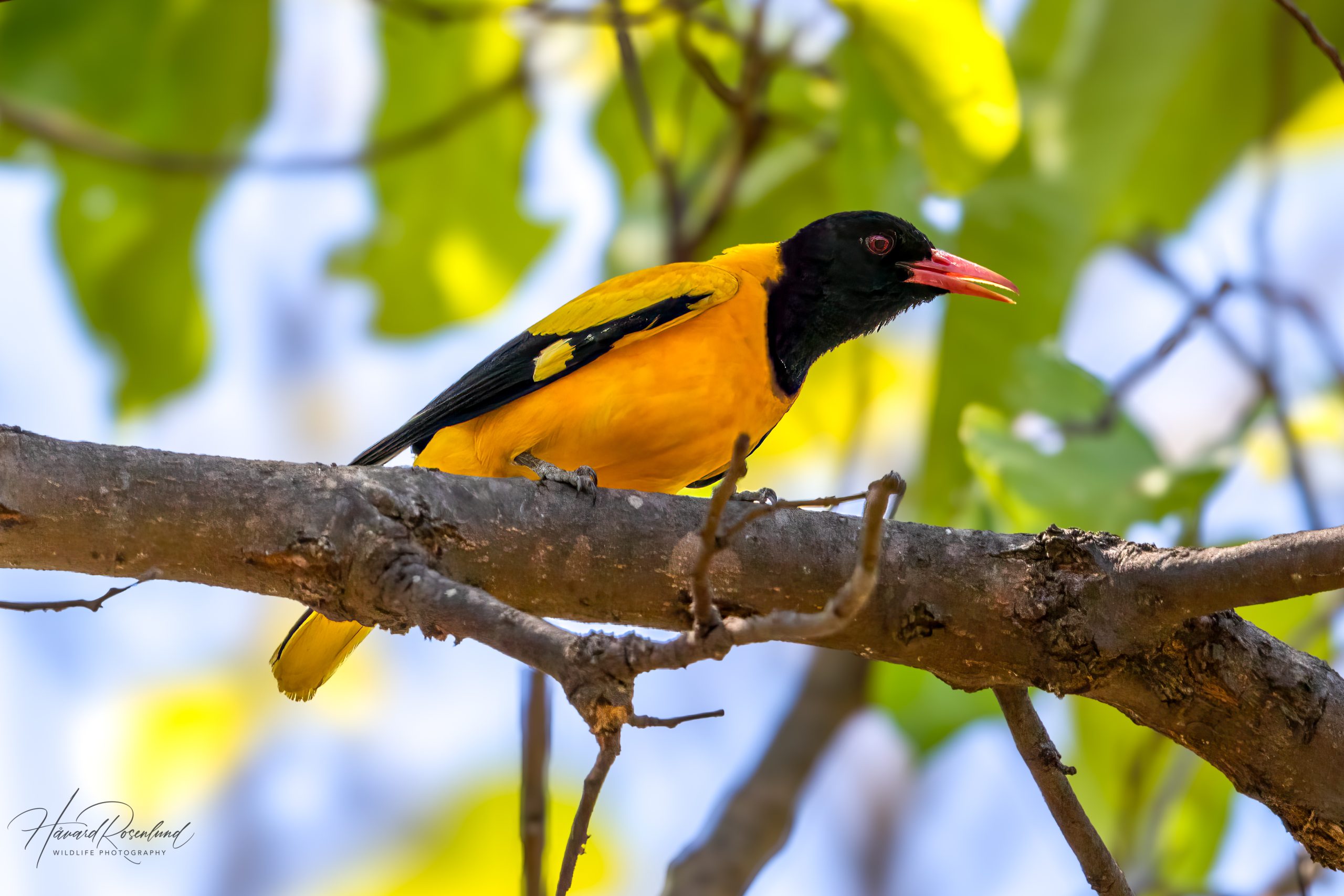
Black-hooded Oriole
Oriolus xanthornus
At a glance
Habitat
- Forest, woodland, forest edge, plantations, orchards and other tree-rich landscapes
Diet
- Fruit, especially fleshy fruit such as figs and berries, together with caterpillars and other insects
Activity
- Diurnal
Size
- Length: 23–25 cm Weight: —
Range
- South Asia east through mainland Southeast Asia and adjoining parts of the region
Description
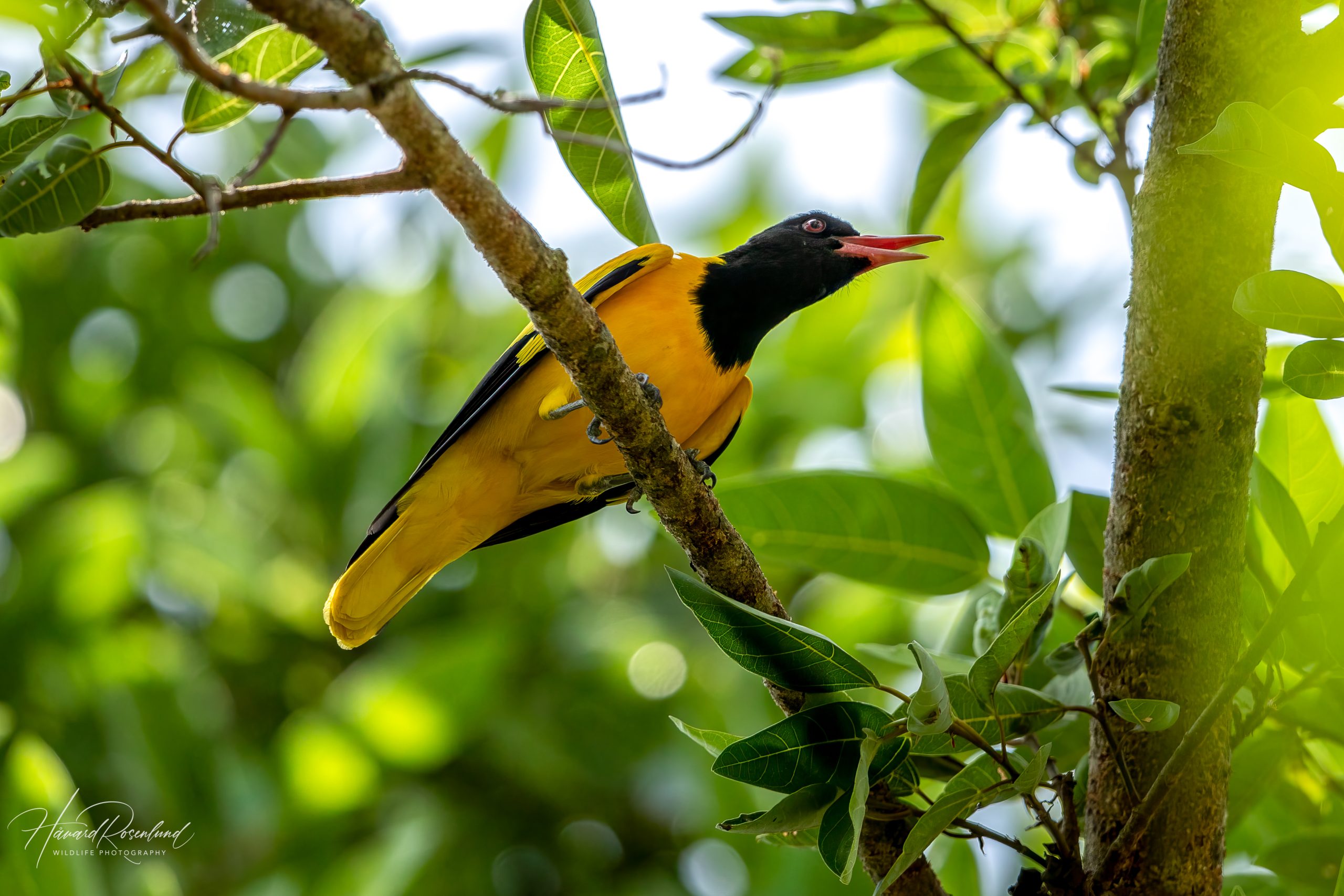
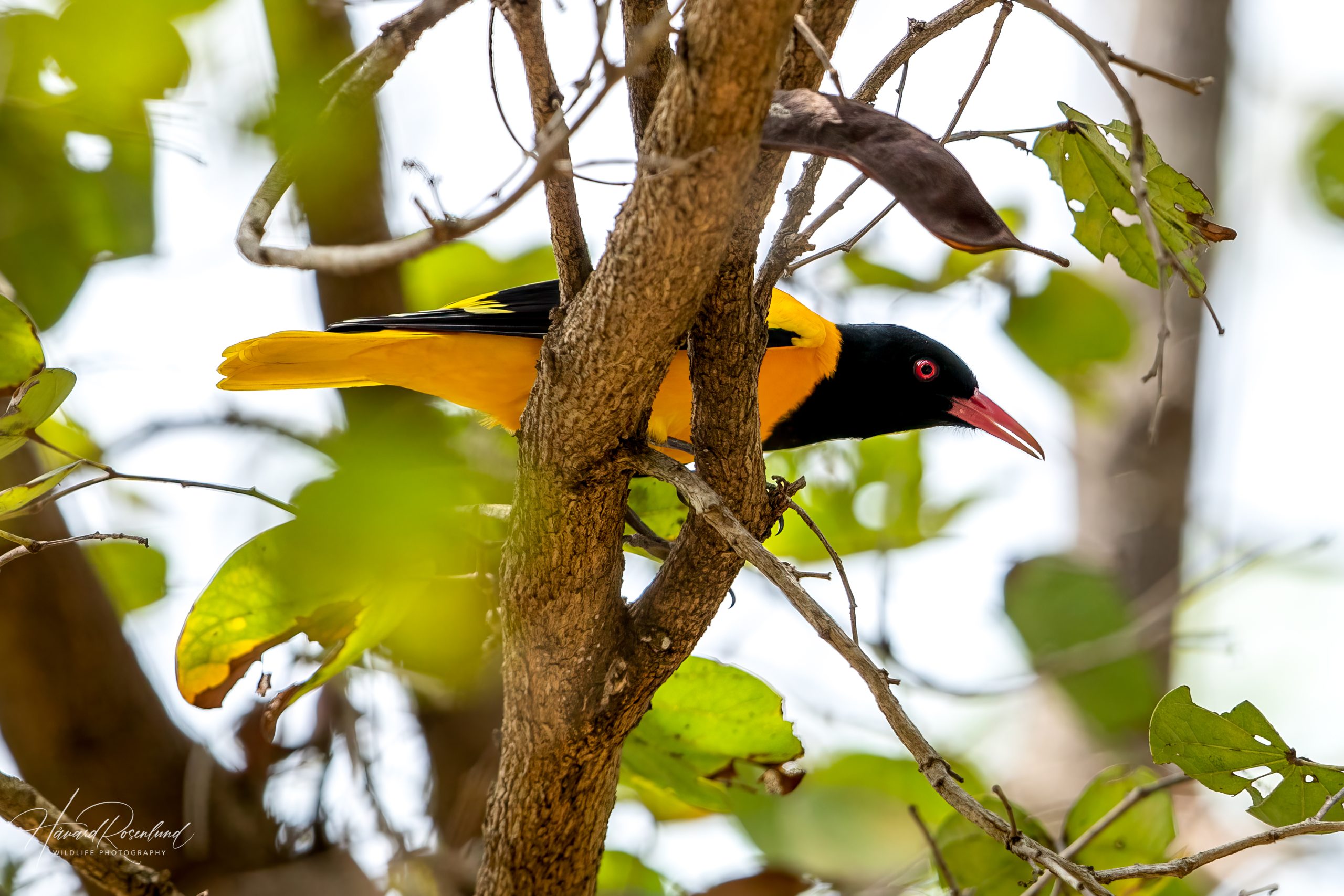
The black-hooded oriole (Oriolus xanthornus) is a medium-sized, brightly coloured songbird of South and Southeast Asia. Adults are roughly 23–25 cm long and are unmistakable in most of their range: the body is rich yellow, while the head, throat and upper breast form a sharply contrasting black hood. The wings and central tail feathers are also largely black, and the bill is reddish to pinkish.
The sexes are similar, although females can be slightly duller or greener in some populations. Within the Indian subcontinent the Indian golden oriole (Oriolus kundoo) provides a more useful comparison than African black-headed orioles: it shares the bright yellow body but lacks the complete black hood and throat of the black-hooded oriole.
Habitat
Black-hooded orioles use a broad range of tree-rich habitats, including deciduous and evergreen forest, open woodland, forest edge and secondary growth. They also occur in plantations, orchards, wooded farmland, parks and large gardens where a reasonably continuous tree canopy provides feeding and nesting sites.
In India, the species is particularly associated with forest and plantation habitats. Its ability to use modified wooded landscapes helps explain why it can remain common in many areas, although extensive removal of mature trees and canopy can still reduce suitable habitat locally.
Diet
The diet combines fruit with animal prey. Figs, berries and other fleshy fruits are important, while caterpillars, beetles and other insects are taken from foliage and branches. The balance varies with season and local food availability, and insect prey becomes especially important when adults are feeding young.
Behaviour
Black-hooded orioles are generally encountered alone or in pairs and spend much of their time high in foliage, where their bright plumage can still be surprisingly difficult to see. Their presence is often revealed first by rich, fluting whistles and harsher calls carried from the canopy.
Most foraging takes place in trees. A study published in 2000 from thorn forest in Mudumalai Wildlife Sanctuary in southern India found the species taking insect prey mainly by gleaning from foliage, with some aerial sallies and feeding from branches. Birds also visit fruiting trees and can move between forest, plantations and wooded settlements as food availability changes.
The species is mainly resident across India. During breeding, pairs become more territorial and defend the area around their nesting trees, while outside this period birds are usually encountered singly or as pairs without obvious larger social groups.
Breeding
Breeding timing varies geographically, with much nesting in India occurring from late winter through the monsoon period. The nest is a carefully woven, deep cup of grasses, fibres, leaves and other plant material, suspended among fine branches and foliage and often well concealed by leaves.
Two or three eggs are typical. The female performs most of the incubation, while both adults remain involved around the nest and feed the chicks, which receive caterpillars and other small insects.
A field note published in 2025 from the Sundarbans in West Bengal followed one pair nesting in a small mango tree. One bird collected grasses, dry leaves, straw and other plant material while the other kept watch nearby. Three chicks later hatched, and the female was observed feeding them caterpillars and small insects and removing faecal material from the nest.
Status
The black-hooded oriole is classified as least concern on the IUCN Red List and remains widespread across South and Southeast Asia. In India, both the long-term national population trend and the current annual trend are considered stable.
Local habitat can nevertheless deteriorate where mature trees and continuous canopy are removed. Plantations and tree-rich settlements can provide alternative habitat in some regions, but they do not fully replace all wooded habitats used by the species.
Image gallery
Loading map and observations…
Have you seen this species?
Independent species archive
Did you find this species page useful?
Wildlife Vagabond is independently built and maintained. Voluntary support helps cover hosting, maps, data storage and continued improvements to the species archive.
Support Wildlife VagabondSpecies content will remain freely available.
References
Information about the species’ global distribution and status is based primarily on global Red List data. See the references below for details.
- BirdLife International. (n.d.). Black-hooded Oriole species factsheet. https://datazone.birdlife.org/species/factsheet/black-hooded-oriole-oriolus-xanthornus
- Ghosh, D. (2025). A field note on the nesting activity and allied observations on Black-hooded Oriole (Oriolus xanthornus , Linn, 1758) from the Sundarbans, India. Biodiversity, 26(3), 302-304. https://doi.org/10.1080/14888386.2025.2492647
- Gokula & Vijayan. (2000). Foraging pattern of birds during the breeding season in thorn forest of Mudumalai Wildlife Sanctuary, Tamil Nadu, Southern India. Tropical Ecology, 41, 195–208. https://www.researchgate.net/publication/252805623_Foraging_pattern_of_birds_during_the_breeding_season_in_thorn_forest_of_Mudumalai_wildlife_sanctuary_Tamil_Nadu_Southern_India
- International Union for Conservation of Nature. (n.d.). Black-hooded Oriole. The IUCN Red List of Threatened Species. https://www.iucnredlist.org/species/22706437/130378031
- State of India's Birds. (n.d.). State of India’s Birds – Black-hooded Oriole. https://stateofindiasbirds.in/species/blhori1/