
Southern Reedbuck
Redunca arundinum
At a glance
Habitat
- Tall grass, reedbeds, floodplains and moist savanna near water
Diet
- Grazer: mainly grasses, with reeds and herbs
Activity
- Most active in early morning and late afternoon; also feeds at night
Size
- Length: 120–160 cm Weight: 50–95 kg
Range
- Central and southern Africa south of the equator
Description
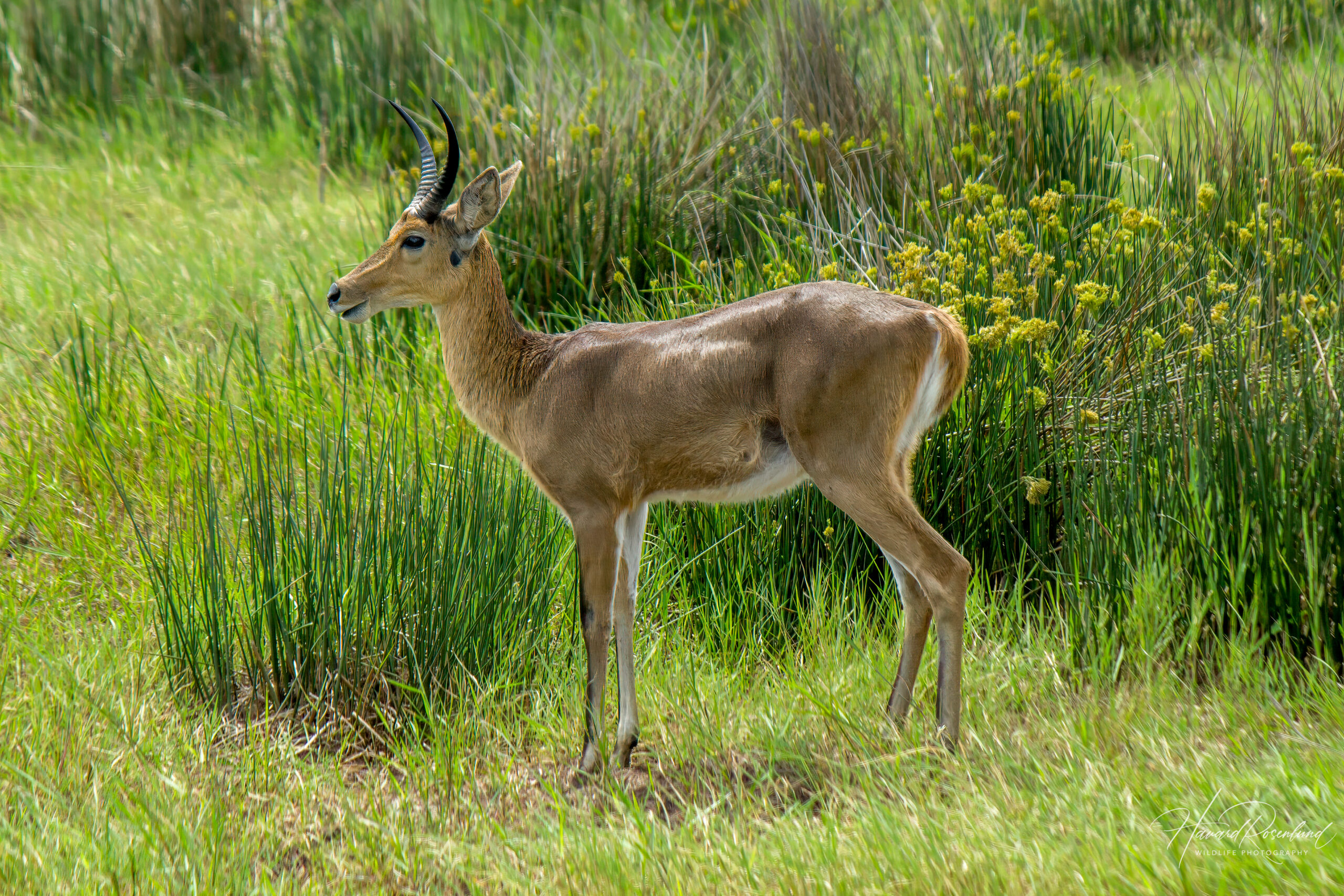
The southern reedbuck, also called the common reedbuck (Redunca arundinum), is the largest of the three reedbuck species. The other two are the bohor reedbuck (Redunca redunca) and mountain reedbuck (Redunca fulvorufula). Males measure about 130–160 cm from head to body, stand 80–105 cm at the shoulder and weigh 60–95 kg. Females are smaller at roughly 120–140 cm long and 50–85 kg.
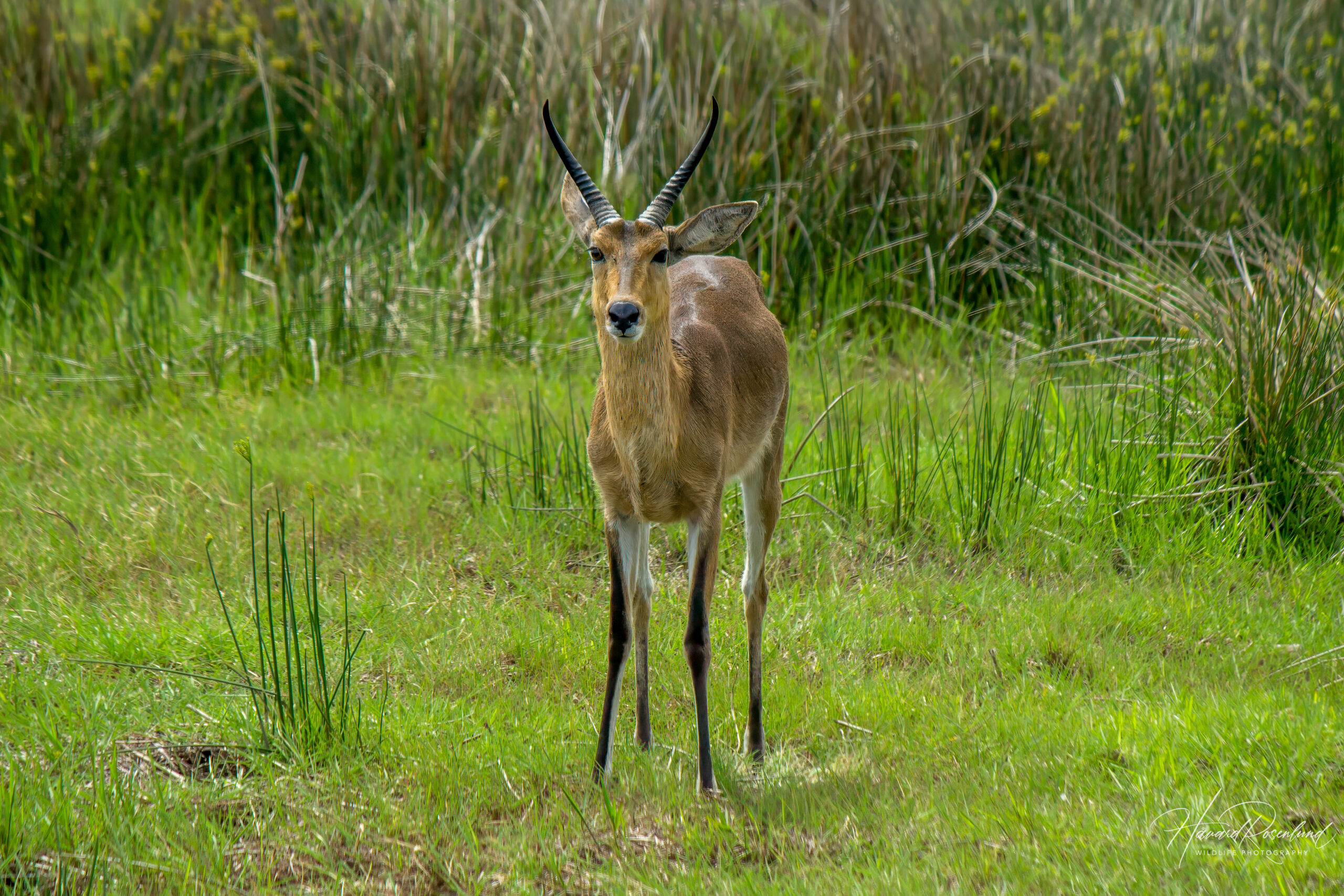
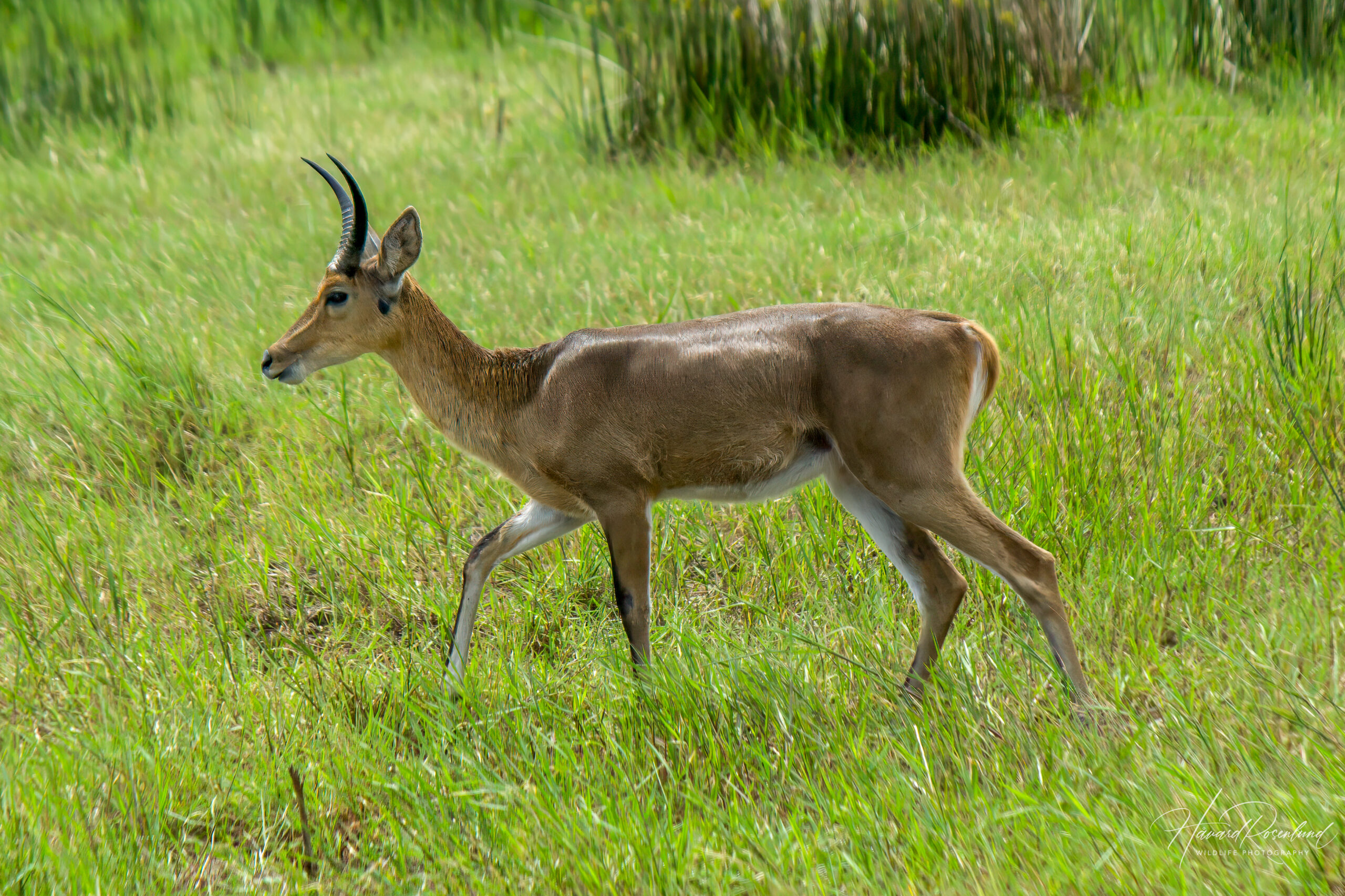
The silky coat varies from pale yellowish brown to grey-brown, with white underparts and a bushy tail that is white below. Both sexes have a dark glandular patch beneath each ear. Only males carry horns, which rise backwards before curving forward at the tips.
Taxonomy
Several subspecies have been named, but two are widely recognised: a northern form, Redunca arundinum occidentalis, and a southern form, R. a. arundinum. The latter occurs in South Africa, Eswatini and the surrounding southern part of the range.
The current Mammal Diversity Database retains these forms within a single species, Redunca arundinum. Genetic research on populations across the range remains limited, and it is therefore still unclear how strongly the named forms differ genetically.
Habitat
Southern reedbucks depend on tall grass, reedbeds and other dense herbaceous cover near permanent or seasonal water. Typical habitats include floodplains, drainage-line grasslands, moist savanna, wet depressions and river valleys. They usually remain on dry ground rather than entering the water and rely strongly on vegetation for concealment. In Kruger, dry-season observations found animals drinking at least once a day and usually remaining within about 1.5–2 km of water.
In South Africa they occur from sea level to roughly 1,800–2,000 m in the Drakensberg. They avoid severe bush encroachment and can disappear where burning removes all tall cover. In some agricultural landscapes, however, high-quality ryegrass or lucerne pastures can provide attractive winter habitat.
Diet
Southern reedbucks are predominantly grazers, favouring fresh grasses. Reeds and herbs are also eaten, and small amounts of browse may become more important in some areas or seasons. They need regular access to water, particularly during the dry season.
Field work in Kruger National Park showed that feeding choices change with grass availability and quality rather than being tied to only a few plant species. This flexibility helps the reedbuck use both natural wet grasslands and, in some places, productive agricultural pastures.
Behaviour
Southern reedbucks are active during both day and night, with strong peaks around dawn and dusk. Resting and rumination often take place in dense cover. When alarmed, an animal may freeze in the tall vegetation before escaping in high, rocking leaps with the tail raised.
A sharp whistling vocalisation is used both as an alarm and in contact with other reedbucks. During forceful leaps a characteristic popping sound may be heard from the groin region, where the species has large scent glands. Bounding, vocalisations and scent marking are therefore used both during alarm and in social interactions.
Social behaviour
Southern reedbucks have a loose social system and may be seen alone, in pairs or in small groups whose composition changes frequently. Temporary groups of 15–20 animals can form when water or suitable cover becomes concentrated, but permanent large herds are not typical.
The degree of male territoriality varies with locality and with the distribution of key resources such as water, tall cover and good grazing. On farmland in KwaZulu-Natal, males became more solitary and territorial from January to April, during the period of greatest mating activity. Where important resources are concentrated, a male may effectively defend an area used by several females, whereas ranges can overlap more where resources are abundant. A male may maintain a relatively stable association with one female, but adult associations often reflect overlapping space use more than strong permanent bonds.
High bounding displays also have a clear social role. Older field accounts from Kruger describe females and subordinate males responding to a dominant male with rapid high leaps, the tail curled upwards and the characteristic popping sound from the groin glands. Similar leaps also occur during alarm, so they are not confined to a single context. Together with vocalisations, posture and scent marking, they form a distinctive part of communication between reedbucks.
Home ranges
Home-range size changes dramatically with habitat quality. In the KwaZulu-Natal highlands, reported home ranges averaged roughly 0.73 km² for adult males and 1.23 km² for females, whereas in the resource-rich iSimangaliso Wetland Park they averaged only about 0.05 and 0.06 km² respectively.
The more than tenfold contrast shows how strongly dense cover, water and high-quality grazing can reduce the need to travel far. Female ranges can overlap several male territories and tend to follow the most attractive wet grassland.
Predation
Southern reedbucks are taken by several large carnivores, including cheetahs (Acinonyx jubatus), leopards (Panthera pardus), lions (Panthera leo) and African wild dogs (Lycaon pictus). During a 28-month study of six radio-collared cheetahs at Phinda, researchers recorded 200 kills. Grey duiker, impala, southern reedbuck and nyala together accounted for 86.5% of the kills, and southern reedbuck was taken far more often than expected from how common it was in the area. Young calves can also be vulnerable to smaller carnivores and large snakes.
The species’ dependence on tall grass is therefore closely tied to predation risk. Reedbucks often remain motionless in cover until danger approaches closely, then erupt into high bounding leaps. The raised white underside of the tail and sharp whistle make the escape conspicuous once concealment has failed.
Reproduction
Breeding can occur throughout the year, with regional peaks linked to the wet season. During courtship, the male closely follows a receptive female in several bouts separated by short pauses, using those pauses to sniff and make contact around the hindquarters. He also investigates her urine and performs flehmen, raising the upper lip to assess the scent more closely. Mounting attempts begin after one or more such bouts.
After a gestation of about seven to eight months, the female normally gives birth to one calf. Twins occur, but are very rare. The calf remains hidden in dense vegetation for at least six weeks and older field accounts describe a concealment period of about two months. During this stage the mother stays nearby but visits only briefly to nurse and clean the calf; some observations describe a single daily visit lasting roughly 10–30 minutes.
After the hiding phase the calf gradually accompanies its mother. Females reach sexual maturity at around two years and typically disperse earlier than males. Young males may remain in their birth area until roughly three years of age, when they begin seeking space of their own.
Relationship with humans
Southern reedbucks are hunted for meat and trophies and are also traded as live animals for game farms and private reserves. Reintroductions and private wildlife management have helped restore the species to parts of its former range, and private land now supports an important share of the regional population.
The relationship is not always positive. Reedbucks can feed heavily on high-quality ryegrass, lucerne and other pastures, leading to persecution where they are regarded as competitors with livestock or as agricultural pests. The combination of valuable live animals, hunting demand and pasture use therefore makes human management an important part of the species’ modern distribution.
Status
The southern reedbuck is listed as Least Concern on the IUCN Red List. It remains widely distributed but naturally patchy because suitable tall, moist grassland occurs in separated pockets across central and southern Africa.
The 2025 regional assessment for South Africa, Eswatini and Lesotho also retained Least Concern and reported an overall increasing trend. At least 3,884 mature animals were documented from protected and private land using 2010–2015 data. iSimangaliso Wetland Park held the largest assessed mature subpopulation, estimated at about 420–840 animals. Across 21 protected areas, numbers increased by roughly 68–80% over three generations, although this pattern was strongly driven by growth in Free State reserves; without those populations, the remaining protected areas declined by about 10–22%.
Local populations can still be reduced by wetland drainage, agricultural conversion, bush encroachment, poorly planned burning and illegal hunting. Because the species depends on tall grass and reedbeds for both food and concealment, leaving unburned cover and maintaining connected wet grassland are especially important. Protected areas such as iSimangaliso remain major strongholds, while conservancies and private land also contribute substantially to the regional population.
Image gallery
Loading map and observations…
Have you seen this species?
Independent species archive
Did you find this species page useful?
Wildlife Vagabond is independently built and maintained. Voluntary support helps cover hosting, maps, data storage and continued improvements to the species archive.
Support Wildlife VagabondSpecies content will remain freely available.
References
Information about the species’ global distribution and status is based primarily on global Red List data. See the references below for details.
- du Plessis, J., Peel, M., & Child, M. F. (2016). A conservation assessment of <i>Redunca arundinum</i>. South African National Biodiversity Institute and Endangered Wildlife Trust. https://ewt.org/wp-content/uploads/2022/11/26.-Southern-Reedbuck-Redunca-arundinum_LC.pdf
- Howard, P. C. (1986). Social organization of common reedbuck and its role in population regulation. African Journal of Ecology, 24(3), 143–154. https://doi.org/10.1111/j.1365-2028.1986.tb00356.x
- International Union for Conservation of Nature. (n.d.). SSC Antelope Specialist Group. Redunca arundinum. The IUCN Red List of Threatened Species. https://www.iucnredlist.org/species/19390/50193692
- Jungius, H. (1971). Studies on the food and feeding behaviour of the Reedbuck <i>Redunca Arundinum</i> Boddaert, 1785 in the Kruger National Park. Koedoe, 14(1). https://doi.org/10.4102/koedoe.v14i1.718
- Jungius. (1971). The biology and behaviour of the reedbuck (Redunca arundinum) in the Kruger National Park. https://portals.iucn.org/library/node/16387
- Mammal Diversity Database. (2026). Redunca arundinum: current taxonomy and distribution. American Society of Mammalogists. https://www.mammaldiversity.org/taxon/1006251/
- Patel, T., & da Silva, J. M. (2025). A conservation assessment of <i>Redunca arundinum</i>. South African National Biodiversity Institute and Endangered Wildlife Trust. https://ewt.org/project/southern-reedbuck/
- Rostro-García, S., Kamler, J. F., & Hunter, L. T. B. (2015). To Kill, Stay or Flee: The Effects of Lions and Landscape Factors on Habitat and Kill Site Selection of Cheetahs in South Africa. PLOS ONE, 10(2), e0117743. https://doi.org/10.1371/journal.pone.0117743