
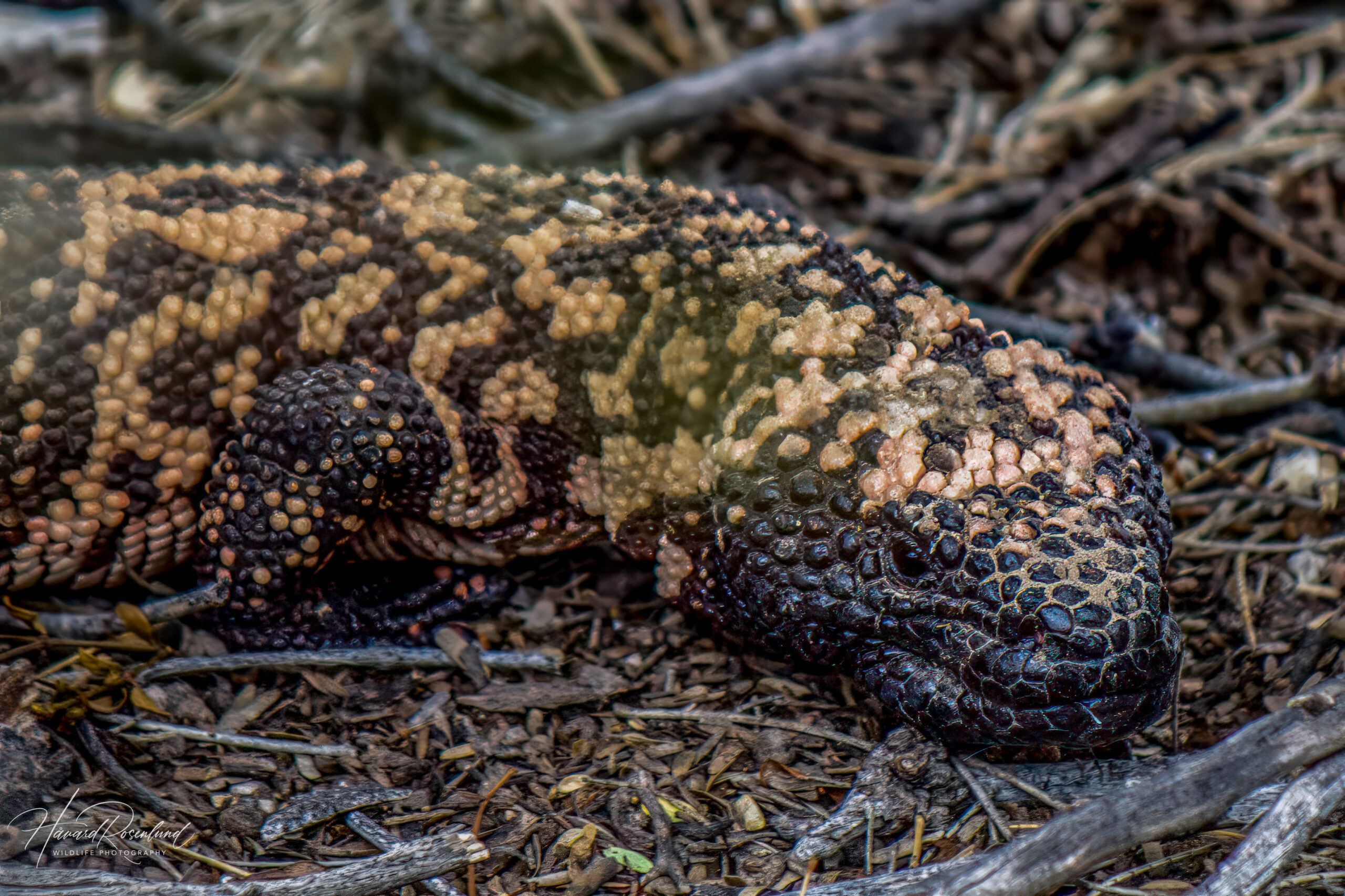
Gila Monster
Heloderma suspectum
At a glance
Habitat
- Rocky desert scrub, thorn scrub, desert grassland and dry woodland
Diet
- Bird and reptile eggs, nestlings, young mammals, lizards and carrion
Activity
- Mostly diurnal in spring; crepuscular or occasionally nocturnal in hot weather
Size
- Length: usually 35–50 cm; large individuals up to about 56 cm Weight: commonly 350–700 g; exceptional individuals exceed 2 kg
Range
- Southwestern United States and northwestern Mexico
Description
The Gila monster (Heloderma suspectum) is the largest lizard native to the United States. It is also the country's only naturally occurring venomous lizard considered medically important. Its close relative, the Mexican beaded lizard (Heloderma horridum), occurs farther south in Mexico and Central America.
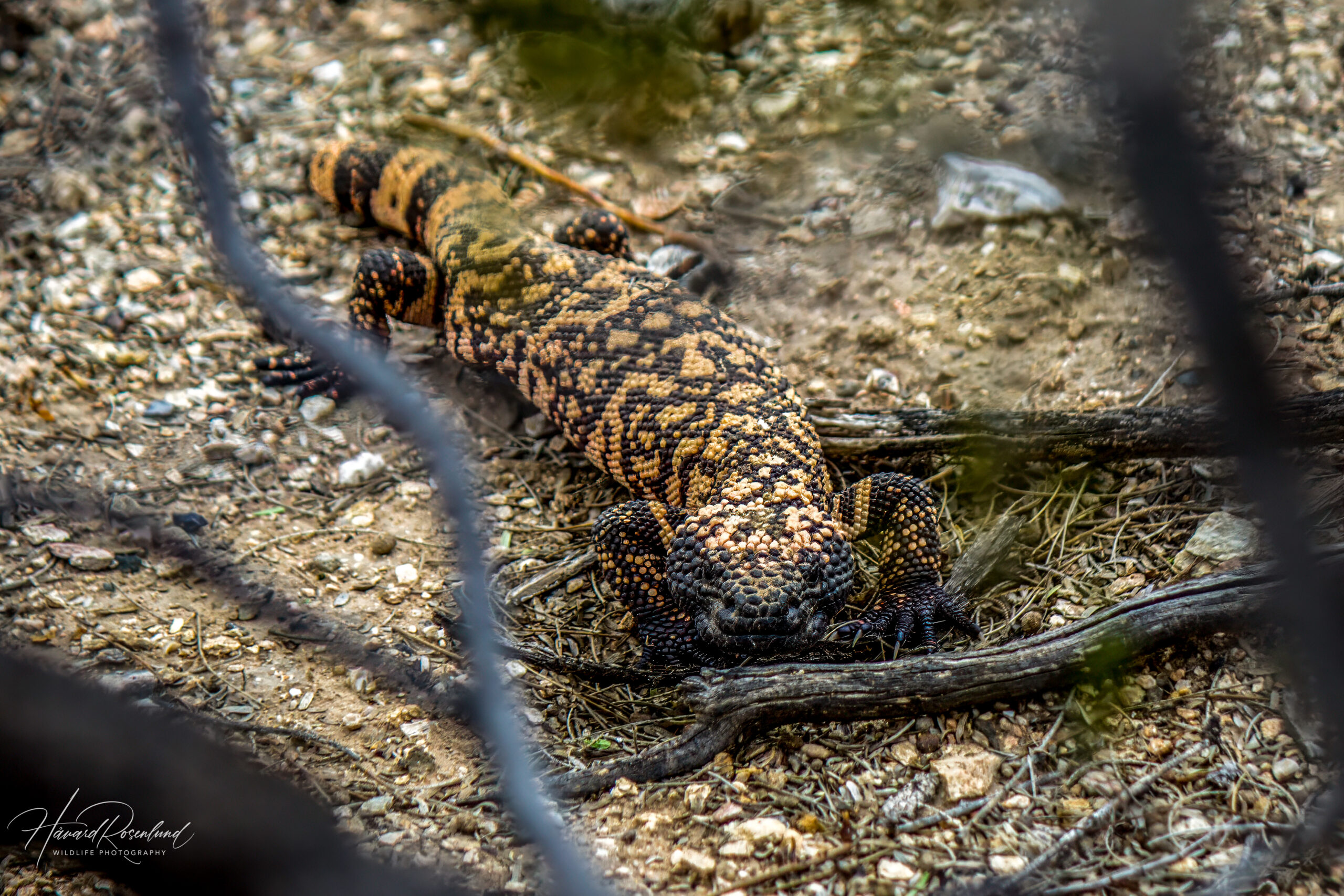
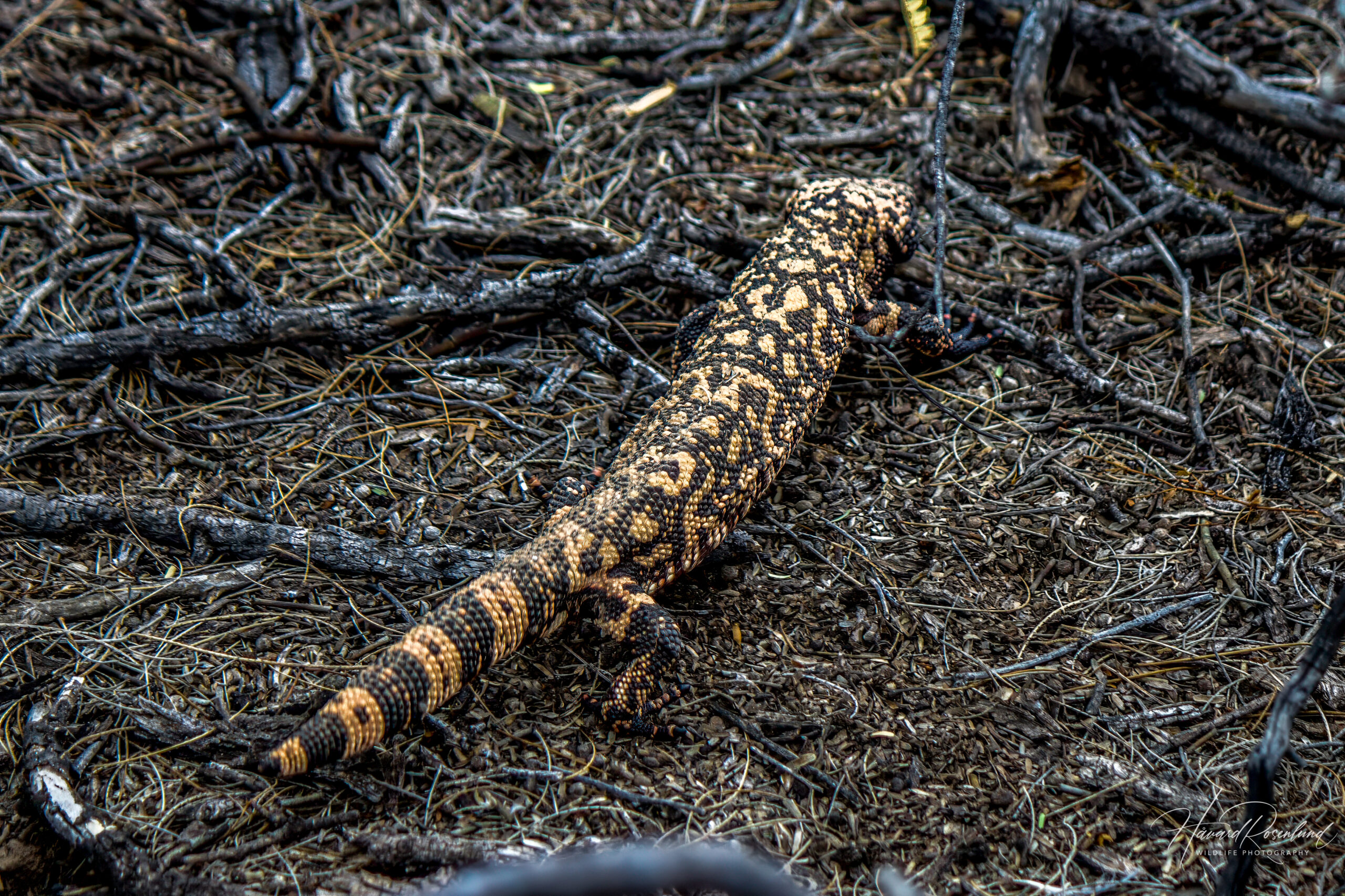
Adults are commonly 35–50 cm long, while large individuals can reach about 56 cm. Most weigh roughly 350–700 g, although exceptionally heavy animals exceed 2 kg. The body is covered with rounded, bead-like scales and patterned in black with pink, orange, salmon or yellow. Each individual’s dorsal pattern is distinctive.
Two subspecies are recognised: the reticulate Gila monster (H. s. suspectum) and the banded Gila monster (H. s. cinctum).
Habitat
Gila monsters inhabit rocky desert scrub, thorn scrub, desert grassland and dry woodland in the southwestern United States and northwestern Mexico. They use burrows, packrat nests, rock cavities and other underground shelters, often in rugged terrain with washes, boulders and good access to protected retreat sites.
Diet
Gila monsters specialise in food that cannot escape quickly: bird and reptile eggs, nestlings and newborn mammals. Lizards, occasional small snakes and carrion are also eaten.
Foraging
A powerful sense of smell and the forked tongue help Gila monsters locate buried nests and concealed young. They may follow scent trails through rocky ground and can climb low trees, shrubs and cacti to reach nests.
Large meals are important to their unusual energy strategy. A single feeding can equal roughly one third of body mass, and three or four large spring meals may in some cases provide enough energy to last until the following spring. Fat stored in the thick tail supports long periods with little feeding.
The venom system is used most clearly in defence. Prey is often swallowed or subdued mechanically, although venom may contribute when a struggling animal is held and chewed.
Behaviour
Gila monsters spend most of their lives underground. Roughly 95–98% of the year may be spent in burrows or other shelters, with surface activity concentrated in spring and early summer.
They are mainly active during cooler daylight hours in spring, but in hot weather may emerge around dusk or shortly after dark. Summer monsoon rain can trigger a second, smaller period of activity. Most encounters are brief because the lizards retreat underground when temperatures become unsuitable.
The species is usually solitary outside the breeding season. It obtains much of its water from prey but drinks when free water is available.
Reproduction
Mating occurs mainly in late spring and early summer. Males locate females by scent and wrestle with rival males, attempting to pin one another to the ground.
The female lays about two to twelve eggs, commonly three to five, in an underground nest during the summer monsoon period. Development continues underground through autumn and winter. Hatchlings emerge the following spring, usually from April to June, at around 16 cm long.
The species is long-lived. Wild individuals can survive for at least two decades, while captive animals may live for 30 years or more.
Venom
Venom glands lie in the lower jaw. Venom flows along grooves in the teeth as the lizard bites and chews, and a Gila monster may maintain its grip for several minutes. The teeth are continuously replaced throughout life. Bites on humans are rare and nearly always involve handling or deliberate disturbance.
Envenomation causes intense pain and may produce swelling, nausea, vomiting, sweating, weakness, dizziness, altered blood pressure and, in severe cases, breathing difficulty. There is no antivenom.
If a Gila monster remains attached, Arizona Poison and Drug Information Center advises removing it as soon as this can be done safely, preferably by carefully prying the jaws open with a strong object while allowing the lizard solid footing. The wound should be irrigated with plenty of water, the affected limb immobilised at about heart level and the patient referred for medical assessment. Broken teeth may remain in the wound and systemic symptoms can develop.
Research on the peptide exendin-4 from Gila-monster secretions led to the development of exenatide, a synthetic medicine used to treat type 2 diabetes.
Status
The Gila monster is listed as near threatened on the IUCN Red List. The global assessment was published in 2007 and is therefore older than much of the information now available on the species.
The Arizona Wildlife Conservation Strategy, updated in September 2024, places the Gila monster in Tier 1, the highest-priority tier among the state's Species of Greatest Conservation Need. This reflects Arizona's high conservation responsibility for the species, but the strategy does not classify it as undergoing a documented statewide decline.
Threats
Habitat loss and fragmentation, roads, deliberate killing and illegal collection remain important concerns. Because Gila monsters spend only a small proportion of the year above ground, road mortality can be concentrated during brief periods of spring and monsoon activity.
Urban expansion and new roads can also divide habitat and remove burrows and rocky retreat sites. The species is legally protected in the United States and Mexico and should never be collected or deliberately disturbed.
Image gallery
Loading map and observations…
Have you seen this species?
Independent species archive
Did you find this species page useful?
Wildlife Vagabond is independently built and maintained. Voluntary support helps cover hosting, maps, data storage and continued improvements to the species archive.
Support Wildlife VagabondSpecies content will remain freely available.
References
Information about the species’ global distribution and status is based primarily on global Red List data. See the references below for details.
- Arizona Game and Fish Department. (n.d.). Arizona Wildlife Conservation Strategy: Heloderma suspectum. https://awcs.azgfd.com/species/reptiles/heloderma-suspectum
- Arizona Poison and Drug Information Center. (n.d.). Gila Monster envenomation and first aid. https://azpoison.com/venom/gila-monster
- French, R., Brooks, D., Ruha, A.-M., Shirazi, F., Chase, P., Boesen, K., & Walter, F. (2015). Gila monster (Heloderma suspectum) envenomation: Descriptive analysis of calls to United States Poison Centers with focus on Arizona cases. Clinical toxicology (Philadelphia, Pa.), 53(1), 60-70. https://doi.org/10.3109/15563650.2014.988791
- Furman, B. L. (2012). The development of Byetta (exenatide) from the venom of the Gila monster as an anti-diabetic agent. Toxicon : official journal of the International Society on Toxinology, 59(4), 464-71. https://doi.org/10.1016/j.toxicon.2010.12.016
- International Union for Conservation of Nature. (2007). Heloderma suspectum (Gila Monster). The IUCN Red List of Threatened Species. https://www.iucnredlist.org/species/9865/13022716
- Liu, M., Reed, D. A., Cecchini, G. M., Lu, X., Ganjawalla, K., Gonzales, C. S., Monahan, R., Luan, X., & Diekwisch, T. G. H. (2016). Varanoid Tooth Eruption and Implantation Modes in a Late Cretaceous Mosasaur. Frontiers in Physiology, 7. https://doi.org/10.3389/fphys.2016.00145
- National Park Service. (n.d.). , Saguaro National Park. Gila Monster: natural history, habitat, diet and reproduction. https://www.nps.gov/sagu/learn/nature/gila-monster.htm
- Strimple, P. D., Tomassoni, A. J., Otten, E. J., & Bahner, D. (1997). Report on envenomation by a Gila monster: venom apparatus, clinical findings and treatment. Wilderness & Environmental Medicine, 8(2), 111–116. https://doi.org/10.1580/1080-6032(1997)008[0111:ROEBAG]2.3.CO;2
- The Reptile Database. (n.d.). Heloderma suspectum: taxonomy, subspecies and distribution. https://reptile-database.reptarium.cz/Heloderma/suspectum