
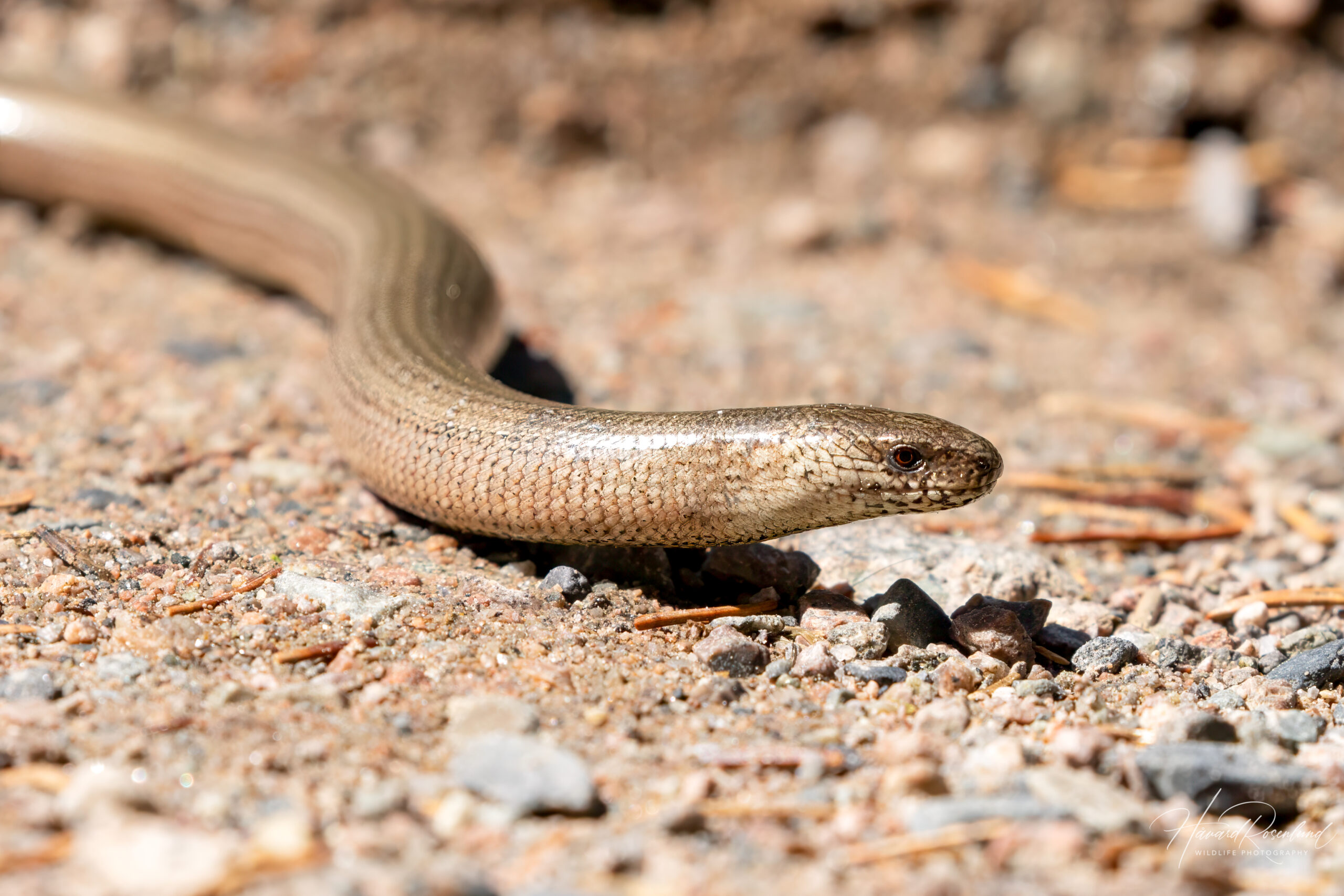
Slow Worm
Anguis fragilis
At a glance
Habitat
- Woodland edges, meadows, heath, gardens and other moist, well-covered open or semi-open habitats
Diet
- Mostly earthworms and slugs; also insects, spiders and occasional small reptiles
Activity
- Active by day and night; often most visible at dusk and in overcast weather
Size
- Length: usually 30–45 cm Weight: about 20–100 g
Range
- Much of Europe; absent from the far north and replaced by related slow-worm species farther east and south
Description
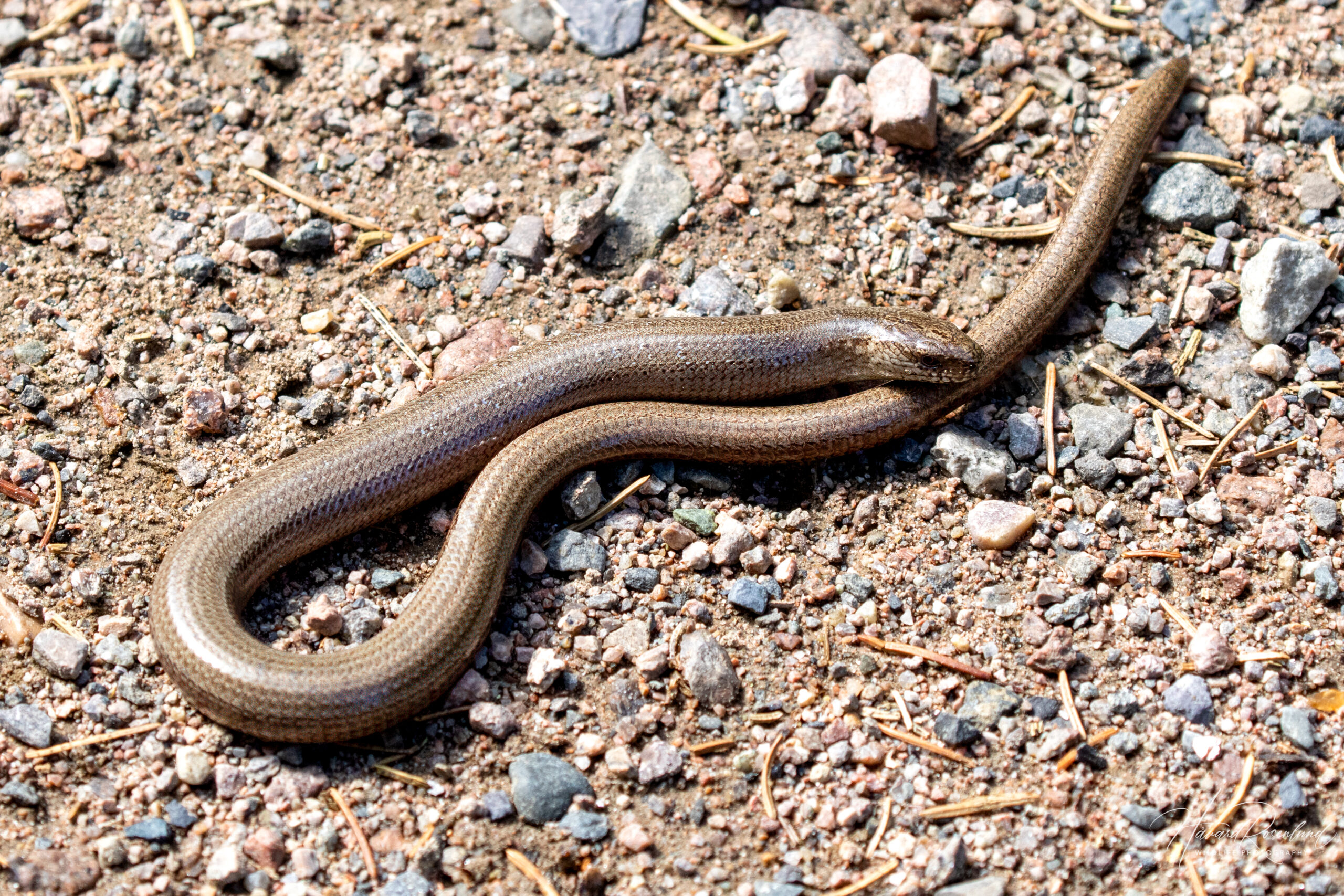
The slow worm (Anguis fragilis) is a legless lizard, not a snake. Adults are usually around 30–45 cm long, with the long tail making up a substantial part of the total length. The smooth, glossy scales give the body a metallic appearance, with colour ranging from grey and brown to coppery or almost black.
Females often retain a dark vertebral stripe and darker flanks, while adult males tend to become more uniformly coloured; some males develop blue or silvery spots, especially around the breeding season. Slow worms can be distinguished from snakes by their movable eyelids, relatively stiff body movements and the absence of the single row of broad belly scales characteristic of snakes.
Taxonomy
The name Anguis fragilis was historically applied to slow worms across a much larger part of Europe than it is today. Genetic work published in 2010 revealed several deeply divergent lineages within this broad concept, supporting the recognition of multiple closely related species. Subsequent taxonomic work has refined these boundaries further.
The genus Anguis is currently treated as containing five species. Modern treatments therefore use A. fragilis in a narrower sense, while other parts of the former range are occupied by related Anguis species. Slow worms in northern and much of western Europe, including Scandinavia, remain within A. fragilis.
Habitat
Slow worms use a wide variety of habitats, including woodland edges, clearings, meadows, heathland, gardens, allotments and other open or semi-open places with dense ground cover. They favour sites that retain some moisture and provide many hiding places beneath vegetation, stones, logs, leaf litter or other cover.
The species can do well where sunny patches for warming lie close to cool, humid refuges. Gardens and other human-modified landscapes can therefore support good populations when rough vegetation, compost heaps, logs and undisturbed cover are retained.
Diet
Earthworms and slugs are particularly important prey, together with snails, insects, spiders and other small invertebrates. Small reptiles, including young slow worms, are occasionally taken.
Slow worms forage close to the ground and under cover rather than pursuing fast-moving prey in the open. Their blunt, backward-curving teeth help them maintain a grip on soft, slippery animals such as earthworms and slugs.
Behaviour
Slow worms are secretive and can be active at different times of day and night, but are often most conspicuous around dusk and during mild, overcast or damp weather. They spend much of their time hidden beneath cover rather than basking openly like many other lizards. In winter they retreat into frost-free holes, burrows, rock piles or other sheltered sites, and several individuals may share a favourable hibernation site.
A major anti-predator defence is tail autotomy. When seized, a slow worm can shed part of its tail, and the detached section continues writhing and may distract the attacker. The tail regenerates only incompletely: the replacement is usually a much shorter structure rather than a copy of the original long tail. Because the tail also stores energy, losing it is an effective but costly escape mechanism.
Reproduction
Mating takes place mainly in spring and early summer. Males may bite and hold females around the head or neck during mating and can also fight one another during the breeding season. Slow worms are live-bearing: the young develop inside the female until birth rather than in eggs laid outside the body.
Births occur mainly in late summer. A four-year study in Galicia, north-western Spain, recorded 68 litters averaging 6.9 young, with a range of 2–12. Larger females produced larger litters, while most adult females at this unusually mild study site reproduced in consecutive years. The results show how both female size and local climate can influence reproduction.
Newborn slow worms have a striking two-tone pattern, with a pale silvery or golden back, a narrow dark midline and dark sides and belly. They are independent from birth.
Status
The slow worm is classified as least concern on the IUCN Red List. It remains widespread across much of Europe, although its secretive habits can make local populations difficult to monitor.
Local populations benefit from having shelter, warm basking spots and moist refuges close together. Intensive tidying of rough vegetation and refuges, habitat fragmentation and road mortality can reduce populations locally, while gardens and other managed landscapes can remain valuable when shelter and connected ground cover are retained.
Image gallery
Loading map and observations…
Have you seen this species?
Independent species archive
Did you find this species page useful?
Wildlife Vagabond is independently built and maintained. Voluntary support helps cover hosting, maps, data storage and continued improvements to the species archive.
Support Wildlife VagabondSpecies content will remain freely available.
References
Information about the species’ global distribution and status is based primarily on global Red List data. See the references below for details.
- Artsdatabanken. (n.d.). Stålorm, artbeskrivelse. https://artsdatabanken.no/arter/takson/1592/beskrivelse
- Bryant, S. V., & Bellairs, A. D. (1967). Tail regeneration in the lizards Anguis fragilis and Lacerta dugesii. Journal of the Linnean Society of London, Zoology, 46(310), 297-305. https://doi.org/10.1111/j.1096-3642.1967.tb00510.x
- Ferreiro, R., & Galán, P. (2004). Reproductive ecology of the slow worm (Anguis fragilis) in the northwest Iberian Peninsula. Animal Biology, 54(4), 353-371. https://doi.org/10.1163/1570756042729528
- Gvoždík, V., Jandzik, D., Lymberakis, P., Jablonski, D., & Moravec, J. (2010). Slow worm, Anguis fragilis, as a species complex: genetic structure reveals deep divergences. Molecular Phylogenetics and Evolution, 55(2), 460–472. https://doi.org/10.1016/j.ympev.2010.01.007
- International Union for Conservation of Nature. (n.d.). Slow Worm. The IUCN Red List of Threatened Species. https://www.iucnredlist.org/species/47113126/216974823
- Pedersen, I. L., Jensen, J. K., & Toft, S. (2009). A method of obtaining dietary data for slow worms (Anguis fragilis) by means of non‐harmful cooling and results from a Danish population. Journal of Natural History, 43(15-16), 1011-1025. https://doi.org/10.1080/00222930802702464
- The Reptile Database. (n.d.). Anguis fragilis. https://reptile-database.reptarium.cz/Anguis/fragilis