
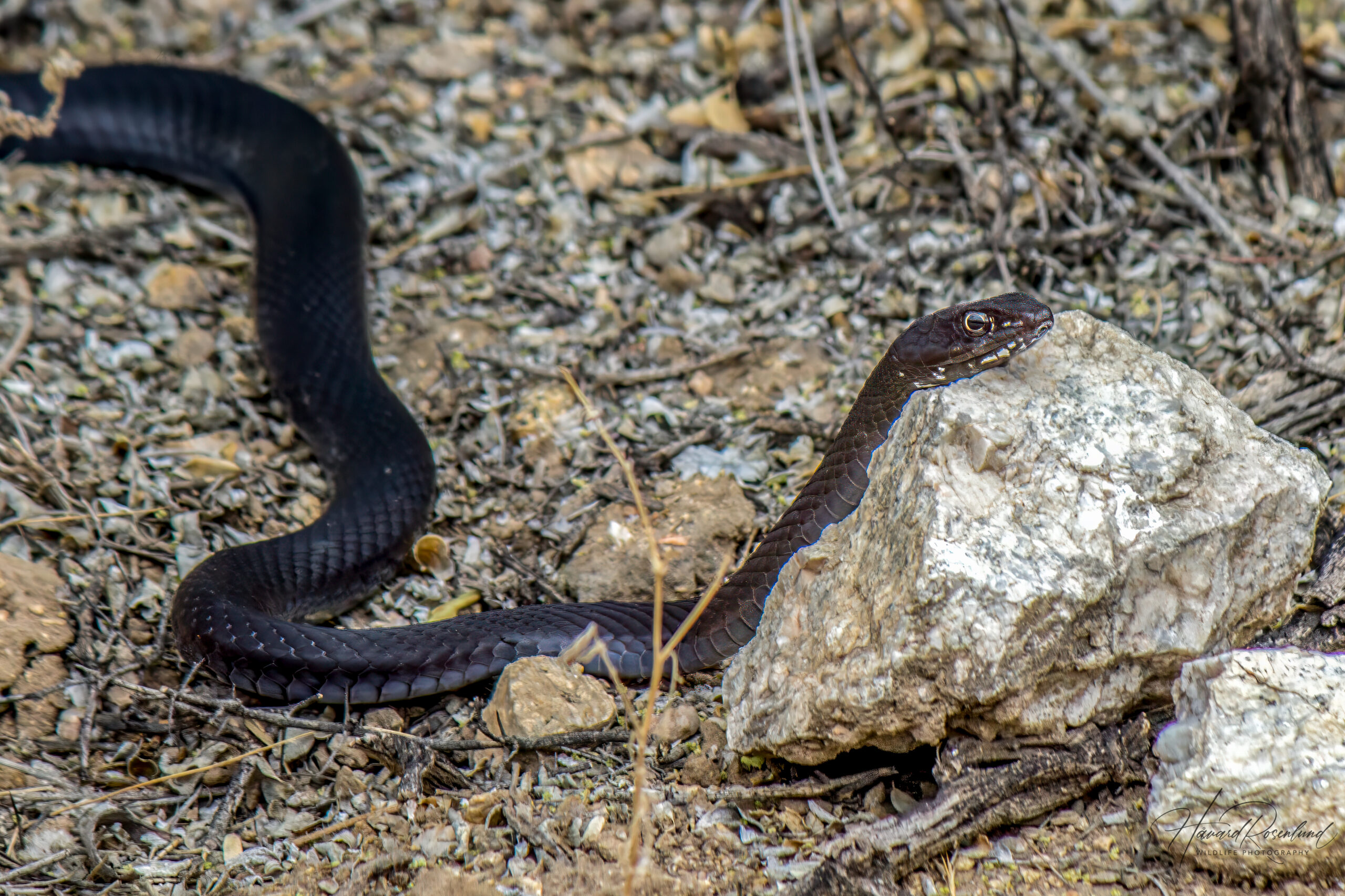
Desert Coachwhip
Masticophis piceus
At a glance
Habitat
- Desert scrub, semidesert grassland, rocky slopes, canyons, dry washes and other open, usually arid habitats
Diet
- Active predator of lizards and their eggs, small snakes, rodents, birds and large insects
Activity
- Diurnal; occasional nocturnal activity has been documented
Size
- Length: Commonly about 50–150 cm in the Sonoran Desert; larger individuals occur elsewhere Weight: —
Range
- Western North America west of the Cochise Filter Barrier, from the southwestern United States into northwestern Mexico
Description
The desert coachwhip (Masticophis piceus) is a long, slender whipsnake of western North America. It has smooth scales, a narrow head, large eyes with round pupils and a very long tapering tail whose braided appearance inspired the coachwhip name. Colour is exceptionally variable across the range: individuals may be tan, brown, grey, pink, reddish or almost black, and the head and front of the body are often darker than the rear. Exceptional individuals can reach about 2.6 m in total length.
The species is non-venomous and not dangerous to people, although a frightened animal may bite defensively if handled. Its reputation for extraordinary speed is partly exaggerated, but desert coachwhips are genuinely fast, alert and agile snakes that rely heavily on rapid escape.
Taxonomy
The desert coachwhip was long treated as part of the widespread coachwhip Masticophis flagellum, usually as one or more western subspecies. Genome-wide analyses later identified a major evolutionary split around the Cochise Filter Barrier between the Sonoran and Chihuahuan desert regions.
O'Connell and Smith recognised the western lineage as the species Masticophis piceus in 2018, and this treatment is now widely used in North American and international reptile taxonomy. The Tucson observation represented on this page lies west of the Cochise Filter Barrier and therefore falls within M. piceus under these species limits.
Three subspecies are currently recognised in the North American treatment: M. p. piceus, M. p. cingulum and M. p. ruddocki. Southern Arizona contains considerable colour and geographic variation, so no subspecies is assigned here solely from the photographed individual.
Habitat
Desert coachwhips use a broad range of open habitats, including Sonoran and Mojave desert scrub, semidesert grassland, rocky slopes, canyons, dry washes, open woodland and some agricultural or otherwise disturbed landscapes.
Open ground allows rapid movement, while shrubs, burrows, rocks and patches of denser vegetation provide shade and refuge. Because the snakes hunt over large areas, fragmentation can restrict movement between suitable feeding and shelter sites.
Diet
Desert coachwhips are active generalist predators. Lizards and their eggs are especially important in many desert populations, but they also take small snakes, rodents, birds and large insects.
Hunting
Prey is usually located while the snake travels through its home range rather than by prolonged ambush. Coachwhips investigate burrows, climb into vegetation and may dig into loose substrate after concealed prey.
When hunting, desert coachwhips often move with the head raised enough to scan the ground ahead. Their large eyes are important for detecting prey, while chemoreception through repeated tongue flicks also helps them follow chemical trails. Western coachwhips have been observed locating snakes hidden beneath sand and excavating them with the snout.
Behaviour
Desert coachwhips are predominantly diurnal and agile both on the ground and in vegetation. Occasional nocturnal activity has also been recorded in western populations, so the species is not strictly a terrestrial daytime runner.
Reproduction
Mating occurs mainly in spring. Males may engage in ritualised combat, raising and twisting the front of the body while competing for access to females. Females lay eggs during the warmer months in protected underground sites or other concealed retreats.
Much of the reproductive literature predates the split from M. flagellum, but western California populations now included within M. piceus provide useful regional data. In the Mojave Desert, clutches of about 4–16 eggs and incubation periods of roughly 76–79 days have been reported, with young appearing in late August or early September. Arizona material from before the taxonomic split also included clutches as small as two eggs, but those statewide data may combine lineages now treated separately. Hatchlings are independent and receive no parental care.
Status
The desert coachwhip has not yet received a separate modern assessment on the IUCN Red List following recognition of Masticophis piceus as a species, and is therefore shown here as not evaluated. The older Least Concern assessment of the broader M. flagellum complex should not be treated as a direct assessment of M. piceus.
The species remains widespread across western North America, but wide-ranging coachwhips can be affected by habitat fragmentation. Work in southern California has linked coachwhip occurrence and movement to the size, isolation and connectivity of remaining natural habitat, making fragmentation an important local conservation issue.
Image gallery
Loading map and observations…
Have you seen this species?
Independent species archive
Did you find this species page useful?
Wildlife Vagabond is independently built and maintained. Voluntary support helps cover hosting, maps, data storage and continued improvements to the species archive.
Support Wildlife VagabondSpecies content will remain freely available.
References
Information about the species’ global distribution and status is based primarily on global Red List data. See the references below for details.
- DeLisle. (2003). Amphibians and Reptiles of Joshua Tree National Park. https://npshistory.com/publications/jotr/amphibians-reptiles-2001.pdf
- O'Connell, K. A., & Smith, E. N. (2018). The effect of missing data on coalescent species delimitation and a taxonomic revision of whipsnakes (Colubridae: Masticophis). Molecular Phylogenetics and Evolution, 127, 356-366. https://doi.org/10.1016/j.ympev.2018.03.018
- SSAR / Center for North American Herpetology. (2025). Desert Coachwhip, Masticophis piceus. https://cnah.org/taxon.aspx?taxon=Masticophis_piceus
- The Reptile Database. (n.d.). Masticophis piceus. https://reptile-database.reptarium.cz/Masticophis/piceus
- U.S. Geological Survey. (n.d.). Coachwhip response to habitat fragmentation. https://www.usgs.gov/publications/behavioral-response-coachwhip-masticophis-flagellum-habitat-fragment-size-and
- U.S. Geological Survey. (n.d.). Red Racer arboreal/nocturnal behavior. https://www.usgs.gov/publications/coluber-masticophis-flagellum-piceus-red-racer-arborealnocturnal-behavior
- Wallach, V. (2025). HISSS (Herpetological Investigations: Systematic Serpentes Sourcebook). Deep Science Publishing. https://doi.org/10.70593/978-93-49307-92-6