
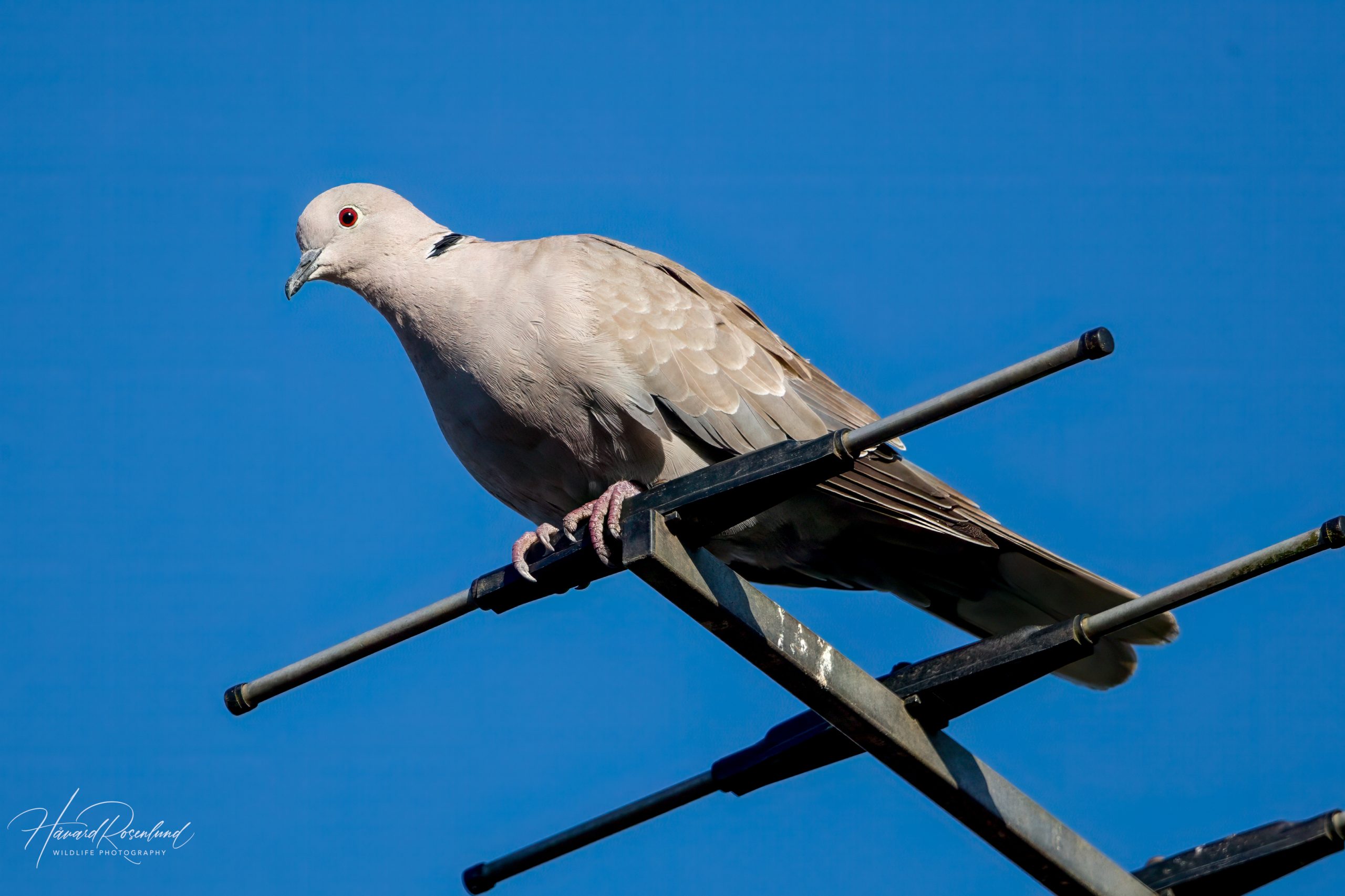
Eurasian Collared Dove
Streptopelia decaocto
At a glance
Habitat
- Towns, villages, farms, parks and open cultivated landscapes with trees and reliable food
Diet
- Mostly seeds and grain, supplemented by green plant material and occasional small invertebrates
Activity
- Diurnal; usually resident once established
Size
- Length: ~31–34 cm Weight: ~205 g average
Range
- Originally centred farther southeast in Eurasia; now widespread across Europe and western Asia, with introduced populations elsewhere
Description
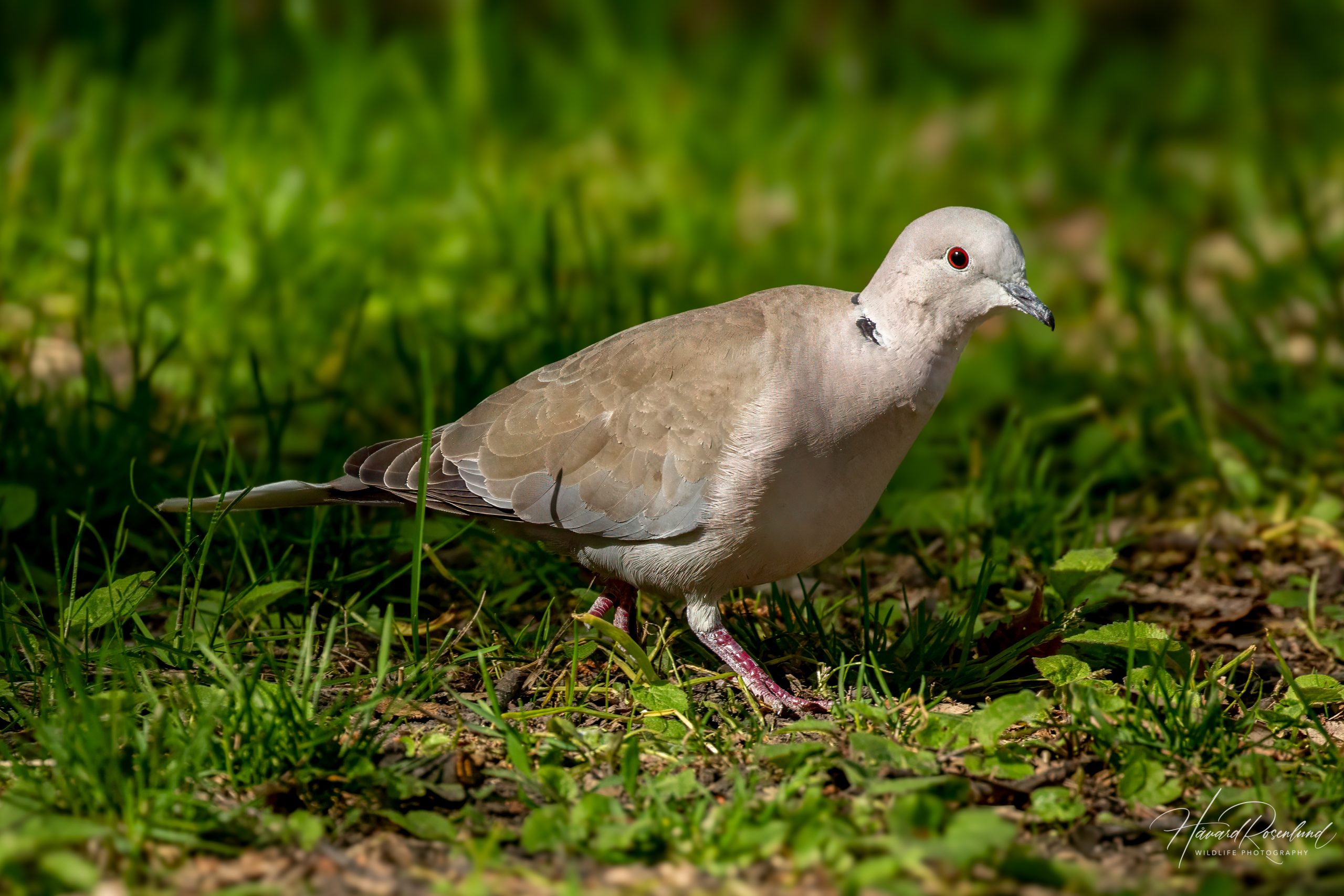
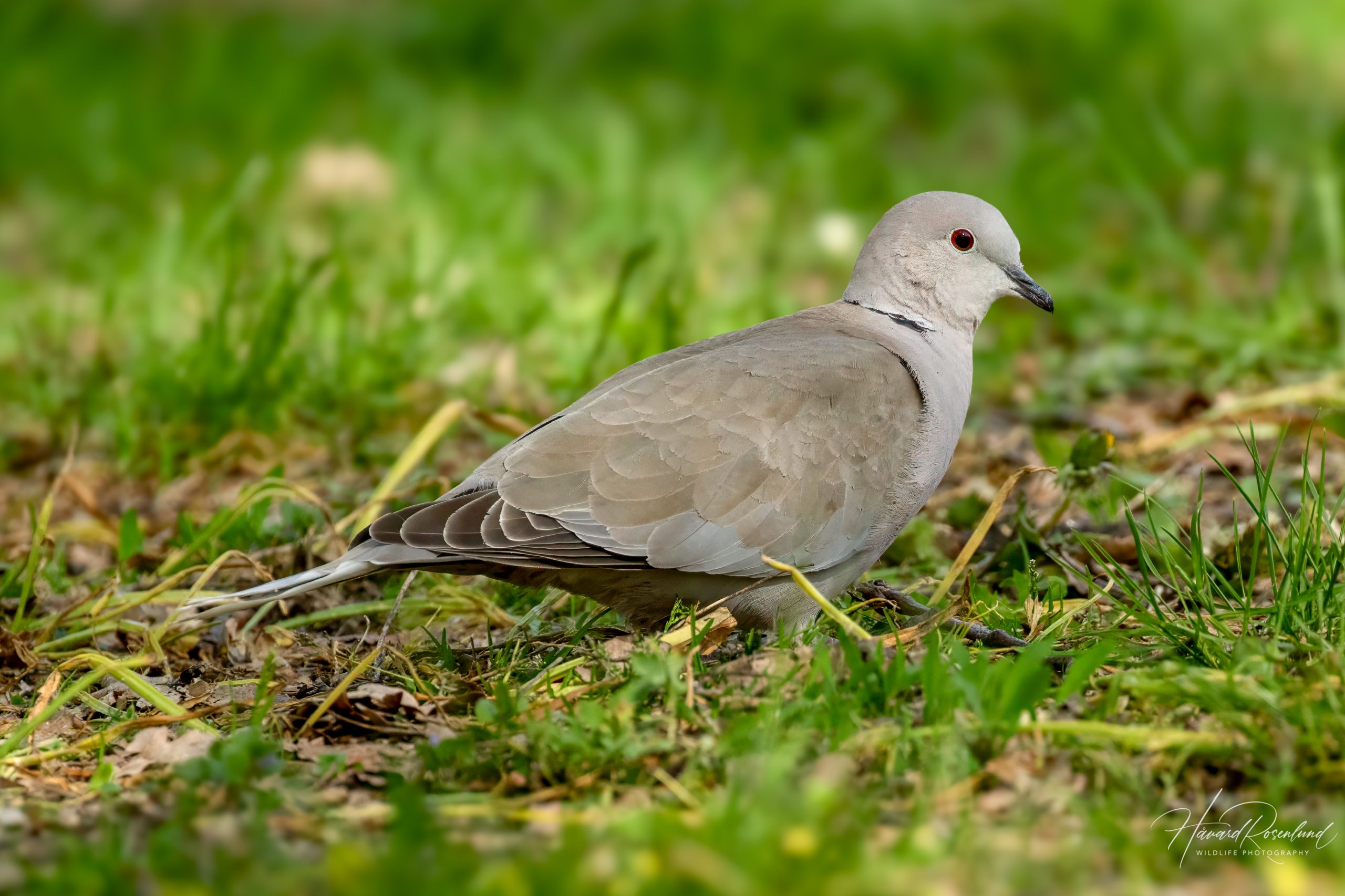
The Eurasian collared dove (Streptopelia decaocto) is a medium-sized, slender dove with pale grey-buff plumage, a long square-ended tail and a narrow black half-collar across the hindneck. The outer tail feathers are broadly tipped white, especially conspicuous in flight. Adults are roughly 31–34 cm long. The sexes are very similar, while juveniles are duller and lack the fully developed neck collar.
The species is famous for an extraordinary expansion of its natural range. From a distribution centred much farther southeast in Eurasia, it spread rapidly through the Balkans and across Europe during the twentieth century, reaching Britain in the 1950s. A study published in 2002 of colonisation in Extremadura in western Spain found that the species first established in urban areas and then spread into the surrounding countryside. This close link with towns and cultivated landscapes was characteristic of the European expansion, which occurred through natural colonisation rather than deliberate introduction.
Habitat
Eurasian collared doves are strongly associated with people across much of their modern range. They favour villages, suburbs, farmsteads, parks, gardens and other open landscapes where trees, buildings and overhead structures provide nesting and resting sites and food is available on the ground.
They generally avoid extensive closed forest and treeless open country. Their success in newly colonised areas is closely tied to settlements and agricultural landscapes, where grain stores, livestock feed, gardens and bird feeding can provide predictable resources through seasons when natural food is scarce.
Diet
Seeds and grain make up most of the diet, including cereal grains and seeds of grasses and other plants. Green plant material is taken in smaller amounts, and small invertebrates are occasionally eaten. Most feeding occurs on the ground, where birds walk and pick individual items from the surface.
Human food sources can be particularly important. Collared doves readily visit bird tables and feeders and forage around farms, grain stores and livestock facilities. This ability to exploit concentrated food has helped the species persist in towns and agricultural landscapes well beyond its former core range.
Behaviour
Collared doves are generally resident once a breeding population has become established, but young birds can disperse long distances. This combination of local residency and strong dispersal by colonising individuals helped drive the rapid twentieth-century expansion across Europe.
Pairs are often seen together throughout the year. Outside breeding, birds may gather in loose flocks where food is abundant. The familiar three-part coo is given repeatedly from exposed perches and also functions as a territorial signal, helping males mark and defend occupied areas against rivals.
Breeding
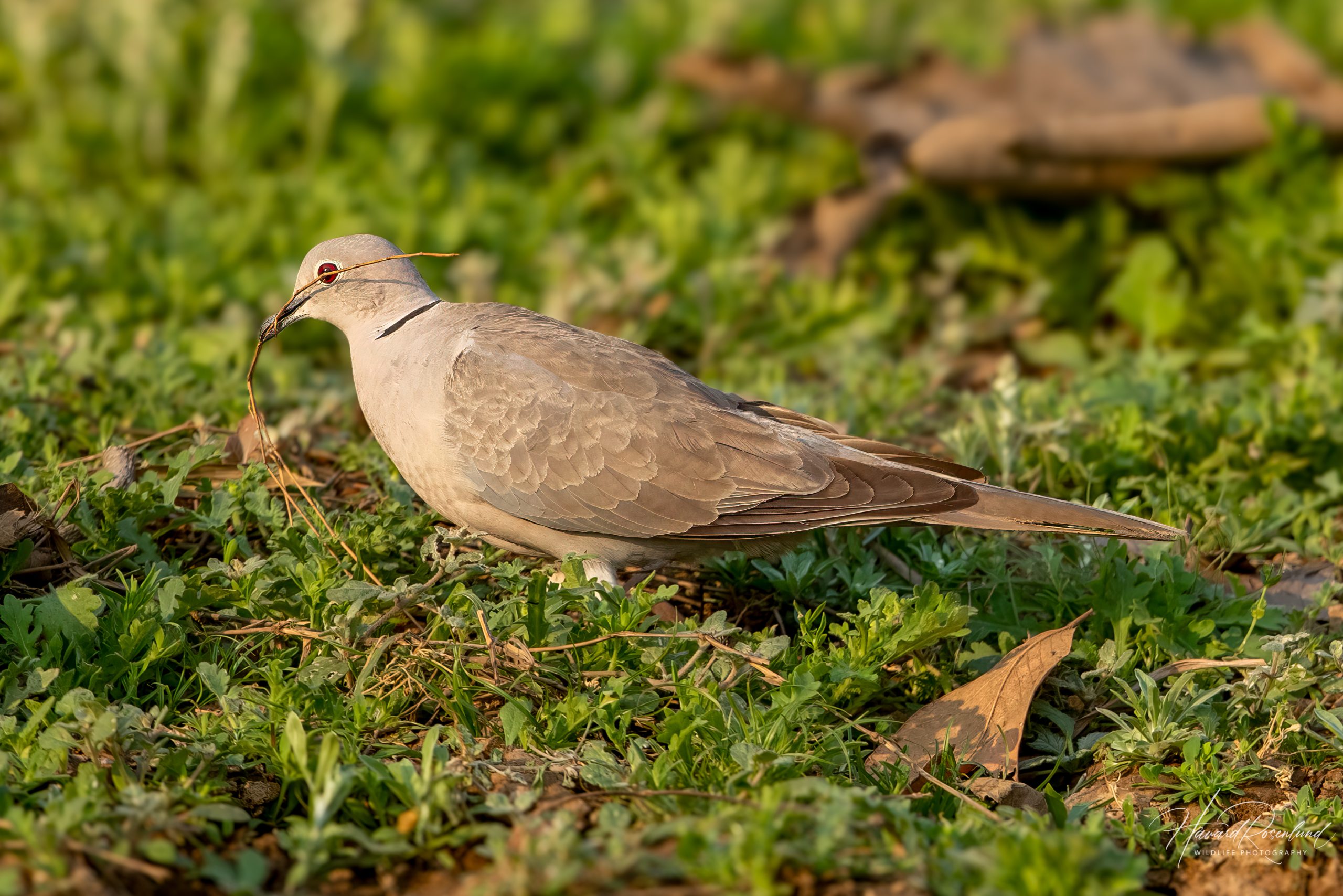
Breeding seasons are long, and in mild conditions nesting can occur during almost any month. Males perform a characteristic courtship flight with a steep climb followed by a descending glide on spread wings and tail. The nest is a simple, often rather flimsy platform of twigs placed in a tree, shrub or on a building. The usual clutch is two white eggs.
Both parents incubate and later feed the chicks with crop milk before increasingly adding softened seed. Incubation typically lasts about 16–17 days and the young leave the nest roughly 17–19 days after hatching. Multiple nesting attempts in a year are common and have contributed to the species' ability to build populations rapidly in newly colonised areas.
Relationship with humans
Few European birds illustrate adaptation to human landscapes as clearly as the collared dove. Towns, farms and supplementary feeding provide both nesting opportunities and reliable food, and the species' European expansion largely followed settled and cultivated landscapes.
Elsewhere, people have also moved the species beyond its naturally expanding range. Birds introduced to the Bahamas in the twentieth century spread to Florida and then rapidly across much of North America. A study published in 2014 of the North American expansion found that developed land cover and temperature were important in shaping local population growth. Studies of habitat and dietary overlap with native doves have found positive associations rather than evidence that collared doves broadly displace them.
Status
The Eurasian collared dove is classified as least concern on the IUCN Red List and has an enormous modern distribution. Regional trends now differ considerably among countries, and some long-established populations have declined despite the species' spectacular historical expansion.
In Britain, for example, numbers rose dramatically after colonisation but have declined since around 2005, probably in part because of the emergence and spread of finch trichomonosis. Changes in food availability, survival and breeding may also influence local trends.
Image gallery
Loading map and observations…
Have you seen this species?
Independent species archive
Did you find this species page useful?
Wildlife Vagabond is independently built and maintained. Voluntary support helps cover hosting, maps, data storage and continued improvements to the species archive.
Support Wildlife VagabondSpecies content will remain freely available.
References
Information about the species’ global distribution and status is based primarily on global Red List data. See the references below for details.
- BirdLife International. (n.d.). Eurasian Collared Dove species factsheet. https://datazone.birdlife.org/species/factsheet/eurasian-collared-dove-streptopelia-decaocto
- British Trust for Ornithology. (n.d.). Collared Dove BirdFacts. https://www.bto.org/learn/about-birds/birdfacts/collared-dove
- International Union for Conservation of Nature. (n.d.). Eurasian Collared Dove. The IUCN Red List of Threatened Species. https://www.iucnredlist.org/species/22727811/154457750
- Rocha-Camarero, G., & de Trucios, S. (2002). The spread of the Collared DoveStreptopelia decaoctoin Europe: colonization patterns in the west of the Iberian Peninsula. Bird Study, 49(1), 11-16. https://doi.org/10.1080/00063650209461239
- Scheidt, S. N., & Hurlbert, A. H. (2014). Range Expansion and Population Dynamics of an Invasive Species: The Eurasian Collared-Dove (Streptopelia decaocto). PLoS ONE, 9(10), e111510. https://doi.org/10.1371/journal.pone.0111510
- Slabbekoorn, H., & Cate, C. T. (1998). Multiple Parameters in the Territorial coo of the Collared Dove: Interactions and Meaning. Behaviour, 135(7), 879-895. https://doi.org/10.1163/156853998792640323