
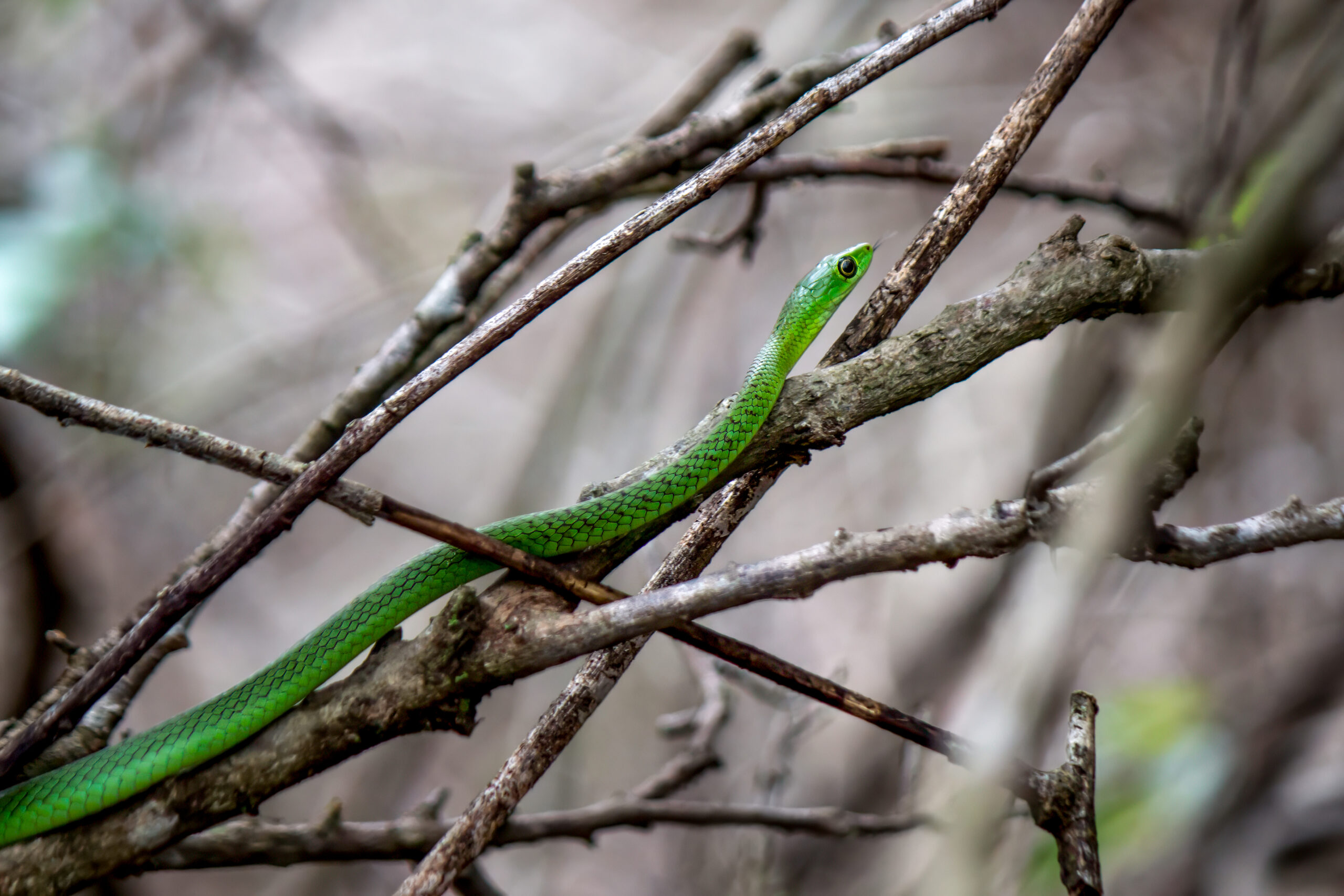
Eastern Natal Green Snake
Philothamnus natalensis
At a glance
Habitat
- Coastal forest, lowland woodland, dense bush, riverine vegetation and moist savanna
Diet
- Mainly frogs and lizards; juveniles may also take insects
Activity
- Diurnal and strongly arboreal
Size
- Length: usually 70–100 cm; occasionally up to about 130 cm Weight: —
Range
- Eastern South Africa, Eswatini, southern Mozambique and southeastern Zimbabwe
Description
The eastern Natal green snake (Philothamnus natalensis) is a slender, harmless colubrid found in southeastern Africa. Adults are usually around 70–100 cm long, although larger individuals can approach 130 cm.
The body is bright green to turquoise green, with a pale green or yellowish underside. Juveniles may have dark markings on the front of the body. The species has large eyes, a narrow head and a body well suited to climbing through foliage.
Taxonomy
The western Natal green snake (Philothamnus occidentalis) was formerly included within P. natalensis but was recognised as a separate species in 2019 following genetic, morphological and ecological work.
The two are very similar. The western species typically has a conspicuously dark eye and often a more turquoise head and tail, whereas the eastern Natal green snake usually shows more yellow in the iris. The green water snake (Philothamnus hoplogaster) is another possible confusion species but is more strongly associated with wetland vegetation and lacks the keeled ventral scales that help Natal green snakes grip while climbing.
Habitat
Eastern Natal green snakes occur in coastal forest, lowland woodland, dense bush, riverine vegetation and moist savanna. They are strongly arboreal and spend much of their time in shrubs and trees, especially near streams, wetlands and other damp habitats.
Diet
Frogs and lizards form most of the diet. Geckos are often taken around buildings, and juveniles may also eat grasshoppers and other insects. A study published in 2025 found that P. natalensis is a flexible generalist taking both frogs and lizards rather than specialising on one prey type.
The species hunts actively by day through branches and foliage, using its slender build, green colour and climbing ability to approach prey. The same hunting style is also used around buildings where geckos are abundant.
Behaviour
The eastern Natal green snake is diurnal, strongly arboreal and usually solitary. Keeled scales on the underside improve grip on bark and other rough surfaces and help the snake move quickly through trees and shrubs.
When disturbed on the ground, it normally retreats rapidly into nearby vegetation. It is non-venomous and poses no danger to people.
Reproduction
The species lays eggs, usually in early summer. Females generally produce about three to eight elongated eggs, which are placed in protected sites such as rotting vegetation, hollow spaces or sheltered cavities.
A study published in 2025 described a mating event involving one female and several males. Unlike the closely related western Natal green snake, the males showed no obvious aggression, combat or visual courtship. The observed mating therefore differed clearly from the western species, in which male combat and visual signalling have been documented.
Relationship with humans
Eastern Natal green snakes can occur in gardens and around buildings where dense vegetation and geckos provide shelter and food. Their bright green colour sometimes leads to confusion with the highly venomous eastern green mamba (Dendroaspis angusticeps).
The Natal green snake is harmless, but unknown green snakes should never be handled. Giving the animal space to leave is the safest response and also prevents harmless snakes from being killed through misidentification.
Status
The eastern Natal green snake is listed as least concern on the IUCN Red List. It has a restricted southeastern African distribution but is locally common, occurs in protected areas and can persist in gardens and other modified environments where suitable vegetation remains.
Loss of coastal forest and dense vegetation may affect local populations, but no major range-wide decline is currently documented.
Image gallery
Loading map and observations…
Have you seen this species?
Independent species archive
Did you find this species page useful?
Wildlife Vagabond is independently built and maintained. Voluntary support helps cover hosting, maps, data storage and continued improvements to the species archive.
Support Wildlife VagabondSpecies content will remain freely available.
References
Information about the species’ global distribution and status is based primarily on global Red List data. See the references below for details.
- Engelbrecht, H. M., Chapelle, K. E. J., & Alexander, G. J. (2025). Specialist Savvy Versus Generalist Grit: Elucidating the Trade-Offs in Adaptive Dietary Ecomorphology Amongst African Green and Bush Snakes. Ecology and evolution, 15(6), e71414. https://doi.org/10.1002/ece3.71414
- International Union for Conservation of Nature. (n.d.). Philothamnus natalensis (Eastern Natal Green Snake). The IUCN Red List of Threatened Species. https://www.iucnredlist.org/species/110152273/43130744
- Kyle, K. J., & Downs, C. T. (2025). Breeding behaviour, visual communication and male combat of Philothamnus occidentalis and Philothamnus natalensis. The Science of Nature, 112(2), 22. https://doi.org/10.1007/s00114-025-01972-6
- South African National Biodiversity Institute. (n.d.). Philothamnus natalensis: ecology, diet and reproduction. https://biodiversityadvisor.sanbi.org/search/detail/80892
- The Reptile Database. (n.d.). Philothamnus natalensis: taxonomy, distribution and habitat. https://reptile-database.reptarium.cz/species?genus=Philothamnus&species=natalensis