
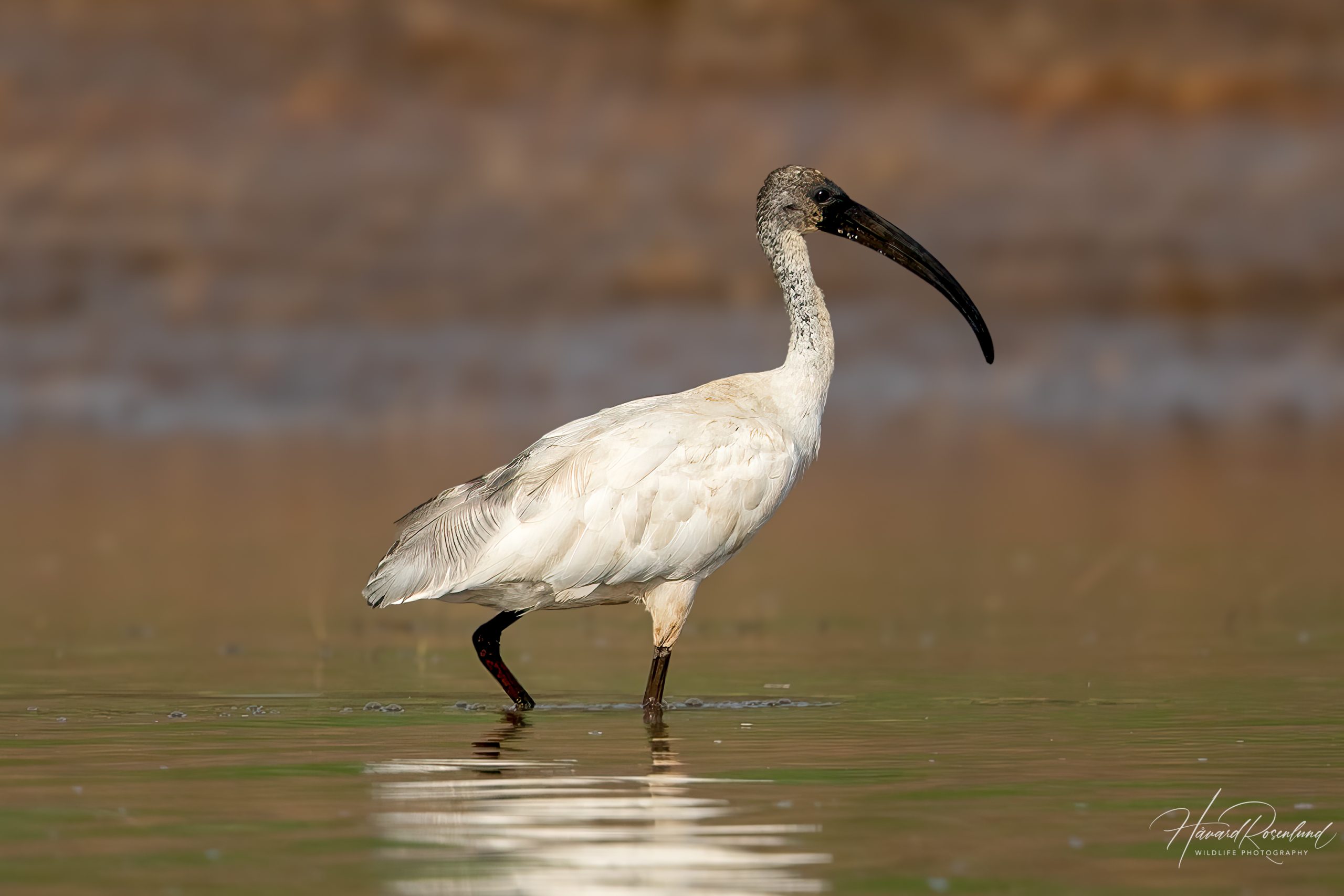
Black-headed Ibis
Threskiornis melanocephalus
At a glance
Habitat
- Shallow freshwater and brackish wetlands, rice fields, flooded grassland and other open wet habitats
Diet
- Aquatic invertebrates, insects, crustaceans, molluscs, amphibians and small fish
Activity
- Diurnal
Size
- Length: 65–76 cm Weight: about 1.38–1.8 kg
Range
- South and Southeast Asia, centred on the Indian subcontinent
Description
The black-headed ibis (Threskiornis melanocephalus) is a large wading bird of South and Southeast Asia. Adults are about 65–76 cm long, have a wingspan of roughly 130 cm and weigh around 1.38–1.8 kg. The plumage is predominantly white, contrasting sharply with the bare black head and neck, black legs and long down-curved bill.
Juveniles retain greyish feathering on the head and neck and have browner, less cleanly patterned plumage. During breeding, adults develop elongated ornamental feathers over the back and rear of the body. These plumes are grey in black-headed ibises, unlike the dark or black ornamental plumes of the closely related African sacred ibis (Threskiornis aethiopicus) and Australian white ibis (Threskiornis molucca), which were historically treated together with it as one species.
Habitat
Black-headed ibises use shallow freshwater and brackish wetlands, marshes, ponds, river margins, flooded fields, rice paddies, irrigation channels and seasonally inundated grassland. They also use some coastal wetlands and human-made wetlands.
A study published in 2018 in southern Rajasthan recorded 580 birds in 2016 and 643 in 2017, with the highest numbers in seasonal wetlands. The birds also occurred in agricultural and other open habitats.
Diet
The long curved bill is swept and probed through shallow water, mud and soft soil, locating much of the prey by touch. The diet includes aquatic insects and other invertebrates, crustaceans, molluscs, amphibians and small fish.
Birds also forage in agricultural land and flooded fields, where invertebrates exposed by cultivation or grazing can become locally important food sources. The species can therefore use both natural wetlands and farmland with abundant prey.
Behaviour
Black-headed ibises are diurnal and mainly resident or locally nomadic rather than strict long-distance migrants. Rainfall, water levels and food availability can trigger substantial movements within the range, allowing birds to leave drying wetlands and concentrate where newly flooded shallow areas provide abundant food.
Social behaviour
Black-headed ibises are strongly social. They commonly forage in loose groups, then spend quieter periods resting and preening at wetland margins or on elevated roost sites. Towards evening birds often gather at communal night roosts, sometimes together with other large waterbirds, and regularly commute between feeding areas and these traditional roosts.
Breeding
Breeding timing varies geographically and is closely tied to rainfall and wetland conditions. In many parts of India nesting is associated with the monsoon. Pairs build broad stick platforms in trees or shrubs, often within large mixed-species colonies, and both adults take part in nest building, incubation and chick care. Clutches usually contain two to four eggs.
The 2018 study in southern Rajasthan recorded nesting sites in Udaipur and Dungarpur together with eight other waterbird species. Eastern cattle egrets were the most frequent nesting associates, while Acacia nilotica and Prosopis juliflora were the most commonly used nest trees. At the much larger mixed heronry in Bhitarkanika, Odisha, 145, 143 and 138 black-headed ibis nests were counted in 2004, 2005 and 2006. The ibises formed their own sub-colonies. This population was unusual in having a mean clutch size of 6 ± 2.16 eggs, substantially above the two to four usually reported elsewhere; monitored nests also had a mean incubation period of 19.56 ± 1.13 days.
Status
The black-headed ibis is classified as least concern on the IUCN Red List. Its global category was changed from Near Threatened to Least Concern in 2024 after new evidence revised the earlier picture of population size and trend. The reassessment incorporated an estimate of more than 400,000 birds in South Asia and long-term population data that did not support the previously assumed global decline.
State of India's Birds 2025 estimates a long-term national increase of about 153.74%, with an uncertainty interval of 110.01–197.3%. The recent annual trend is also positive at about +1.83%, with an interval of +0.5 to +3.16%. Local populations can nevertheless decline where wetlands are drained or polluted, disturbance is high, or large roosting and nesting trees are lost.
Image gallery
Loading map and observations…
Have you seen this species?
Independent species archive
Did you find this species page useful?
Wildlife Vagabond is independently built and maintained. Voluntary support helps cover hosting, maps, data storage and continued improvements to the species archive.
Support Wildlife VagabondSpecies content will remain freely available.
References
Information about the species’ global distribution and status is based primarily on global Red List data. See the references below for details.
- BirdLife International. (n.d.). Black-headed Ibis species factsheet. https://datazone.birdlife.org/species/factsheet/black-headed-ibis-threskiornis-melanocephalus
- Chaudhury, S., & Koli, V. K. (2018). Population status, habitat preference, and nesting characteristics of black-headed ibis Threskiornis melanocephalus Latham, 1790 in southern Rajasthan, India. Journal of Asia-Pacific Biodiversity, 11(2), 223-228. https://doi.org/10.1016/j.japb.2018.01.013
- Chaudhury, S., & Koli, V. K. (2024). An Ethogram of the Black-Headed Ibis Threskiornis melanocephalus during Breeding Season. Journal of the Bombay Natural History Society (JBNHS). https://doi.org/10.17087/jbnhs/2024/v121/170653
- Gopi, G. V., & Pandav, B. (2012). Nesting ecology of the Near Threatened colonial waterbird Black-headed Ibis Threskiornis melanocephalus in Bhitarkanika Mangroves, Odisha. Journal of the Bombay Natural History Society, 109(1–2), 101–110. https://www.bnhsjournal.in/index.php/bnhs/article/view/156194
- International Union for Conservation of Nature. (n.d.). BirdLife International 2024 – IUCN assessment for Threskiornis melanocephalus. The IUCN Red List of Threatened Species. https://www.iucnredlist.org/species/22697516/252063963
- State of India's Birds. (2025). 2025 – Black-headed Ibis. https://stateofindiasbirds.in/species/blhibi1/