
Grass Snake
Natrix natrix
At a glance
Habitat
- Wetlands, pond margins, riverbanks, damp woodland and other mosaic habitats near freshwater
Diet
- Mostly amphibians; also fish and occasional small vertebrates
Activity
- Diurnal in the warm season; overwinters in sheltered sites
Size
- Length: usually 60–100 cm; large females can approach 140 cm Weight: about 100 g average; large females much heavier
Range
- Scandinavia and central/eastern Europe east through Russia to north-western China
Description
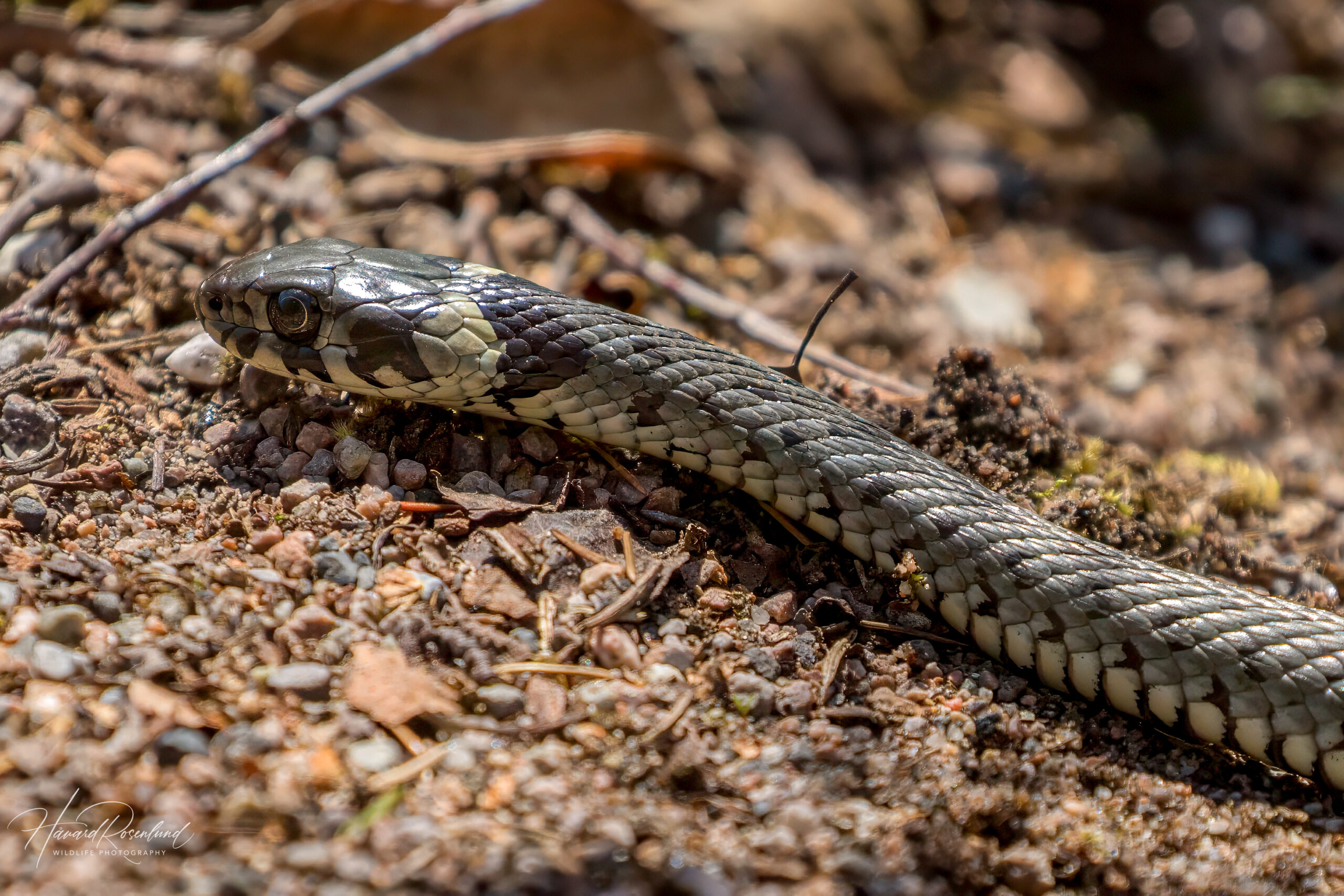
The grass snake (Natrix natrix) is a large, non-venomous snake native to Scandinavia and much of central and eastern Europe, with a range extending east through Russia into western Asia. Adults are usually around 60–100 cm long, with females substantially larger than males; exceptional females can approach 140 cm.
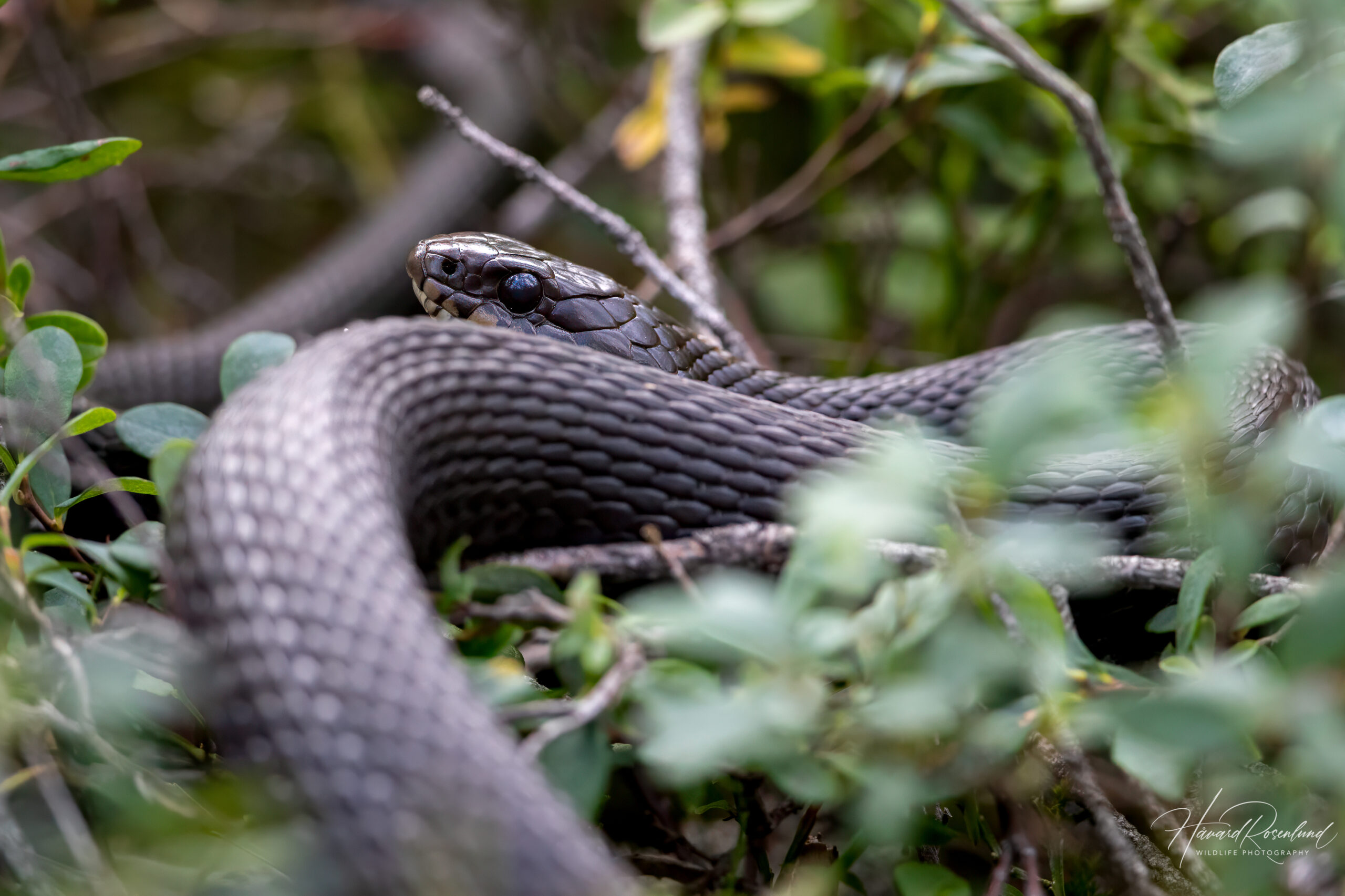
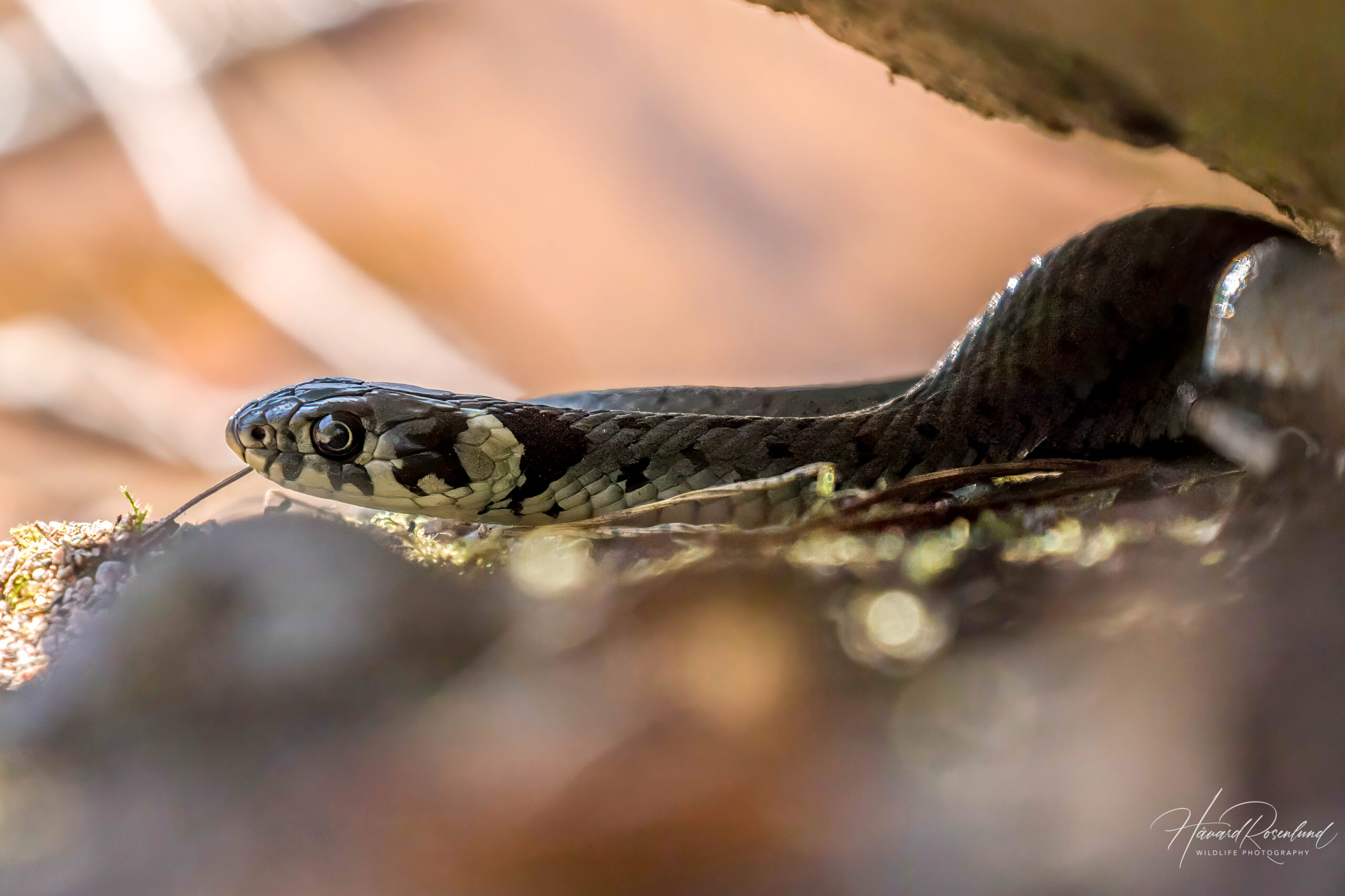
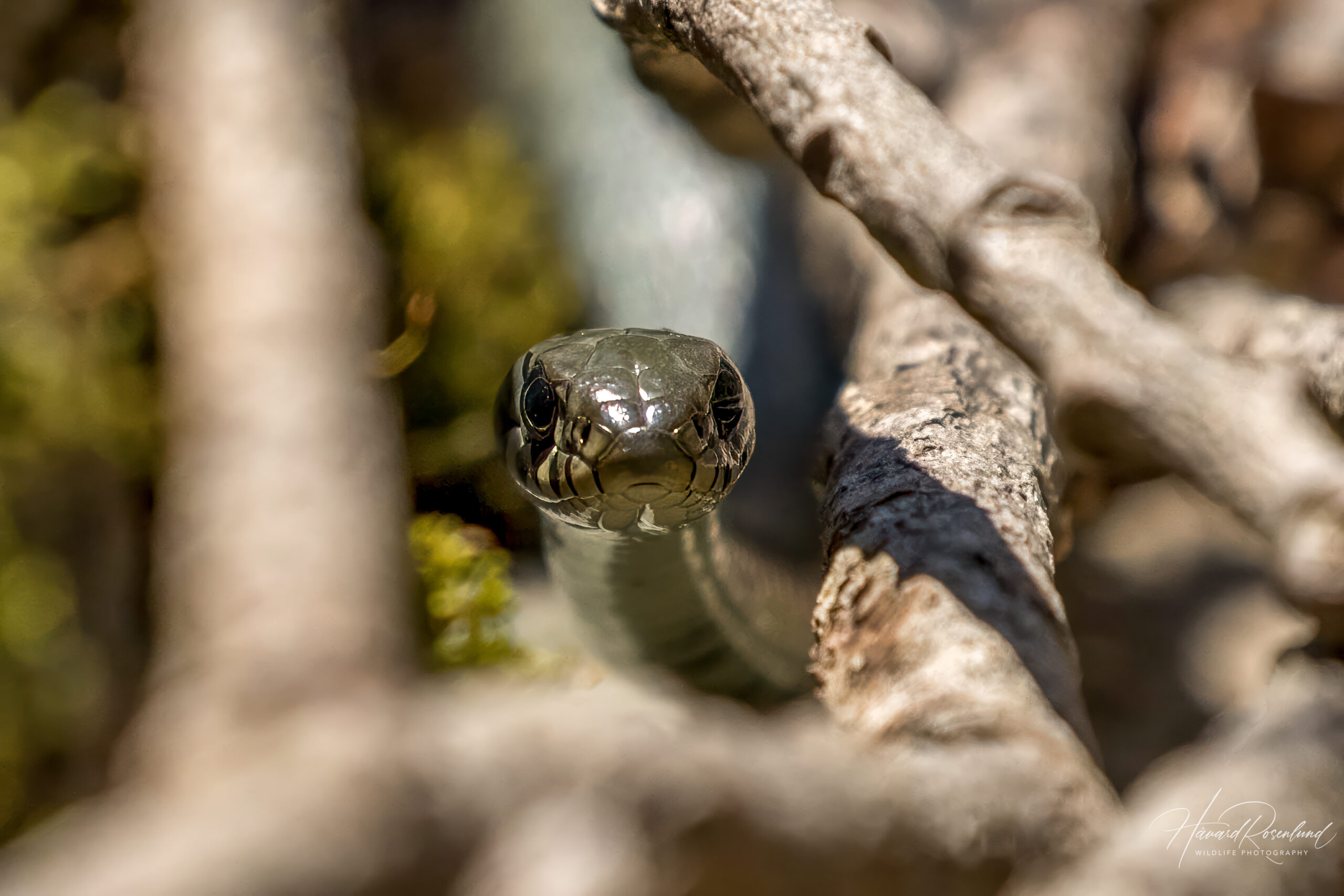
Colour ranges from grey and olive to brown or almost black. Most individuals show two pale yellowish or whitish patches behind the head, although these may disappear in melanistic snakes. Grass snakes have keeled dorsal scales and round pupils. A dark individual can be separated from a melanistic adder (Vipera berus) by features including the round pupil, large plates on top of the head and a single row of scales between the eye and mouth.
Taxonomy
The name Natrix natrix was historically applied to grass snakes across most of Europe, but genetic and morphological research has substantially narrowed that concept. The Ibero-Maghrebian grass snake was recognised as the separate species Natrix astreptophora in 2016, and work on contact zones around the Rhine supported species status for the barred grass snake Natrix helvetica in 2017.
Modern N. natrix therefore has a more easterly distribution than older field guides often show. It remains the grass snake occurring in Scandinavia and extends through central and eastern Europe into western Asia, while N. helvetica replaces it farther west and N. astreptophora occurs in south-western Europe and north-western Africa.
Habitat
Grass snakes are strongly associated with wetlands and landscapes containing ponds, marshes, slow rivers or other freshwater, although they can range well away from water through woodland, meadows and farmland. Good habitat combines open basking sites, dense cover, abundant amphibian prey, suitable egg-laying material and frost-free places to overwinter.
The species can also use human-modified landscapes when these elements remain available. Compost and manure heaps can provide valuable egg-laying sites, while ponds, rough vegetation and connected cover allow snakes to move between feeding, basking and overwintering sites.
Diet
Amphibians dominate the diet. Frogs and toads are particularly important, while newts, fish and occasional small mammals, birds or other vertebrates are also taken.
Diet changes with body size. Large females can handle larger prey than males and smaller snakes, while young grass snakes rely more heavily on small amphibians. This close link to amphibian prey makes productive ponds and wetland mosaics important even when the snakes spend part of their time well away from water.
Hunting
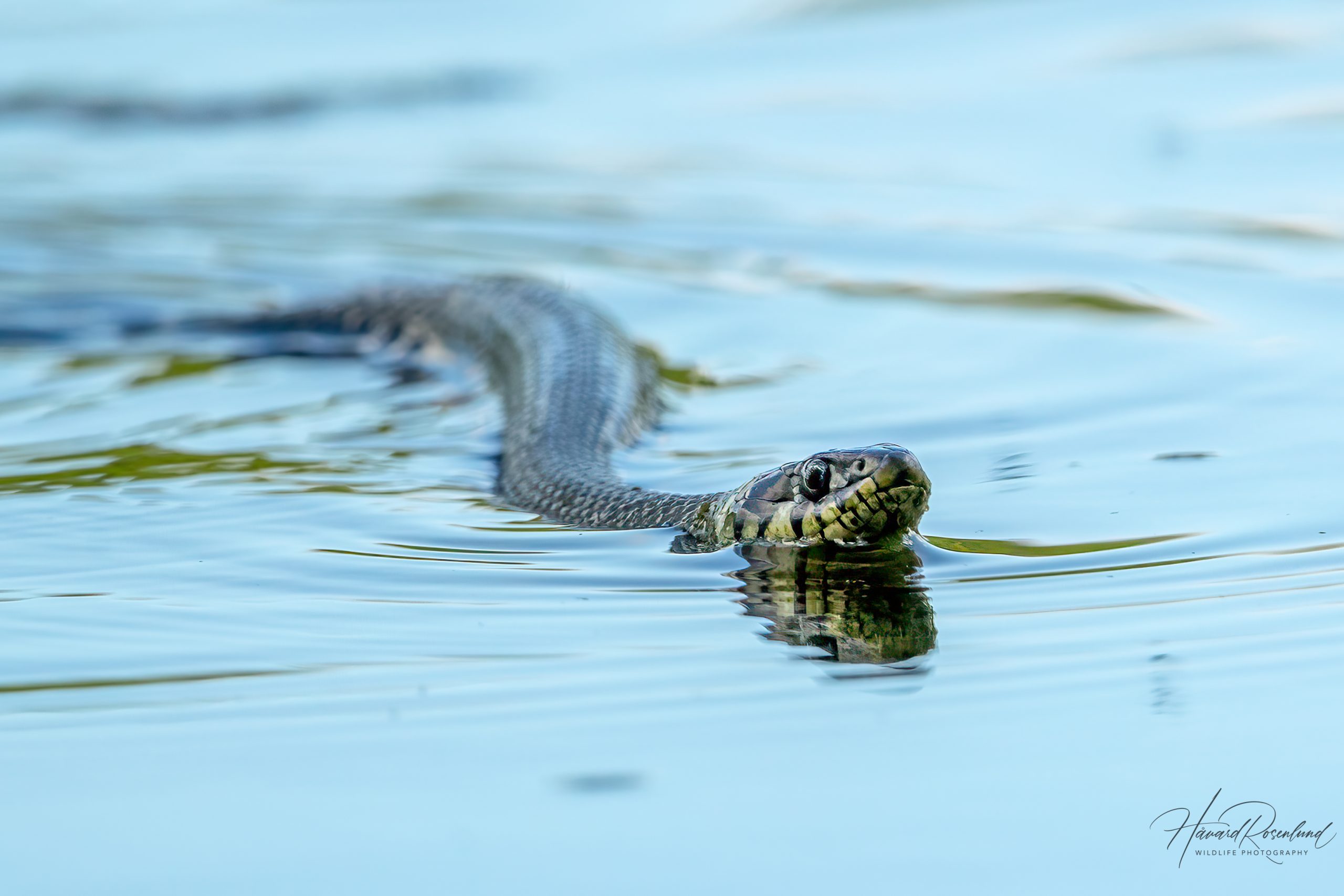
Grass snakes hunt actively both on land and in water, particularly around ponds and other places rich in amphibians. They are strong swimmers and can pursue prey through shallow water and dense waterside vegetation, but may also wait in ambush.
A study published in 2020 documented grass snakes climbing into vegetation and waiting for European tree frogs (Hyla arborea) above the ground. Once seized, prey is swallowed alive without constriction or venom. This combination of active searching, swimming and ambush allows the species to exploit amphibians in several parts of the same wetland landscape.
Behaviour
Grass snakes are mainly diurnal and often bask to raise body temperature before becoming active. They may move over surprisingly large areas during the warm season. In cold climates they spend winter dormant in frost-protected sites such as cavities, burrows, compost heaps and other sheltered places, sometimes sharing favourable overwintering sites with other snakes.
When threatened, a grass snake usually tries to escape. If cornered it may hiss, flatten the front of the body and release a foul-smelling secretion from the cloaca. A particularly distinctive defence is thanatosis, or death-feigning: the snake rolls onto its back, opens the mouth, lets the tongue hang out and remains limp as if dead. Several snakes may also gather near overwintering sites in early spring.
Reproduction
Mating occurs mainly after emergence in spring, although autumn mating is also known. Several males may gather tightly around a single female.
Grass snakes lay eggs, making warm egg-laying sites especially important near the northern edge of the range. Females seek warm, humid material such as compost or manure heaps and piles of rotting vegetation. A Swedish field experiment published in 2012 found 71% hatching success in manure heaps and 43% in compost, while none of the eggs placed in the tested natural sites hatched. The result shows how strongly successful incubation can depend on these heat-producing sites in cool climates.
A five-year study in the Italian Alps found one clutch of 4–24 eggs per female in late July, with larger females producing larger clutches. Females matured at around 6–8 years at the cool Alpine site, compared with about 4–5 years in a previously studied lowland Swedish population. Climate can therefore have a strong effect on growth and age at maturity.
Temperature also strongly affects development inside the egg. A Swedish incubation experiment published in 2012 found mean incubation periods of about 33 days at 31 °C and 71 days at 19 °C. The young are independent from hatching.
Status
The grass snake is classified as least concern on the IUCN Red List. It remains widespread across a large range, but local populations depend on connected wetland mosaics, amphibian prey, basking sites, egg-laying sites and safe places to overwinter.
Drainage and loss of ponds, reductions in amphibians, road mortality and loss of traditional compost or manure heaps can all reduce habitat quality locally. Because the species lays eggs, warm incubation sites can be particularly important near the cool northern edge of its range.
Image gallery
Loading map and observations…
Have you seen this species?
Independent species archive
Did you find this species page useful?
Wildlife Vagabond is independently built and maintained. Voluntary support helps cover hosting, maps, data storage and continued improvements to the species archive.
Support Wildlife VagabondSpecies content will remain freely available.
References
Information about the species’ global distribution and status is based primarily on global Red List data. See the references below for details.
- Bury, S., Mazgajski, T. D., Najbar, B., Zając, B., & Kurek, K. (2020). Melanism, body size, and sex ratio in snakes—new data on the grass snake (Natrix natrix) and synthesis. The Science of Nature, 107(3), 22. https://doi.org/10.1007/s00114-020-01678-x
- International Union for Conservation of Nature. (n.d.). Grass Snake. The IUCN Red List of Threatened Species. https://www.iucnredlist.org/species/165594334/545209
- Kaczmarski, M. (2020). Arboreal foraging and ambush by grass snakes <i>Natrix natrix</i> on European treefrogs <i>Hyla arborea</i>. The Herpetological Bulletin, 154, 39–40. https://doi.org/10.33256/hb154.3940
- Kindler, C., Chèvre, M., Ursenbacher, S., Böhme, W., Hille, A., Jablonski, D., Vamberger, M., & Fritz, U. (2017). Hybridization patterns in two contact zones of grass snakes reveal a new Central European snake species. Scientific Reports, 7(1), 7378. https://doi.org/10.1038/s41598-017-07847-9
- Luiselli, L., Capula, M., & Shine, R. (1997). Food habits, growth rates, and reproductive biology of grass snakes, Natrix natrix (Colubridae) in the Italian Alps. Journal of Zoology, 241(2), 371-380. https://doi.org/10.1111/j.1469-7998.1997.tb01965.x
- Luiselli, L. (1996). Individual success in mating balls of the grass snake, Natrix natrix: size is important. Journal of Zoology, 239(4), 731-740. https://doi.org/10.1111/j.1469-7998.1996.tb05474.x
- Löwenborg, K., Gotthard, K., & Hagman, M. (2012). How a thermal dichotomy in nesting environments influences offspring of the world's most northerly oviparous snake,Natrix natrix(Colubridae). Biological Journal of the Linnean Society, 107(4), 833-844. https://doi.org/10.1111/j.1095-8312.2012.01972.x
- Löwenborg, K., Kärvemo, S., Tiwe, A., & Hagman, M. (2012). Agricultural by-products provide critical habitat components for cold-climate populations of an oviparous snake (Natrix natrix). Biodiversity and Conservation, 21(10), 2477-2488. https://doi.org/10.1007/s10531-012-0308-0
- Löwenborg, K., Shine, R., & Hagman, M. (2011). Fitness disadvantages to disrupted embryogenesis impose selection against suboptimal nest-site choice by female grass snakes, Natrix natrix (Colubridae). Journal of Evolutionary Biology, 24(1), 177-183. https://doi.org/10.1111/j.1420-9101.2010.02153.x
- Löwenborg, K., Shine, R., Kärvemo, S., & Hagman, M. (2010). Grass snakes exploit anthropogenic heat sources to overcome distributional limits imposed by oviparity. Functional Ecology, 24(5), 1095-1102. https://doi.org/10.1111/j.1365-2435.2010.01730.x
- Pokrant, F., Kindler, C., Ivanov, M., Cheylan, M., Geniez, P., Böhme, W., & Fritz, U. (2016). Integrative taxonomy provides evidence for the species status of the Ibero-Maghrebian grass snakeNatrix astreptophora. Biological Journal of the Linnean Society, 118(4), 873-888. https://doi.org/10.1111/bij.12782
- The Reptile Database. (n.d.). Natrix natrix. https://reptile-database.reptarium.cz/species?genus=Natrix&species=natrix