
Adder
Vipera berus
At a glance
Habitat
- Heathland, moorland, forest edges, clearings and other mosaic habitats with both cover and basking sites
Diet
- Mainly small mammals; juveniles rely more on amphibians and lizards
Activity
- Mostly diurnal in cool climates; inactive in winter
Size
- Length: usually 35–85 cm; exceptionally over 100 cm Weight: males often 50–70 g; females often 80–100 g
Range
- A vast Eurasian range from western Europe across northern Asia to the Pacific
Description
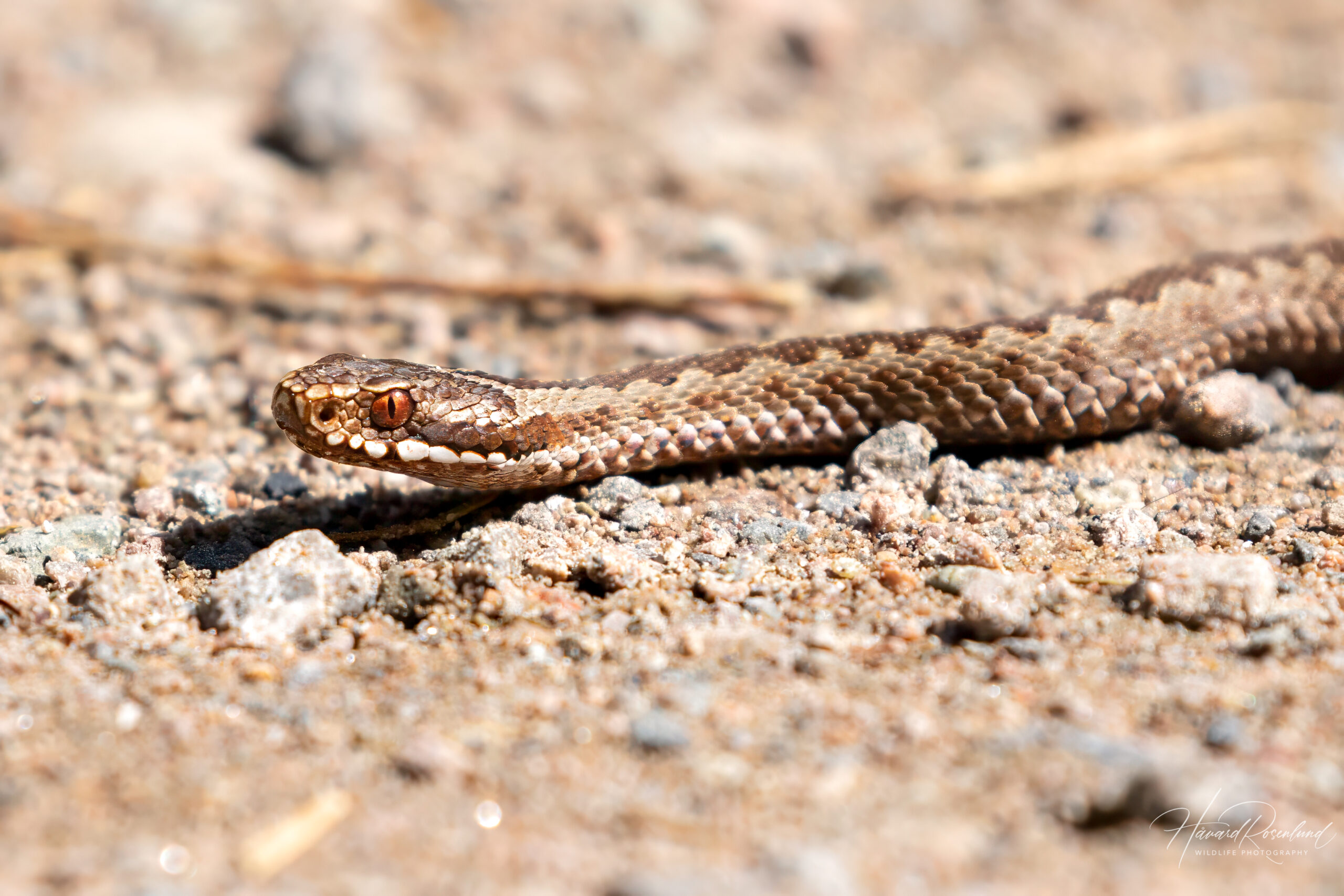
The adder (Vipera berus), also called the European adder or common viper, is a stout venomous snake with an exceptionally broad Eurasian range, extending from western Europe across northern Asia to the Pacific. Adults are usually about 35–85 cm long, with females generally larger than males; individuals exceeding one metre are exceptional.
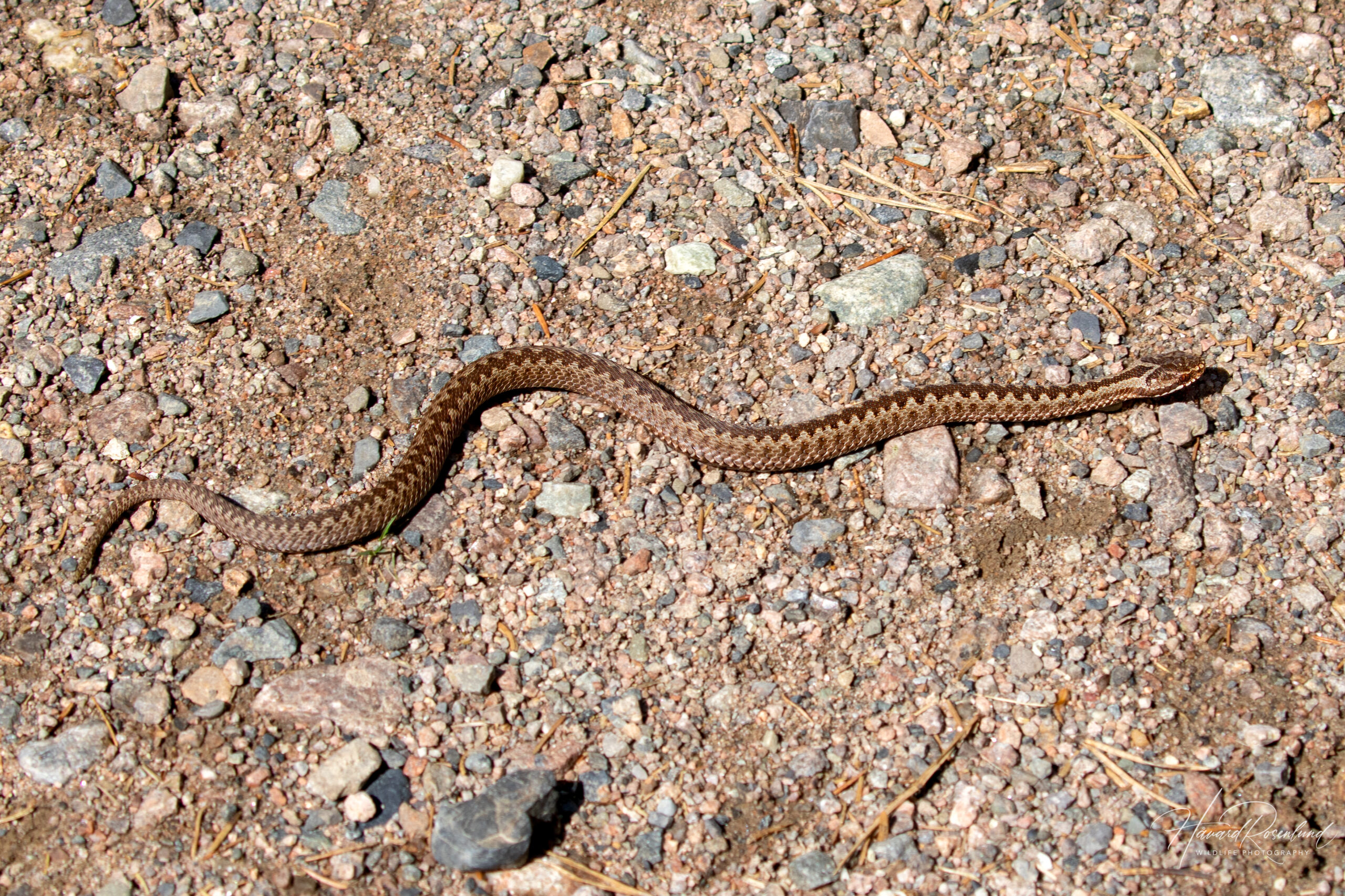
The best-known pattern is a dark zigzag running along the back. Males are often grey with a sharply contrasting black zigzag, while females more often have brown or reddish ground colours, but variation is considerable and some individuals are entirely black. The vertically slit pupil, many small scales on the top of the head and two rows of scales between the eye and mouth are particularly useful when identifying melanistic adders whose zigzag is difficult to see. Grass snakes (Natrix natrix) and smooth snakes (Coronella austriaca) have round pupils and larger head plates.
Habitat
Adders occupy a wide variety of open and semi-open habitats, including heathland, moorland, forest edges, clearings, bogs, rough grassland and mountain heath. Good habitat combines sunny places for warming with nearby dense vegetation or other cover, suitable prey and frost-free overwintering sites.
The arrangement of these features matters. Adders often return to the same seasonal areas year after year, so connected habitat that allows safe movement between hibernation sites, spring basking and mating areas and summer feeding grounds is especially valuable.
Diet
Adult adders feed mainly on small mammals such as voles and mice, supplemented by lizards, amphibians and occasionally birds. Newborn and juvenile snakes are too small to handle most rodents and depend much more heavily on small frogs, salamanders and lizards.
Hunting
Prey is normally bitten and envenomated before being swallowed. When attacking a potentially dangerous small mammal, an adder can release it after the strike rather than trying to hold a struggling animal, then locate the prey again after the venom has begun to take effect. This strike-and-release strategy reduces the risk of injury while allowing the venom to do much of the work of subduing the prey.
Behaviour
Adders are mainly solitary but follow a highly structured annual cycle. Individuals may return to the same hibernation site, spring area and summer range year after year and move between them seasonally. Several snakes can therefore appear close together around a traditional hibernation site without being social in the usual sense.
Males often emerge before females in spring. A study of male adders found that during the first post-hibernation period their body temperatures in the field averaged about 4 °C lower than later in spring. Early emergence appears to help males complete sperm development before mating, even though it means being active under poorer thermal conditions.
When disturbed, an adder normally remains still and relies on camouflage or retreats if it can. Basking is not aggressive behaviour but an essential part of body-temperature regulation in this cold-adapted ectotherm.
Venom
Adder venom is used primarily to immobilise prey. It is a complex mixture of biologically active proteins and enzymes, so describing it simply as ‘neurotoxic’ or ‘haemotoxic’ is misleading.
In humans, envenomation varies considerably. Pain and swelling around the bite are common, while more substantial envenomation can also cause systemic effects such as nausea, vomiting, weakness or cardiovascular symptoms. A systematic review of European Vipera bites found V. berus to be the species most often represented in the published cases. Bites on people are defensive; the venom's main biological roles are prey capture and defence.
Reproduction
Mating takes place mainly in spring. Males search actively for females and may engage in ritualised combat, raising the front of the body and pushing against one another in the well-known ‘adder dance’. Females give birth to live young rather than laying externally developing eggs.
Reproduction is energetically demanding and mature females often skip breeding seasons while rebuilding body reserves. An 18-year mark–recapture study in northern Belgium found intervals of one year between successive litters in only 8% of cases, compared with two years in 63% and three years in 29%. Females producing a litter can lose around a third of their body mass over the reproductive cycle, helping explain why two- or three-year intervals are common.
Young are born from late summer into autumn and are independent immediately. At the same long-term study site in northern Belgium, litters ranged from 4 to 12 young and increased with female size.
Status
The adder is classified as least concern on the IUCN Red List and remains extraordinarily widespread across Eurasia.
Local populations can nevertheless be vulnerable because many individuals repeatedly use traditional hibernation and mating sites. Habitat fragmentation, destruction of hibernation sites, road mortality, prey declines and deliberate killing can therefore have persistent local effects. Connected habitat with both sunny basking areas and secure cover is especially important for populations that move between fixed seasonal sites.
Image gallery
Loading map and observations…
Have you seen this species?
Independent species archive
Did you find this species page useful?
Wildlife Vagabond is independently built and maintained. Voluntary support helps cover hosting, maps, data storage and continued improvements to the species archive.
Support Wildlife VagabondSpecies content will remain freely available.
References
Information about the species’ global distribution and status is based primarily on global Red List data. See the references below for details.
- Artsdatabanken. (n.d.). Hoggorm, artbeskrivelse. https://artsdatabanken.no/arter/takson/1596/beskrivelse
- Bauwens, D., & Claus, K. (2019). Intermittent reproduction, mortality patterns and lifetime breeding frequency of females in a population of the adder (Vipera berus). PeerJ, 7, e6912. https://doi.org/10.7717/peerj.6912
- Herczeg, G., Saarikivi, J., Gonda, A., Perälä, J., Tuomola, A., & Merilä, J. (2007). Suboptimal thermoregulation in male adders (Vipera berus) after hibernation imposed by spermiogenesis. Biological Journal of the Linnean Society, 92(1), 19-27. https://doi.org/10.1111/j.1095-8312.2007.00827.x
- International Union for Conservation of Nature. (n.d.). Adder. The IUCN Red List of Threatened Species. https://www.iucnredlist.org/species/47756146/743903
- Paolino, G., Di Nicola, M., Pontara, A., Didona, D., Moliterni, E., Mercuri, S., Grano, M., Borgianni, N., Kumar, R., & Pampena, R. (2020). Vipera snakebite in Europe: a systematic review of a neglected disease. Journal of the European Academy of Dermatology and Venereology, 34(10), 2247-2260. https://doi.org/10.1111/jdv.16722
- The Reptile Database. (n.d.). Vipera berus. https://reptile-database.reptarium.cz/species?genus=Vipera&species=berus