
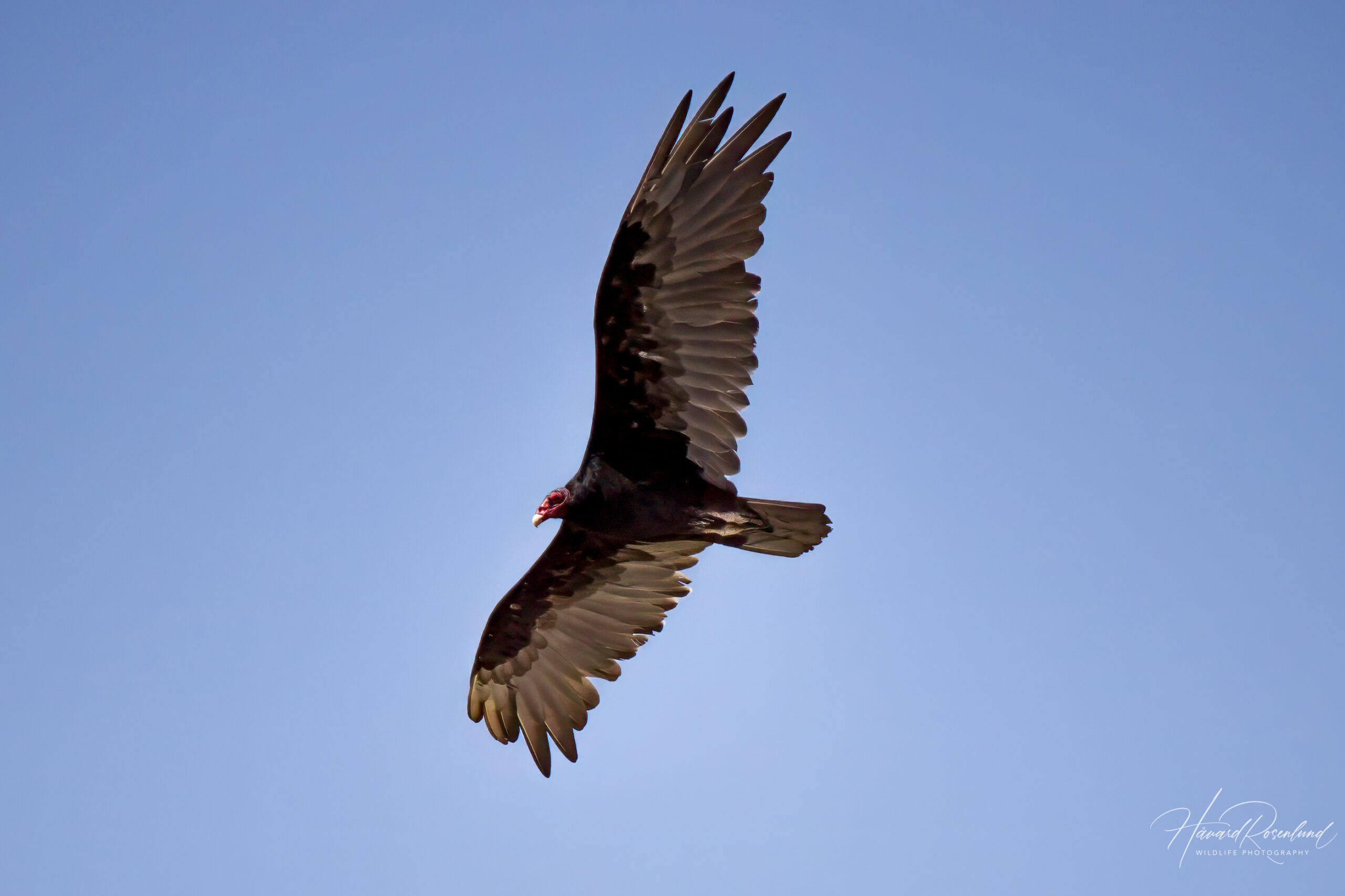
Turkey Vulture
Cathartes aura
At a glance
Habitat
- Open woodland, farmland, grassland, desert, roadsides and other landscapes with open airspace and carrion
Diet
- Scavenger; almost entirely carrion, especially mammals, but also birds, reptiles, amphibians and fish
Activity
- Diurnal
Size
- Length: 64–81 cm Weight: About 2 kg
Range
- Throughout the Americas, from southern Canada to southern South America
Description
The turkey vulture (Cathartes aura) is one of the most widespread large scavenging birds in the Americas, occurring from southern Canada to the southern tip of South America. Adults are 64–81 cm long, with a wingspan of about 170–178 cm and a weight around 2 kg. The body is dark brown to black, while adults have a small bare red head and pale bill; juveniles have a darker grey head.
In flight the long wings are held in a shallow V and the bird characteristically rocks from side to side with few wingbeats. The flight feathers look much paler from below, creating a two-toned underwing. Compared with the black vulture, turkey vultures have a longer tail and wings and a much more buoyant, teetering flight.
Habitat
Turkey vultures use an enormous range of landscapes, including deserts, rangeland, farmland, open forest, mountain valleys, roadsides, suburbs and landfill surroundings. Open airspace is important for efficient soaring, while trees, cliffs and structures provide resting and roosting sites.
The species can cross very different habitats while searching for food and is not tied to one vegetation type. Access to rising air and a steady supply of carcasses are often more important than the exact habitat.
Diet
Carrion makes up almost the entire diet. Mammals dominate, but dead birds, reptiles, amphibians and fish are also eaten. Turkey vultures generally prefer relatively fresh carcasses and only very rarely take living prey.
A highly acidic digestive system and other physiological defences allow them to consume carrion carrying pathogens that would be dangerous to many animals. By rapidly removing carcasses they provide an important ecological sanitation service.
Scavenging
Smell is central to how turkey vultures find carrion. They can detect volatile compounds released during early decomposition and locate carcasses hidden beneath forest canopy, where vision alone would be much less effective.
The anatomy behind this ability is exceptional. Comparative work found that the olfactory bulbs are about four times larger than those of black vultures relative to brain size and unusually developed compared with a large sample of other birds. Black vultures can exploit this advantage by watching and following turkey vultures to carcasses.
Ecological role
Turkey vultures are major carcass removers across the Americas. By consuming dead animals rapidly, their highly acidic digestive system helps break down material carrying pathogens and returns nutrients to the food web while shortening the time carcasses remain in the environment.
Their exceptional sense of smell gives them an additional role within the scavenger community. Turkey vultures can locate small or concealed carcasses beneath forest canopy that more visually dependent scavengers may miss, and other species such as black vultures can then use their movements to find the same food. They therefore help connect otherwise hidden carrion with the wider scavenger guild.
Behaviour
Turkey vultures exploit rising air extremely efficiently and can travel long distances with remarkably little flapping. In the morning they often stand with the wings spread, which helps warm and dry the feathers before sustained flight.
They also have unusual responses to heat and danger. Vultures can cool themselves by excreting onto the bare legs, allowing evaporation to remove heat. When strongly threatened they may regurgitate crop or stomach contents as a defence. Despite their size, they are often displaced from carcasses by more aggressive scavengers such as black vultures and caracaras.
Social behaviour
Turkey vultures often search for food alone, but become strongly social at communal roosts, migration bottlenecks and rich carcasses. Roosts can contain many birds and may be used repeatedly over long periods.
When thermals form, migrating and locally travelling birds gather into circling groups known as kettles. These temporary groups are produced by many individuals exploiting the same columns of rising air rather than by tight flock coordination.
Migration
Migration varies strongly with latitude. Many birds in the southern United States and tropics are resident, while northern populations migrate south for winter. Western North American birds can travel particularly far, with major movements through Central America and some individuals continuing into northern South America.
Tracking studies show that turkey vultures use thermals and other atmospheric uplift to cover long distances at low energetic cost. Routes concentrate strongly where topography and weather provide reliable soaring conditions.
Home ranges
Home-range size varies enormously between populations and seasons. GPS tracking of breeding adults near the northern range limit in Saskatchewan produced a mean breeding home range of about 371 km², while studies of vultures elsewhere have recorded home ranges from under 1,000 to well over 30,000 km² depending on residency, season and estimation method.
Migratory birds can use still larger wintering areas, and tracked individuals from Saskatchewan have occupied seasonal ranges of many thousands of square kilometres in South America. Vegetation productivity, temperature and the availability of atmospheric uplift all help determine how much space a bird needs within a season. This is distinct from migration itself: the home range describes the area repeatedly used after a bird has reached a seasonal destination.
Breeding
Turkey vultures do not build a conventional nest. Eggs are laid in secluded rock crevices, caves, hollow logs and trees, dense thickets, mammal burrows or abandoned buildings, and some sites are reused for many years.
A clutch contains one to three eggs. Both parents incubate for about 28–40 days and later feed the chicks by regurgitation. The young remain at the nest site for roughly two to almost three months before fledging. Courtship includes prolonged follow-flights in which one bird closely mirrors the twists and turns of another.
Relationship with humans
Roads, livestock farming and other human activities can create abundant carrion, and turkey vultures readily exploit roadkill, slaughter waste and some landfill food. This can bring them into close contact with vehicles, buildings and people.
Scavenging also exposes the species to human-made poisons. Lead fragments in shot carcasses and gut piles can cause poisoning, while residues of veterinary euthanasia drugs such as pentobarbital can kill vultures feeding on improperly disposed domestic-animal carcasses. Local persecution and collisions also occur.
Status
The turkey vulture is classified as least concern on the IUCN Red List and remains one of the most abundant large scavengers in the Americas.
The species' enormous range, flexible habitat use and ability to exploit widespread carrion sources provide substantial resilience, although local populations can still be affected by poisoning, persecution and collision risks.
Image gallery
Loading map and observations…
Have you seen this species?
Independent species archive
Did you find this species page useful?
Wildlife Vagabond is independently built and maintained. Voluntary support helps cover hosting, maps, data storage and continued improvements to the species archive.
Support Wildlife VagabondSpecies content will remain freely available.
References
- Avibase. (n.d.). AviList 2025 / Avibase – Turkey Vulture (Cathartes aura). https://avibase.bsc-eoc.org/species.jsp?avibaseid=36B3872DAFE1EC1C&lang=EN
- BirdLife International. (n.d.). Turkey Vulture species factsheet. https://datazone.birdlife.org/species/factsheet/turkey-vulture-cathartes-aura
- Cornell Lab of Ornithology. (n.d.). Turkey Vulture Life History. https://www.allaboutbirds.org/guide/Turkey_Vulture/lifehistory
- Dodge, S., Bohrer, G., Bildstein, K., Davidson, S. C., Weinzierl, R., Bechard, M. J., Barber, D., Kays, R., Brandes, D., Han, J., & Wikelski, M. (2014). Environmental drivers of variability in the movement ecology of turkey vultures (Cathartes aura) in North and South America. Philosophical transactions of the Royal Society of London. Series B, Biological sciences, 369(1643), 20130195. https://doi.org/10.1098/rstb.2013.0195
- Grigg, N. P., Krilow, J. M., Gutierrez-Ibanez, C., Wylie, D. R., Graves, G. R., & Iwaniuk, A. N. (2017). Anatomical evidence for scent guided foraging in the turkey vulture. Scientific Reports, 7(1), 17408. https://doi.org/10.1038/s41598-017-17794-0
- International Union for Conservation of Nature. (n.d.). Turkey Vulture. The IUCN Red List of Threatened Species. https://www.iucnredlist.org/species/22697627/131941613
- Potier, S., Duriez, O., Célérier, A., Liegeois, J.-L., & Bonadonna, F. (2019). Sight or smell: which senses do scavenging raptors use to find food? Animal cognition, 22(1), 49-59. https://doi.org/10.1007/s10071-018-1220-0
- U.S. Geological Survey. (n.d.). Barbiturates and scavenger poisoning. https://www.usgs.gov/publications/barbiturates
- U.S. Geological Survey. (n.d.). Experimental lead poisoning in Turkey Vultures. https://www.usgs.gov/publications/experimental-lead-poisoning-turkey-vultures-cathartes-aura