
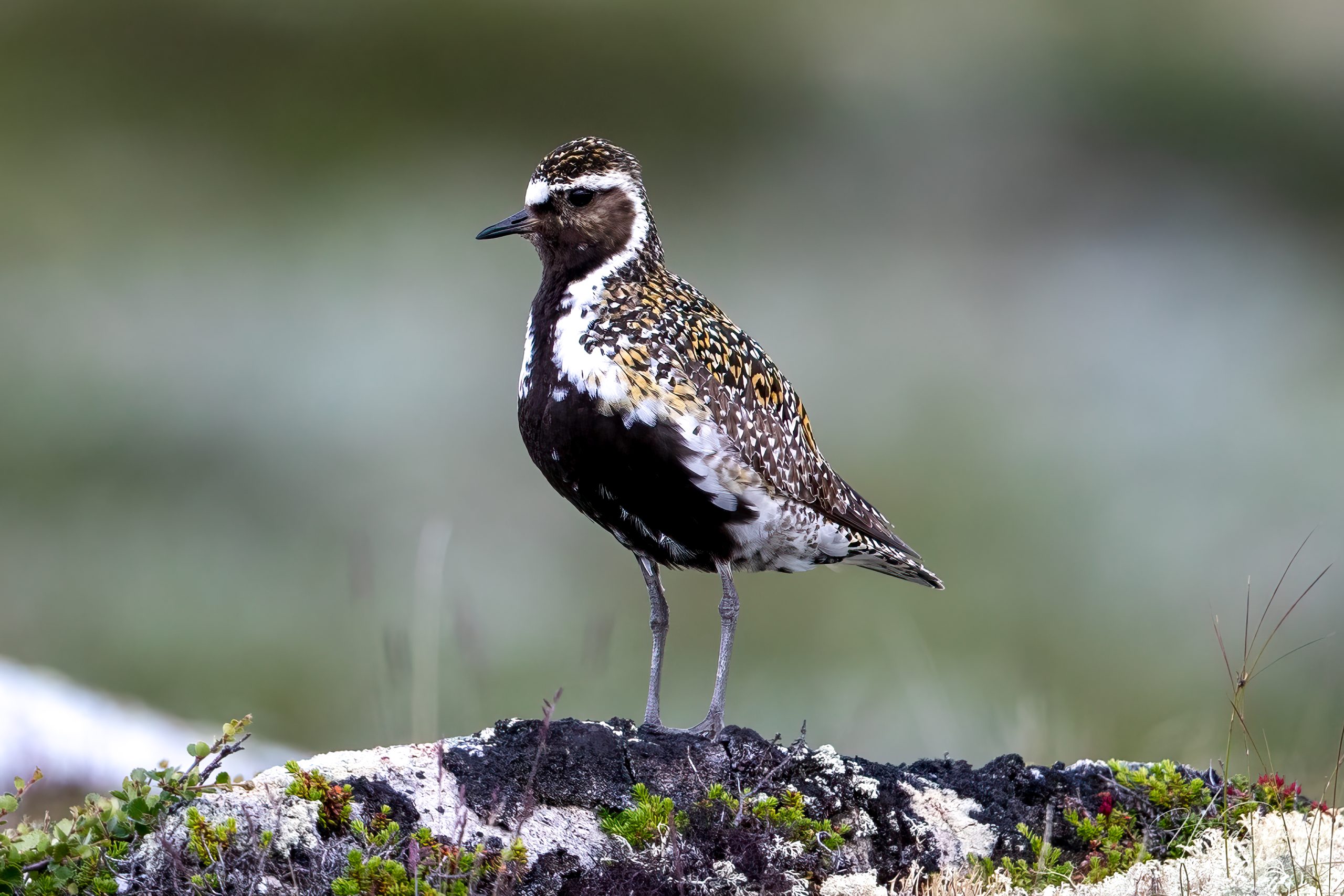
European Golden Plover
Pluvialis apricaria
At a glance
Habitat
- Open moorland, tundra, blanket bog and upland heath for breeding; farmland, grassland and coastal plains in winter
Diet
- Mainly beetles, earthworms and other invertebrates; also seeds and other plant material
Activity
- Diurnal; can also feed at night, especially on wintering grounds
Size
- Length: ~26–29 cm Weight: ~160–280 g
Range
- Breeds from Iceland and the British Isles through Scandinavia to northwest Russia; winters mainly in western and southern Europe and locally North Africa
Description
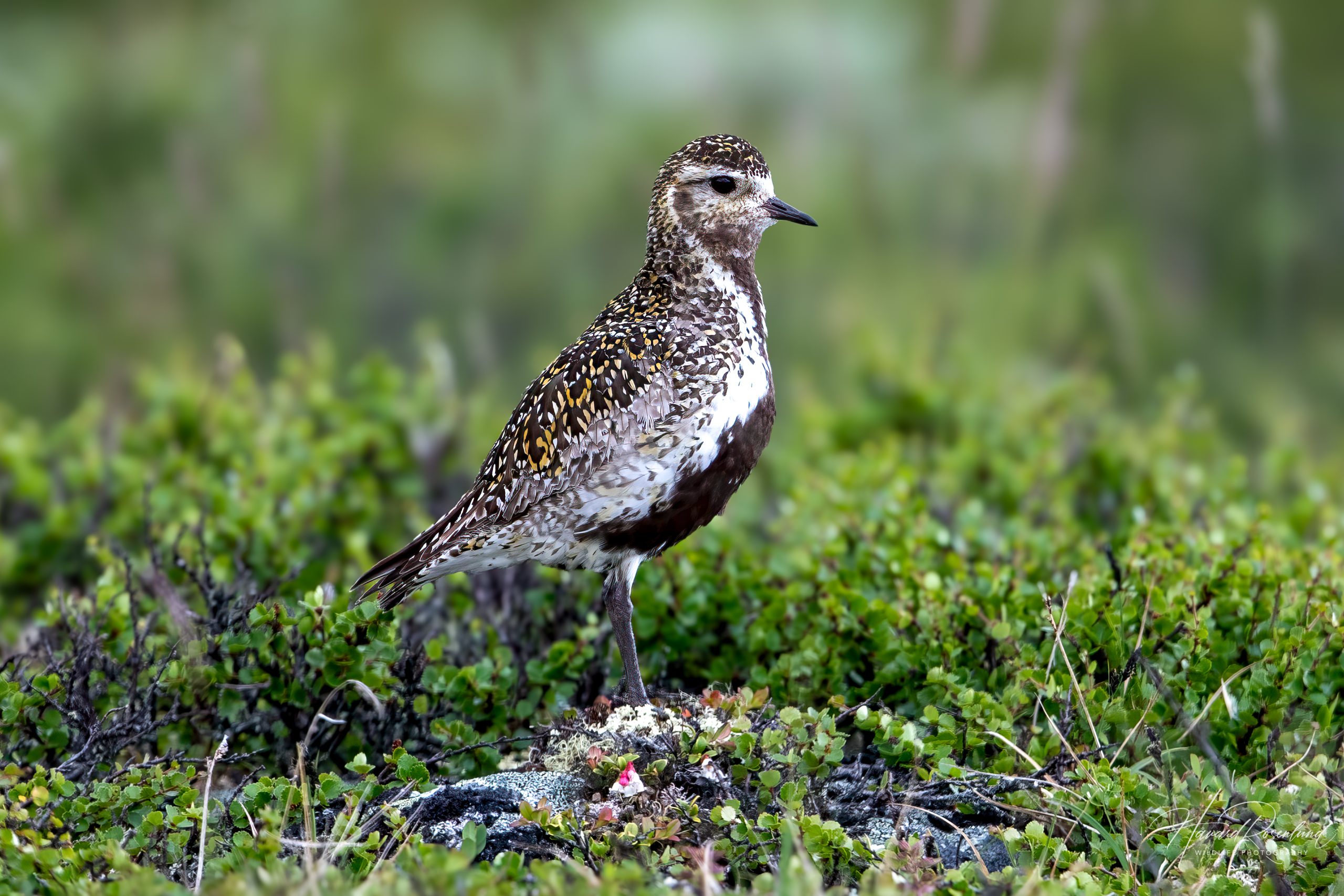
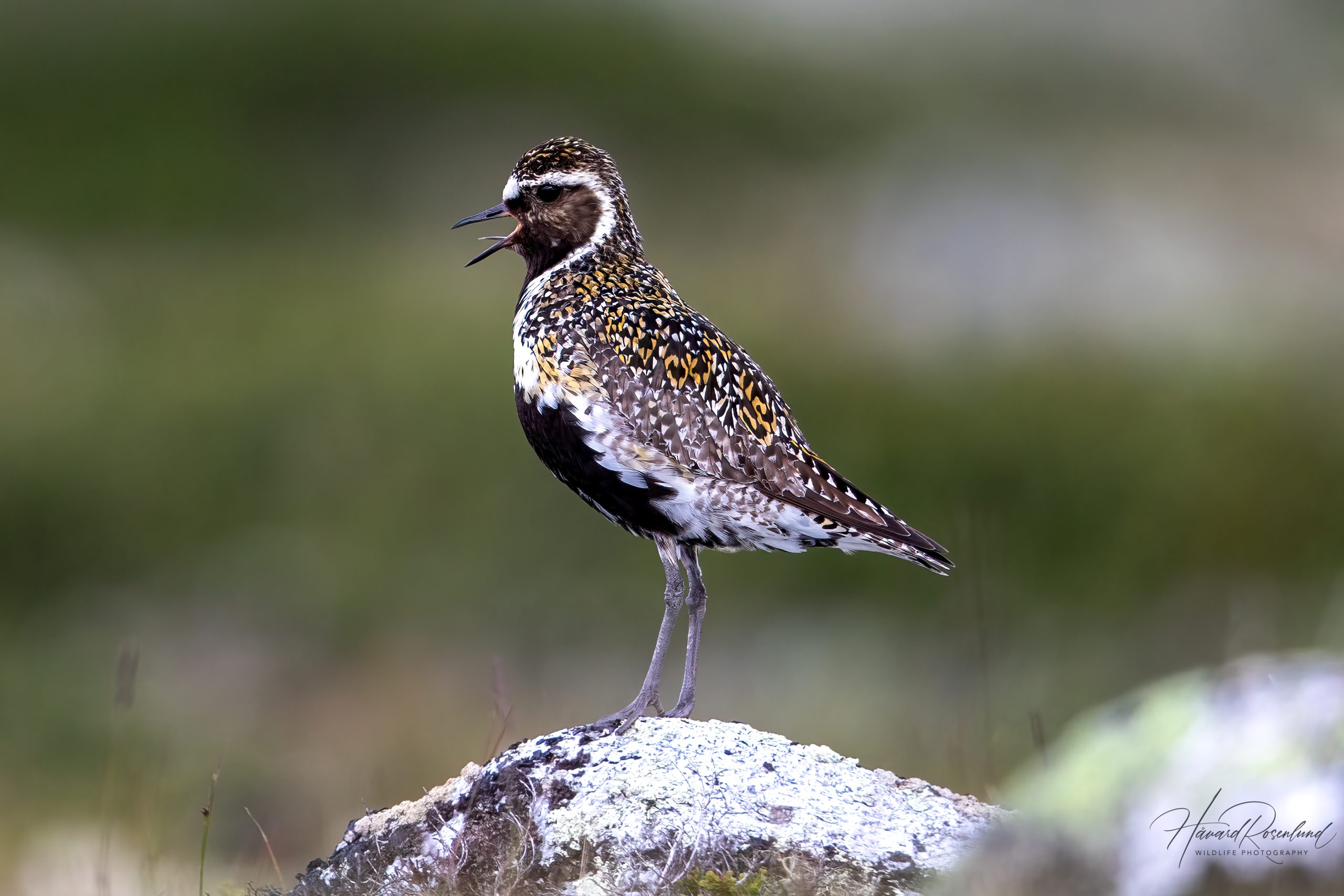
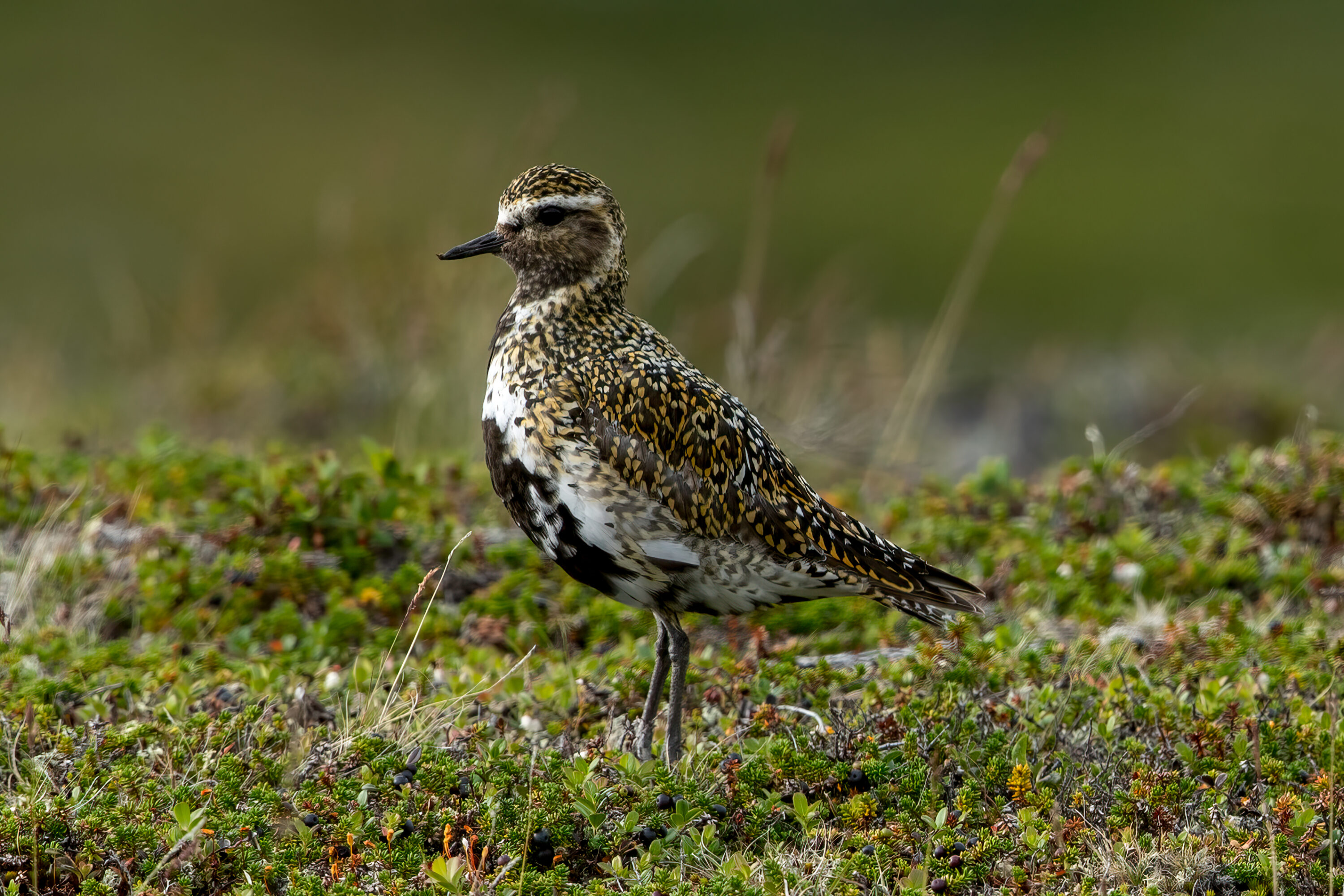
The European golden plover (Pluvialis apricaria) is a medium-sized plover that breeds across northern Europe. Adults are about 26–29 cm long, have a wingspan of roughly 67–76 cm and weigh around 160–280 g. The back and wings are densely spangled with gold and black, creating excellent camouflage among heather, moss and tundra vegetation.
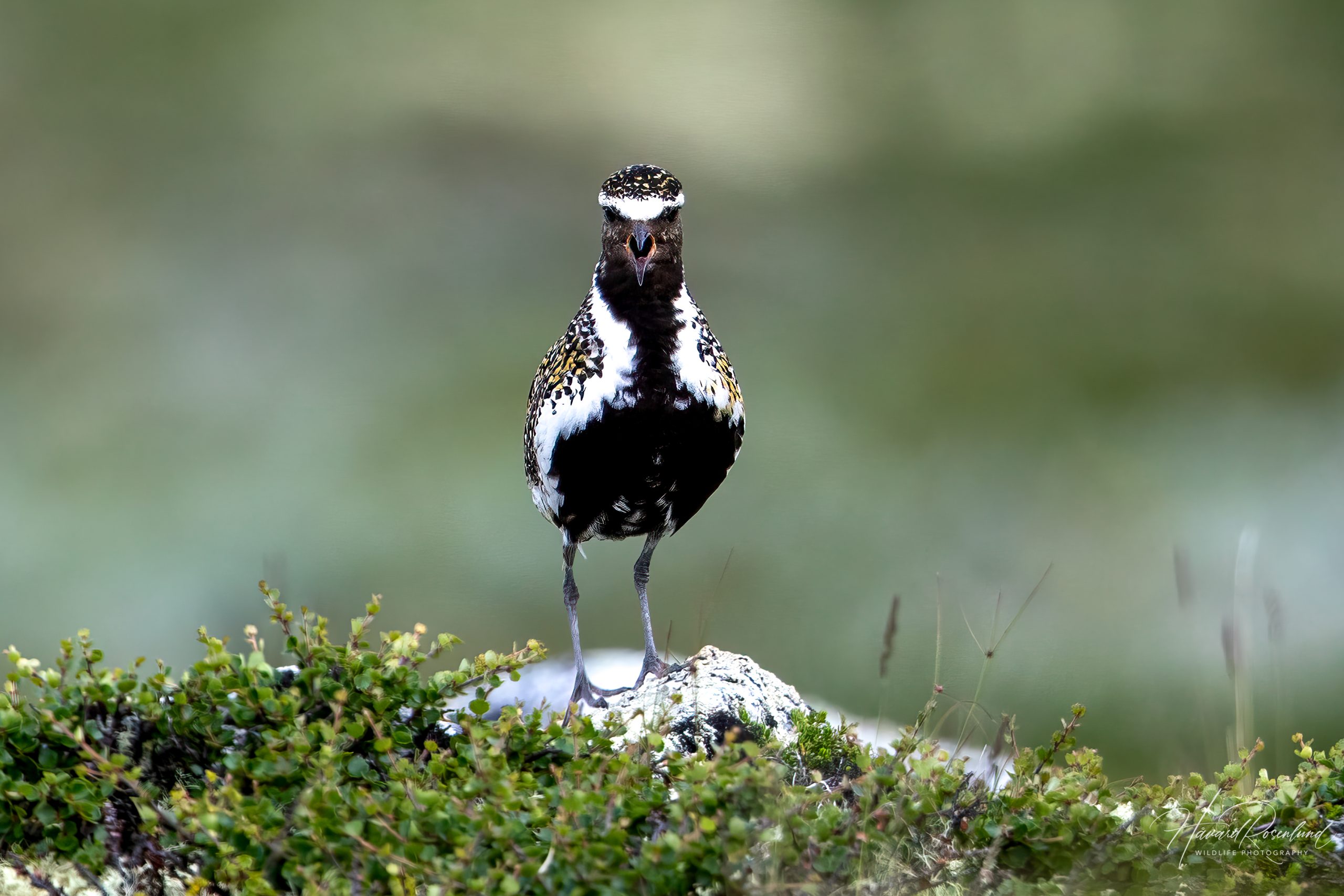
In breeding plumage the face, throat and belly become black, bordered along the sides by a broad white stripe. Outside breeding, the black underparts disappear and the bird becomes much more subdued and brownish. The similar Pacific golden plover (Pluvialis fulva) is slimmer and longer-legged, with a narrower white border along the black underparts in breeding plumage.
Habitat
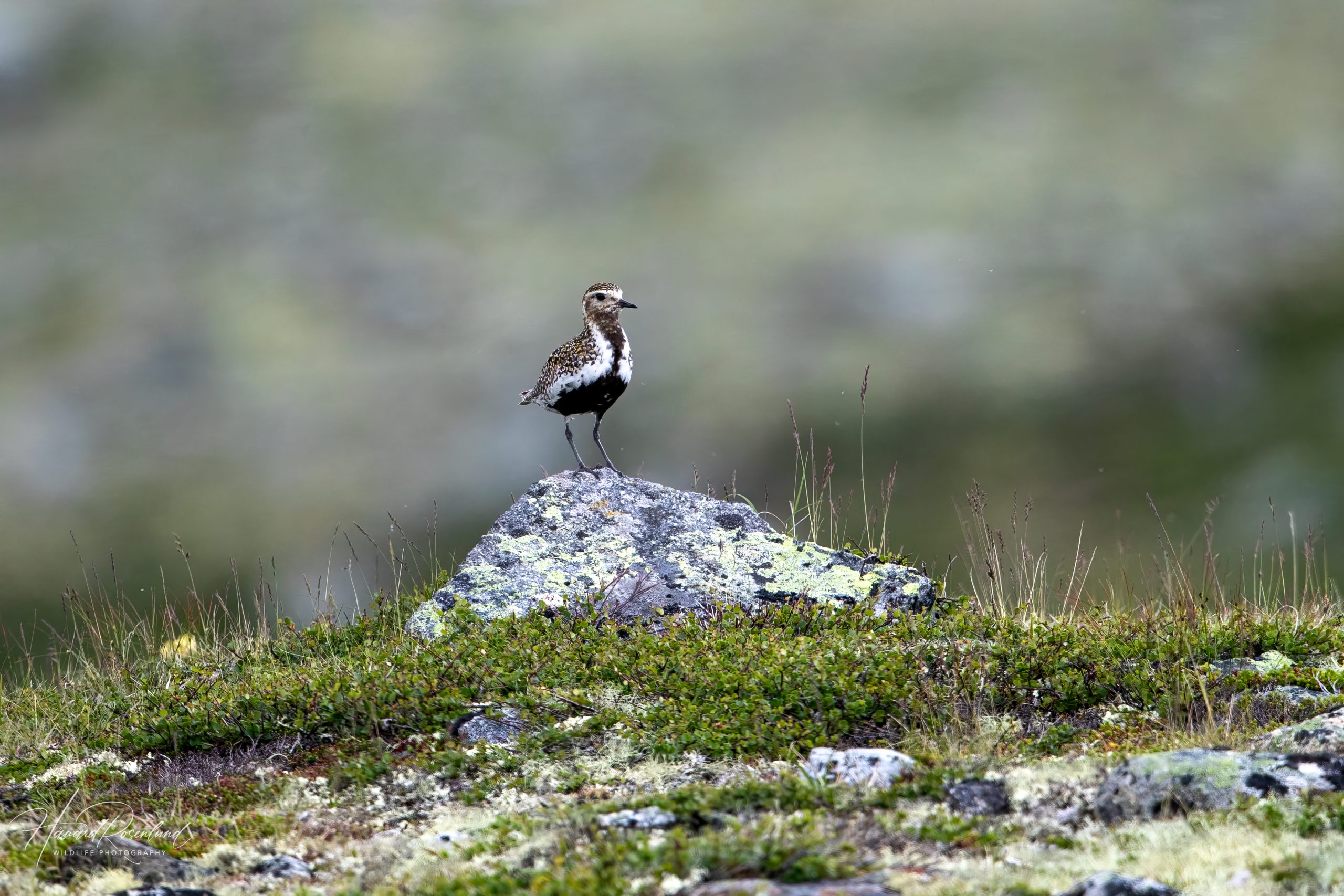
European golden plovers breed in open northern landscapes such as moorland, blanket bog, tundra, mountain heath and other treeless uplands. Short vegetation is important because the birds feed on the ground and depend on a wide view of approaching predators around the nest.
Outside the breeding season they shift into much more productive lowland habitats, especially grazed grassland, ploughed fields, stubble and coastal plains.
Diet
The diet consists mainly of ground-living invertebrates, particularly beetles, earthworms, insect larvae, spiders and other small animals. Seeds, berries and other plant material are also taken, especially outside the breeding season.
Golden plovers typically feed by running a short distance, stopping abruptly and picking prey from the ground. On winter grassland they can also feed after dark, when earthworms and other prey are more active near the surface.
Behaviour
Outside the breeding season, European golden plovers become highly social and may gather in large flocks. These flocks often move between feeding fields and safer roosting sites and commonly associate with northern lapwings (Vanellus vanellus).
Migration
Most northern populations migrate south and west after breeding, but the species' winter movements are unusually flexible. Many Scandinavian birds winter in northwest Europe, while others continue to Iberia, the Mediterranean region or North Africa.
A geolocator study published in 2015 yielded migration data from seven golden plovers breeding in Swedish Lapland, with one bird tracked through two winters. Some stayed in northwest Europe throughout winter, while others moved on to Iberia or Morocco when freezing conditions made feeding difficult. The bird tracked in two successive years used different winter strategies in the two winters. Migration is therefore not simply a fixed route, but can change as weather alters access to food.
Breeding
The nest is a shallow scrape on the ground, usually lined with lichens, moss, grass or other nearby vegetation. Four eggs are typical, with two to four recorded. Both parents take part in incubation, which lasts about 28–31 days. Their mottled colour makes the eggs difficult to see among the surrounding vegetation.
The chicks leave the nest within hours of hatching and quickly begin finding food for themselves while the parents guard and guide them. They usually fledge after about 25–33 days and until then depend on suitable feeding ground and good visibility around the breeding territory.
Status
The European golden plover is classified as least concern on the IUCN Red List and remains numerous across much of northern Europe. Breeding populations can nevertheless decline when open upland habitats are drained, planted with trees or converted to other land uses, and climate can also influence conditions on the breeding grounds.
Population trends differ substantially between regions, with stability or increases in some areas and declines in others. Because the species uses very different habitats through the year, conditions on both northern breeding grounds and lowland wintering areas can affect its numbers.
Image gallery
Loading map and observations…
Have you seen this species?
Independent species archive
Did you find this species page useful?
Wildlife Vagabond is independently built and maintained. Voluntary support helps cover hosting, maps, data storage and continued improvements to the species archive.
Support Wildlife VagabondSpecies content will remain freely available.
References
Information about the species’ global distribution and status is based primarily on global Red List data. See the references below for details.
- BirdLife International. (n.d.). European Golden Plover species factsheet. https://datazone.birdlife.org/species/factsheet/european-golden-plover-pluvialis-apricaria
- British Trust for Ornithology. (n.d.). Golden Plover BirdFacts. https://www.bto.org/learn/about-birds/birdfacts/golden-plover
- International Union for Conservation of Nature. (n.d.). European Golden Plover. The IUCN Red List of Threatened Species. https://www.iucnredlist.org/species/22693727/86551440
- Machín, P., Fernández‐Elipe, J., Flores, M., Fox, J. W., Aguirre, J. I., & Klaassen, R. H. G. (2015). Individual migration patterns of Eurasian golden plovers Pluvialis apricaria breeding in Swedish Lapland; examples of cold spell‐induced winter movements. Journal of Avian Biology, 46(6), 634-642. https://doi.org/10.1111/jav.00768
- Royal Society for the Protection of Birds. (n.d.). Golden Plover. https://www.rspb.org.uk/birds-and-wildlife/golden-plover