
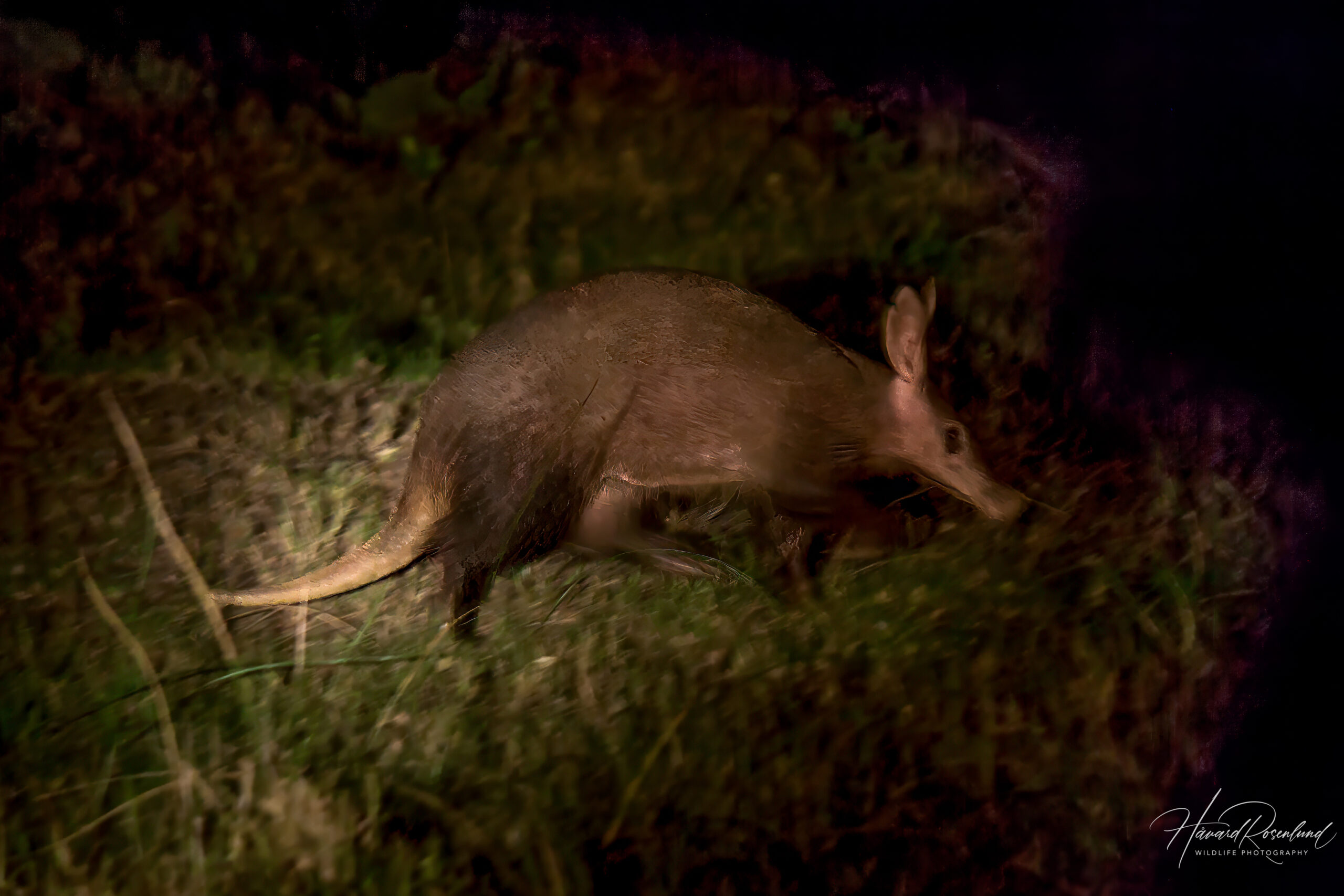
Aardvark
Orycteropus afer
At a glance
Habitat
- Savanna, grassland, woodland and thickets with diggable soil and abundant ants or termites
Diet
- Almost entirely ants and termites
Activity
- Mostly nocturnal; can shift activity under cold or severe drought
Size
- Length: 105–130 cm body + 45–70 cm tail Weight: about 40–65 kg
Range
- Widely distributed across sub-Saharan Africa outside the driest deserts
Description
The aardvark (Orycteropus afer) is one of Africa's most distinctive mammals and the only living species in the order Tubulidentata. Despite its pig-like name and appearance, it is not closely related to pigs or true anteaters. It belongs to Afrotheria, the major African mammal lineage that also includes elephants, hyraxes, sengis and several other groups. Adults have a head-and-body length of about 105–130 cm, a tail 45–70 cm long and typically weigh around 40–65 kg. The skin is thick and the body is only sparsely covered with hair.
The long mobile snout, large ears and enormously powerful forelimbs are adaptations for finding and excavating social insects. The teeth are equally unusual: adults lack incisors and canines, while the remaining cheek teeth lack enamel and are made from many vertical tubes of dentine. This tubular construction gives the order Tubulidentata its name.
Habitat
Aardvarks occupy a remarkably broad range of African habitats, including savanna, grassland, open woodland, bushland and semi-arid country. The essential requirements are abundant ants or termites and soil that can be excavated for both feeding and shelter.
They are absent from the driest true deserts and from areas where shallow rock, flooding or other ground conditions prevent effective digging. Suitable soils are therefore just as important as vegetation type, which helps explain why the species can occur across otherwise very different landscapes.
Diet
Aardvarks are highly specialised myrmecophages, feeding almost entirely on ants and termites.
A 2002 study at Tussen die Riviere Nature Reserve in the Nama Karoo, South Africa, found that the aardvarks' diet consisted entirely of ants and termites, with ants predominating throughout the seasons studied. Termites became relatively more important in winter when ant availability declined, showing that aardvarks switch among social-insect prey as seasonal conditions change.
Foraging
Aardvarks use their keen sense of smell to locate ant and termite colonies, then rip open soil, underground galleries or termite mounds with the powerful foreclaws before collecting exposed insects with a long, sticky tongue that can reach about 25–30 cm in length.
They can travel several kilometres during a night's foraging, moving from one colony to another as they search across a large area before returning to a shelter burrow. This combination of searching over large areas and rapid excavation allows them to exploit social insects that are widely scattered across the landscape but locally concentrated in colonies.
Behaviour
Aardvarks are usually solitary and predominantly nocturnal, but their activity is flexible. A three-year study of 12 adult aardvarks in the Kalahari, published in 2020, showed that increased daytime activity was associated with energy shortage rather than simply warm weather. During food scarcity, aardvarks shifted more of their activity into daylight while shortening their total active periods, in some cases becoming completely diurnal. Daytime activity can therefore be a sign that an aardvark is struggling to meet its energy needs.
Digging is central to almost every part of aardvark life. Powerful forelimbs and claws allow an animal to rapidly excavate temporary escape holes and construct much deeper burrows used for daytime shelter and longer-term occupation. The more stable temperature and humidity underground provide protection from climatic extremes.
These burrows also make the aardvark an important ecosystem engineer. A South African study published in 2011 recorded 27 other vertebrate species using aardvark burrows, which were cooler by day, warmer at night and more humid than surrounding surface sites. Warthogs and spotted hyenas are among the larger mammals known to use or modify aardvark burrows. Abandoned burrows can therefore remain valuable refuges for other animals long after the aardvark has moved on.
Reproduction
Aardvarks come together mainly for mating. Birth timing varies geographically; births have been reported mainly from May to July in South Africa and from October to November in parts of Central Africa. Gestation lasts roughly seven to eight months, and females usually give birth to a single young underground. The newborn remains protected there during its first weeks before beginning to accompany its mother outside.
Maternal care continues for several months as the juvenile gradually develops its own digging and foraging skills, and sexual maturity is reached at around two years. Reproductive biology remains relatively poorly documented because aardvarks are difficult to observe and spend so much of their lives below ground. In captivity, individuals have been recorded living for nearly 30 years.
Status
The aardvark is classified as least concern on the IUCN Red List and remains widely distributed across sub-Saharan Africa, although no reliable range-wide population estimate exists.
Hunting, persecution, habitat conversion, soil degradation and declines in insect prey can reduce populations locally. Hotter and drier conditions can pose an additional challenge in arid regions. A study published in 2017 from Tswalu Kalahari Reserve in South Africa documented what happened during an exceptionally hot and dry summer in 2013, when five of six monitored aardvarks and 11 other aardvarks at the site died as food shortage developed. Body-temperature regulation progressively broke down, with minima reaching about 25 °C before death, and activity shifted from night toward daytime. This was a local extreme event rather than evidence of a comparable decline across Africa, but it demonstrates how prolonged drought can affect a highly specialised insect-eater.
Image gallery
Loading map and observations…
Have you seen this species?
Independent species archive
Did you find this species page useful?
Wildlife Vagabond is independently built and maintained. Voluntary support helps cover hosting, maps, data storage and continued improvements to the species archive.
Support Wildlife VagabondSpecies content will remain freely available.
References
- Haussmann, N. S., Louw, M. A., Lewis, S., Nicol, K. J., van der Merwe, S., & le Roux, P. C. (2018). Ecosystem engineering through aardvark (Orycteropus afer) burrowing: Mechanisms and effects. Ecological Engineering, 118, 66-72. https://doi.org/10.1016/j.ecoleng.2018.04.022
- International Union for Conservation of Nature. (n.d.). Orycteropus afer (Aardvark). The IUCN Red List of Threatened Species. https://www.iucnredlist.org/species/41504/21286437
- Mammal Diversity Database. (2026). Orycteropus afer, current taxonomy and distribution. American Society of Mammalogists. https://www.mammaldiversity.org/taxon/1000520/
- Rey, B., Fuller, A., Mitchell, D., Meyer, L. C. R., & Hetem, R. S. (2017). Drought-induced starvation of aardvarks in the Kalahari: an indirect effect of climate change. Biology Letters, 13(7), 20170301. https://doi.org/10.1098/rsbl.2017.0301
- South African National Biodiversity Institute. (n.d.). SANBI Species Status – Orycteropus afer, ecology and regional conservation assessment. https://speciesstatus.sanbi.org/taxa/detail/2287/
- Taylor, W., Lindsey, P., & Skinner, J. (2002). The feeding ecology of the aardvark Orycteropus afer. Journal of Arid Environments, 50(1), 135-152. https://doi.org/10.1006/jare.2001.0854
- Weyer, N. M., Fuller, A., Haw, A. J., Meyer, L. C. R., Mitchell, D., Picker, M., Rey, B., & Hetem, R. S. (2020). Increased Diurnal Activity Is Indicative of Energy Deficit in a Nocturnal Mammal, the Aardvark. Frontiers in Physiology, 11, 637. https://doi.org/10.3389/fphys.2020.00637
- Whittington-Jones, G., Bernard, R., & Parker, D. (2011). Aardvark burrows: a potential resource for animals in arid and semi-arid environments. African Zoology, 46(2), 362-370. https://doi.org/10.1080/15627020.2011.11407509