
CT-based Model Reproduced Muskox Skull Vibrations During Experimental Validation
A biomechanics study published online on 6 July 2026 built and experimentally tested the first finite-element model designed to reproduce the dynamic response of a muskox (Ovibos moschatus) skull. CT scans captured the skull’s internal geometry, while local bone density was used to assign different material stiffnesses throughout the model.
A finite-element model divides a complex structure into many small elements and calculates how each part responds to force. The validation experiment did not simulate an actual head-to-head collision. Instead, the researchers tested whether the digital skull could reproduce the vibration behaviour of the real specimen under controlled loading.
The skull was excited from 10 to 10,000 Hz
For the experimental test, the real skull was subjected to harmonic mechanical excitation across frequencies from 10 to 10,000 Hz. A scanning laser Doppler vibrometer measured how the surface moved on the left horn and on the nasal bone.
The same harmonic loading was simulated in the CT-based model. The researchers then compared experimental and numerical transfer functions — the relationship between the applied load and the resulting vibration velocity — as well as the skull’s natural frequencies, vibration mode shapes and phase response. Phase response describes the timing offset between the applied vibration and the skull’s resulting motion.
Horn and nasal bone showed different deformation patterns
The horn and nasal region did not behave as one rigid structure across the frequency range. Different resonances produced distinct mode shapes: characteristic patterns in which particular parts of the structure move together while other regions move less.
The nasal bone produced especially complex mode shapes, so the researchers matched measured resonance peaks with the corresponding simulated modes and compared the shifts in frequency. This allowed a more stringent comparison than simply checking whether peaks appeared at roughly the same frequencies.
Model and experiment agreed through several kilohertz
The authors report good agreement between measured and simulated transfer functions and mode shapes up to about 5 kHz. In their overall assessment, which also included phase response, they summarised the model as experimentally validated up to about 4 kHz.
The validation therefore covered both when the skull resonated and how the horn and nasal regions deformed during those resonances. The authors report that this extends experimental and numerical validation to a higher frequency range than previously achieved for finite-element models of other bovid skulls.
Bone density was built into the model
The CT data were also used for more than reconstructing the outer shape. The researchers assigned material properties according to local density, allowing the model to represent stiffness gradients within the skull rather than treating all bone as mechanically identical.
This density-based approach is established in medical bone modelling but had not previously been applied in this way to bovid skulls. It provides a route for studying how geometry and spatial differences in bone properties contribute to the skull’s dynamic response.
The validated model is a foundation for impact research
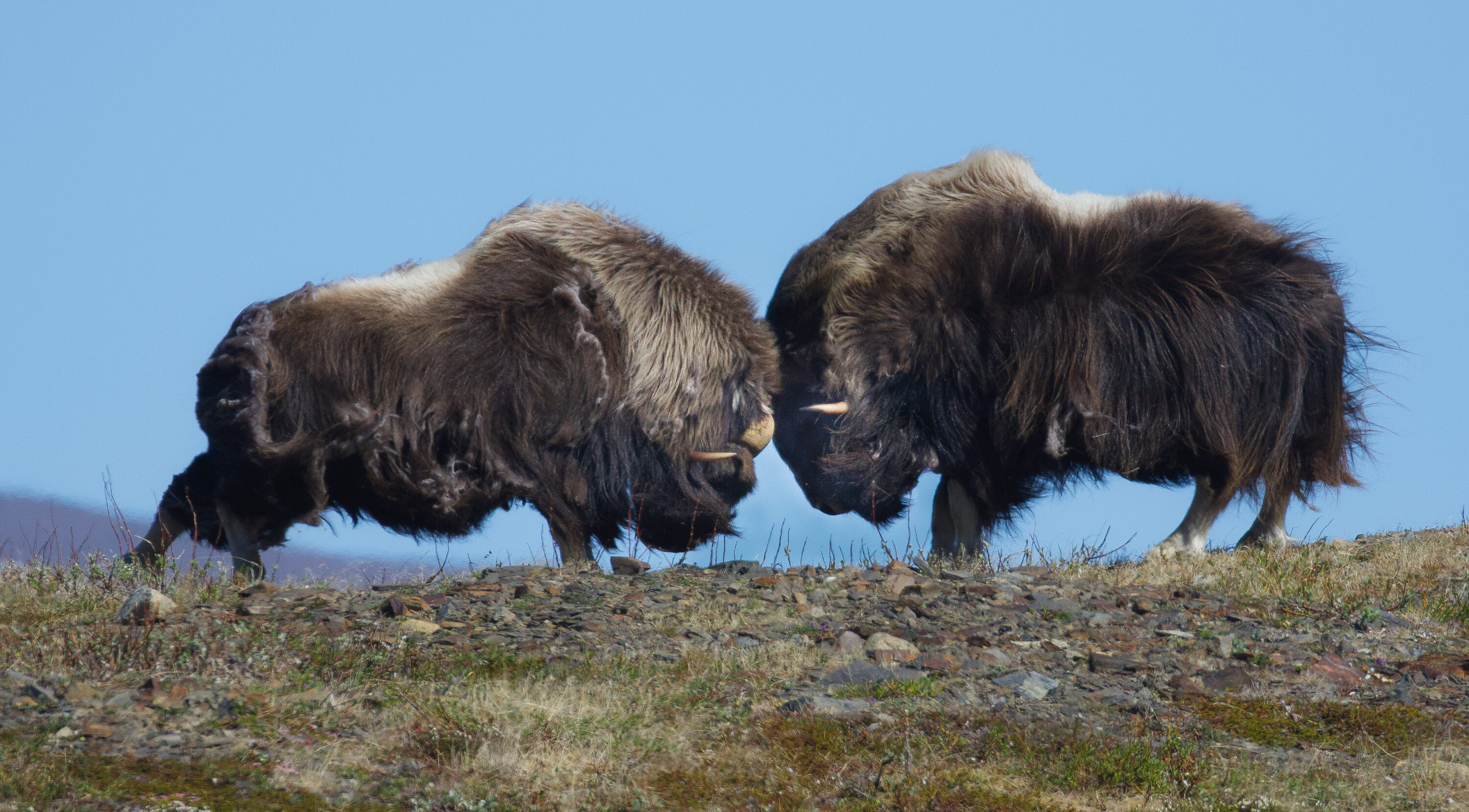
Muskox bulls repeatedly strike one another head-first during combat, making the skull a model system for research on structures that tolerate repeated high-energy loading. The broader research project aims to understand how skull geometry, bone architecture and material properties may contribute to impact mitigation.
This validation study establishes the numerical tool needed for that work. Its experimental test used controlled harmonic vibration rather than an actual collision, but showing that the model reproduces the real skull’s measured dynamics is a prerequisite before the same framework can be used to investigate more complex impact loading.
Anatomy & morphology
Related news
Model Points to Feces and Alternative Hosts in Muskox Bacterial Disease
A 2026 multi-host model of Erysipelothrix rhusiopathiae in Arctic muskoxen found that direct and fecal transmission could sustain…
Read story →
Synthetic Images Helped Train Muskox Detectors When Real Aerial Photos Were Scarce
A 2026 study found that object-detection models trained only on synthetic muskox images could detect more than 80%…
Read story →
Dovrefjell Winter Count Found 220 Muskoxen, Above the 200-animal Management Target
Norway's 2026 winter count recorded 220 muskoxen on Dovrefjell, including 32 calves. The population has ranged from 200…
Read story →SPECIES IN THIS STORY
Species in this story

Independent research and conservation news archive
Did you find this information useful?
Wildlife Vagabond is independently built and maintained. Voluntary support helps cover source verification, hosting and continued work on research and conservation news.
Support Wildlife VagabondThe news archive will remain freely available.