
Sloth Bears in Nepal Had Low Genetic Diversity but Little Sign of Three Separate Populations
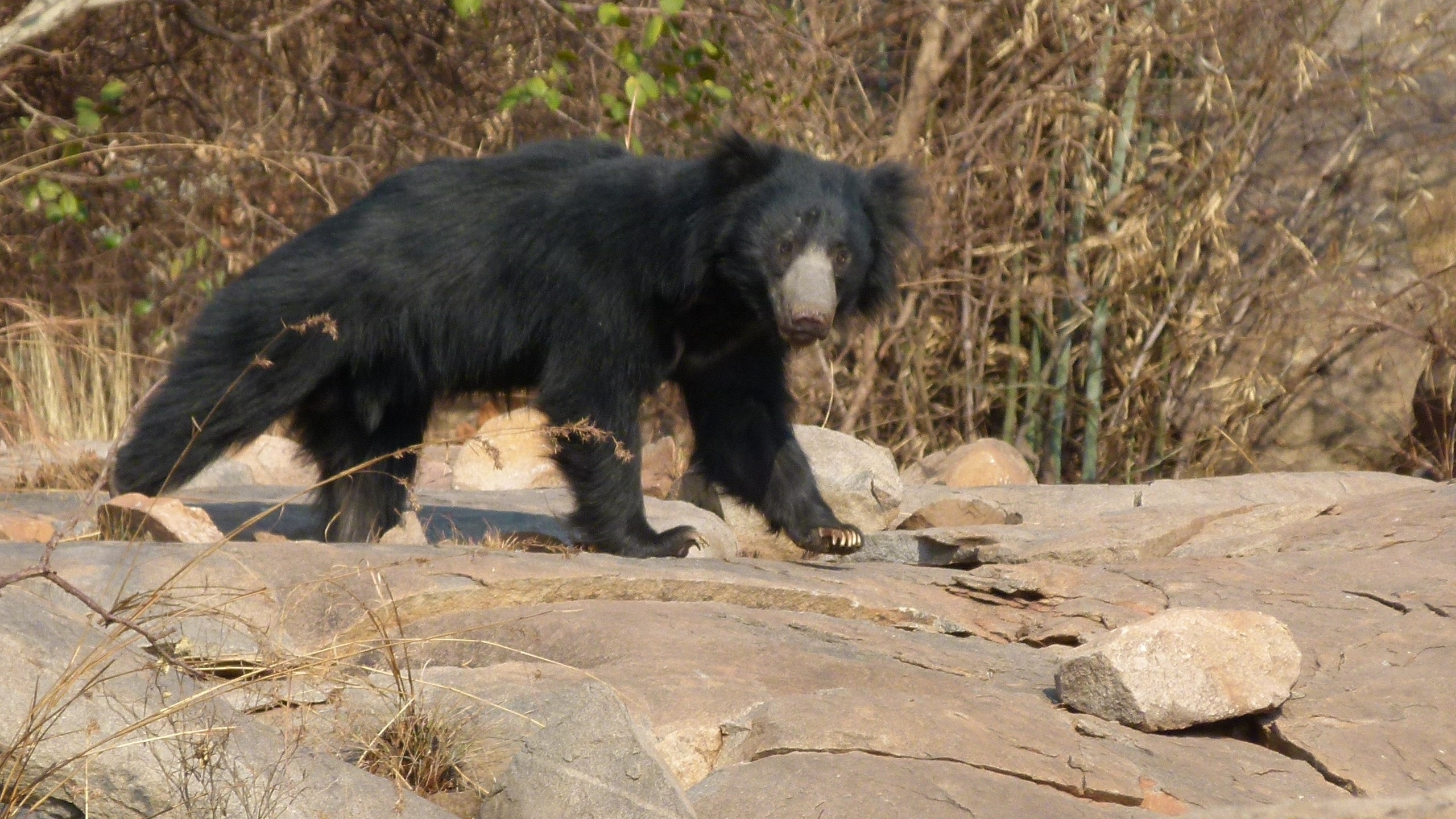
Nepal’s first non-invasive conservation-genetic survey of sloth bears (Melursus ursinus) found relatively low genetic diversity across three major habitat patches in the Churia–Terai landscape. Microsatellite genotypes gave little support for clear nuclear separation among bears from Chitwan National Park, Bardiya National Park and Trijuga forest, but the sampling was heavily concentrated in Chitwan, so the study could not show that the three areas are currently well connected.
Between 2019 and 2021, the researchers collected 127 non-invasive samples—mostly faeces, with some hair—from roughly 1,000 km² of forest and grassland. Twelve microsatellite loci were used to examine genetic diversity and population structure, while the mitochondrial control region was sequenced to identify maternal haplotypes. Sixty samples produced complete, reliable genotypes and represented 37 individual bears: 32 from Chitwan, three from Trijuga and two from Bardiya.
Genetic diversity was low compared with several Indian populations
Expected heterozygosity across the Nepalese sample was 0.48. This is a measure of genetic variation at the markers, with higher values indicating greater variation. The authors describe 0.48 as relatively low compared with other bear populations; for comparison, expected heterozygosity in several studied Indian sloth bear populations ranged from 0.61 to 0.75. Observed heterozygosity in the Nepalese sample was 0.44, slightly below the expected value. This difference produced a weakly positive inbreeding coefficient and points to a modest heterozygote deficit, but does not by itself demonstrate strong inbreeding.
The authors therefore describe genetic diversity in Nepal as relatively low. They caution, however, that diversity estimates depend on both the markers used and sample size, and the eastern and western Nepalese sites were represented by very few bears. The result is best treated as a first national genetic baseline rather than a precise ranking of populations across the species’ range.
Microsatellites did not reveal clear separation among the three areas
Clustering of the nuclear microsatellite genotypes was most consistent with one broad genetic group in the available material, with little support for assigning bears to clearly separated eastern, central and western populations. This does not demonstrate strong contemporary gene flow. With 32 bears from Chitwan but only five from the other two areas combined, real differentiation could have been missed.
The authors also point out that much of the recent fragmentation and land-use change in the Churia–Terai is young on an evolutionary timescale. If formerly connected bears have only recently become more isolated, genetic drift may not yet have produced a strong nuclear signal. Larger and more balanced samples from eastern and western Nepal are therefore needed before present-day connectivity can be assessed reliably.
Four mitochondrial haplotypes showed regional maternal lineages
Mitochondrial DNA revealed four haplotypes. The bears from Trijuga and Bardiya each carried distinct regional haplotypes, while Chitwan contained two maternal haplotypes.
Despite this geographic pattern, the mitochondrial lineages differed very little genetically. The authors interpret them as sharing common ancestry with only slight differentiation. Because mitochondrial DNA is inherited through the maternal line, these haplotypes mainly inform historical female-mediated dispersal; they cannot by themselves establish how much gene flow occurs today across the nuclear genome.
Low diversity matters, but connectivity remains unresolved
The researchers regard low heterozygosity as a potential long-term conservation concern because loss of genetic variation and inbreeding can reduce a small population’s ability to respond to environmental change and disease. At the same time, they stress that immediate demographic threats—including poaching, human–bear conflict, disease, habitat degradation and climate change—may be more pressing than genetic diversity alone.
The study therefore supports continued non-invasive genetic monitoring and much stronger sampling in eastern and western Nepal. Better data are needed to test whether the Churia landscape still facilitates gene flow between habitat patches, and faecal and hair sampling can provide that information without capturing bears.
Genetics & genomics
Related news
Blackbuck, Striped Hyenas, Sloth Bears and Indian Wolves Occurred Across Koppal’s Agro-pastoral Landscape
In Koppal district, Karnataka, interview-based models estimated occupancy of 63% for blackbuck, 52% for striped hyena and 26%…
Read story →
Sloth Bears Act as Selective Seed Dispersers in Western India
A 2026 study shows strong seasonal shifts in sloth bear diet and confirms that seeds of several plant…
Read story →
Sloth Bears in Unprotected Gujarat Favoured Riverine Forest
Sign surveys in unprotected parts of Gujarat found that sloth bears strongly favoured riverine forest. Over the same…
Read story →SPECIES IN THIS STORY
Species in this story
Independent research and conservation news archive
Did you find this information useful?
Wildlife Vagabond is independently built and maintained. Voluntary support helps cover source verification, hosting and continued work on research and conservation news.
Support Wildlife VagabondThe news archive will remain freely available.