
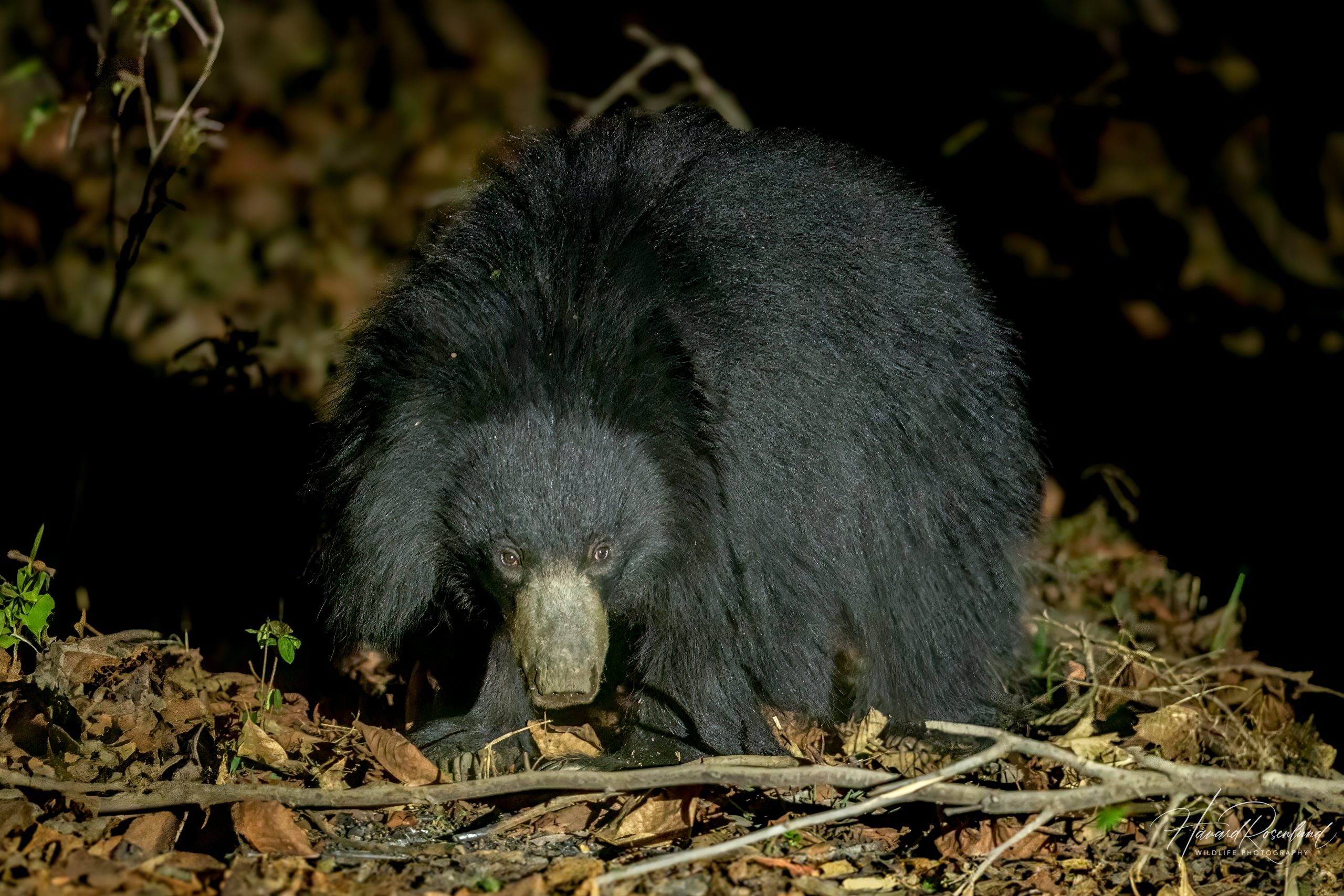
Sloth Bear
Melursus ursinus
At a glance
Habitat
- Dry and moist forest, tall grassland and scrub, especially where rocky cover, caves or dense vegetation provide shelter
Diet
- Omnivorous; especially termites, ants and seasonal fruit, with an important role as a seed disperser
Activity
- Flexible; often nocturnal or crepuscular near people or in hot areas, but also active by day
Size
- Length: 1.4–1.9 m Weight: females about 55–95 kg; males about 80–175 kg
Range
- India, Sri Lanka and southern Nepal; possibly still present in Bhutan; extinct in Bangladesh
Description
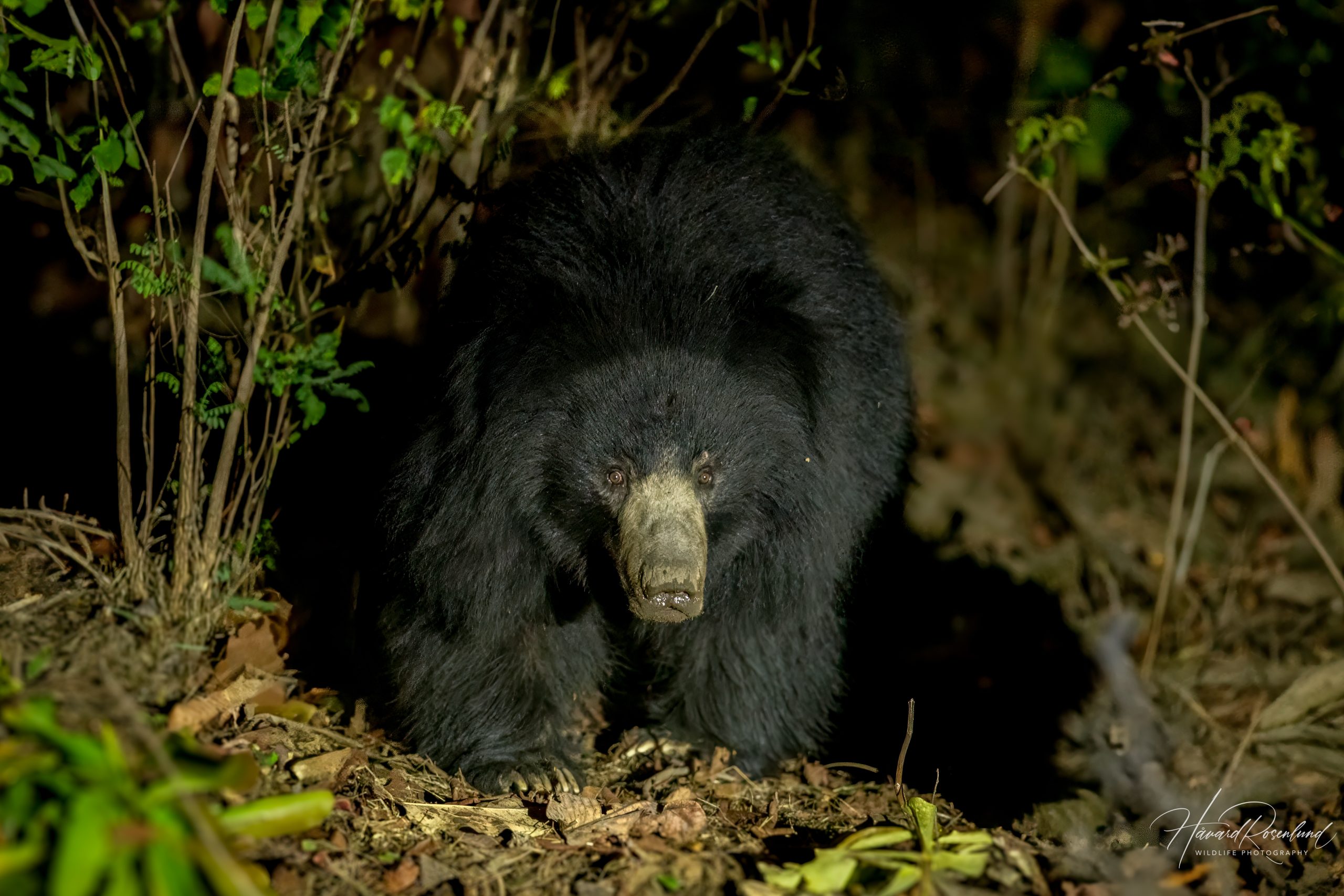
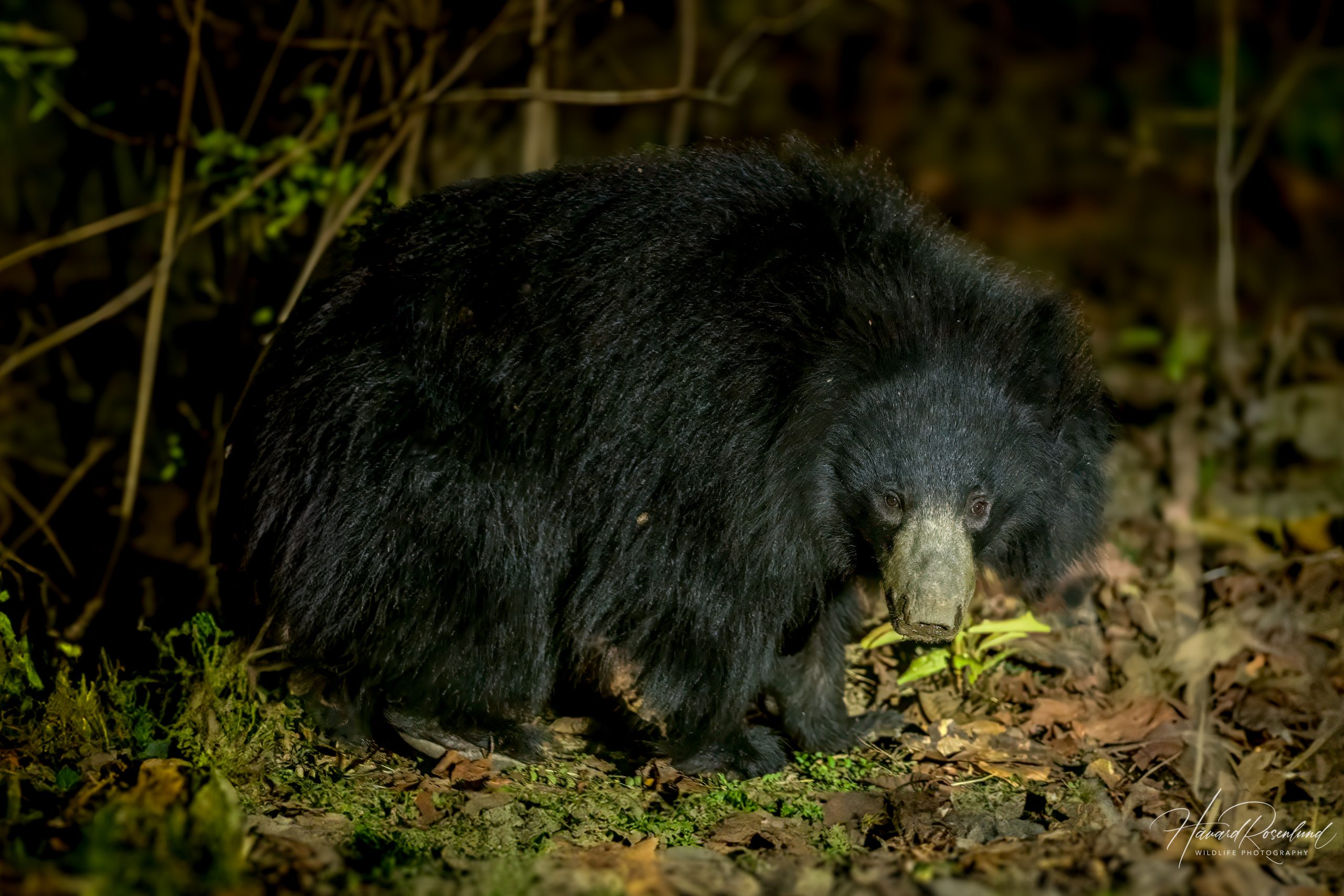
The sloth bear (Melursus ursinus) is a distinctive bear native to the Indian subcontinent. It survives mainly in India, Sri Lanka and the lowlands of southern Nepal; its continued presence in Bhutan is uncertain, while it is considered extinct in Bangladesh. The species is easily recognised by its long, shaggy black coat, pale muzzle and the white or yellowish V- or Y-shaped marking often visible on the chest.
The elongated snout, flexible lips, nostrils that can be closed and a gap where the upper central incisors are absent are unusual adaptations linked to its specialised feeding on ants and termites. The long curved claws are used for digging and tearing open insect nests. Adults are generally 1.4–1.9 m long; females commonly weigh about 55–95 kg and males about 80–175 kg.
Habitat
Sloth bears occupy a wide variety of habitats, including dry and moist deciduous forest, evergreen forest, savanna, tall grassland and scrub. They are primarily a lowland species, although records extend to roughly 2,000 metres in parts of the Western Ghats.
Dense vegetation, rocky outcrops, caves and crevices provide important resting and denning sites. A study published in 2025 used camera traps from 2014–2018 at five sites in eastern Karnataka and analysed 34 caves used by solitary bears and 21 used by family groups. Natural caves served both as daytime resting sites and as maternal dens, providing shelter from heat, disturbance and exposure.
Diet
Sloth bears are omnivores, but termites and ants form a particularly important part of the diet through much of the year. Fruit can become equally or more important when seasonally abundant, together with flowers, honey, beetles and grubs. Eggs and carrion may also be taken opportunistically, although carrion appears to be uncommon. A 2026 study in the Aravalli Mountains found pronounced seasonal shifts, with fruit dominating the winter diet and insects forming a larger share in summer.
Fruit feeding also gives the species an ecological role as a seed disperser. In the same study, seeds of six plant species remained viable after passing through the digestive system. This can support plant regeneration, although the bears may also spread invasive plants such as Lantana camara.
Foraging
Sloth bears have one of the most specialised feeding techniques among bears. They locate ant and termite colonies with their sense of smell, tear open mounds or nests with the long foreclaws and then use the elongated muzzle and highly mobile lips to suck out the insects. The gap created by the missing upper central incisors helps form a passage for suction, while the nostrils can be closed to keep dust and insects out.
The resulting feeding can be remarkably noisy, with strong snorting and sucking sounds audible from some distance. The same powerful claws and flexible feeding apparatus are also useful when opening logs, digging for larvae or reaching other concealed foods.
Behaviour
Sloth bears are mostly solitary, except when a mother is accompanied by cubs or several animals gather at a rich food source. They do not hibernate. Activity is flexible: in hot or heavily disturbed areas they are often nocturnal or crepuscular, whereas bears in more secure conditions may also be active during the day.
They communicate with grunts, roars and snorts and are capable climbers and swimmers. Bears use caves, dense cover and other sheltered places for daytime rest, and their activity pattern can shift with temperature, food availability and human presence. Avoidance is normally the first response to people, but a bear surprised at close range can defend itself forcefully.
Home ranges
A study published in 2007 radio-tracked ten adult sloth bears in Wasgomuwa National Park, Sri Lanka, during 2002–2003. Their home ranges averaged only about 2.2 km² for females and 3.8 km² for males, among the smallest reported for any bear species. The animals kept their ranges almost entirely within the protected area.
A study published in 2023 used 40 camera-trap records of one recognisable bear in Bannerghatta National Park, southern India, from 2019–2020 and suggested a much larger home range of about 58 km². This estimate is not directly comparable with the Wasgomuwa values because it came from a single animal and a different method. The large difference nevertheless illustrates how strongly sloth-bear space use can vary with landscape, food distribution and local conditions.
Reproduction
In much of India, mating often peaks during the hot season from May to July, while breeding is less seasonal in Sri Lanka. Sloth bears show delayed implantation: after fertilisation, the embryo remains at a very early developmental stage for a period before implanting in the uterine wall. This helps explain why the total interval between mating and birth can vary.
Females usually give birth to about two cubs in a protected den, although litters of one or three also occur. The cubs are highly dependent at birth and usually emerge from the den at about two to three months. They routinely ride on the mother's back after emerging and may continue doing so until roughly six to nine months old — an unusual behaviour among bears and an important defence against predators such as tigers (Panthera tigris) and leopards (Panthera pardus). Young remain dependent on their mother for roughly two years, sometimes longer.
Relationship with humans
Sloth bears usually try to avoid people, but a sudden close encounter can trigger an immediate and severe defensive attack. The species is regarded as one of the most dangerous wild animals in India in such encounters, particularly where people and bears move through the same dense forest and scrub.
A study published in 2017 interviewed 166 victims from the Kanha–Pench corridor. Eighty-one percent of attacks occurred in forest, including 42% while people were collecting forest products other than timber, and 63% of victims had not seen the bear before the attack began. A broader 2022 comparison compiled 1,778 attacks from eight studies across the Indian subcontinent. The season and time of day of peak attacks differed strongly among regions, but attacks were consistently most frequent during periods when people used bear habitat most intensively.
The species has also had a long and troubled relationship with people through the former use of wild-caught cubs as so-called “dancing bears” in India. The practice linked wildlife exploitation with the livelihoods of Kalandar communities and later became a major focus of animal-welfare and conservation programmes.
Status
The sloth bear is listed as Vulnerable on the IUCN Red List, and the global population is considered to be declining. India holds by far the largest remaining population, with smaller populations in Sri Lanka and southern Nepal and uncertain persistence in Bhutan. Bangladesh considers the species regionally extinct.
Published range-wide population estimates have varied widely and are not considered reliable enough to track the species accurately. The species is also listed in CITES Appendix I, under which international trade is permitted only in exceptional circumstances and commercial trade is generally prohibited.
Threats
The main threats are habitat loss and fragmentation caused by agriculture, settlements, timber extraction, mining and infrastructure development. As suitable habitat shrinks and people increasingly use the same forests, encounters become more frequent and can lead to injury, fear and retaliatory killing.
Poaching, wire snares and illegal trade in bears or body parts remain additional pressures. In fragmented landscapes, bears also have to cross areas used more intensively by people to move between suitable habitat patches, increasing their exposure to people, roads and traps.
Conservation
One of the best-known conservation issues for sloth bears was the former use of wild-caught cubs as “dancing bears” in India. Conservation programmes combined rescue and law enforcement with alternative livelihoods and education for Kalandar communities that had traditionally depended on the practice. Wildlife SOS reports that the final dancing bear in India was surrendered in 2009 and that hundreds of bears were rescued through the programme.
Ending this practice was a major welfare and conservation achievement, but wild sloth bears remain exposed to poaching, illegal trade, habitat fragmentation and dangerous encounters with people. Caves and other secure resting sites, abundant natural food and connections between habitat patches remain important for populations outside as well as inside protected areas.
Conservation organizations


Image gallery
Loading map and observations…
Have you seen this species?
Independent species archive
Did you find this species page useful?
Wildlife Vagabond is independently built and maintained. Voluntary support helps cover hosting, maps, data storage and continued improvements to the species archive.
Support Wildlife VagabondSpecies content will remain freely available.
References
Information about the species’ global distribution and status is based primarily on global Red List data. See the references below for details.
- Dancing bears in India. (n.d.). a sloth bear status report. https://www.bearbiology.org/download/dancing-bears-in-india-a-sloth-bear-status-report/
- Dhamorikar, A. H., Mehta, P., Bargali, H., & Gore, K. (2017). Characteristics of human - sloth bear (Melursus ursinus) encounters and the resulting human casualties in the Kanha-Pench corridor, Madhya Pradesh, India. PLOS ONE, 12(4), e0176612. https://doi.org/10.1371/journal.pone.0176612
- Gubbi, S., Menon, A., Suthar, S., Prabhu, K., & Poornesha, H. C. (2023). Home range estimate of sloth bear using noninvasive camera-trap data. Ursus, 34(e7), 1–6. https://doi.org/10.2192/URSU-D-22-00004
- International Association for Bear Research and Management. (n.d.). Sloth Bear species account. https://www.bearbiology.org/the-eight-bear-species/melursus-ursinus-sloth-bear/
- International Union for Conservation of Nature. (n.d.). Melursus ursinus. The IUCN Red List of Threatened Species. https://www.iucnredlist.org/species/13143/166519315
- Mammal Diversity Database. (n.d.). Melursus ursinus. American Society of Mammalogists. https://www.mammaldiversity.org/taxon/1005933/
- Prajapati, U., Sundar, K. S. G., & Koli, V. K. (2026). Seasonal Diet and Seed Dispersal by Sloth Bears Melursus ursinus in Western India. Biotropica, 58(4), e70223. https://doi.org/10.1111/btp.70223
- Ratnayeke, S., van Manen, F. T., & Padmalal, U. K. G. K. (2007). Home ranges and habitat use of sloth bears Melursus ursinus inornatus in Wasgomuwa National Park, Sri Lanka. Wildlife Biology, 13(3), 272–284. https://doi.org/10.2981/0909-6396(2007)13[272:HRAHUO]2.0.CO;2
- Sharp, T. R., Smith, T. S., Swaminathan, S., & Arun, A. S. (2022). Sloth bear attacks: regional differences and safety messaging. Scientific Reports, 12(1), 3943. https://doi.org/10.1038/s41598-022-07974-y
- Swaminathan, S., Pannerselvam, Y., Puspanathan, R., Sharp, T. R., Arun, A. S., Satyanarayan, K., & Seshamani, G. (2025). Sloth bear denning behavior in eastern Karnataka, India. Ursus, 2025(36e11). https://doi.org/10.2192/URSUS-D-24-00015R1
- Wildlife SOS. (n.d.). Dancing Bear Project. https://wildlifesos.org/conservation/dancing-bear-project/