
Where offshore wind plans could overlap with Little Terns

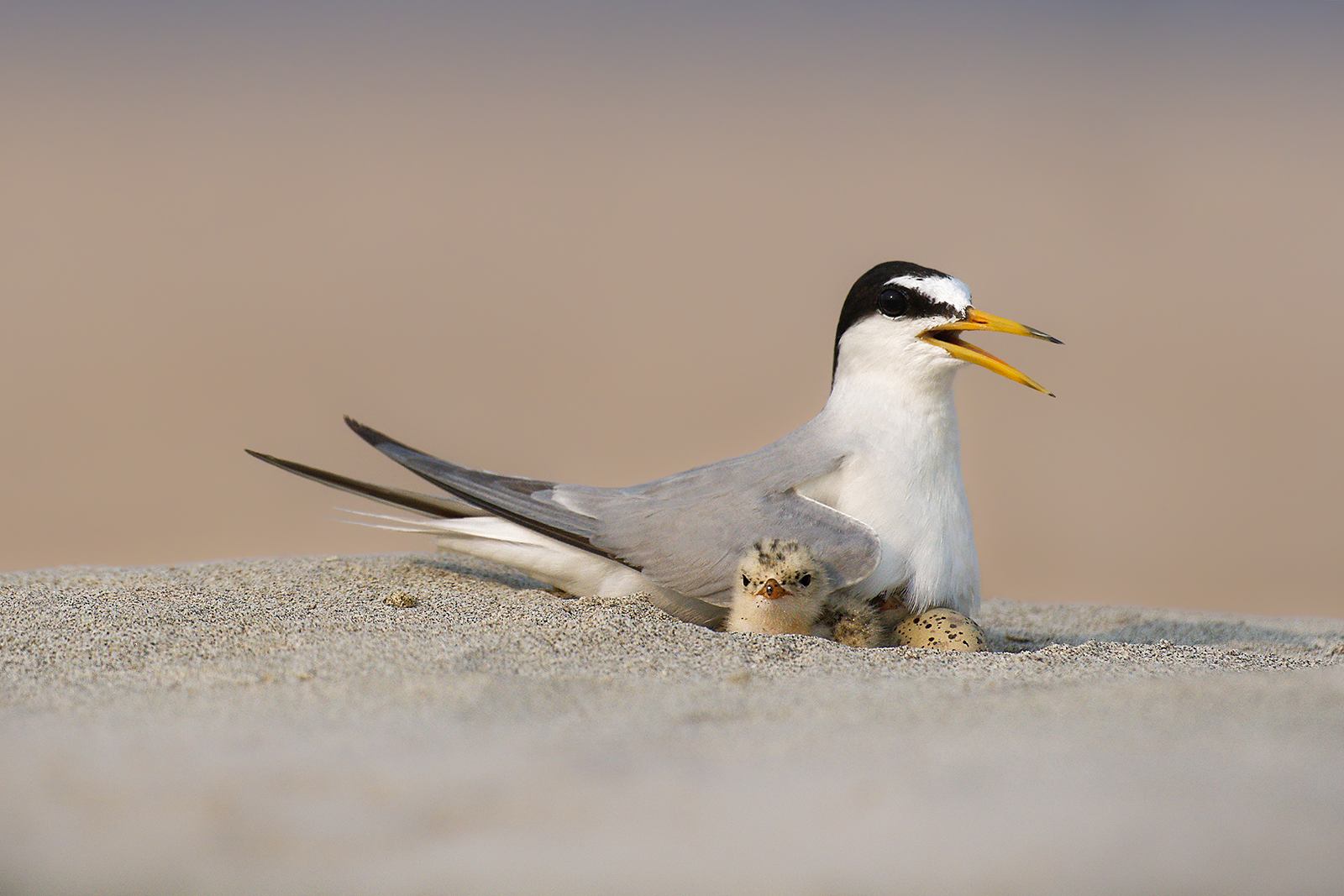
Offshore wind farms may be planned in coastal waters that breeding Little Terns (Sternula albifrons) use to find food. Researchers in Japan have developed a way to identify potential overlap even when the birds’ breeding colonies move between years.
The framework combines maps of suitable nesting habitat, estimates of how far the terns can forage from their colonies, and observations of flight behaviour around wind turbines. Because breeding terns forage from a colony, the distance they can travel to feed helps determine which marine areas may be used. Using median prey-energy values, the model estimated a maximum one-way foraging distance of 8.92 kilometres. The nesting-habitat analysis drew on 95 occupied grid cells, each 500 metres across, and identified bare land as the strongest positive predictor of nesting suitability.
The mapped potential feeding areas overlapped with offshore wind projects undergoing environmental impact assessment and with government-designated early planning areas. Three-dimensional flight observations indicated horizontal avoidance of turbines: fewer approaches were recorded 60–140 metres from turbine towers, and no recorded flight path came within 70 metres of a tower. Most tracked flights occurred below the height swept by the turbine blades.
Combining these findings can help planners identify coastal areas where wind development deserves closer, site-specific investigation before construction. Overlap on a map indicates a possible conflict, not demonstrated harm from any individual wind project. The study did not calculate collision deaths or effects on Little Tern populations.
Ecology
Related news
Little Terns at Seaton Carew Fledged Just 17 Young in 2026
At Seaton Carew in England, 83 pairs of Little Terns produced only 17 fledglings in 2026, down from…
Read story →
A Record 116 Little Tern Pairs Attempted to Breed at Beacon Lagoons in 2026
At least 116 Little Tern pairs attempted to breed at Beacon Lagoons in 2026, a site record. By…
Read story →
Little Tern-designated Natura 2000 Sites Overlapped Just 0.18% of the Tracked Core Area in Cádiz
GPS tracking of 29 breeding little terns found that Natura 2000 sites overall covered 75.9% of the population…
Read story →SPECIES IN THIS STORY
Species in this story

Independent research and conservation news archive
Did you find this information useful?
Wildlife Vagabond is independently built and maintained. Voluntary support helps cover source verification, hosting and continued work on research and conservation news.
Support Wildlife VagabondThe news archive will remain freely available.