
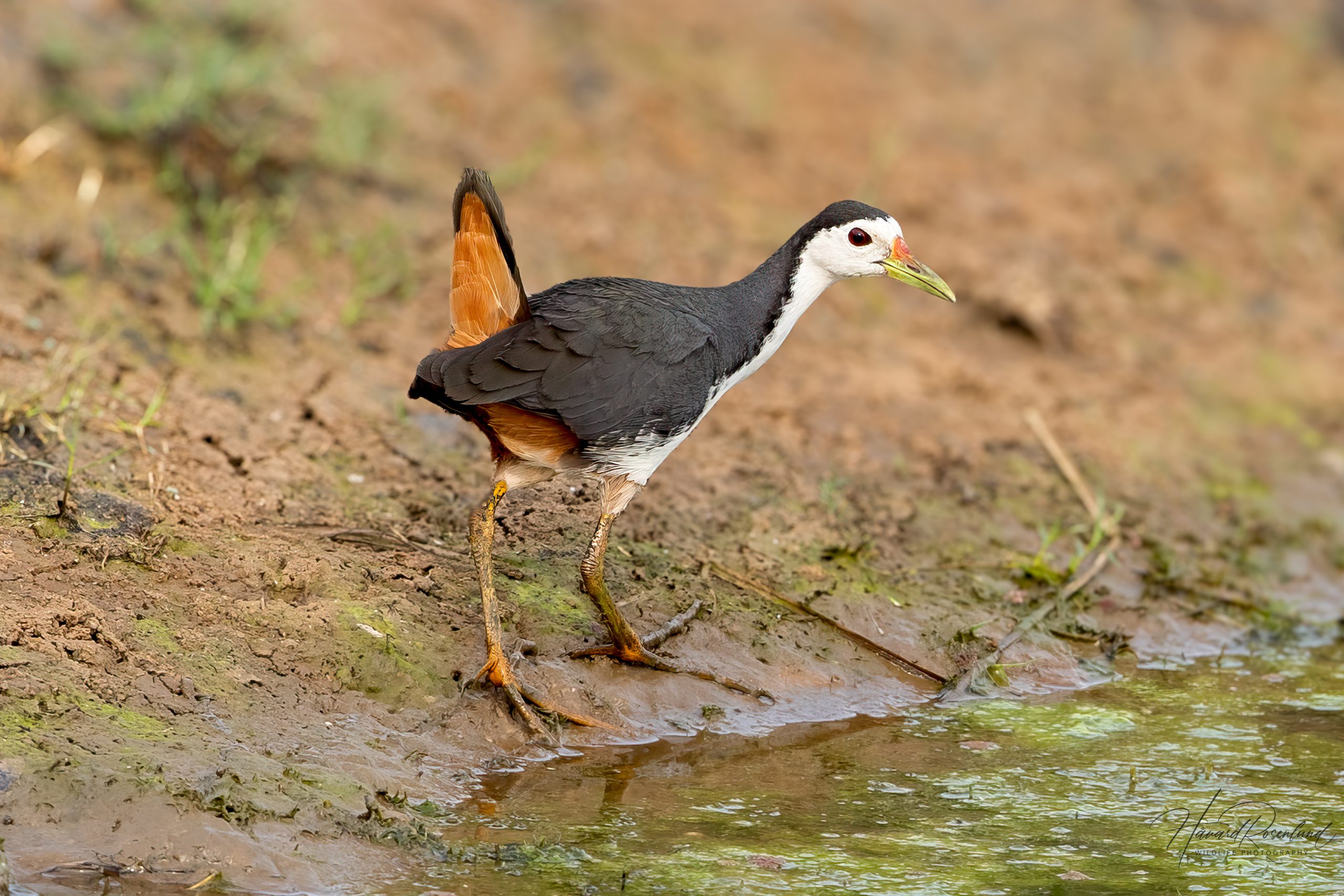
White-breasted Waterhen
Amaurornis phoenicurus
At a glance
Habitat
- Vegetated freshwater wetlands, marshes, rice fields, canals, ponds, mangroves, gardens and other damp areas with dense cover
Diet
- Insects, spiders, worms, snails, other aquatic invertebrates, small fish and plant material
Activity
- Mainly diurnal, especially active around dawn and dusk
Size
- Length: 28–33 cm Weight: about 166–203 g
Range
- Widespread from the Indian subcontinent through southern China and Southeast Asia to the Philippines and parts of Indonesia
Description
The white-breasted waterhen (Amaurornis phoenicurus) is a medium-sized rail, about 28–33 cm long and typically weighing roughly 166–203 g. Adults have dark slate-brown upperparts and flanks contrasting strongly with a white face, throat, breast and belly. The vent and undertail are rich rufous-chestnut, a colour often flashed as the bird raises and flicks its short tail.
The bill is yellowish-green, with a reddish base to the upper mandible becoming more noticeable in breeding condition; there is no separate red forehead patch. The legs and very large feet are yellowish, and the exceptionally long toes spread the bird's weight over soft mud and floating vegetation. Juveniles are duller and browner, with greyer underparts and a darker bill.
Habitat
White-breasted waterhens live in and around freshwater wetlands with dense vegetation, including marshes, reedbeds, swamps, rice fields, canals, pools and small streams. They also use mangroves and other brackish habitats, and readily enter parks, gardens and urban areas where water and thick cover occur together.
The species is less specialised than many rails and often moves between water margins and damp terrestrial vegetation. Long toes allow it to walk across soft ground and broad floating leaves, while the narrow body lets it slip rapidly into dense cover when disturbed. In quiet ponds and cultivated wetlands it can nevertheless become surprisingly bold and feed in the open.
Diet
The diet is broad and opportunistic. Insects, spiders, worms, snails and other small invertebrates are important, together with small fish and other aquatic prey. Seeds, shoots, roots and other plant material are also eaten.
Most food is collected while walking slowly through shallow water, mud or damp vegetation. Birds pick items from the surface, probe soft substrate and turn leaves or debris to expose hidden prey. They can also forage above ground in low bushes and vegetation.
Behaviour
White-breasted waterhens are often secretive and quick to disappear into dense vegetation, but individuals living around quiet ponds, canals or gardens can become surprisingly confiding. They are usually solitary or in pairs, though small groups may gather where food is concentrated. Activity is greatest around dawn and dusk, especially in hot weather, and the species swims readily despite spending much of its time walking along wetland margins and on land.
They are also exceptionally vocal for such a frequently concealed bird. Loud, repeated calls carry far across wetlands, especially around dawn, dusk and the breeding season. A playback study published in 2019 from Pratas Island tested an advertising call and an aggressive call at 26 stations. Birds responded more often to the advertising call, while response frequency did not differ clearly among the months tested. Different call types can therefore trigger distinctly different responses in a species that often communicates from dense cover.
Breeding
Breeding timing varies geographically and is often associated with seasonal rains. Pairs defend nesting areas and become especially vocal during courtship, which can include bowing, bill contact and nibbling. The nest is a shallow cup or platform of stems, leaves and grasses, usually concealed in dense vegetation near water. It may be placed on the ground, among reeds or tussocks, or raised within vegetation; surrounding stems can form a partial roof.
Clutch size varies geographically. A field study published in 2026, based on breeding observations in wetlands of Kerala from April to October 2018, recorded clutches of two to six eggs, with six particularly common, and an incubation period of 19–21 days. Both parents incubate and care for the young. The chicks hatch covered in black down and are precocial, meaning that they are mobile and able to leave the nest soon after hatching, although they continue to depend on their parents for protection and food while they develop.
Status
The white-breasted waterhen is classified as least concern on the IUCN Red List and is widespread across a large part of tropical and subtropical Asia. Its ability to use rice fields, canals, gardens and other human-modified wetlands helps it persist in landscapes where more specialised wetland birds may struggle.
State of India’s Birds 2025 estimates a long-term national increase of about 114.15%, with an uncertainty interval of 94.07–135.94%. The recent annual estimate is about +5.57%, with an interval of 4.62–6.51%; both intervals remain above zero. Wetland drainage, removal of dense waterside vegetation, pollution and collisions with vehicles can still affect local populations.
Image gallery
Loading map and observations…
Have you seen this species?
Independent species archive
Did you find this species page useful?
Wildlife Vagabond is independently built and maintained. Voluntary support helps cover hosting, maps, data storage and continued improvements to the species archive.
Support Wildlife VagabondSpecies content will remain freely available.
References
Information about the species’ global distribution and status is based primarily on global Red List data. See the references below for details.
- Athulya, M. M., Rashiba, A. P., Siraj, M., Gafoor, P. A., & Krishna, T. P. A. (2026). Breeding ecology of the White-breasted Waterhen (<i>Amaurornis phoenicurus</i>) in the wetland habitats of Kerala, India. Munis Entomology & Zoology, 21(1). https://www.munisentzool.org/Issue/publish/breeding-ecology-of-the-white-breasted-waterhen-amaurornis-phoenicurus-in-the-wetland-habitats-of-kerala-india_14632
- BirdLife International. (n.d.). White-breasted Waterhen species factsheet. https://datazone.birdlife.org/species/factsheet/white-breasted-waterhen-amaurornis-phoenicurus
- Chen, C.-C., Lin, K.-H., & Yang, Y.-H. (2019). Effect of Call Types on White-Breasted Waterhen (Amaurornis phoenicurus) Response to Playbacks on Pratas Island, Taiwan. Waterbirds, 42(3), 321. https://doi.org/10.1675/063.042.0308
- Cornell Lab of Ornithology. (n.d.). Birds of the World – White-breasted Waterhen. https://birdsoftheworld.org/bow/species/whbwat1/cur/introduction
- International Union for Conservation of Nature. (n.d.). White-breasted Waterhen. The IUCN Red List of Threatened Species. https://www.iucnredlist.org/species/22692640/95217833
- State of India's Birds. (2025). State of India’s Birds 2025 – White-breasted Waterhen. https://stateofindiasbirds.in/species/whbwat1/
- Tobias, J. A., Sheard, C., Pigot, A. L., Devenish, A. J. M., Yang, J., Sayol, F., Neate‐Clegg, M. H. C., Alioravainen, N., Weeks, T. L., Barber, R. A., Walkden, P. A., MacGregor, H. E. A., Jones, S. E. I., Vincent, C., Phillips, A. G., Marples, N. M., Montaño‐Centellas, F. A., Leandro‐Silva, V., Claramunt, S., … Schleuning, M. (2022). AVONET: morphological, ecological and geographical data for all birds. Ecology Letters, 25(3), 581-597. https://doi.org/10.1111/ele.13898