
Common Cuckoo
Cuculus canorus
At a glance
Habitat
- Open woodland, moorland, heath, wetlands, reedbeds and farmland where suitable hosts and insect prey occur
Diet
- Mostly insects and larvae, especially caterpillars, including hairy species avoided by many birds
Activity
- Diurnal
Size
- Length: 32–34 cm Weight: about 114 g
Range
- Breeds across much of Eurasia; northern and western populations winter mainly in sub-Saharan Africa
Description
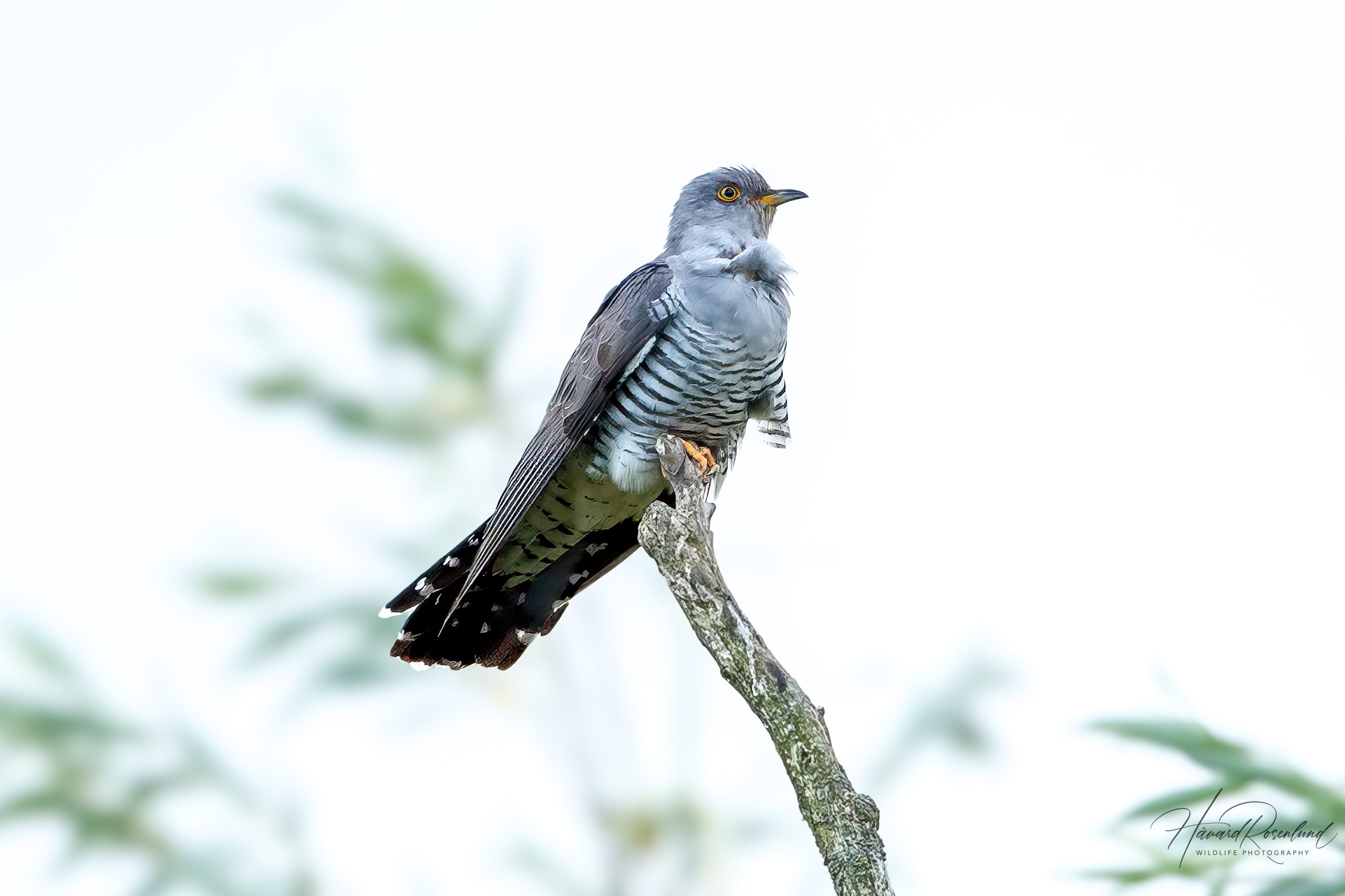
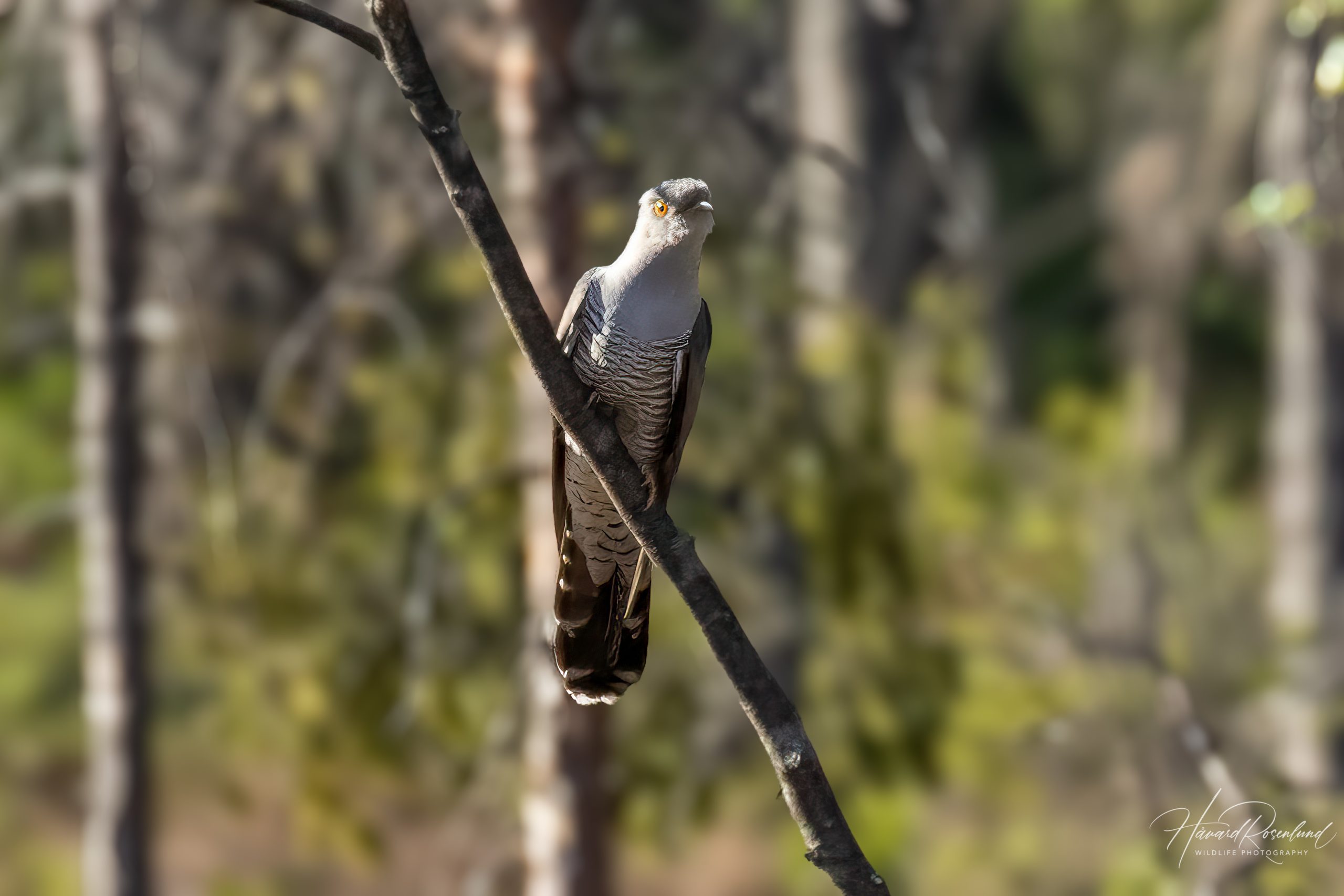
The common cuckoo (Cuculus canorus) is a medium-sized long-distance migrant that breeds across much of Eurasia. Adults are about 32–34 cm long and average roughly 114 g. The common grey morph has blue-grey upperparts, pale barred underparts, pointed wings and a long tail. Females also occur in a rufous morph, with reddish-brown upperparts and stronger dark barring. The familiar two-note call of the male is one of the characteristic sounds of the European spring.
The cuckoo's resemblance to a small Eurasian sparrowhawk (Accipiter nisus) is more than superficial. Experiments show that small birds can respond to barred cuckoos much as they do to sparrowhawks, and further work has shown that hawk-like appearance can reduce mobbing by host species. The resemblance is therefore an experimentally supported form of mimicry and is also a useful field clue when a cuckoo is seen only briefly in flight.
Habitat
Common cuckoos use a broad range of open and semi-open habitats, including woodland edges, moorland, heath, wetlands, reedbeds, mountain landscapes and farmland. Their local distribution is strongly influenced by the availability of suitable host species as well as abundant insect prey.
Because the species relies on other birds for reproduction, apparently suitable feeding habitat is not enough on its own. Productive breeding areas also need sufficient numbers of host species nesting at the right time.
Diet
The diet consists mainly of insects and their larvae. Caterpillars are particularly important, including hairy species that many other insect-eating birds avoid. Adults also take beetles, grasshoppers, dragonflies and other invertebrates.
Cuckoos often hunt from a perch, dropping or flying into vegetation or onto the ground to seize prey. Their ability to handle hairy caterpillars gives them access to a food resource that is less heavily used by many other birds.
Migration
The common cuckoo is a long-distance migrant, with northern Eurasian populations leaving the breeding grounds well before winter. Satellite tracking of eight adults tagged on breeding territories in eastern Denmark and southern Sweden revealed an annual journey of roughly 16,000 km. The birds used remarkably narrow migration corridors, made several prolonged stopovers and wintered in south-western Central Africa.
The outward and return journeys formed a large clockwise loop rather than simply retracing the same route. Because cuckoos migrate alone and young birds receive no guidance from their parents, this precise long-distance migration is achieved without travelling in family groups or socially learned flocks.
Breeding
The common cuckoo is an obligate brood parasite: the female does not build a nest or raise her own young, but lays eggs in the nests of other birds. Different female lineages are specialised on particular host types and produce characteristic egg forms. Their eggs can closely mimic the colour and pattern of the host's eggs, and experiments show that mimicry is most refined in hosts that are especially good at recognising and rejecting foreign eggs.
Genomic work published in 2025 showed that this adaptation has a complex genetic basis. Eggshell background colour was strongly associated with maternally inherited genetic variation, while spotting and other pattern elements also involved genes inherited from both parents. These host-associated egg forms are part of an evolutionary arms race in which hosts improve egg recognition while cuckoos evolve increasingly convincing counterfeits.
The cuckoo egg is incubated by the host and normally hatches after about 11–13 days. Soon after hatching, the young cuckoo pushes the host's eggs or chicks over the rim of the nest and is then raised alone. Experiments with common reed warblers (Acrocephalus scirpaceus) showed that the chick's rapid begging call can stimulate feeding at a level normally associated with several host chicks. The young cuckoo normally leaves the nest after roughly 17–21 days but continues to receive food from its foster parents afterwards.
Cultural significance
Few European birds have a call as deeply woven into seasonal culture as the common cuckoo. Its return and repeated two-note song have been treated for centuries as signs of spring, and the bird has accumulated an unusually rich body of folklore across Europe and parts of Asia.
The cuckoo's cultural image also reflects the contrast between its familiar voice and its unusual reproductive strategy. It has appeared in songs, literature and traditional beliefs as both a welcome herald of the new season and a symbol associated with deception, infidelity or misplaced parenthood. Its call is recorded in the medieval English song Sumer is icumen in, illustrating how long the bird has been linked with the arrival of spring.
Status
The common cuckoo is classified as least concern on the IUCN Red List because of its enormous range and large total population. This broad category nevertheless hides substantial regional declines.
In Britain, long-term BTO monitoring shows a marked reduction in the breeding population since the 1990s. Habitat and land-use change can reduce both caterpillar abundance and populations of suitable host species, while conditions along migration routes and in African wintering areas may also influence survival.
Climate-driven changes in breeding timing are another possible influence because cuckoos must find host nests at the correct stage. Such effects are not uniform, however: a study from North Norway covering 1980–2013 found no evidence that common cuckoos were arriving increasingly out of step with their principal host species. The causes of regional decline are therefore likely to differ across the range.
Image gallery
Loading map and observations…
Have you seen this species?
Independent species archive
Did you find this species page useful?
Wildlife Vagabond is independently built and maintained. Voluntary support helps cover hosting, maps, data storage and continued improvements to the species archive.
Support Wildlife VagabondSpecies content will remain freely available.
References
Information about the species’ global distribution and status is based primarily on global Red List data. See the references below for details.
- Barrett, R. (2014). Has climate change resulted in a mismatch between the spring arrival of the Common Cuckoo Cuculus canorus and its hosts in North Norway? Ornis Norvegica, 37, 11. https://doi.org/10.15845/on.v37i0.608
- BirdLife International. (n.d.). Common Cuckoo species factsheet. https://datazone.birdlife.org/species/factsheet/common-cuckoo-cuculus-canorus
- British Trust for Ornithology. (n.d.). Cuckoo BirdFacts. https://www.bto.org/learn/about-birds/birdfacts/cuckoo
- Davies, N., & Welbergen, J. (2008). Cuckoo–hawk mimicry? An experimental test. Proceedings of the Royal Society B: Biological Sciences, 275(1644), 1817-1822. https://doi.org/10.1098/rspb.2008.0331
- Davies, N., Kilner, R., & Noble, D. (1998). Nestling cuckoos, Cuculus canorus, exploit hosts with begging calls that mimic a brood. Proceedings of the Royal Society of London. Series B: Biological Sciences, 265(1397), 673-678. https://doi.org/10.1098/rspb.1998.0346
- Folger Shakespeare Library – Birds of Shakespeare. (n.d.). The cuckoo. https://www.folger.edu/blogs/shakespeare-and-beyond/birds-of-shakespeare-cuckoo/
- International Union for Conservation of Nature. (n.d.). Common Cuckoo. The IUCN Red List of Threatened Species. https://www.iucnredlist.org/species/22683873/155496731
- Merondun, J., Fossøy, F., Meshcheryagina, S., Atkinson, P., Bachurin, G., Bulyuk, V., Fenchuk, V., Golovatin, M., Hewson, C., Honza, M., Markovets, M., Moskát, C., Owens, G. L., Procházka, P., Red’kin, Y., Rutila, J., Šulc, M., Thorup, K., Stokke, B. G., … Wolf, J. B. W. (2025). Genomic architecture of egg mimicry and its consequences for speciation in parasitic cuckoos. Science, 390(6772), 527-532. https://doi.org/10.1126/science.adt9355
- Morelli, F., Møller, A. P., Nelson, E., Benedetti, Y., Liang, W., Šímová, P., Moretti, M., & Tryjanowski, P. (2017). The common cuckoo is an effective indicator of high bird species richness in Asia and Europe. Scientific Reports, 7(1), 4376. https://doi.org/10.1038/s41598-017-04794-3
- Stoddard, M. C., & Stevens, M. (2010). Pattern mimicry of host eggs by the common cuckoo, as seen through a bird's eye. Proceedings of the Royal Society B: Biological Sciences, 277(1686), 1387-1393. https://doi.org/10.1098/rspb.2009.2018
- Welbergen, J. A., & Davies, N. B. (2011). A parasite in wolf's clothing: hawk mimicry reduces mobbing of cuckoos by hosts. Behavioral Ecology, 22(3), 574-579. https://doi.org/10.1093/beheco/arr008
- Willemoes, M., Strandberg, R., Klaassen, R. H. G., Tøttrup, A. P., Vardanis, Y., Howey, P. W., Thorup, K., Wikelski, M., & Alerstam, T. (2014). Narrow-Front Loop Migration in a Population of the Common Cuckoo Cuculus canorus, as Revealed by Satellite Telemetry. PLoS ONE, 9(1), e83515. https://doi.org/10.1371/journal.pone.0083515