
Great Crested Grebe
Podiceps cristatus
At a glance
Habitat
- Large lakes, reservoirs, ponds and slow waters with open water, fish and sheltered nesting vegetation
Diet
- Mostly small and medium-sized fish, supplemented by aquatic invertebrates, amphibians and other aquatic prey
Activity
- Diurnal; feeding can peak around dawn and dusk where fish move into shallower water
Size
- Length: 46–61 cm Weight: 0.6–1.2 kg
Range
- Europe and Asia with separate populations in Africa and Australasia; northern birds move to ice-free winter waters
Description
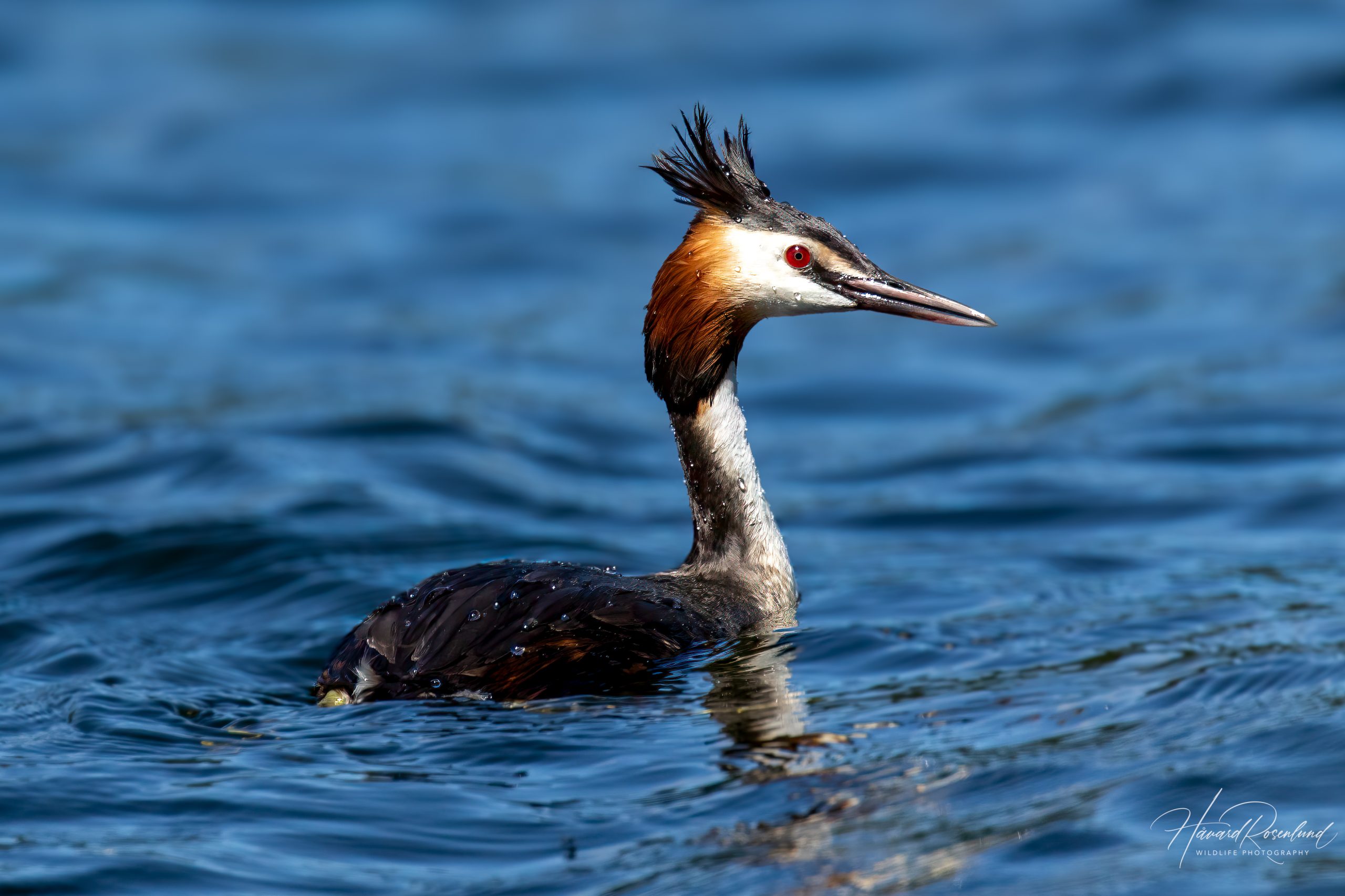
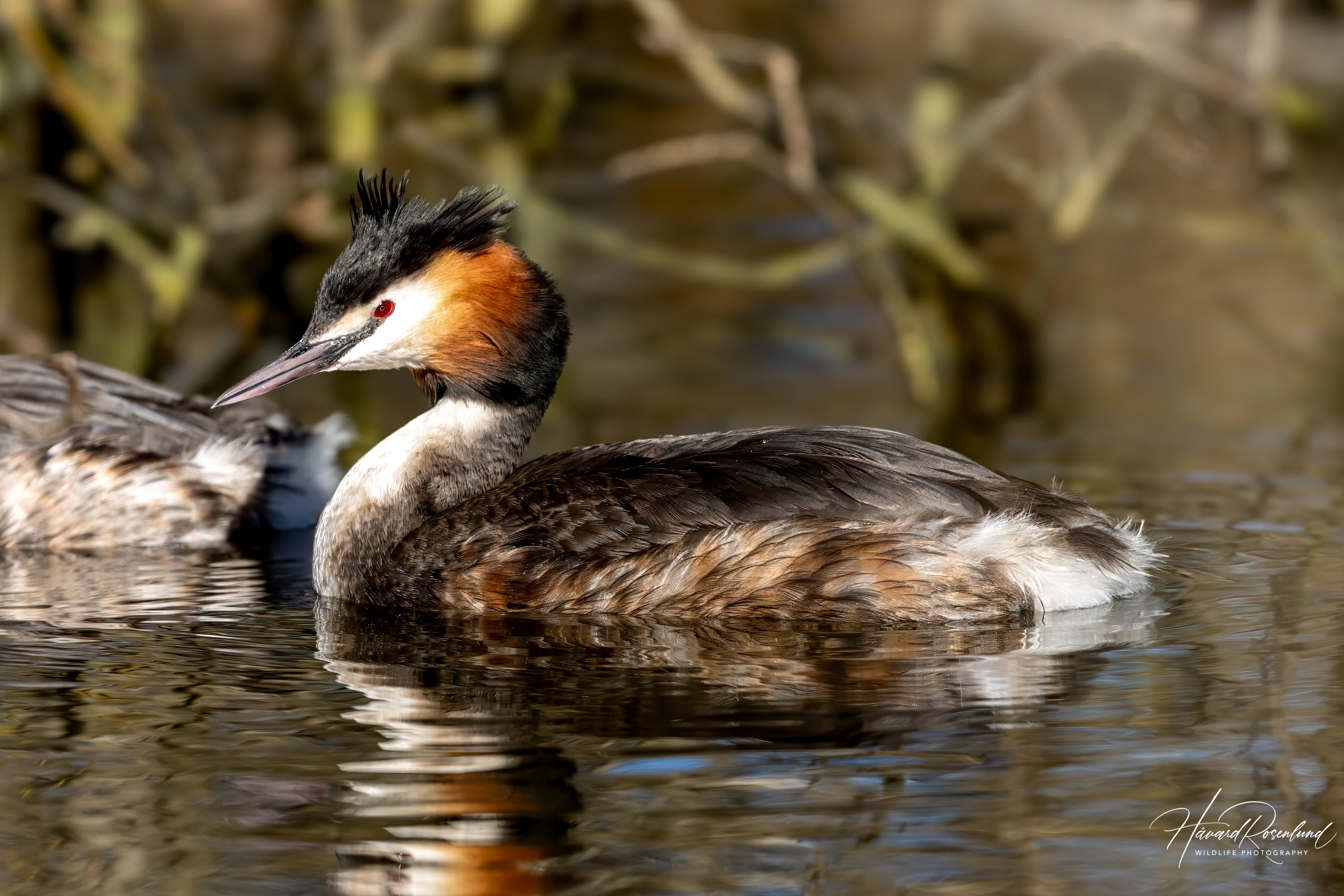
The great crested grebe (Podiceps cristatus) is the largest widespread grebe in Europe and one of the most distinctive waterbirds in breeding plumage. Adults are 46–61 cm long and weigh roughly 0.6–1.2 kg. In spring and summer the white face is framed by a black double crest and an expandable chestnut-and-black head ruff, while the long pale neck and slender dagger-like bill give the species an elegant profile.
Winter adults lose most of the ornamental head feathers and become much plainer grey and white. Chicks are strikingly striped on the head and neck. The legs are set far back on the body and the toes carry broad lobes rather than webs, a configuration that produces powerful underwater propulsion but makes the species awkward on land.
Habitat
Breeding great crested grebes use lakes, reservoirs, large ponds and slow-flowing waters that combine open water for diving with sheltered margins for nesting. Reedbeds and other emergent vegetation are often used, although birds can also nest at relatively open sites where floating vegetation or artificial structures provide enough protection.
Fish abundance, water clarity and nutrient status strongly influence habitat quality. A 25-year study published in 2019 from Lake Sempach in Switzerland found nutrient status to be the main driver of breeding numbers as the lake recovered from severe eutrophication. The study concluded that mesotrophic to eutrophic conditions supported a large breeding population, whereas extreme eutrophication had previously coincided with a major decline. Outside the breeding season, many grebes move to larger lakes, estuaries or sheltered coastal waters where open water remains available through winter.
Diet
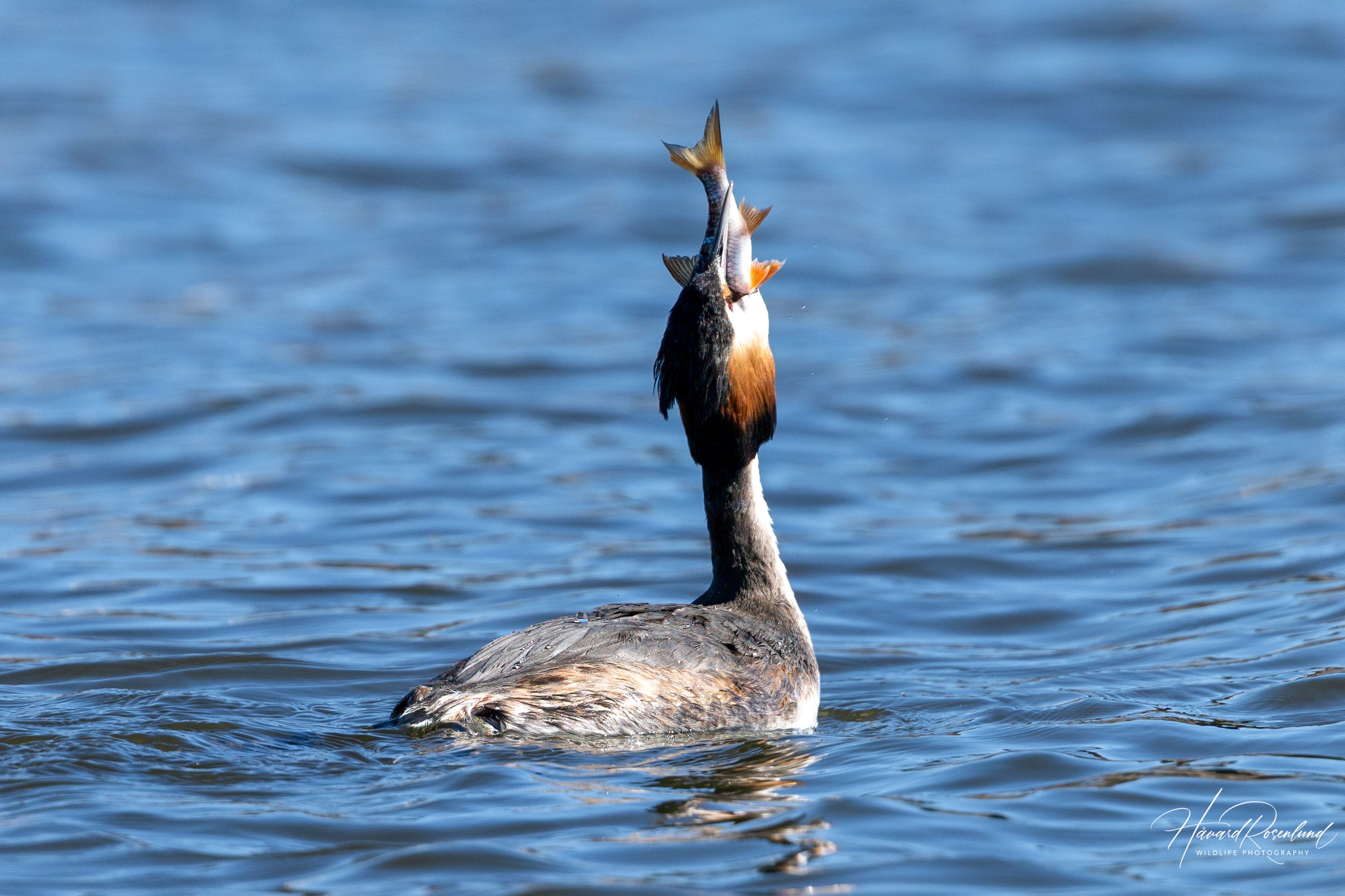
Fish form the core of the diet, with prey size and species varying among lakes and seasons. Aquatic insects, crustaceans, molluscs, amphibians and other small aquatic animals supplement the diet, especially for chicks or where fish are less available.
The species also deliberately swallows its own feathers and feeds feathers to its chicks. A 1989 study of 407 grebes from Lake IJsselmeer in the Netherlands found that only four of 8,718 identified stomach feathers came from other species. The authors proposed that the feather mass supplies indigestible material needed to form pellets that can be regurgitated, while regularly emptying the stomach may also limit the build-up of gastric parasites.
Hunting
Great crested grebes pursue prey underwater, compressing the plumage as they slip below the surface and then swimming rapidly with powerful strokes of the lobed feet. Fish are seized with the long, pointed bill.
A study published in 1988 from Lake IJsselmeer found that moulting grebes concentrated almost all feeding into one or two hours around dawn and again around dusk. Their main prey, smelt, moved toward the surface at twilight, when enough light remained for the fish to be detected and the diving distance was shortest. The hunting rhythm therefore closely followed the daily vertical movements of the prey.
Behaviour
Outside the nesting season birds can gather in loose flocks. During the annual wing moult they replace the flight feathers simultaneously and become temporarily flightless, making large undisturbed lakes and other safe open waters especially important.
Migration
Movement patterns differ strongly across the species' enormous range. Birds breeding where waters remain ice-free can be resident, whereas populations from colder regions move to large unfrozen lakes, estuaries and coastal waters after breeding. Winter flocks may therefore contain birds drawn from a much wider breeding area.
Northern European grebes move mainly south and west, and some populations also make distinct movements to large lakes for wing moult before winter. Migration is less spectacular than in many long-distance landbirds, but access to ice-free fish-rich water determines where the birds can remain during the cold season.
Breeding
The elaborate courtship is one of the best-known displays among European birds. Partners face each other with crests and ruffs erected, shake their heads in synchrony and perform a sequence of ritualised postures. In the famous weed ceremony, both birds dive for aquatic plants and rise upright breast-to-breast on the water while holding vegetation in the bill. Breeding pairs also defend nesting territories.
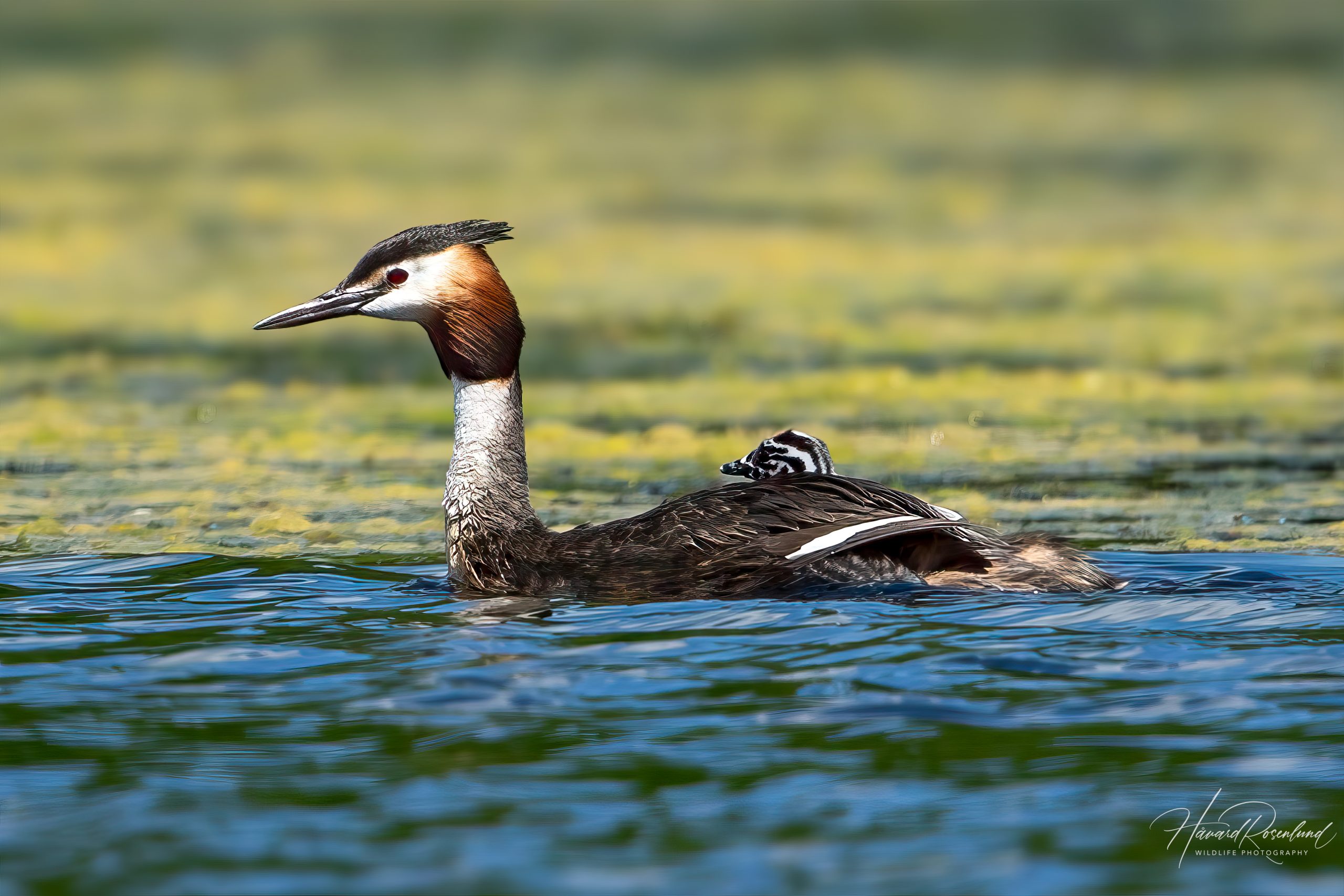
The nest is a floating platform of wet vegetation anchored to reeds or other plants. Three or four eggs are typical, and both parents incubate for about 27–29 days. After hatching, the striped chicks frequently climb onto a parent's back and ride concealed among the wing feathers while the other adult brings food. Back-carrying is especially important during roughly the first three weeks of life, when the young are still small and vulnerable.
A study published in 1994 on fish-farm ponds in the southeastern Netherlands found chick mortality highest during the first two weeks of life and survival highest in broods receiving more food per unit time. Parents continue feeding the chicks long after the main back-carrying period, and the young typically become capable of sustained flight after about 10–11 weeks.
Status
The great crested grebe is classified as least concern on the IUCN Red List and has a very large range across Europe, Asia, Africa and Australasia. Regional trends vary, and populations respond strongly to changes in fish abundance, water quality, disturbance and the availability of secure nesting sites.
Pollution, excessive eutrophication, sudden changes in water level and recreational disturbance can reduce breeding success locally. Conversely, creation of reservoirs and improved protection of wetlands have allowed the species to expand in some regions. Regional populations can therefore change substantially even while the species remains globally secure.
Image gallery
Loading map and observations…
Have you seen this species?
Independent species archive
Did you find this species page useful?
Wildlife Vagabond is independently built and maintained. Voluntary support helps cover hosting, maps, data storage and continued improvements to the species archive.
Support Wildlife VagabondSpecies content will remain freely available.
References
Information about the species’ global distribution and status is based primarily on global Red List data. See the references below for details.
- BirdLife International. (n.d.). Great Crested Grebe species factsheet. https://datazone.birdlife.org/species/factsheet/great-crested-grebe-podiceps-cristatus
- British Trust for Ornithology. (n.d.). Great Crested Grebe BirdFacts. https://www.bto.org/learn/about-birds/birdfacts/great-crested-grebe
- International Union for Conservation of Nature. (n.d.). Great Crested Grebe. The IUCN Red List of Threatened Species. https://www.iucnredlist.org/species/22696602/154250080
- Keller, V., & Korner-Nievergelt, P. (2019). Effect of trophic status of a deep-water lake on breeding Great Crested GrebesPodiceps cristatusduring a phase of recovery from eutrophication: a long-term study. Bird Study, 66(1), 1-10. https://doi.org/10.1080/00063657.2019.1618241
- Piersma, T., & van Eerden, M. R. (1989). Feather eating in Great Crested Grebes Podiceps cristatus: a unique solution to the problems of debris and gastric parasites in fish‐eating birds. Ibis, 131(4), 477-486. https://doi.org/10.1111/j.1474-919X.1989.tb04784.x
- Piersma, T., Lindeboom, R., & van Eerden, M. R. (1988). Foraging rhythm of great crested grebes Podiceps cristatus adjusted to diel variations in the vertical distribution of their prey Osmerus eperlanus in a shallow eutrophic lake in The Netherlands. Oecologia, 76(4), 481-486. https://doi.org/10.1007/BF00397858
- Ulenaers, P., & Dhondt, A. A. (1994). Great Crested GrebePodiceps cristatuschick mortality in relation to parental fishing. Bird Study, 41(3), 211-220. https://doi.org/10.1080/00063659409477221