
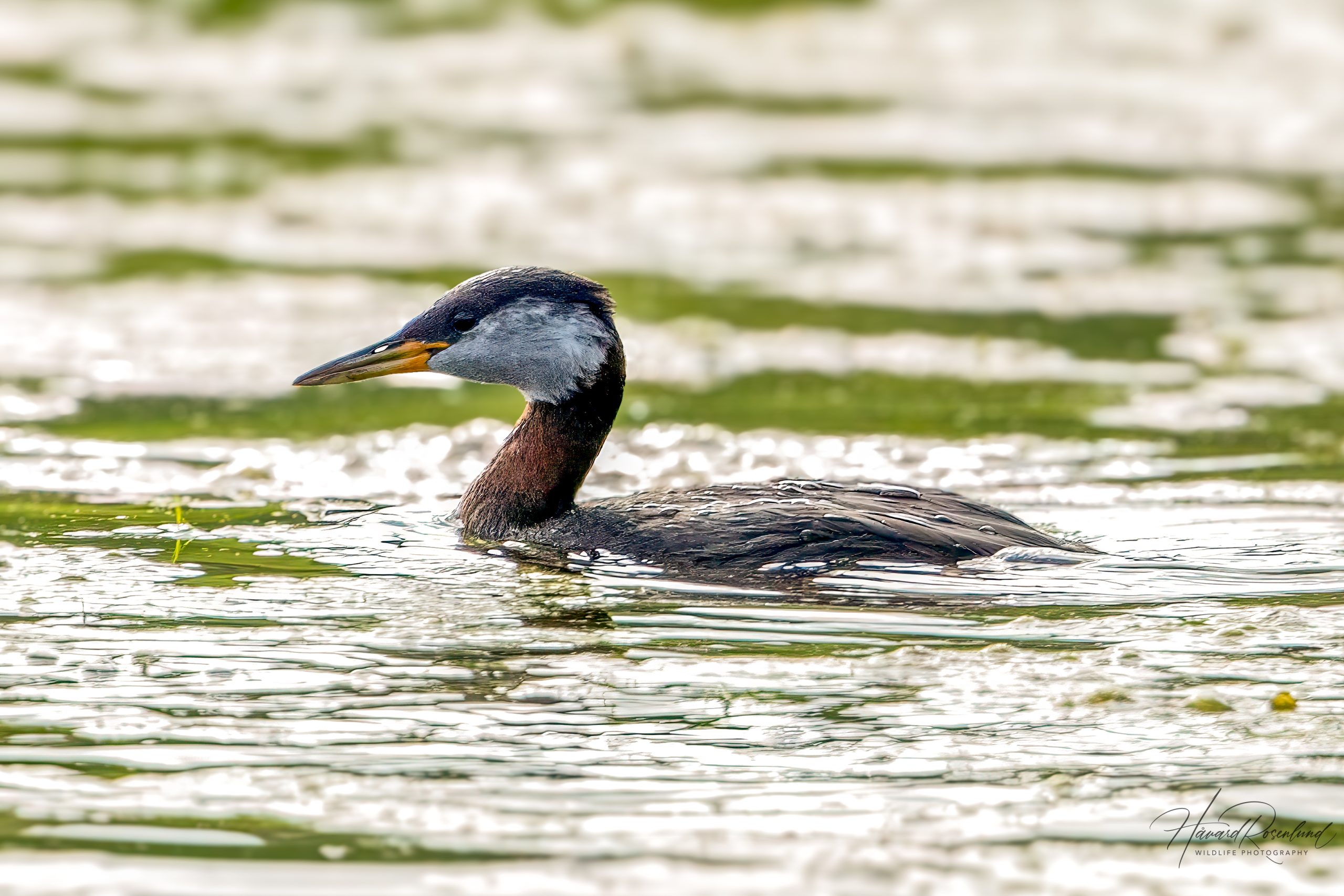
Red-necked Grebe
Podiceps grisegena
At a glance
Habitat
- Shallow, productive freshwater lakes and ponds with emergent vegetation for breeding; coastal and large open waters in winter
Diet
- Fish and a wide range of aquatic invertebrates, amphibians and other small aquatic prey
Activity
- Diurnal, with some nocturnal migration and feeding
Size
- Length: 40–50 cm Weight: about 700–1,600 g
Range
- Temperate and boreal parts of Eurasia and North America; winters mainly on ice-free coastal and large inland waters
Description
The red-necked grebe (Podiceps grisegena) is a medium-large diving bird of the northern hemisphere. Adults are about 40–50 cm long, have a wingspan of roughly 77–85 cm and weigh around 700–1,600 g. In breeding plumage, the black cap, pale grey cheeks and throat and rich chestnut-red neck make the species distinctive.
Winter birds are much greyer, with a thick pale neck and dark crown. Compared with the great crested grebe (Podiceps cristatus), the red-necked grebe is stockier, has a shorter and thicker neck and a heavier bill with a yellow base. Two subspecies are recognised. The North American P. g. holbollii is generally larger than the nominate Eurasian form P. g. grisegena.
Habitat
Breeding red-necked grebes favour relatively small, shallow and productive freshwater lakes, ponds and marshes with patches of reeds, sedges or other emergent vegetation. They need open water for diving but also vegetation to anchor the floating nest and provide shelter from wind and waves.
Outside the breeding season the habitat changes dramatically. Many birds move to larger lakes, estuaries and sheltered coastal waters, where they can spend months far from the vegetated ponds used for nesting. Ice conditions strongly influence how far inland birds can remain during winter.
Diet
Fish are important, especially outside the breeding season, but the diet also includes aquatic insects, crustaceans, molluscs, frogs, tadpoles, salamanders and other small aquatic animals. The balance changes strongly with season and habitat.
Studies on European breeding ponds show how flexible this can be. Grebes on fish-stocked ponds rely much more heavily on fish, whereas birds on fishless ponds can obtain a large share of their food from amphibians and invertebrates. Chicks also receive progressively more and larger fish as they grow where suitable fish are available.
Hunting
Red-necked grebes hunt mainly by sight. A bird may scan from the surface, sometimes with the head partly submerged, before diving and pursuing prey underwater with powerful strokes of the lobed feet. Prey is seized rapidly with the bill from the water column, bottom or aquatic vegetation.
Small prey can be swallowed underwater, while larger fish or crustaceans may be brought to the surface and shaken or bitten into a better position before swallowing. The species is not restricted to active fish pursuit: on shallow breeding ponds it also gleans invertebrates from the bottom and vegetation and takes amphibians when these are abundant.
Prey choice is shaped by what can actually be caught. Winter studies found red-necked grebes selecting smaller fish than expected from their availability, suggesting that prey swimming performance can matter as much as simple prey size. During chick provisioning, fish require more handling than many alternative prey, and items that are too large for the chick to swallow are often rejected.
Behaviour
Like other grebes, the red-necked grebe is superbly adapted to life on water but awkward on land. When threatened it usually dives rather than flies, disappearing below the surface and resurfacing at a safer distance.
Taking off also reflects its aquatic way of life: the bird normally needs a running start across the water before the wings generate enough lift. Once airborne it is a strong flier, but most everyday movement and escape take place on or beneath the water.
Migration
Most northern populations are migratory. Eurasian birds leave breeding lakes as autumn advances and move toward ice-free lakes and coastal waters around the North Sea and Baltic Sea, along Atlantic coasts, and in the Mediterranean and Black Sea. North American birds make comparable movements toward the Pacific and Atlantic coasts.
Much migration takes place at night, so large movements are less obvious than the daytime gatherings seen on wintering waters. Some birds travel long distances, while others only need to move far enough to reach open water. The timing therefore varies strongly with latitude and winter ice conditions.
Breeding
Pairs become conspicuous during courtship. They face one another, shake their heads, rise upright from the water and may present pieces of aquatic vegetation to each other. The pair builds a floating platform of wet vegetation, usually anchored to reeds or other plants in shallow water, and both adults add material throughout the nesting period. A typical clutch contains three to five eggs, and both parents incubate them for roughly 20–25 days.
The chicks hatch covered in striped down and leave the nest quickly, but remain heavily dependent on their parents. Small chicks often ride hidden among the feathers on a parent’s back while the other adult brings food. They can swim and dive early but do not become capable of flight until roughly seven to ten weeks after hatching.
Parents can respond surprisingly flexibly when conditions deteriorate. A Polish study published in 2017 documented rare cases in which adults moved flightless young to another pond when food conditions at the breeding site became poor. The transfer was risky, but showed that families can abandon a failing pond rather than remain where the brood is unlikely to survive.
Eggs do not always hatch at exactly the same time. A study published in 2003 on breeding pairs in Polish fish ponds showed that when food became limited, the smallest late-hatched chicks were most likely to die, and adults sometimes stopped incubating the last eggs after the first chicks had hatched. This brood reduction can concentrate parental effort on the young most likely to survive when food is insufficient for the whole brood.
Status
The red-necked grebe is classified as least concern on the IUCN Red List. It has a broad distribution across Eurasia and North America, although local breeding populations can fluctuate and decline when shallow wetlands are lost or degraded.
Drainage of wetlands, changes in water levels, removal of emergent vegetation, disturbance and pollution can all reduce breeding habitat. Wintering birds are also exposed to oil pollution, fishing gear and changes in coastal food resources. Because the species uses very different habitats in summer and winter, conservation depends on both inland breeding wetlands and safe ice-free wintering waters.
Image gallery
Loading map and observations…
Have you seen this species?
Independent species archive
Did you find this species page useful?
Wildlife Vagabond is independently built and maintained. Voluntary support helps cover hosting, maps, data storage and continued improvements to the species archive.
Support Wildlife VagabondSpecies content will remain freely available.
References
Information about the species’ global distribution and status is based primarily on global Red List data. See the references below for details.
- AviList. (n.d.). v2025b – Podiceps grisegena and subspecies. https://explore.avilist.org/
- BirdLife International. (n.d.). Red-necked Grebe species factsheet. https://datazone.birdlife.org/species/factsheet/red-necked-grebe-podiceps-grisegena
- British Trust for Ornithology. (n.d.). Red-necked Grebe BirdFacts. https://www.bto.org/learn/about-birds/birdfacts/red-necked-grebe
- Cornell Lab of Ornithology. (n.d.). Cornell Lab – Red-necked Grebe life history. https://www.allaboutbirds.org/guide/Red-necked_Grebe/lifehistory
- International Union for Conservation of Nature. (n.d.). Red-necked Grebe. The IUCN Red List of Threatened Species. https://www.iucnredlist.org/species/22696599/132582688
- Kloskowski, J., & Frączek, K. (2017). A novel strategy to escape a poor habitat: red-necked grebes transfer flightless young to other ponds. Acta ethologica, 20(2), 191-195. https://doi.org/10.1007/s10211-017-0254-7
- Kloskowski, J., & Trembaczowski, A. (2015). Fish reduce habitat coupling by a waterbird: evidence from combined stable isotope and conventional dietary approaches. Aquatic Ecology, 49(1), 21-31. https://doi.org/10.1007/s10452-015-9501-z
- Kloskowski, J. (2003). Brood reduction in the Red‐necked GrebePodiceps grisegena. Ibis, 145(2), 233-243. https://doi.org/10.1046/j.1474-919X.2003.00145.x
- Kloskowski, J. (2004). Food Provisioning in Red-Necked Grebes (Podiceps Grisegena) at Common Carp (Cyprinus Carpio) Ponds. Hydrobiologia, 525(1-3), 131-138. https://doi.org/10.1023/B:HYDR.0000038860.37405.d0
- Oiseaux.net. (n.d.). Red-necked Grebe biometrics. https://www.oiseaux.net/oiseaux/grebe.jougris.html
- Piersma, T. (1988). Body size, nutrient reserves and diet of Red-necked and Slavonian GrebesPodiceps grisegenaandP. aurituson Lake IJsselmeer, The Netherlands. Bird Study, 35(1), 13-24. https://doi.org/10.1080/00063658809476975