
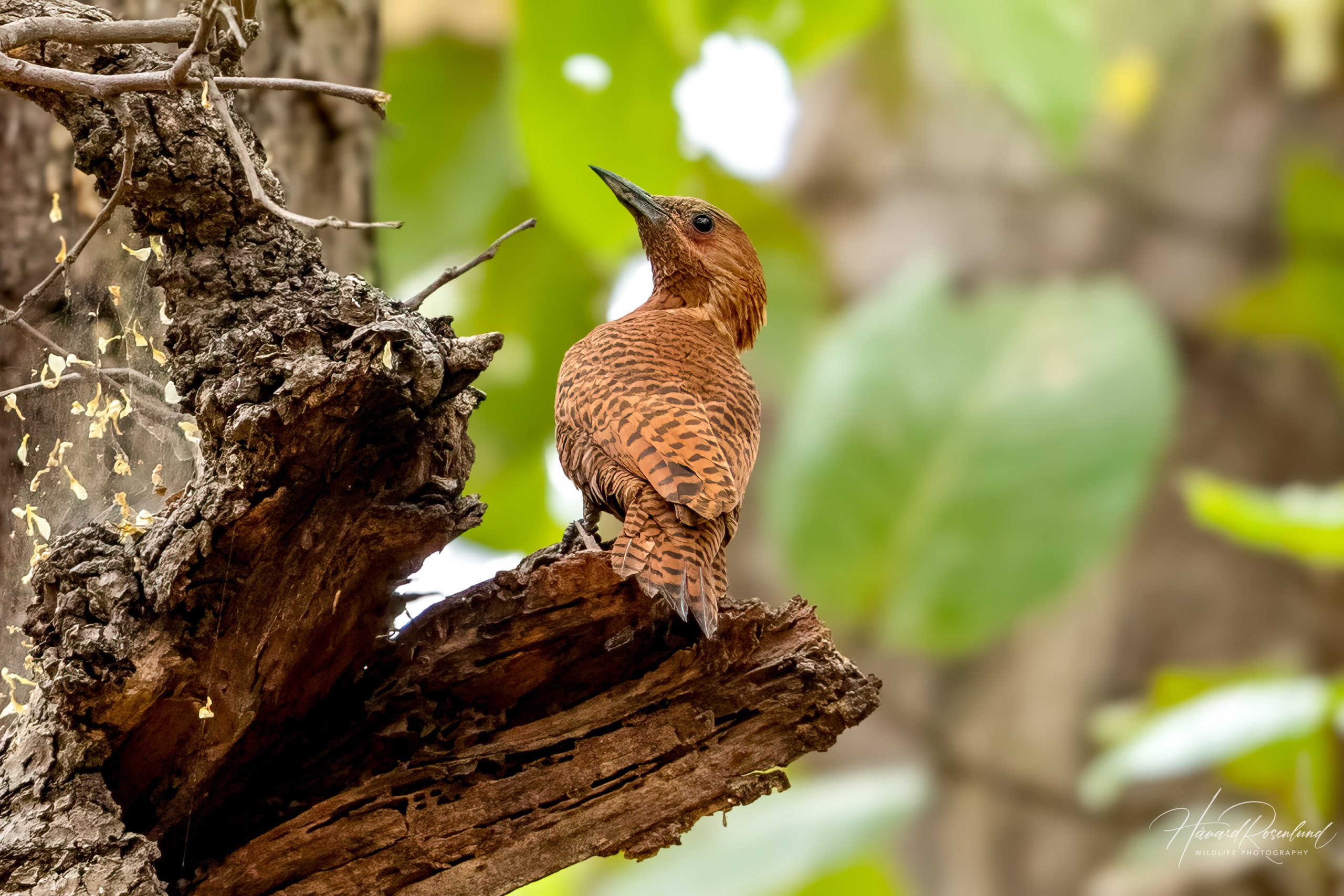
Rufous Woodpecker
Micropternus brachyurus
At a glance
Habitat
- Tropical and subtropical forest, secondary woodland, bamboo, mangroves and shaded plantations
Diet
- Strongly ant-focused; especially Crematogaster ants and their brood, with other insects also taken
Activity
- Diurnal
Size
- Length: about 25–27 cm Weight: about 70–85 g
Range
- South and Southeast Asia from the Indian subcontinent to southern China, the Malay Peninsula and parts of Indonesia
Description
The rufous woodpecker (Micropternus brachyurus) is a medium-sized Asian woodpecker with an unusually uniform reddish-brown appearance. Adults are about 25–27 cm long and typically weigh around 70–85 g. Dark barring crosses the wings, back, flanks and tail, while the relatively short bill is slightly curved rather than strongly chisel-shaped. Males have a small red patch below the eye that females lack.
The species is the only member of the genus Micropternus. Its plumage, bill shape and close ecological relationship with tree-dwelling ants make it rather different from the more familiar black, white and red woodpeckers of temperate regions.
Habitat
Rufous woodpeckers occupy a broad range of wooded habitats, including evergreen and deciduous forest, secondary woodland, bamboo, mangroves, forest edge and plantations with a developed tree canopy. In India they are resident birds associated with both forest and well-wooded plantations.
The availability of arboreal ant colonies can be as important as the trees themselves. A 2008 study in Wayanad, India, found that 31 of 37 Crematogaster ant nests observed being raided by rufous woodpeckers were in shade-grown coffee plantations rather than natural forest. In shade-grown agriculture, crops such as coffee are cultivated beneath a retained or planted canopy of taller trees instead of in an open, sun-exposed monoculture. This preserves more of the vertical structure of woodland and can retain habitat for ants and other forest-associated organisms, helping explain why these plantations can remain useful feeding habitat for the woodpecker.
Diet
Ants form an unusually important part of the diet, especially tree-dwelling acrobat ants in the genus Crematogaster. The birds eat adults as well as eggs, larvae and pupae. Termites and other insects and invertebrates are also taken.
A 2023 study in Sri Lanka found Crematogaster remains in all faecal samples examined from five rufous woodpeckers and a positive relationship between woodpecker occurrence and ant-nest density. The birds are therefore not simply opportunistic ant-eaters: in at least some populations their ecology is closely tied to these colonies.
Foraging
Rufous woodpeckers forage on trunks, branches and among dense vegetation, probing and pecking into the carton-like nests of arboreal Crematogaster ants rather than relying mainly on deep excavation of wood. They open active colonies and take both adult ants and brood directly from the nest.
The relationship with Crematogaster is particularly unusual because the same ants that are eaten also provide nesting sites. The birds can move around active colonies without being driven away by the aggressive ants, and experiments in the same 2023 Sri Lankan study found that the ants were attracted to rufous woodpecker feathers rather than reacting to them as they did to feathers of other birds. The mechanism is still being investigated.
Breeding
The rufous woodpecker has one of the most remarkable nesting strategies among woodpeckers. Breeding timing varies geographically but falls mainly between February and June across much of the range. Rather than excavating a cavity directly in wood, pairs often cut a nest chamber into the carton nest of an active Crematogaster ant colony attached to a tree. The ants and birds then occupy the same structure during the breeding period.
A clutch usually contains about two or three white eggs. Both adults take part in incubation and later feed the young. Incubation lasts roughly 12–14 days. Why the ants tolerate the nesting birds is not fully understood, but the relationship may give the woodpeckers a protected nest site while the birds simultaneously prey on members of the colony.
Status
The rufous woodpecker is classified as least concern on the IUCN Red List and remains widely distributed across South and Southeast Asia.
State of India’s Birds 2025 estimates a long-term change of about −19% in India, but the uncertainty range spans both decline and slight increase, so the long-term direction remains uncertain. The current annual estimate is about +1.27% and indicates a broadly stable recent population. The species is resident and associated with forest and plantations in India.
Retaining mature trees, secondary woodland and shaded plantations can therefore be valuable, particularly where these habitats also support the arboreal ant colonies on which the species depends.
Image gallery
Loading map and observations…
Have you seen this species?
Independent species archive
Did you find this species page useful?
Wildlife Vagabond is independently built and maintained. Voluntary support helps cover hosting, maps, data storage and continued improvements to the species archive.
Support Wildlife VagabondSpecies content will remain freely available.
References
Information about the species’ global distribution and status is based primarily on global Red List data. See the references below for details.
- BirdLife International. (n.d.). Rufous Woodpecker species factsheet. https://datazone.birdlife.org/species/factsheet/rufous-woodpecker-micropternus-brachyurus
- International Union for Conservation of Nature. (n.d.). Rufous Woodpecker. The IUCN Red List of Threatened Species. https://www.iucnredlist.org/species/22681314/92901215
- Seneviratne, S. S., Gunasekara, V. R., & Weerakkody, S. (2023). Predator-prey and Commensal Association of Rufous Woodpecker (Micropternus brachyurus jerdonii) and Crematogaster Ants in Sri Lanka. Proceedings of International Forestry and Environment Symposium, 27. https://doi.org/10.31357/fesympo.v27.6527
- State of India's Birds. (2025). State of India’s Birds 2025 – Rufous Woodpecker. https://stateofindiasbirds.in/species/rufwoo2/
- Tobias, J. A., Sheard, C., Pigot, A. L., Devenish, A. J. M., Yang, J., Sayol, F., Neate‐Clegg, M. H. C., Alioravainen, N., Weeks, T. L., Barber, R. A., Walkden, P. A., MacGregor, H. E. A., Jones, S. E. I., Vincent, C., Phillips, A. G., Marples, N. M., Montaño‐Centellas, F. A., Leandro‐Silva, V., Claramunt, S., … Schleuning, M. (2022). AVONET: morphological, ecological and geographical data for all birds. Ecology Letters, 25(3), 581-597. https://doi.org/10.1111/ele.13898
- Vishnudas, C. K. (2008). Crematogaster ants in shaded coffee plantations: a critical food source for Rufous Woodpecker and other forest birds. Indian BIRDS, 4(1), 9–11. https://indianbirds.in/pdfs/IB4.1_Vishnudas_RufousWoodpecker.pdf
- Winkler, H., & Christie, D. (2020). Rufous Woodpecker (Micropternus brachyurus). In Birds of the World. Cornell Lab of Ornithology. https://doi.org/10.2173/bow.rufwoo2.01