
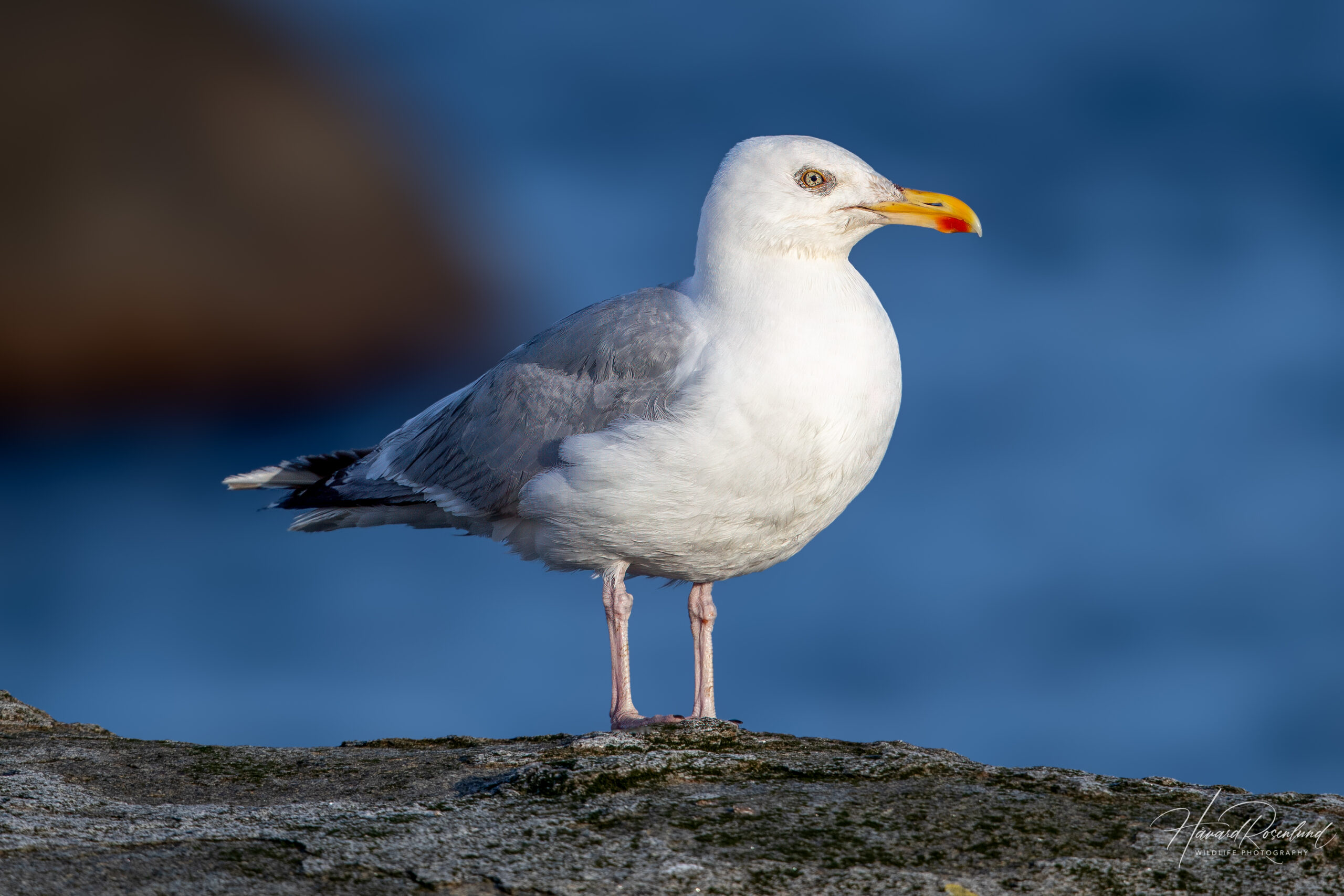
European Herring Gull
Larus argentatus
At a glance
Habitat
- Coasts, islands, estuaries and intertidal shores; also reservoirs, farmland and urban areas
Diet
- Highly opportunistic: fish, marine and terrestrial invertebrates, carrion, eggs and chicks, and human-derived food
Activity
- Diurnal
Size
- Length: 53–68 cm Weight: ca. 1.0 kg
Range
- Northern and western Europe; partly migratory, with northern breeders generally moving farther in winter
Description
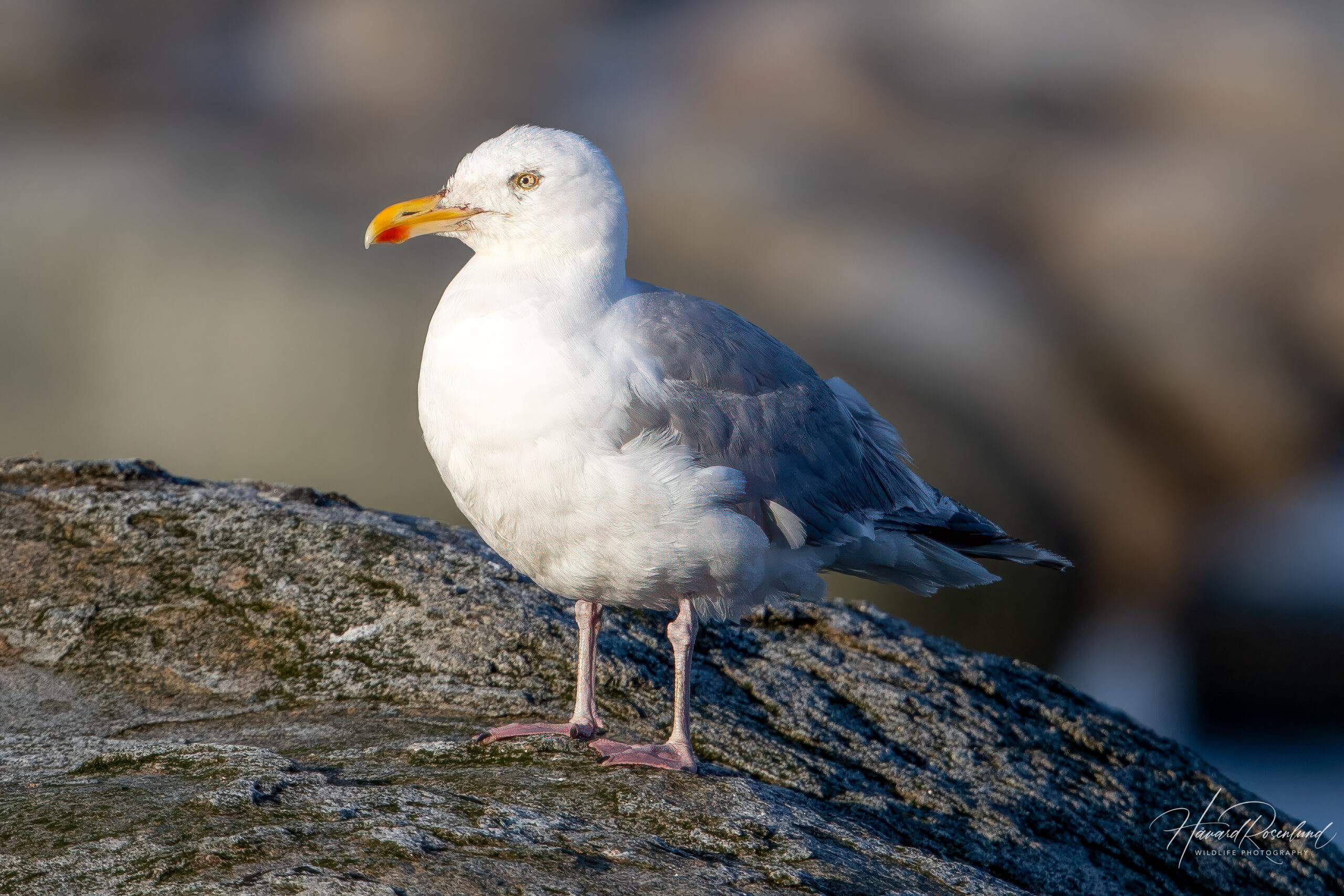
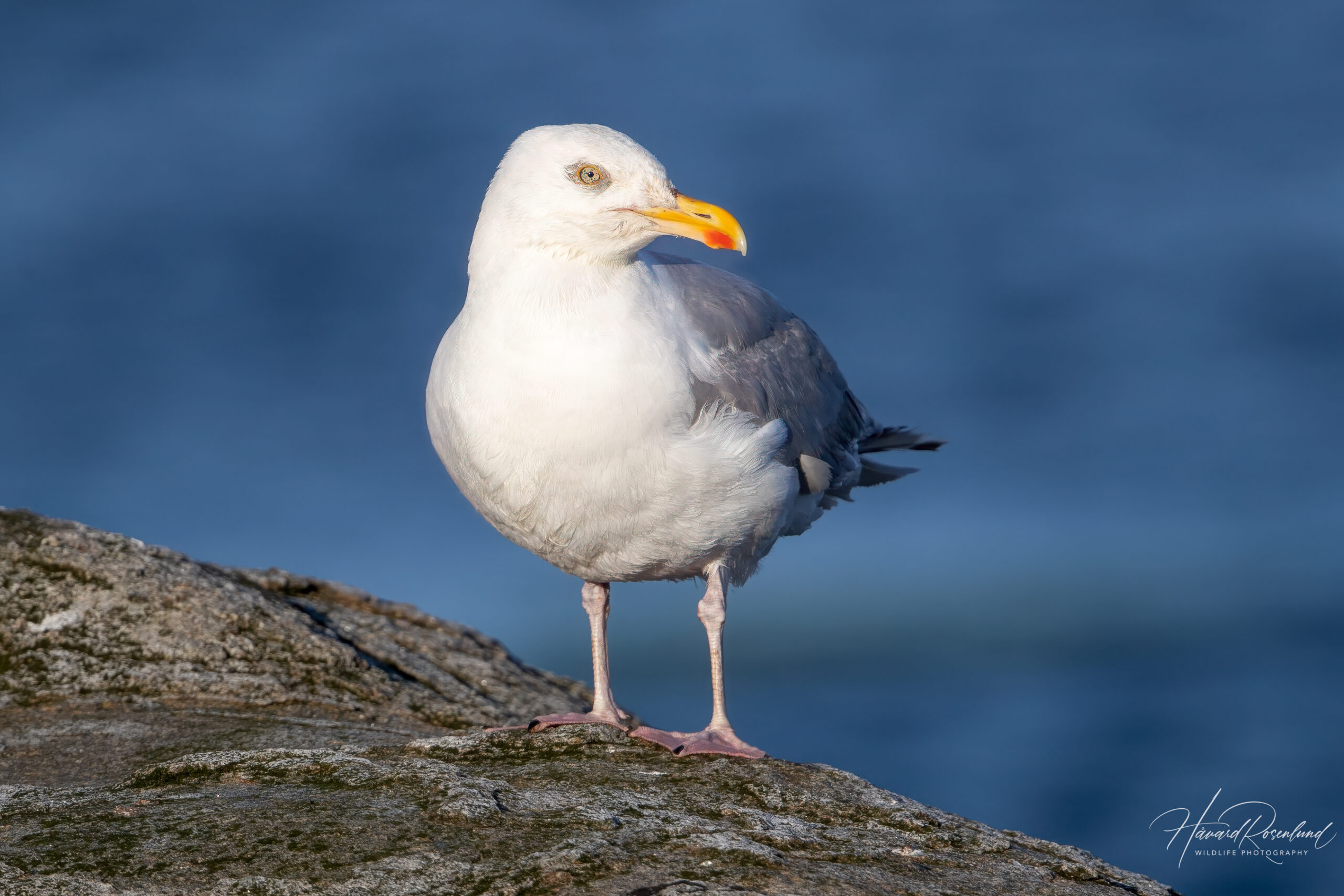
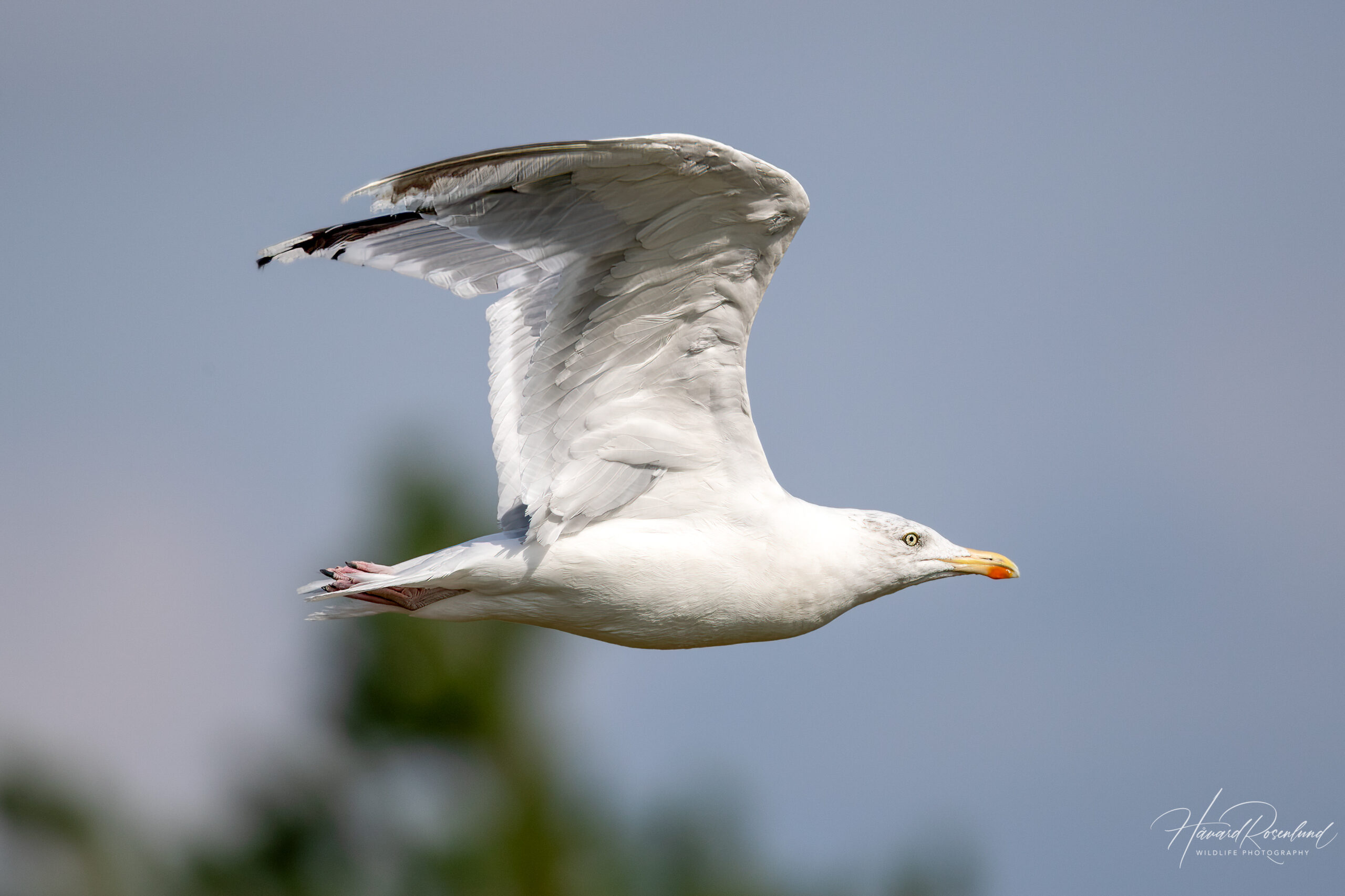
The European herring gull (Larus argentatus) is a large gull of northern and western Europe. Adults are about 53–68 cm long and average close to 1 kg. They have a pale grey mantle, white head and underparts, black outer primaries with white tips, and a heavy yellow bill marked with a red spot on the lower mandible. Chicks peck at this mark while begging, helping to trigger the parent's feeding response. Young birds begin mottled brown and pass through several immature plumages before acquiring the clean grey-and-white adult appearance at around four years of age.
Among European gulls it is larger and heavier-billed than the common gull (Larus canus), while adult lesser black-backed gulls (Larus fuscus) have a much darker mantle. Immature large gulls are considerably more difficult to identify because plumage changes gradually over several years.
Taxonomy
The herring-gull complex has undergone repeated taxonomic revision. AviList treats the European herring gull Larus argentatus and American herring gull Larus smithsonianus as separate species. They are extremely similar, particularly in immature plumages, and reliable identification often depends on a combination of structure, plumage pattern, moult and geographic context rather than one simple field mark.
Within the European species, the larger and often slightly darker nominate form L. a. argentatus predominates around Scandinavia and the Baltic, while L. a. argenteus occurs mainly farther west in Europe. Broad zones of overlap and variation make the boundaries between these forms less obvious in the field than their names might suggest.
Habitat
European herring gulls are strongly associated with coasts, islands, estuaries and intertidal shores, but they also use reservoirs, farmland, refuse sites and towns. Breeding colonies occur on islands, skerries, cliffs and increasingly on buildings, while feeding birds may travel well inland.
Habitat use varies greatly among colonies and individuals. GPS tracking at a declining British coastal colony found around three quarters of off-colony locations in intertidal and near-shore habitat, especially mussel beds, illustrating that even highly adaptable gulls can remain strongly dependent on natural coastal feeding areas.
Diet
The diet is exceptionally broad and includes fish, crabs, molluscs, worms and other invertebrates, carrion, eggs and chicks of other birds, and food derived from human activity. Individuals and colonies can differ markedly in which resources they exploit.
Research in coastal Norway has likewise found substantial dietary differences between urban and more remote breeding colonies. This flexibility allows the species to switch among marine, terrestrial and human-derived foods, but it does not mean that every population depends heavily on refuse or food from people.
An exceptional observation in Paris in 2005 documented one adult deliberately dropping pieces of bread into a pond to attract goldfish and then catching the fish as they rose to feed. The behaviour shows how far individual feeding innovation can extend in this highly opportunistic species.
Migration
The European herring gull is partially migratory. Many birds in milder coastal areas remain within the same broad region throughout the year, whereas breeders from farther north generally travel farther south or west after the breeding season. How far individuals move varies with age, latitude, weather and food availability.
Breeding
Herring gulls form long-lasting pairs and usually nest colonially, although isolated pairs also occur. Traditional sites include islands, skerries, cliffs and other open coastal ground, while urban birds can nest on rooftops and buildings. Nests are substantial cups of grass, seaweed and other vegetation, often rebuilt within the same territory in successive years.
A typical clutch contains three eggs, with two to four recorded. The female performs most incubation, with the male incubating occasionally, over about 28–30 days. Both parents guard and feed the semi-precocial chicks, which become capable of flight after roughly 35–40 days but may remain dependent on their parents for longer.
Relationship with humans
Herring gulls are highly visible neighbours in many towns and cities. Buildings provide nesting sites, while streets, parks and discarded food create additional feeding opportunities. This can bring gulls into conflict with people over noise, defensive behaviour around chicks and access to food, even though urban birds represent only part of the wider population.
Urban herring gulls are also remarkably attentive to human behaviour. Experiments with free-living birds found that gulls were more likely to investigate food they had watched a person handle, and another study showed a strong preference for food matching the colour of an item a nearby person was eating. Yet only a minority of birds in earlier experiments approached food placed close to people, suggesting that familiar food-stealing behaviour is concentrated in particular individuals and situations rather than being universal.
Status
The European herring gull is classified as least concern on the IUCN Red List, but the broad global category masks substantial regional decline. In Europe, the species was classified as Near Threatened in the 2021 European Red List.
Long-term British data likewise show a major reduction in coastal breeding numbers, even though urban nesting has increased in some areas. The contrast illustrates why the continued visibility of herring gulls around towns does not necessarily reflect the condition of the wider population.
Image gallery
Loading map and observations…
Have you seen this species?
Independent species archive
Did you find this species page useful?
Wildlife Vagabond is independently built and maintained. Voluntary support helps cover hosting, maps, data storage and continued improvements to the species archive.
Support Wildlife VagabondSpecies content will remain freely available.
References
Information about the species’ global distribution and status is based primarily on global Red List data. See the references below for details.
- Artsdatabanken. (2021). Gråmåke, Norsk rødliste 2021. https://lister.artsdatabanken.no/rodlisteforarter/2021/27696
- BirdLife International. (n.d.). European Herring Gull species factsheet. https://datazone.birdlife.org/species/factsheet/european-herring-gull-larus-argentatus
- British Trust for Ornithology. (n.d.). Herring Gull BirdFacts. https://www.bto.org/learn/about-birds/birdfacts/herring-gull
- Clewley, G. D., Barber, L. J., Conway, G. J., Clark, N. A., Donato, B. J., Thaxter, C. B., & Burton, N. H. K. (2021). Foraging habitat selection by breeding Herring Gulls (<i>Larus argentatus</i>) from a declining coastal colony in the United Kingdom. Estuarine, Coastal and Shelf Science, 261, 107564. https://doi.org/10.1016/j.ecss.2021.107564
- European Commission / BirdLife International. (2021). European Red List of Birds. https://environment.ec.europa.eu/publications/european-red-list-birds-2021_en
- Feist, F., Smith, K., & Graham, P. (2023). Inter-species stimulus enhancement: herring gulls (Larus argentatus) mimic human food choice during foraging. Biology Letters, 19(5), 20230035. https://doi.org/10.1098/rsbl.2023.0035
- Goumas, M., Boogert, N. J., & Kelley, L. A. (2020). Urban herring gulls use human behavioural cues to locate food. Royal Society Open Science, 7(2), 191959. https://doi.org/10.1098/rsos.191959
- International Union for Conservation of Nature. (n.d.). European Herring Gull. The IUCN Red List of Threatened Species. https://www.iucnredlist.org/species/62030608/206585142
- Keilen, E. K., Borgå, K., Thorstensen, H. S., Hylland, K., Helberg, M., Warner, N., Bæk, K., Reiertsen, T. K., & Ruus, A. (2022). Differences in Trophic Level, Contaminant Load, and DNA Damage in an Urban and a Remote Herring Gull (Larus argentatus) Breeding Colony in Coastal Norway. Environmental Toxicology and Chemistry, 41(10), 2466-2478. https://doi.org/10.1002/etc.5441
- Rheindt, F. E., Donald, P. F., Donsker, D. B., Gerbracht, J. A., Iliff, M. J., Lepage, D., Norman, J. A., Rasmussen, P. C., Schodde, R., Schulenberg, T. S., Areta, J. I., Brammer, F. P., Chesser, R. T., Dowsett, R. J., Peterson, A., Alström, P., Stervander, M., Remsen, J. V., Garnett, S. T., … Christidis, L. (2025). AviList: a unified global bird checklist. Biodiversity and Conservation, 34(10), 3359–3376. https://doi.org/10.1007/s10531-025-03120-y