
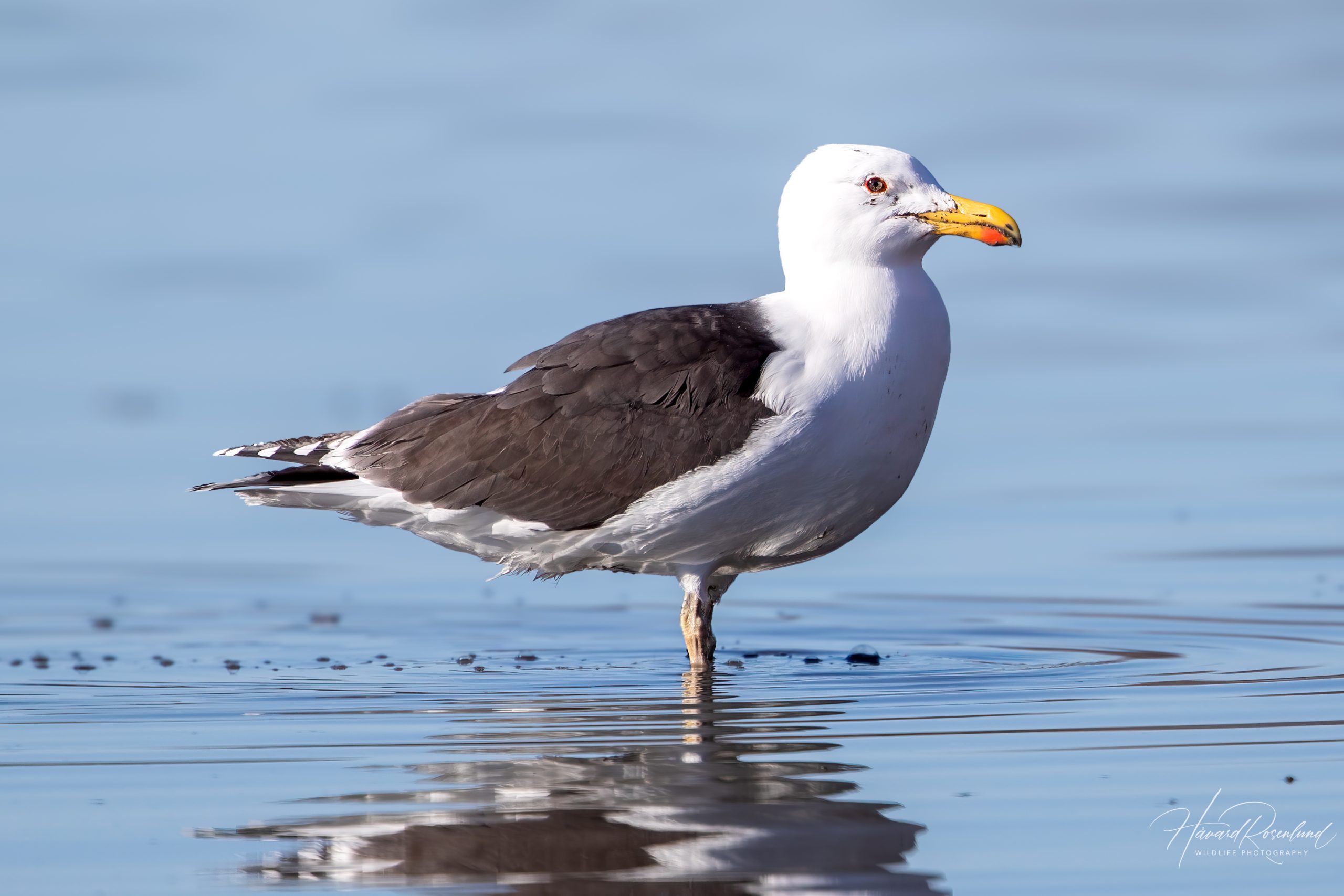
Great Black-backed Gull
Larus marinus
At a glance
Habitat
- Rocky coasts, islands, cliffs, estuaries, harbours and offshore waters
Diet
- Fish, marine invertebrates, carrion, refuse, birds, eggs and small mammals
Activity
- Diurnal; wide-ranging coastal and marine forager
Size
- Length: 64–79 cm Weight: Average ~1.56 kg
Range
- North Atlantic coasts of Europe and North America
Description
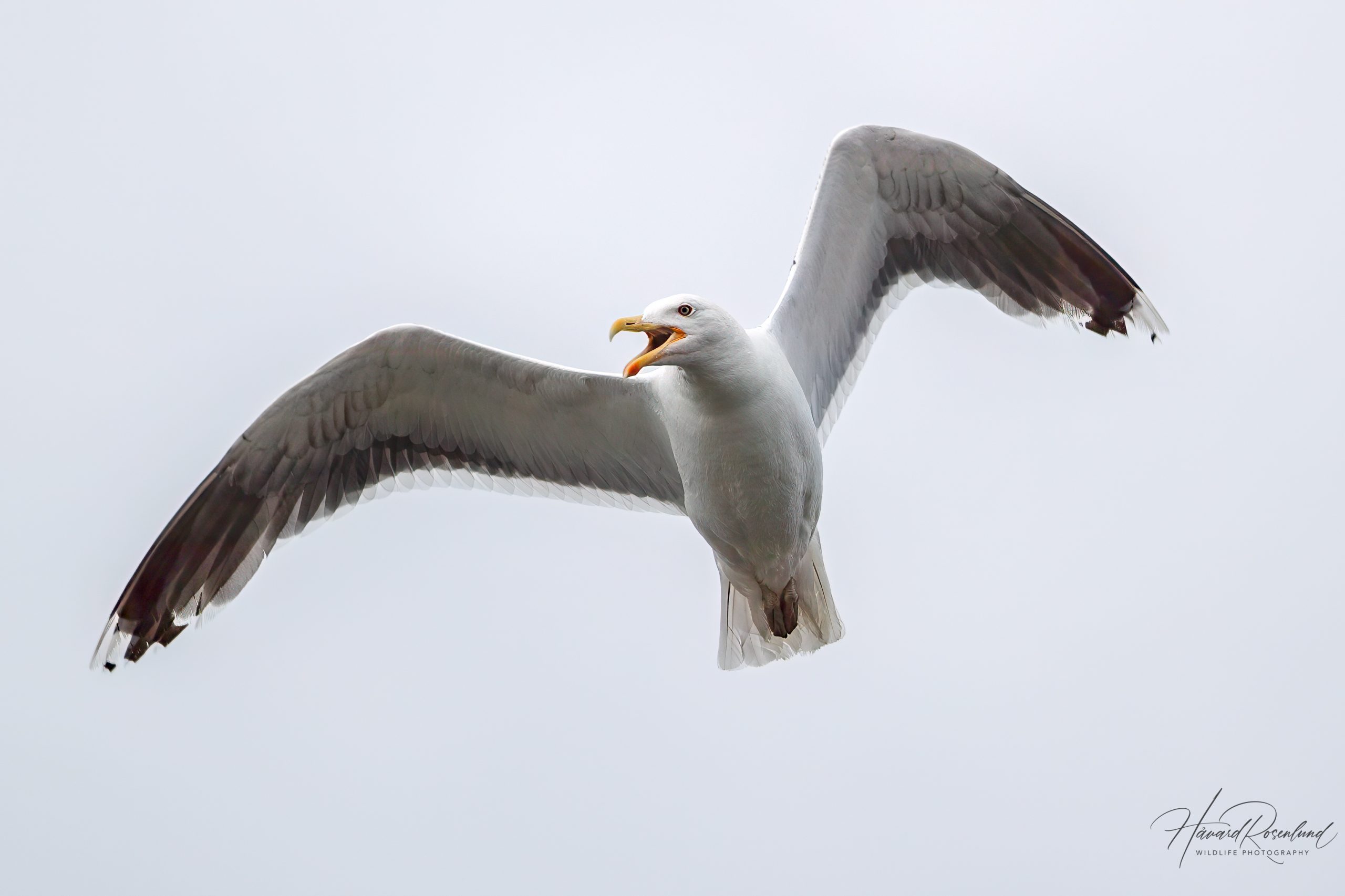
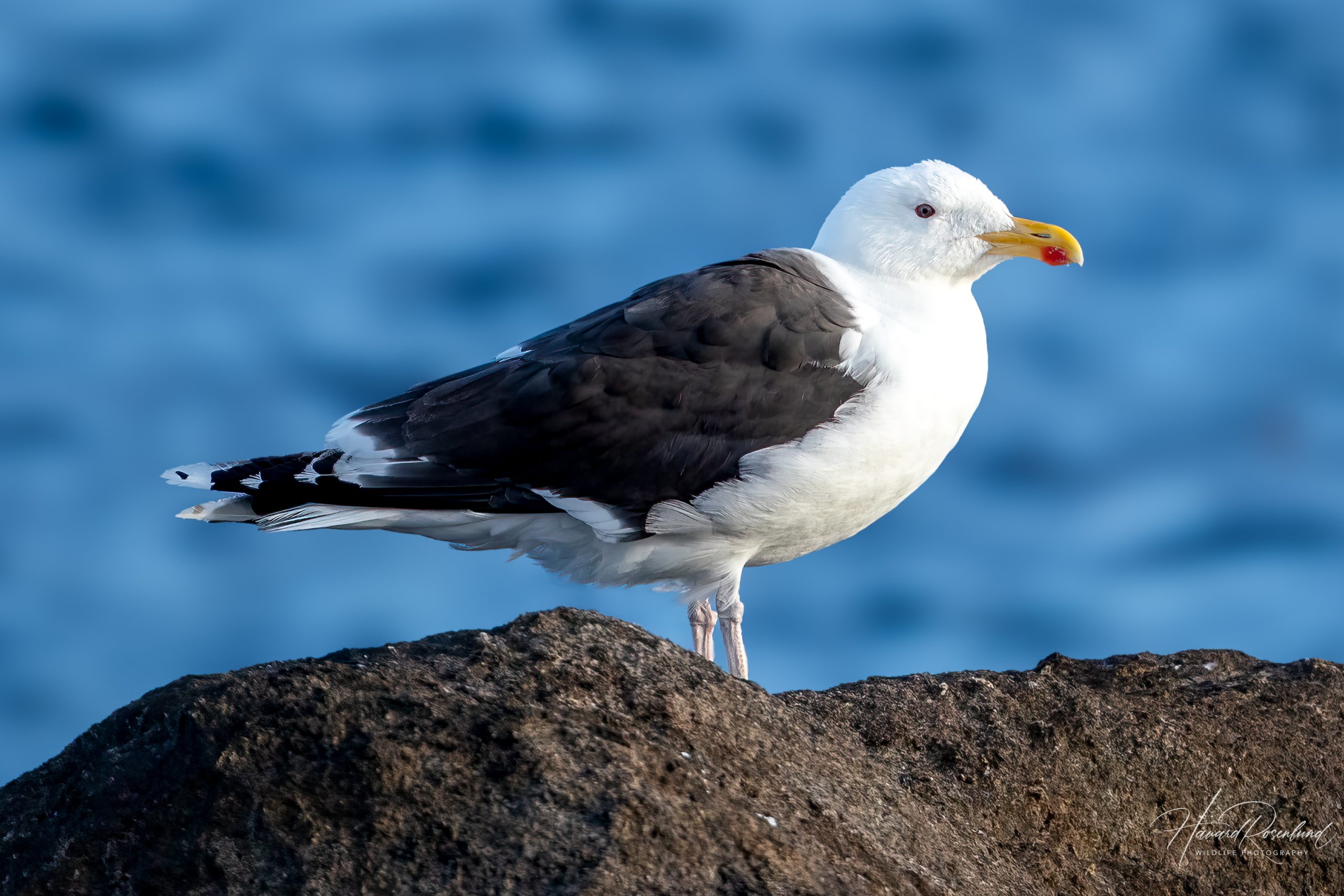
The great black-backed gull (Larus marinus) is the world's largest living gull. Adults are about 64–79 cm long with a wingspan of roughly 150–170 cm and an average body mass of about 1.56 kg, although large individuals can exceed 2 kg. Adults have a white head and underparts, almost black mantle and upperwings, pink legs and a powerful yellow bill with a red spot on the lower mandible.
Immatures are mottled brown and take several years to acquire the clean adult plumage. The smaller lesser black-backed gull (Larus fuscus) is more slender, usually has yellow legs and a less massive bill, while its mantle is generally lighter than the near-black upperparts of an adult great black-backed gull. The species is long-lived; ringing records include an individual more than 26 years old.
Habitat
Great black-backed gulls are strongly associated with the North Atlantic coast. They breed on rocky islands, skerries, cliffs, low coastal ground and occasionally rooftops or inland islands, while feeding across coastal waters, estuaries, beaches, harbours and offshore areas. Outside breeding, they can also occur around large inland waters and refuse or fish-processing sites.
The species is highly flexible and readily shifts between natural and human-created feeding habitats. During breeding, birds tend to feed within reach of the nest, whereas non-breeding individuals can range much more widely along coastlines and at sea.
Diet
The great black-backed gull is both an opportunistic scavenger and one of the most powerful avian predators in northern coastal ecosystems. Fish, marine invertebrates, carrion, refuse, eggs, chicks and adult birds are all taken, together with small mammals and other terrestrial prey. Individuals also steal food from other seabirds, including fish carried back to colonies.
Diet varies enormously between places and even between neighbouring pairs. A study published online in 2019 on Skokholm in Wales analysed more than 1,000 regurgitated pellets from 26 breeding pairs. Seabirds, especially Manx shearwaters, and rabbits dominated the remains. Most pairs were generalists, while seven of the 26 pairs specialised strongly on either birds or mammals. A 2016 study at two seabird colonies in eastern Canada found equally strong local effects. On Gull Island, great black-backed gulls consumed up to 40% of the common murre eggs laid and also took black-legged kittiwake eggs, chicks and adults. Such predation can be locally important without meaning that every gull or every colony has the same ecological effect.
Foraging
Great black-backed gulls usually forage alone, in pairs or in loose groups rather than through coordinated group hunting. They patrol coastlines and seabird colonies from the air, search shorelines for food and watch other birds for opportunities to steal prey. Their large body size allows adults to dominate many smaller gulls at carcasses and other rich food sources.
Outside the breeding season, birds may gather at productive feeding sites and communal roosts. During breeding, individual adults can show strong fidelity to particular feeding areas and repeatedly use similar routes, so neighbouring birds may exploit quite different parts of the surrounding landscape.
Migration
The species is a partial migrant. Many birds in milder parts of western Europe remain within the same broad region throughout the year, while northern breeders move south and southwest after breeding. Britain and Ireland receive wintering birds from Scandinavia, confirmed by ringing recoveries.
Movements are highly variable between individuals. Some remain close to breeding coasts, while others travel more than a thousand kilometres to wintering areas. The result is a mixture of resident and migratory birds across much of the North Atlantic range.
Breeding
Great black-backed gulls breed either as isolated pairs or in loose colonies, often alongside other seabirds. Breeding pairs defend their nesting territories vigorously. The nest is a substantial ground scrape or mound lined with grass, seaweed and other vegetation and is usually placed on an island, rocky shore, cliff ledge or other open site with good visibility.
Two or three eggs are typical. Both adults incubate for about 27–28 days and jointly defend and feed the chicks. The downy young leave the immediate nest cup early but remain dependent on their parents, becoming capable of flight after roughly 50–55 days.
Status
The great black-backed gull is classified as least concern on the IUCN Red List. However, a range-wide analysis published online in 2022 estimated that the global breeding population fell from about 291,000 pairs in 1985 to roughly 152,000–165,000 pairs in 2021, a decline of about 43–48% over three generations. That level of decline is large enough to meet the IUCN threshold for Vulnerable, and the study recommended reassessment.
No single cause explains the decline everywhere. Reduced fisheries discards and other changes in food availability, shifts in seabird and forage-fish populations, control measures, disease and predation may all contribute in different regions. The species' flexible diet may buffer some populations but has not prevented widespread declines.
Image gallery
Loading map and observations…
Have you seen this species?
Independent species archive
Did you find this species page useful?
Wildlife Vagabond is independently built and maintained. Voluntary support helps cover hosting, maps, data storage and continued improvements to the species archive.
Support Wildlife VagabondSpecies content will remain freely available.
References
Information about the species’ global distribution and status is based primarily on global Red List data. See the references below for details.
- BirdLife International. (n.d.). Great Black-backed Gull species factsheet. https://datazone.birdlife.org/species/factsheet/great-black-backed-gull-larus-marinus
- Borrmann, R. M., Phillips, R. A., Clay, T. A., & Garthe, S. (2019). High foraging site fidelity and spatial segregation among individual great black‐backed gulls. Journal of Avian Biology, 50(12), jav.02156. https://doi.org/10.1111/jav.02156
- British Trust for Ornithology. (n.d.). Great Black-backed Gull BirdFacts. https://www.bto.org/learn/about-birds/birdfacts/great-black-backed-gull
- International Union for Conservation of Nature. (n.d.). Great Black-backed Gull. The IUCN Red List of Threatened Species. https://www.iucnredlist.org/species/22694324/132342572
- Langlois Lopez, S., Bond, A. L., O’Hanlon, N. J., Wilson, J. M., Vitz, A., Mostello, C. S., Hamilton, F., Rail, J.-F., Welch, L., Boettcher, R., Wilhelm, S. I., Anker-Nilssen, T., Daunt, F., & Masden, E. (2023). Global population and conservation status of the Great Black-backed GullLarus marinus. Bird Conservation International, 33, e23. https://doi.org/10.1017/S0959270922000181
- Langlois Lopez, S., Daunt, F., Wilson, J., O'Hanlon, N. J., Searle, K. R., Bennett, S., Newell, M. A., Harris, M. P., & Masden, E. (2023). Quantifying the impacts of predation by Great Black-backed Gulls Larus marinus on an Atlantic Puffin Fratercula arctica population: Implications for conservation management and impact assessments. Marine Environmental Research, 188, 105994. https://doi.org/10.1016/j.marenvres.2023.105994
- Veitch, B. G., Robertson, G. J., Jones, I. L., & Bond, A. L. (2016). Great Black-Backed Gull (Larus marinus) Predation on Seabird Populations at Two Colonies in Eastern Canada. Waterbirds, 39(sp1), 235-245. https://doi.org/10.1675/063.039.sp121
- Westerberg, K., Brown, R., Eagle, G., & Votier, S. C. (2019). Intra-population variation in the diet of an avian top predator: generalist and specialist foraging in Great Black-backed GullsLarus marinus. Bird Study, 66(3), 390-397. https://doi.org/10.1080/00063657.2019.1693961