
Blanford’s Rock Agama
Psammophilus blanfordanus
At a glance
Habitat
- Rocky outcrops, boulder fields and dry deciduous landscapes with exposed basking sites and nearby crevices
Diet
- Mainly insects and other small invertebrates
Activity
- Diurnal and strongly dependent on basking for body-temperature regulation
Size
- Length: up to about 30 cm total length Weight: —
Range
- Endemic to India, especially central and peninsular regions
Description
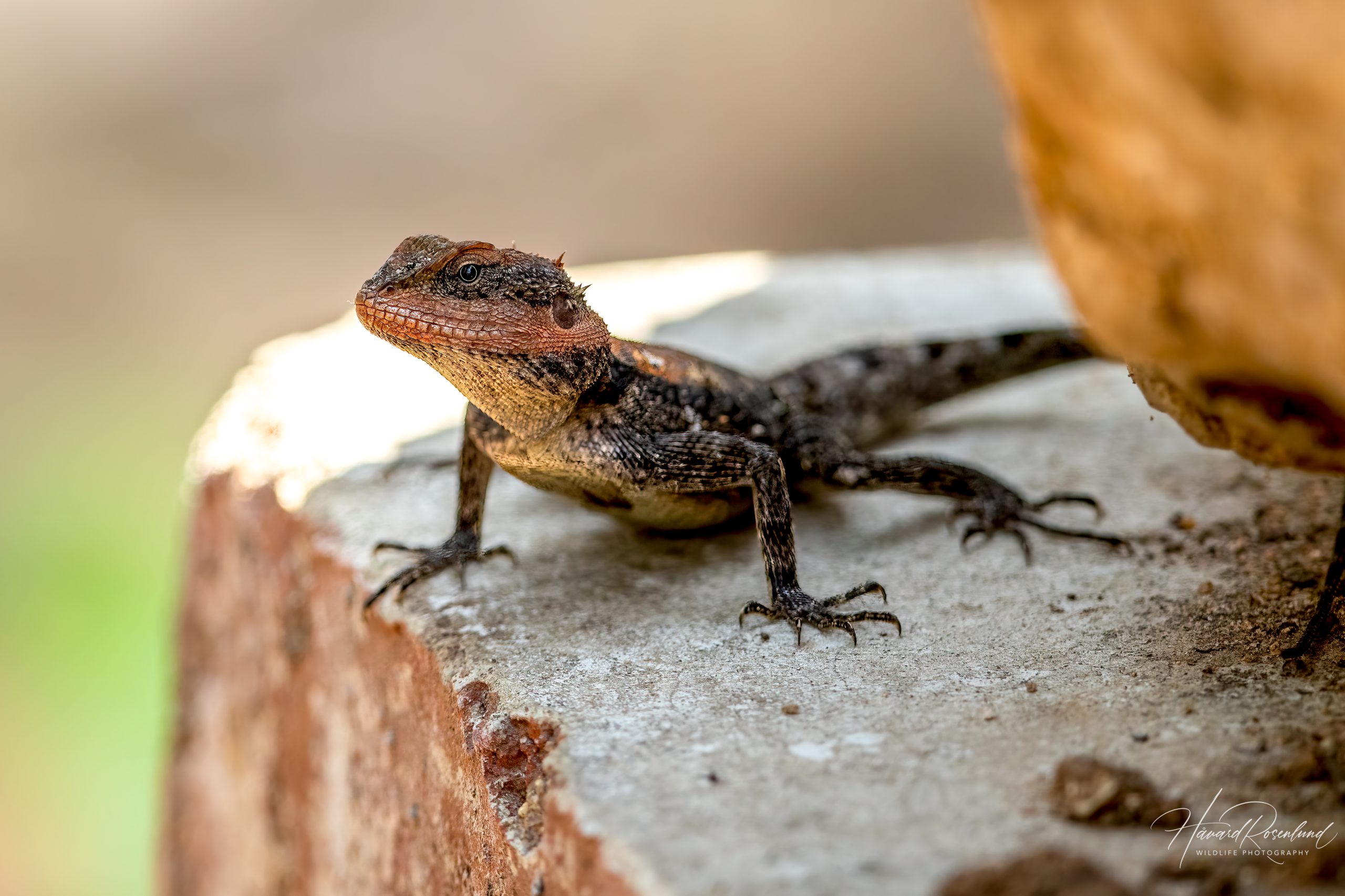
Blanford's rock agama (Psammophilus blanfordanus) is an agama endemic to India and associated with rocky landscapes in central and peninsular parts of the country. It is a sturdy lizard that can reach roughly 30 cm in total length, with the tail making up much of that measurement. Males are also distinctly larger than females.
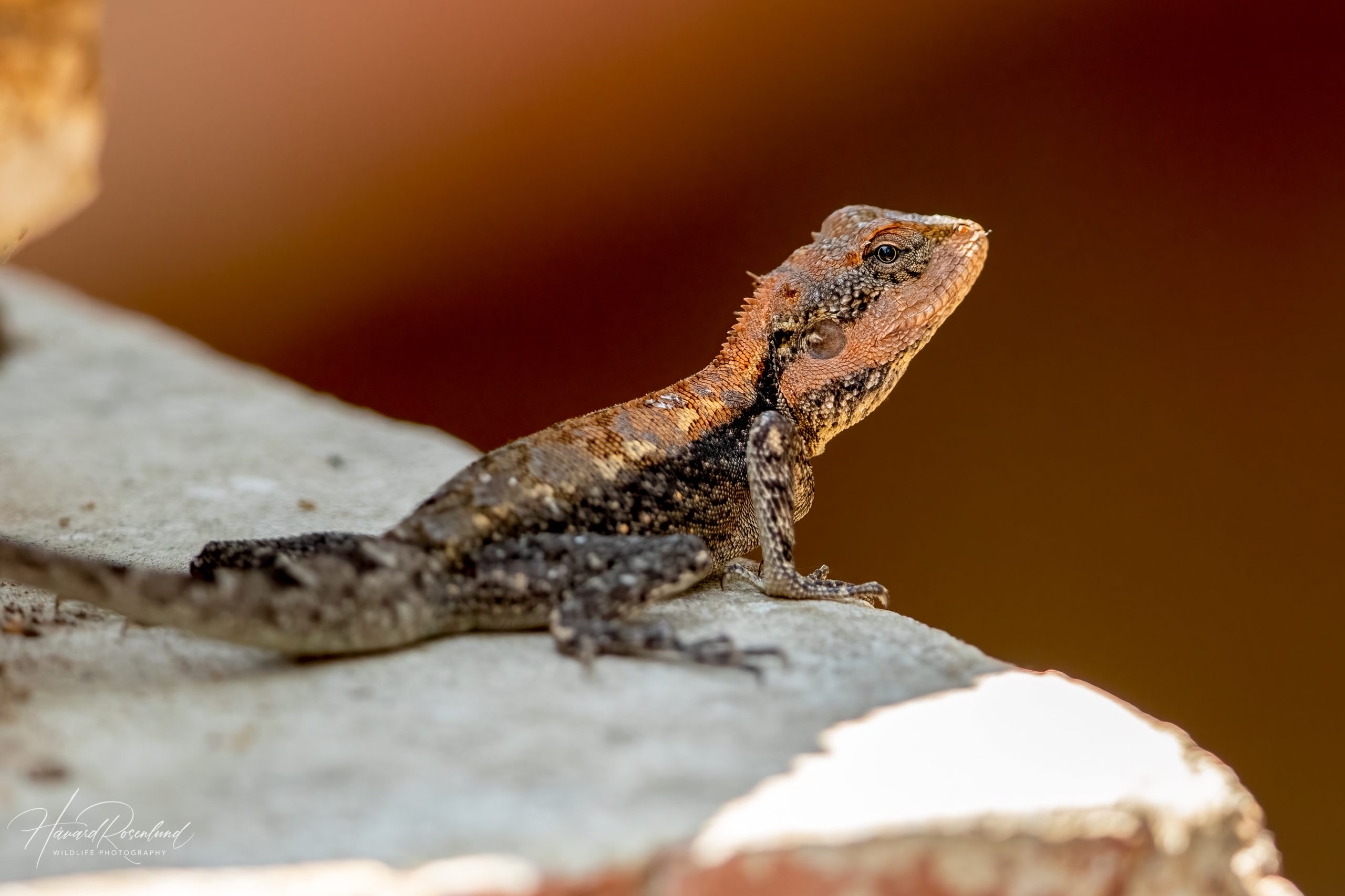
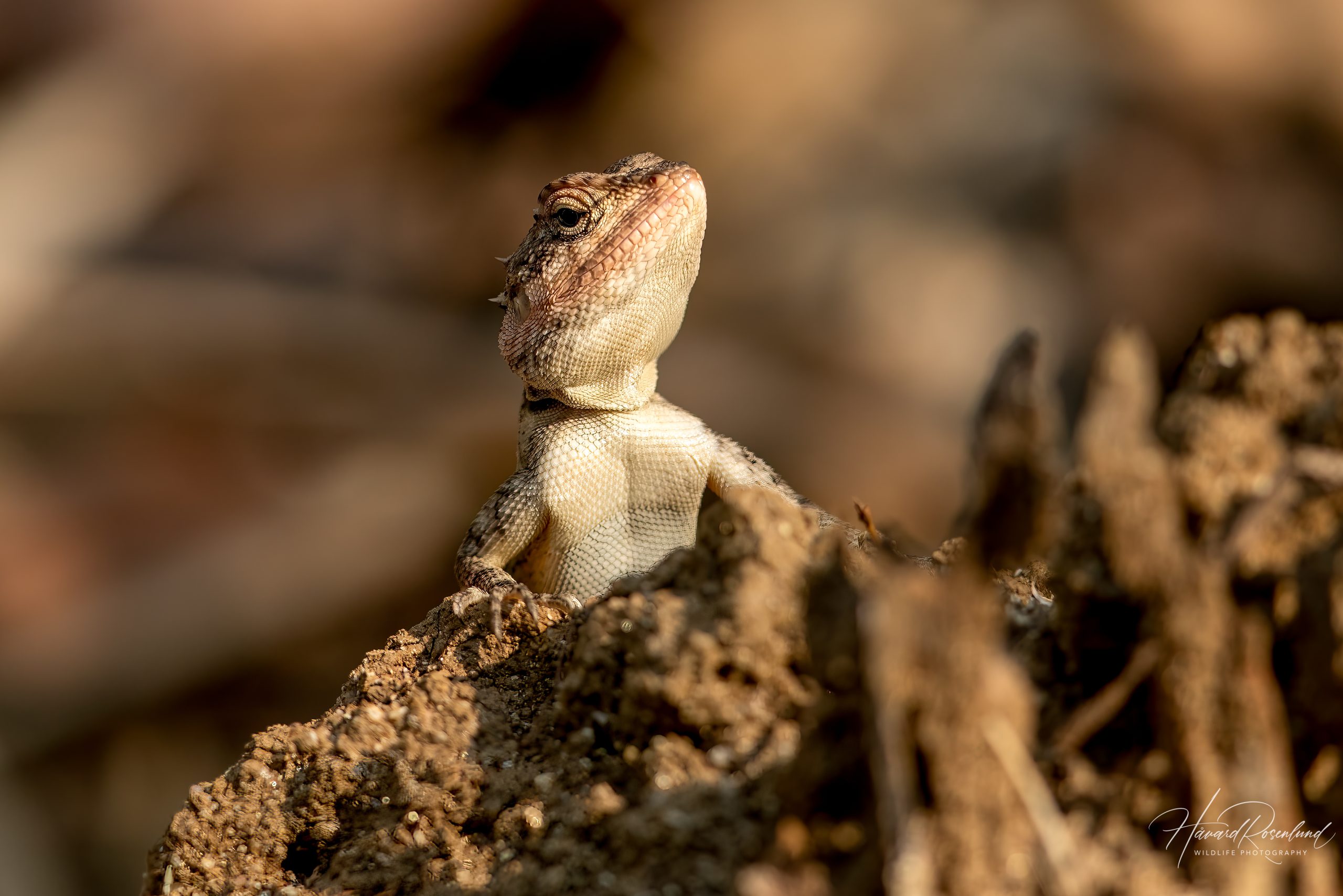
The sexes differ strongly in colour. Females and young animals are mainly grey-brown or olive-brown and blend well into rock and dry vegetation. Adult males can develop vivid orange-red to scarlet colour over the head and front of the body, contrasting with much darker areas farther back. The closely related South Indian rock agama (Psammophilus dorsalis) is very similar, but differs in scalation and generally shows more extensive and stronger colour changes in males during the reproductive season.
Habitat
The species is strongly associated with rocky terrain, including exposed outcrops, boulder fields, dry hillsides and rocky clearings in deciduous forest. Large rocks provide basking platforms, lookout points and a network of cracks and crevices used as refuge. Despite this strong association with rock, Blanford's rock agamas have also been recorded using tree trunks.
Because the lizard relies on external heat, the arrangement of sun and shade is important. Individuals move between exposed rock surfaces and sheltered crevices as conditions change through the day, allowing them to remain active without overheating.
Diet
Blanford's rock agama is mainly insectivorous, taking ants, termites and other small arthropods that are located visually and captured with short, rapid pursuits across rock surfaces or nearby ground.
The diet is not entirely restricted to invertebrates. A 2025 field observation from Kalahandi in Odisha documented a Blanford's rock agama capturing a small skink (Riopa punctata). Such vertebrate prey is probably opportunistic rather than typical, but it shows that the species can exploit larger prey when the opportunity arises.
Behaviour
The species is diurnal, and basking is a central part of its daily routine. Individuals often use exposed rocks as feeding lookouts and basking sites, but remain close enough to cracks and crevices to disappear rapidly when disturbed. During hotter periods they shift into shade or shelter, so much of the daily activity pattern is shaped by the need to balance warming with avoidance of overheating.
Males also use prominent rocks as display sites and communicate visually with rivals and potential mates through head movements, push-up displays and conspicuous body colour. A comparative study published in 2023 showed rapid physiological colour change in P. blanfordanus: males can shift from dull brown to a red head and crest with a darkened body during both courtship and aggressive encounters, and the extent of change differs between body regions. More subdued colours outside intense social interactions make the lizards far less conspicuous against rock and dry vegetation.
Reproduction
Reproductive activity can extend from roughly April to October and is strongest around the pre-monsoon and monsoon months, particularly June to August. Males become more conspicuous and territorial, and visual displays and colour changes play an important role in courtship and competition. Females excavate nest pits in loose soil or other suitable substrate and bury the eggs after laying.
Clutch size and incubation time vary considerably. In a captive study from Gujarat published in 2021, one female laid six eggs in August and all hatched after 34 days at nest temperatures of roughly 27.5–31.5 °C. Earlier observations from Odisha reported eight eggs with a 75-day incubation period in one case and clutches of 12–14 eggs with incubation of 41–44 days in another. Female size and nest temperature are likely to contribute to this variation.
Status
Blanford's rock agama is classified as least concern on the IUCN Red List. It has a broad distribution within India and can be locally common where suitable rocky habitat remains intact.
No major range-wide threat is currently recognised, but quarrying, road building, construction and other disturbance of rocky outcrops can remove basking sites and crevice refuges locally. Because these rock structures cannot be replaced quickly, relatively small developments can alter habitat quality at individual sites.
Image gallery
Loading map and observations…
Have you seen this species?
Independent species archive
Did you find this species page useful?
Wildlife Vagabond is independently built and maintained. Voluntary support helps cover hosting, maps, data storage and continued improvements to the species archive.
Support Wildlife VagabondSpecies content will remain freely available.
References
Information about the species’ global distribution and status is based primarily on global Red List data. See the references below for details.
- Batabyal, A., Zambre, A., Mclaren, T., Rankin, K. J., Somaweera, R., Stuart‐Fox, D., & Thaker, M. (2023). The extent of rapid colour change in male agamid lizards is unrelated to overall sexual dichromatism. Ecology and Evolution, 13(7), e10293. https://doi.org/10.1002/ece3.10293
- India Biodiversity Portal. (n.d.). Psammophilus blanfordanus. https://indiabiodiversity.org/species/show/257443
- International Union for Conservation of Nature. (n.d.). Psammophilus blanfordanus. The IUCN Red List of Threatened Species. https://www.iucnredlist.org/species/172604/1350372
- Mishra, A., Harpal, B., & Mohanta, S. (2025). Predation on Riopa punctata (Squamata: Scincidae) by a rock agama Psammophilus blanfordanus (Squamata: Agamidae) in Kalahandi, Odisha, India. Hamadryad, 42(1–2), 91–92. https://hamadryad.org/index.php/journal/article/view/168
- The Reptile Database. (n.d.). Psammophilus blanfordanus. https://reptile-database.reptarium.cz/Psammophilus/blanfordanus
- Vyas, R. (2021). Breeding data on Blanford’s Rock Agama Psammophilus blanfordanus (Stoliczka, 1871) from Gujarat State, India. Journal of Animal Diversity, 3(1), 120–126. https://doi.org/10.52547/JAD.2021.3.1.8